Rain belts move north, Shenyang takes the "second exam"
Over the past two days, an extreme heavy rainfall has swept through Shenyang, Liaoning Province.
According to the Liaoning Provincial Meteorological Observatory, affected by the peripheral cloud system of Typhoon No. 9 "Bavi", severe torrential rain has occurred in the central and eastern parts of Liaoning. Multiple rainfall records in the urban area of Shenyang have hit the highest values since complete meteorological records began in 1951. After assessment, the comprehensive intensity of this rainstorm process in Shenyang's urban area reaches an extremely strong level.
"Shenyang has experienced the strongest rainfall since 1951" — the last time such news appeared was in July 2024. At that time, under the combined influence of the subtropical high and low-vortex shear, plus the long-distance transport of water vapor from the periphery of Typhoon "Gaemi", Shenyang saw its strongest rainfall since meteorological observation records started in 1951.
Twice in three years, why does Shenyang keep encountering these "low-probability events"? In fact, with global climate change, the traditional climate pattern of "drought in the north and flood in the south" is quietly changing. The National Climate Center predicts that over the next five years, the general trend of more precipitation in northern China will continue. Northeastern China and most of North China will have a high probability of above-average precipitation, with elevated risks of disasters caused by torrential rains and severe convective weather.
As "historical extremes" are repeatedly broken, and once "rare" extreme weather becomes the "new normal", torrential rains are not only a sudden major test for Shenyang's emergency response system, but also a concentrated review of the megacity's years of "evolution" achievements.
"It's Becoming More and More Like the South"
"Since the night of the 12th, the rain has never stopped." On July 14th, Mr. Wang, a shop owner in Heping District, Shenyang, recalled that during the most intense period of the rainstorm, the accumulated water in some areas could even submerge the calves. Water also entered his shop, causing machinery to get damp, and many private cars parked by the roadside were soaked.
How heavy was the rain in Shenyang? Data from the Liaoning Provincial Meteorological Bureau shows that from 0:00 on July 13 to 16:00 on July 14, the average rainfall in Shenyang's urban area reached 346.8 millimeters. Calculated based on Shenyang's annual average precipitation of about 615.9 millimeters, this is equivalent to the total rainfall of more than half a year falling in less than two days.
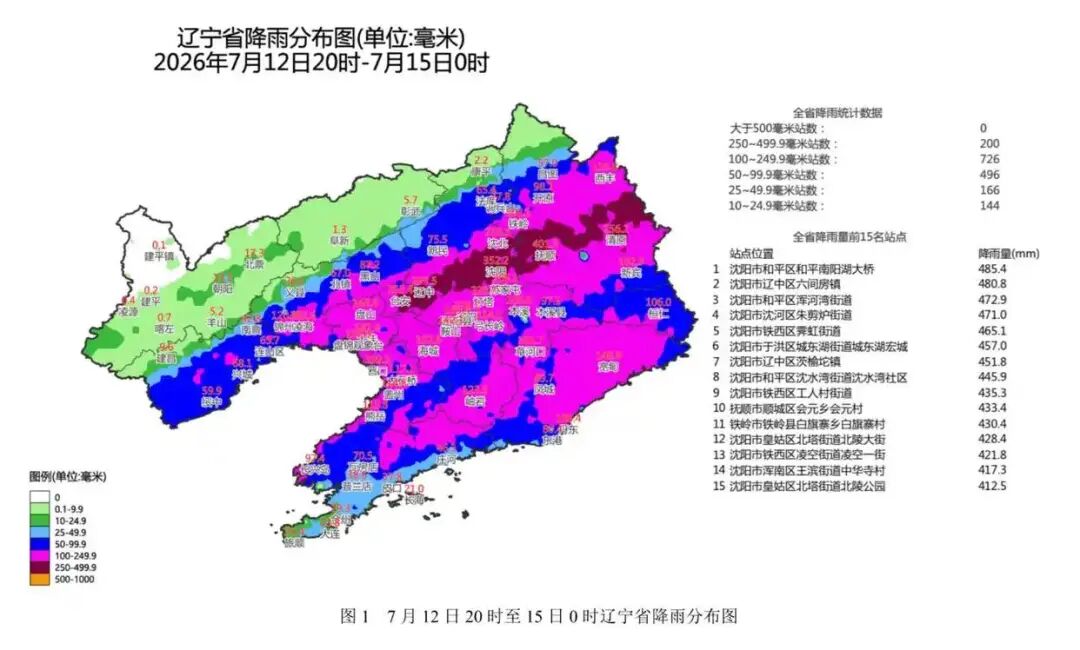
Rainfall Distribution Map of Liaoning Image Source: Liaoning Provincial Meteorological Observatory
In the memory of Lao Zhao, a resident living in Hunnan, Shenyang, the rainfall in the city has increased significantly this summer. "It's been constantly drizzling, and it seems like it rains almost every day." Not only in Shenyang, Lao Zhao also noticed the torrential rain in Fushun in early July —
From 15:00 on July 3 to 8:00 on July 4, Fushun experienced severe torrential rain with local extreme torrential rain. The city's average precipitation was 108.8 millimeters, and the maximum precipitation in some areas reached 329.2 millimeters.
Since then, he has been closely following the rainfall warnings from meteorological departments. "I had no idea about rainfall amounts before, but now I know that a 24-hour rainfall exceeding 200 millimeters in urban areas counts as extreme torrential rain."
Compared with Lao Zhao's personal experience with rainfall, Lin Jing, who lives in Dalian, Liaoning Province, felt extremely surprised by the rainstorm in Shenyang. "I never imagined why Shenyang would be hit by such a heavy downpour." She told *City Evolution* that due to the extreme rainstorm a couple of days ago, many of her relatives and friends in Shenyang had to suspend work and classes and stay at home.
In fact, in many people's impressions, Shenyang is not a city with abundant rainfall. This perception is not unfounded — local water authorities once stated in 2019 that among the five years before that, only 2016 was a "wet year" for Shenyang. In 2018, the city's average precipitation was 444.9 millimeters, 25.7% less than the multi-year average.
The shift has taken place in the past five years. Shenyang's average precipitation has been significantly higher than normal, entering a multi-year consecutive wet period. Especially in 2022 and 2024, Shenyang's average precipitation reached 940 millimeters and 977.6 millimeters respectively, both over 50% higher than the historical average (615.9 millimeters).
"This impact has exceeded local people's understanding of the rainy season." As a native Shenyang resident, Mr. Huang believes that from the increasingly frequent and prolonged rainy seasons in recent years to this record-breaking rainstorm, Shenyang is becoming more and more like cities in southern China.
The Challenge of Warning
With frequent extreme weather, the difficulty of issuing sudden emergency warnings has become a more pressing issue to address.
Looking at the two recent extreme torrential rains in Shenyang caused by climate factors such as typhoons, northward-moving typhoons show the characteristic of "weak wind but fierce rainfall", which can easily trigger extreme rainstorms in northern regions that break historical records. More critically, northward-moving typhoons are generally more difficult to forecast.
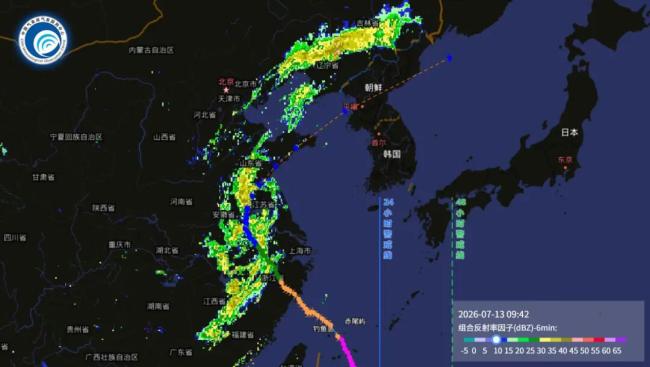
At 9:42 on July 13, the center of Typhoon "Bavi" was located in Suzhou City, Anhui Province, moving slowly in the north-northeast direction Image Source: China Meteorological Administration
As Zhao Dajun, a researcher at the Chinese Academy of Meteorological Sciences, points out, northward-moving typhoons constantly interact with the subtropical high, mid-latitude westerly systems, cold air and other factors during their movement, leading to greater uncertainty in their paths, intensities and precipitation distribution. Precipitation forecasting, in particular, is one of the biggest challenges in predicting northward-moving typhoons.
When the window for accurate prediction is narrowed, the city's response speed becomes a critical line of defense against disasters.
This round of rainstorm in Shenyang started on the evening of July 10, intensified significantly on the 12th, and entered its most severe stage in the early morning of the 13th. Shenyang's flood control emergency response was upgraded several levels in just a few hours — from Level III to Level II, and then to Level I. At 9:10 on July 13, the city officially issued a red flood control warning.
Multiple Shenyang residents interviewed recalled that they received official typhoon and rainstorm alerts pushed by local authorities for two consecutive days on July 12 and 13. At the provincial level, the Liaoning Provincial Flood Control and Drought Relief Headquarters also sent SMS reminders to residents in Shenyang, Dalian, Anshan, Fushun, Benxi, Dandong and other areas to take precautions against the typhoon from the 12th to the 13th.
Following the instructions of Shenyang's Flood Control and Drought Relief Headquarters on July 13, all primary and secondary schools, kindergartens and off-campus training institutions in the city suspended in-person classes, construction sites halted operations, and mountain-related and water-related scenic spots as well as morning and night markets closed. On the 14th, on the basis of these emergency measures, a new decision was added that government agencies, enterprises and public institutions (excluding those ensuring basic urban operations) would work from home in principle.
In terms of road traffic, the city has dynamically adjusted 129 traffic control points, with all passenger transport services and bus routes suspended, and some subway stations closed. It was not until 14:10 on July 14 that Shenyang's meteorological department announced that the strong precipitation echo had moved out of the region, and the city gradually lifted all emergency measures.
From the local perspective, pressing the "slowdown button" on urban operations for two consecutive days is by no means over-prevention. The hourly rainfall intensity in local areas during this precipitation process repeatedly broke historical extremes, and the short-term water accumulation rate far exceeded the capacity of the drainage pipeline network. Minimizing unnecessary personnel movement is the most direct and effective way to isolate risks.
Upgrading Infrastructure
Emergency response tests speed, while infrastructure determines the limit of resilience.
For a long time, southern China has been the main battlefield of flood control in China. Northern regions, to a certain extent, have based their flood control designs, engineering construction and emergency management on the historical pattern of "drought in the north and flood in the south". In other words, the urban infrastructure configurations that might have been "sufficient" in northern regions in the past are now facing a new major test.
A report released by experts from China Academy of Urban Planning & Design (Beijing) Co., Ltd. points out that Shenyang, as a water-dispersing plain city in northern China, has three natural characteristics: "flat terrain", "shallow rivers" and "sparse water networks". The overall terrain is extremely gentle, the urban area presents a "washboard-like" form with widespread local low-lying zones; most inland rivers are renovated from irrigation channels, with an average depth of only 3 to 4 meters; and the river network density is only 0.18 kilometers per square kilometer.
With too gentle a slope, rainwater flows extremely slowly; with too shallow rivers, the water storage and drainage capacity is limited; with too sparse a river network, stagnant flood water has to travel a long distance to find an outlet. The combination of these three natural characteristics makes most areas of Shenyang's built-up area unable to drain water naturally by gravity.
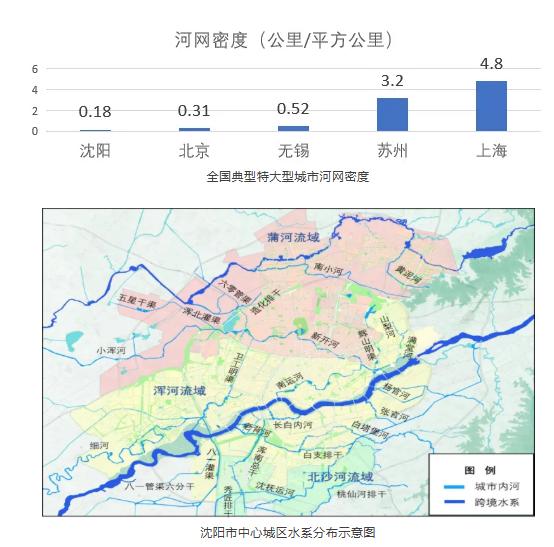
Image Source: *Planning China*
Not only does Shenyang have "inherent disadvantages", but it also faces "acquired shortcomings". The report notes that most of the pipelines in Shenyang's built-up area were constructed from the 1960s to the 1990s, whose construction standards are far below the current relevant specifications, leading to insufficient capacity of drainage facilities.
As early as 2013, the Ministry of Housing and Urban-Rural Development issued a notice requiring all cities to compile and submit comprehensive plans for urban drainage (rainwater) and waterlogging prevention. According to the compilation outline of the Ministry of Housing and Urban-Rural Development, the central urban areas of provincial capitals including Shenyang should be able to effectively cope with rainstorms with a return period of no less than 50 years. That means that after Shenyang completes the renovation in accordance with its drainage and waterlogging prevention plan, the city can not only resist ordinary rainstorms, but also withstand rainstorms that occur once every 50 years.
At that time, relevant Shenyang authorities stated that Shenyang's drainage capacity could theoretically only withstand moderate rain with an hourly rainfall of 24 to 30 millimeters. In case of sudden heavy rain or torrential rain exceeding this amount, urban waterlogging might occur. Moreover, the main drainage difficulties in Shenyang lie in the old urban areas, where 70% to 80% of the drainage pipes are old ones under high operational pressure.
Enhancing the climate resilience of infrastructure is a long-term solution. Back in the 13th Five-Year Plan period, Shenyang proposed to build a "Sponge City". By the end of the 14th Five-Year Plan, Shenyang was approved as a national Sponge City demonstration city. It has renovated 29 waterlogging points, and 45.8% of its built-up area has reached the waterlogging prevention standard of a 20-year return period.
The 15th Five-Year Plan period will be a critical stage for Shenyang to "systematically promote Sponge City construction across the entire region". Integrating climate resilience into planning standards, Shenyang has proposed to "continuously implement the construction and renovation of rainwater pipe networks and pumping stations to strengthen the capacity to cope with short-term heavy rainfall. By 2030, more than 50% of the built-up area will have a waterlogging prevention level of no less than the 50-year return period standard."
In professional fields, "20-year return period" or "50-year return period" is not purely a time concept, but a probability concept — it means there is a certain annual chance for such an event to occur. However, in the current context of intensifying extreme climate change, instead of waiting for the probability to be broken, cities should take the initiative to raise the baseline of their defense capabilities.
(All interviewees in the article use pseudonyms)
This article is from the WeChat Official Account "City Evolution", written by Liu Xuqiang, and published by 36Kr with authorization.