Apple's AI filing has been approved, but what it gets may be an old ticket
Apple's Apple Intelligence (Apple AI) has finally received its official entry signal.
On July 15, the cyberspace administration authorities announced a new batch of filing information for on-device generative AI services on mobile phones. A total of seven products have completed the filing: Apple Intelligence, Huawei Xiao Yi AI, OPPO AndesGPT, vivo Blue Heart On-Device Large Model, Xiaomi Surge AI, Samsung Galaxy AI, and Nubia Doubao Mobile Large Model.
Alibaba later confirmed that Tongyi Qianwen will participate in the Chinese version of Apple Intelligence, providing capabilities such as text understanding, image understanding, and content generation. However, Tongyi Qianwen is not the only underlying model for all of Apple's AI capabilities. According to insiders, Apple's cooperation with Baidu focuses on AI search capabilities, which will also be used to upgrade the Chinese version of the Siri voice assistant.
In other words, the current division of labor is roughly: Tongyi Qianwen handles generative AI, and Baidu handles search and Siri. It is worth noting that Baidu has been the search service provider for Apple's Siri in mainland China for many years.
But the filing only resolves the compliance qualification issue, which does not mean the product is ready. It is reported that some image recognition features of Apple Intelligence still rely on Google's reverse image search, and Google's related services are not accessible in mainland China. This technical dependency needs to be further replaced with a local solution. Therefore, Apple still has a series of specific engineering tasks to complete.
More importantly, Apple's competitors this time are not only domestic mobile phone manufacturers such as Huawei and OPPO, whose on-device AI product penetration rates are already much higher than Apple's, but also native AI applications such as Doubao and DeepSeek, and even super apps like WeChat and Alipay. They are all fighting for the same thing: the next-generation service entry point.
01. This may not be the version of Siri that Apple unveiled back in June
Apple first introduced Apple Intelligence at WWDC24 in June 2024, with core features including basic AI functions such as text rewriting, content summarization, image generation, and cross-app basic operations.
And just over a month ago at WWDC 2026, Apple unveiled a completely redesigned new Siri, internally called Siri AI, whose underlying technology was replaced with a new model developed in partnership with Google and derived from Gemini.
It is no longer just a chatty voice assistant; it can understand the content displayed on the phone screen, remember who the user recently talked to and what they discussed, and continuously perform multi-step operations such as writing emails, searching for old photos, and organizing schedules. What it points to is precisely the super entry point of services and the right to distribute them.
However, at that launch event, Craig Federighi, Apple's Senior Vice President of Software Engineering, stated that this entire new Siri AI feature set would not be available to mainland China users in the short term, as the company is still advancing relevant regulatory approvals.
Therefore, what has passed the filing today is most likely still the "entry-level version" from two years ago. The product that Apple itself defines as the "next generation" may not have completed the entire approval process yet.
02. Built-in mobile AI is becoming a "stock business"
After entering the market, Apple first has to face the battlefield of on-device AI.
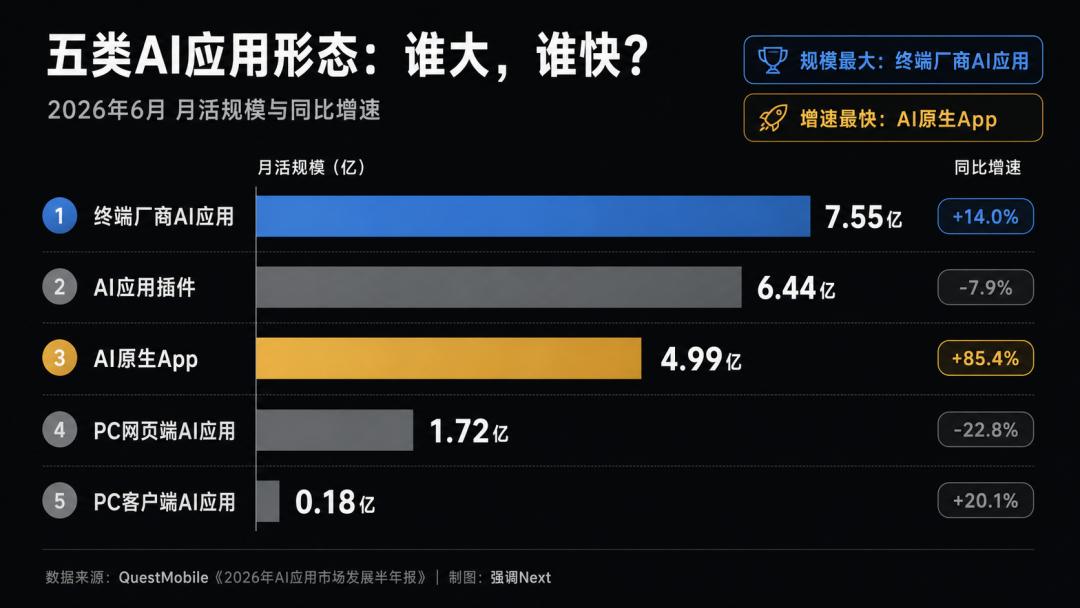
Data from QuestMobile's "2026 H1 AI Application Market Development Insight Report" shows that as of June 2026, the monthly active users (MAU) of AI applications from terminal manufacturers reached 755 million, a scale larger than the 499 million MAU of AI-native apps.
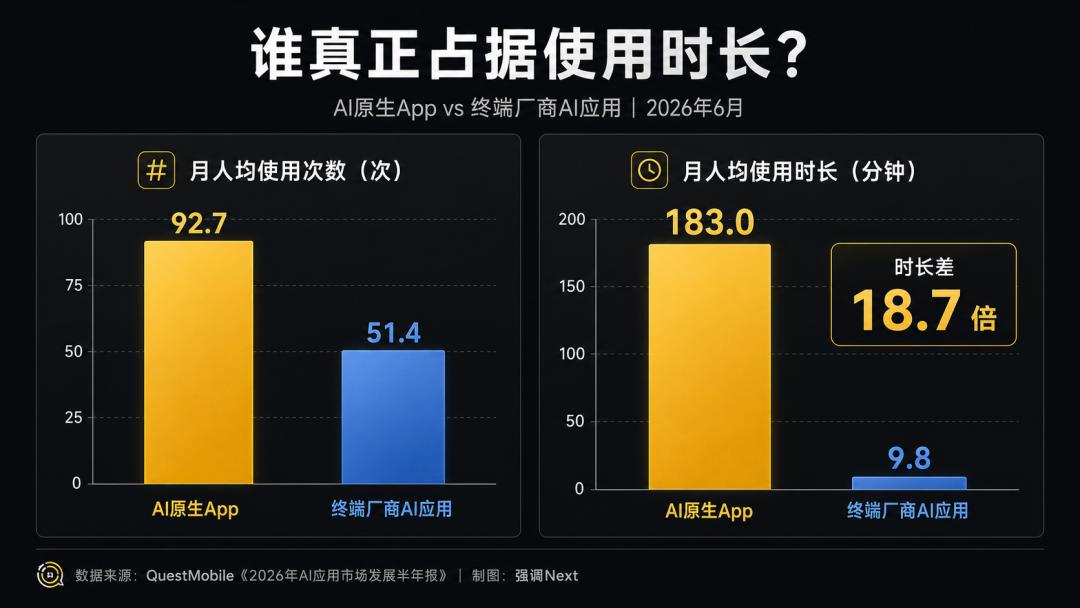
However, the monthly average usage times and duration per user for terminal manufacturers' AI applications are 51.4 times and 9.8 minutes respectively, far lower than the 92.7 times and 183 minutes for AI-native apps. The frequency difference is nearly double, and the duration difference is 18.7 times.
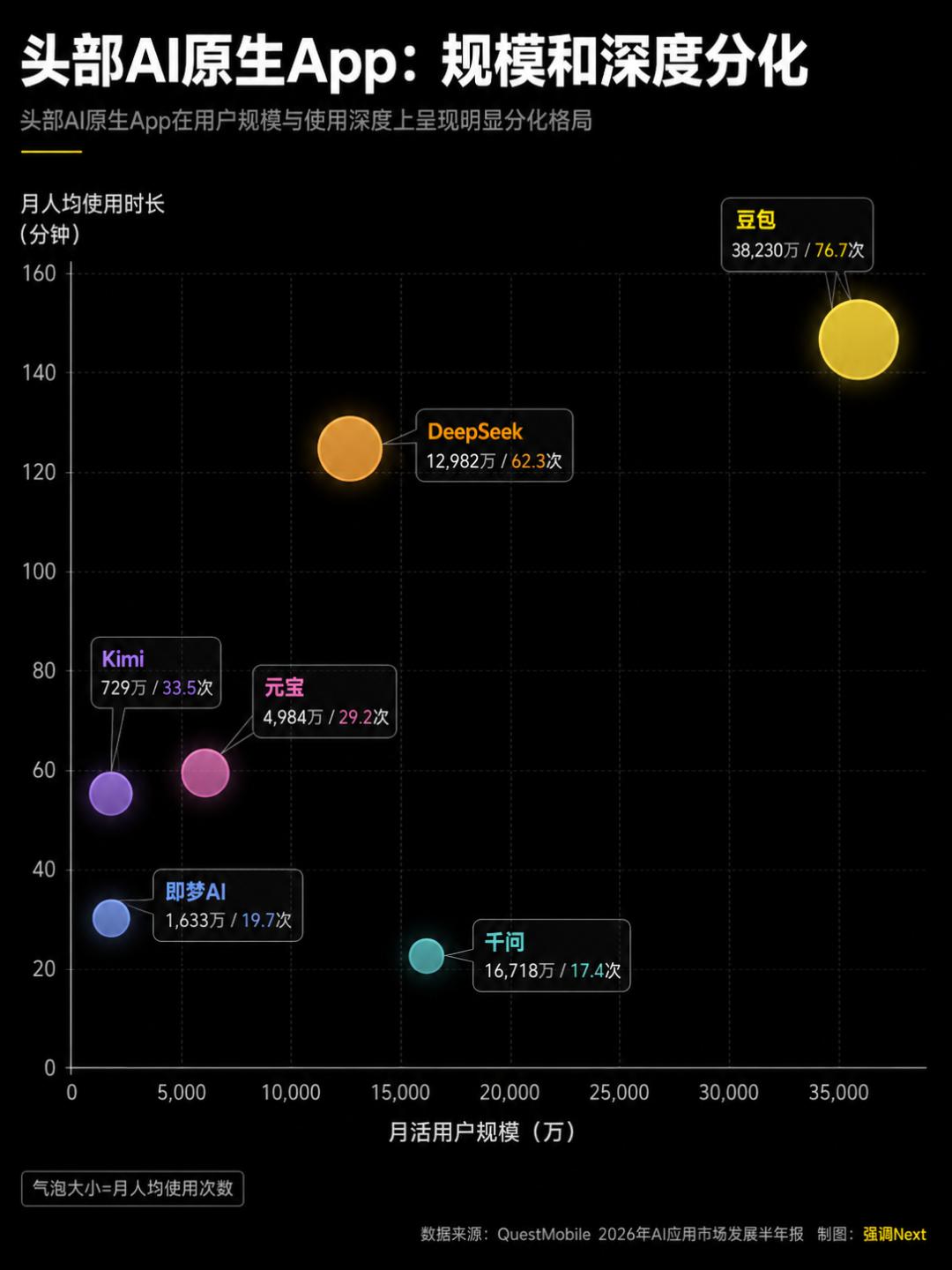
This indicates that mobile AI assistants achieve scale through pre-installation and device ownership, but independent applications such as Doubao, Tongyi Qianwen, and DeepSeek are the ones that truly handle complex tasks and long-duration usage. In June, the MAU of the three reached 382 million, 167 million, and 130 million respectively, with growth rates remaining very high.
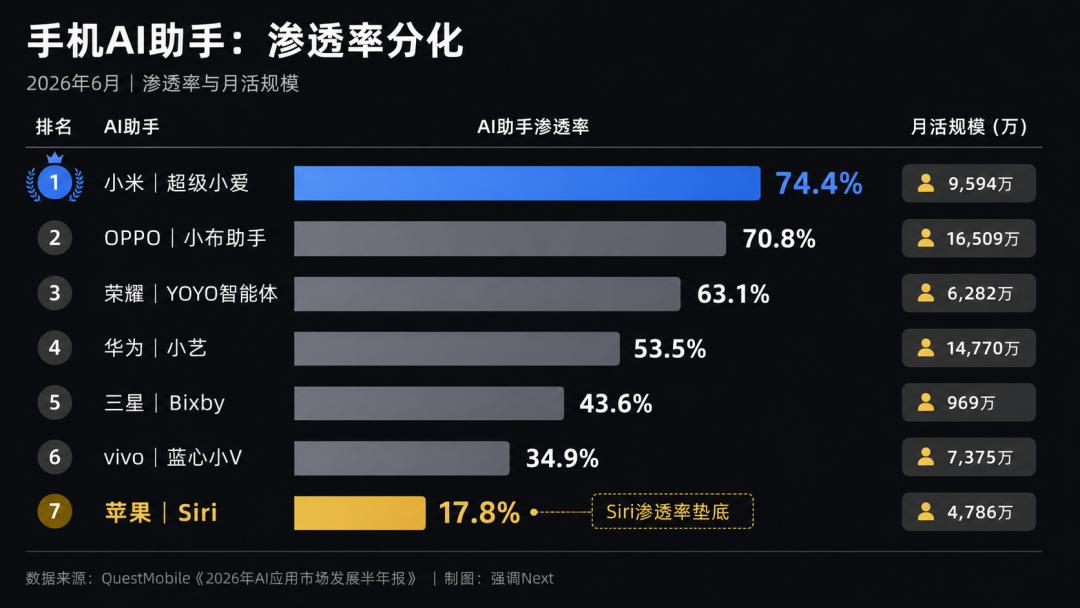
The comparison of AI assistants from individual mobile phone manufacturers is even more obvious, among which Siri's data is particularly weak. In June 2026, Siri's penetration rate among Apple mobile phone users was 17.8%, far lower than Xiaomi Super Xiao Ai's 74.4%, OPPO Breeno's 70.8%, and Honor YOYO's 63.1%. Apple's Siri has an MAU of less than 48 million, which is about 1/8 of Doubao's.
Siri's monthly average usage per user is 3.8 times and 1.5 minutes, with the number of uses and duration decreasing by 15.5% and 15.9% year-on-year respectively. Xiaomi Super Xiao Ai reached 29.0 times and 7.7 minutes in the same period.
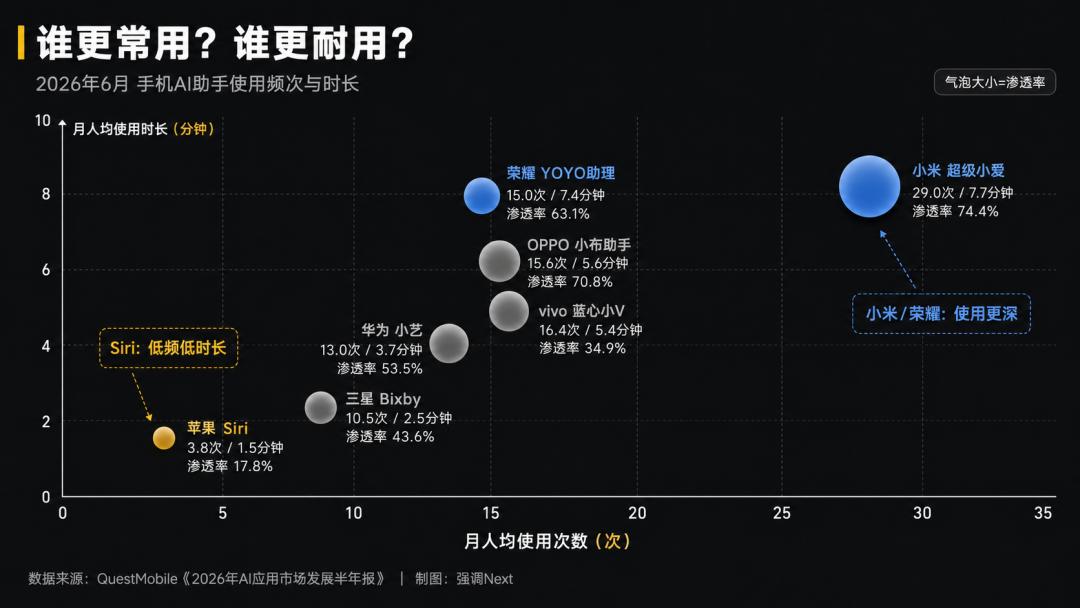
In other words, Apple first has to catch up with mobile phone manufacturers, and then catch up with third-party AI-native apps.
Of course, the above set of data mainly counts traditional Siri, not the new generation of Siri AI that has not yet entered China. It does not mean that Apple's AI has failed, but that Apple needs to face a fundamental base with a very low starting point, as well as the fact that having installed base does not necessarily guarantee penetration.
For Apple, this is ostensibly a matter of whether the AI assistant is easy to use, but in reality, it concerns the long-term strategy.
In the past, the entry points of iPhone were the home screen and the App Store, and users decided for themselves whether to open WeChat, Meituan, or Taobao. In the agent era, the entry point may become a natural language command, where AI judges what the user wants to do and which service to call. Whichever AI entry point first captures the user's intent will hold the next round of task distribution rights.
What Apple is worried about is not that Siri loses to another chatbot, but that Doubao, DeepSeek, or other third-party agents will gradually become the de facto entry point on the iPhone. Therefore, Apple Intelligence is fighting to keep this layer of control within iOS.
03. Agent phones are turning into a free-for-all
On July 17, Nubia will debut its "world's first AI agent phone" at the World Artificial Intelligence Conference in Shanghai. The "Doubao Mobile Assistant", which completed the large model filing in the same batch, is integrated into this device.
But the title of "world's first" is not easy to wear. StepStar almost simultaneously released its own terminal brand STEPX, also claiming to be the "world's first large model native agent phone". The fact that the two companies are fighting for this title shows that at least one of them is still in a stage dominated by public relations.
Major manufacturers have had similar products and actions even earlier. Huawei introduced the "Agent-Centric System Architecture" in HarmonyOS 7, breaking down traditional apps into callable Skills and agents. Xiao Yi currently has an average daily wake-up volume of 3 billion times, with more than 2,100 system-level capabilities and over 500 partner-selected Skills.
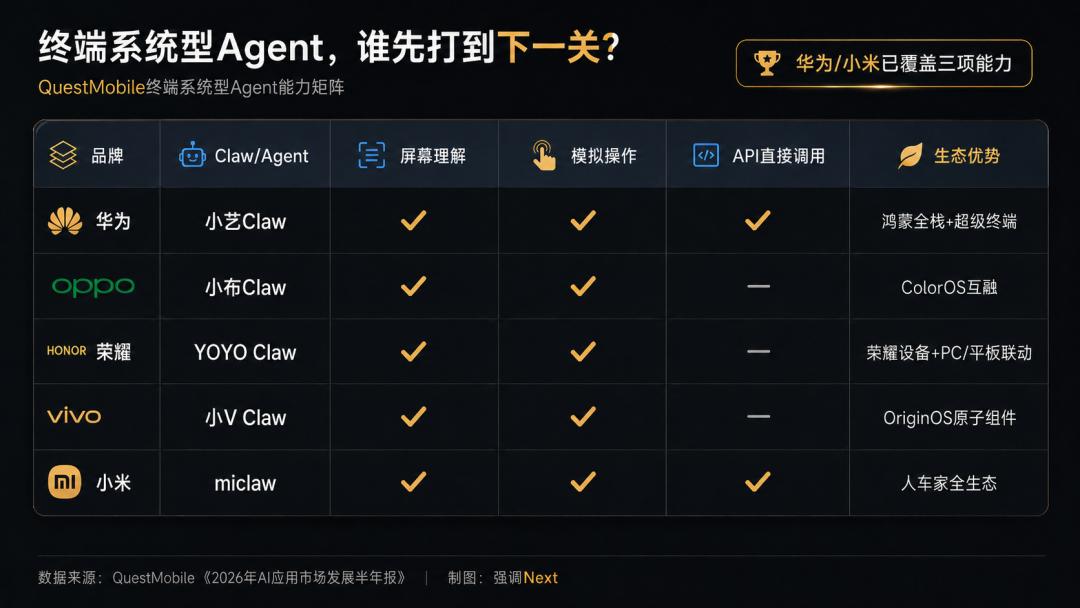
Xiaomi's miclaw has entered a small-scale internal test, which can call more than 50 system-level tools to complete continuous actions such as reading text messages, creating calendars, setting alarms, checking the weather, and opening transit codes. OPPO and vivo have also launched frameworks such as Breeno Claw and Jovi Claw, focusing on screen understanding and simulated operations. WeChat, in partnership with Huawei, Honor, Xiaomi and other manufacturers, has opened up the A2A protocol, allowing mobile assistants to directly hand over tasks to WeChat's own Agent for execution.
However, behind the excitement, we must also pour a splash of cold water. According to recent media tests of seven mobile agents: Doubao Mobile Assistant, Zhipu, Honor, Huawei, Xiaomi, OPPO, and vivo, the overall success rate in a total of 70 task tests is only 20%, 39% of tasks are interrupted after starting, and 24% are directly downgraded to information Q&A.
The truly critical issue is permissions. These agents generally have more than 100 permissions in total, involving highly sensitive permissions such as system control, screen control and injection, window and display management, and private data access. Most agents rely on accessibility permissions to "read the screen", and issues such as account security, platform risk control, and stability have not been truly resolved yet.
QuestMobile's report distinguishes these capabilities using MCP and Skill: MCP solves "whether it can connect", and Skill determines "whether the task can be completed". Domestic mobile phone manufacturers have at least pushed the competition to the level of "getting things done for users".
Apple's new Siri AI is not behind in product direction, as it also emphasizes screen awareness, personal context, and cross-app execution. The real problem it faces in China is whether the underlying model is strong enough and whether the accessed services are sufficiently smooth.
QuestMobile's data shows that Tongyi Qianwen still lags far behind competitors such as Doubao and DeepSeek in terms of user scale and user usage frequency, which to a certain extent reflects users' preference. More importantly, even if AI accurately identifies the user's intent, it cannot unilaterally decide which interfaces Taobao, WeChat, Douyin, Ctrip, and Meituan will open. Alibaba, Tencent, ByteDance, and Meituan cannot easily hand over the foundations they have accumulated over the past decade.
Of course, Apple's bargaining chip is user quality and scale. Last night, Alibaba's U.S. stock price rose by more than 7% after the market opened, which to a certain extent demonstrates the potential of the Apple brand for its partners.
Apple also has enough motivation to give up certain benefits in subsequent cooperation. For Apple, the strategic significance of accessing these services lies in the entry point.
In the past, developers competed for downloads and usage time through the App Store. In the future, the functions in apps may be split into individual Skills that can be directly called by agents, and users can complete tasks such as booking tickets, hailing rides, and shopping without even opening the app. Apple needs to control this layer of task distribution and build a new set of service entry points on top of the App Store; otherwise, it risks being reduced to a mere pipeline.
04. But don't rush to count Apple out
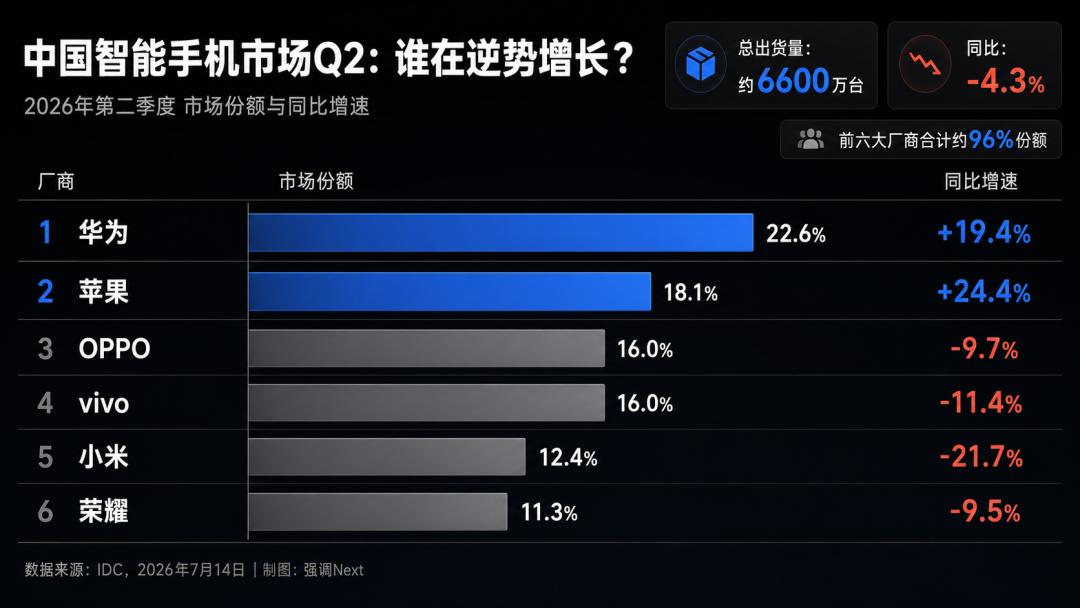
Siri lagging behind does not mean Apple has lost. IDC data shows that in the second quarter of 2026, China's smartphone market shipments were about 66.01 million units, down 4.3% year-on-year, marking five consecutive quarters of decline.
However, against the backdrop of a declining overall market, both Huawei and Apple achieved about 20% year-on-year growth in shipments. Huawei's market share rose from 18.1% to 22.6%, ranking first. Apple's share rose to 18.1%, ranking second.
On the contrary, Xiaomi's shipments fell by 21.7% year-on-year, the largest drop among mainstream manufacturers.
After the price of memory chips rose, Huawei and Apple did not follow suit to raise prices; instead, they launched targeted promotions, becoming a few "stable price" brands. Apple's winning edge in China this time comes from "others raise prices but we don't", which has nothing to do with whether Siri is smart or not.
But this is precisely why Apple must quickly make up for its shortcomings in AI. If the iPhone 18 series raises prices this autumn, the share dividend obtained from "price stability" will not last long.
In the past few years, the marginal upgrades of screens, cameras, and chips have been difficult to independently drive device replacement. Apple Intelligence also undertakes a more practical task: to find a new purchase reason for the new generation of iPhones. If it can only rewrite text and generate images, it will be difficult to drive device replacement. Only when it can significantly reduce operation steps and even complete tasks for users will AI transform from a conference selling point into hardware sales.
In the longer term, Apple is not just fighting for device replacement. If in the future users no longer open apps one by one, but directly hand over their needs to agents, then the most important entry point of mobile phones will shift from the home screen and the App Store to the understanding and distribution of user intent. Apple needs to avoid having the next-generation mobile entry point fall into the hands of other applications or agents such as Doubao and WeChat.
This filing gives Apple a ticket, and next it needs to access local account, transaction, payment, and service systems, and also prove that users are willing to continue using it.
The same is true for all manufacturers shouting "agent phones". It is not important for Nubia and StepStar to fight for "the world's first". What matters is whether the first batch of users are just trying it out, or will stay for the experience. A "first" that cannot retain users will eventually be reduced to a story told to investors.