Nature breakthrough, the embryonic form of next-generation AI systems? MIT team: Starting from reasoning over 100 new games
Even without having played a new game before, humans can judge whether it is fair and engaging based on its rules. For artificial intelligence (AI) systems to master this capability, they need to learn how to flexibly handle unprecedented new problems and decide on their next move.
Regarding how this capability is achieved, a newly published research paper in the authoritative scientific journal *Nature* provides the answer: the MIT team and their collaborators, based on a large-scale behavioral study of 121 games, proposed the "Intuitive Gamer model" computational cognitive model to explain how humans quickly evaluate, form judgments, and take actions when facing new games.
Paper link: https://www.nature.com/articles/s41586-026-10722-1
The research team points out in the paper that compared with complete, in-depth deduction, human judgment is closer to a small number of fast, shallow goal-directed simulations. Even without prior experience, humans can systematically evaluate new games and take relatively reasonable actions. The "Intuitive Gamer" model built on this mechanism outperforms alternative models in approximating human performance across multiple tasks.
This work also provides inspiration for building more flexible AI systems that better align with human reasoning patterns: future AI should not only learn to solve new tasks, but also judge which tasks are worth further deliberation.
The Intuitive Gamer Model: A Computational Framework for Novice Reasoning
Different from previous game reasoning models that rely on deep search, the Intuitive Gamer model offers a computational explanation for novice game reasoning. It emphasizes a small number of shallow, goal-directed, and probabilistic mental simulations to illustrate how people evaluate new games and select actions when lacking experience. Specifically, the Intuitive Gamer model consists of two components: a Player Module and a Reasoning Module:
1. Player Module: Designed to explain action selection. It evaluates the value of available moves based on goal-directed heuristic rules. These rules consider both how to advance one's own objectives and how to prevent opponents from achieving theirs. The model then probabilistically selects the next move based on the calculated action values.
2. Reasoning Module: Designed to explain people's judgments about game properties. It invokes the Player Module to run a small number of self-play simulations to infer outcomes such as victory, defeat, or draw. These simulations can either run to the end of the game or stop early, ultimately estimating the probability of different results occurring.
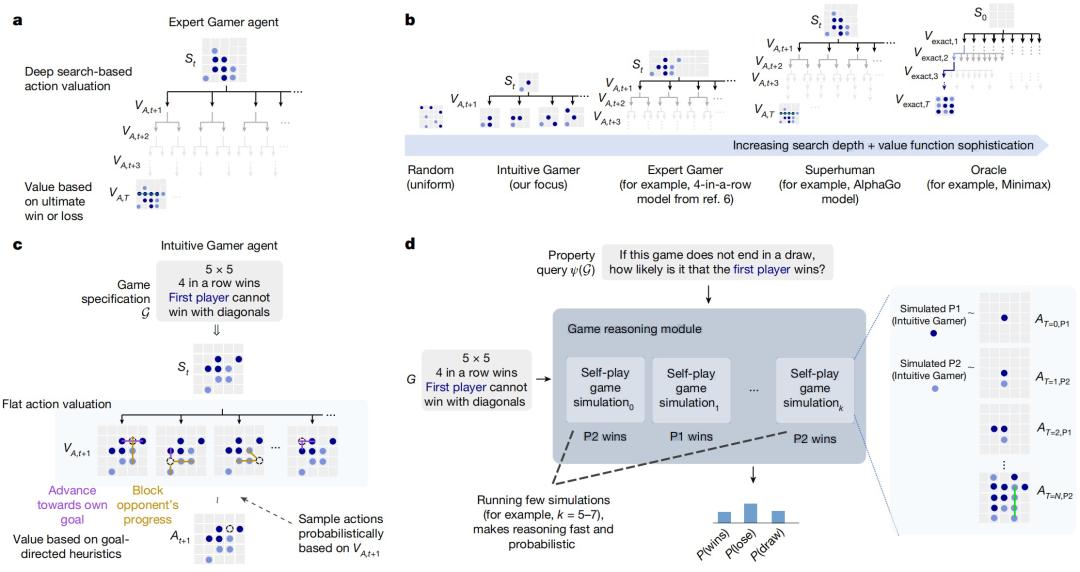
Figure: Comparison between the Intuitive Gamer model and previous game reasoning models.
To study how novices reason about new games, the research team conducted a large-scale behavioral study, recruiting over 1000 participants and designing 121 two-player strategy board games. These tasks are based on line-connection gameplay prototypes such as tic-tac-toe and Gomoku, but vary in board size and specific rules. The design retains the familiarity of basic gameplay while allowing investigation of people's judgments and actions when facing new rules.
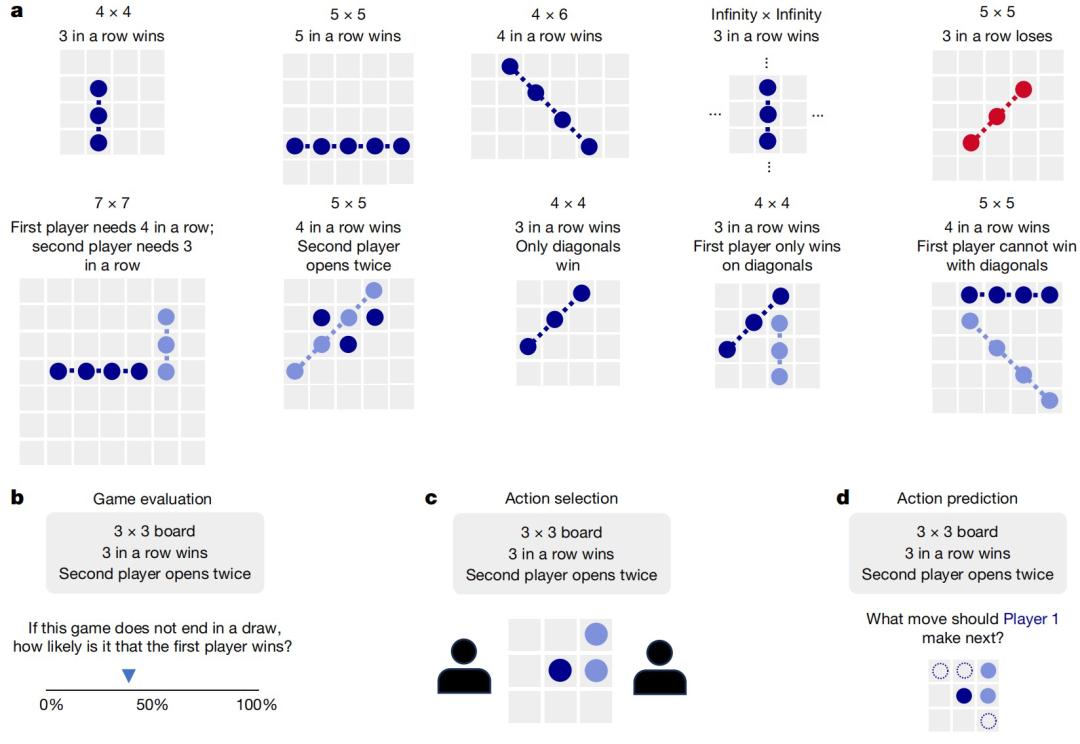
Figure: The new game dataset and a set of game tasks.
To verify whether the Intuitive Gamer model better approximates human performance, the research team also set up several types of control models to compare different reasoning approaches: Expert Players perform deeper, more complex searches; Random Players take actions purely at random; Monte Carlo Tree Search uses more computationally intensive tree search methods; models based on game descriptions or linguistic information do not explicitly simulate the game process.
What Are the Experimental Results?
Overall, humans do not make judgments through complete, in-depth deduction, but primarily rely on a small number of fast, shallow goal-directed simulations in their minds. Across multiple tasks, the Intuitive Gamer model also outperforms alternative models in approximating human performance. The specific results are as follows:
1. Game Fairness
The Intuitive Gamer model shows high consistency with human evaluations. The research team had 238 participants evaluate game outcomes solely based on rules and a blank board, without ever playing the relevant games. The correlation between model predictions and human judgments reached 0.81, close to the interpretability upper bound of 0.82 for the human dataset itself.
Further Ablation Analysis shows that goal-directedness, probabilistic selection, shallow reasoning, and a small number of simulations all affect model performance. Removing any of these settings reduces the model's fitting effect; among them, the model aligns most closely with human judgments when the number of simulations is around 5-7.
Across 78 games where optimal payoffs can be calculated, human judgments are generally consistent with the direction of theoretically optimal outcomes; however, when predicting the actual fairness judgments given by humans, the Intuitive Gamer model is more accurate than results derived solely from optimal payoffs.
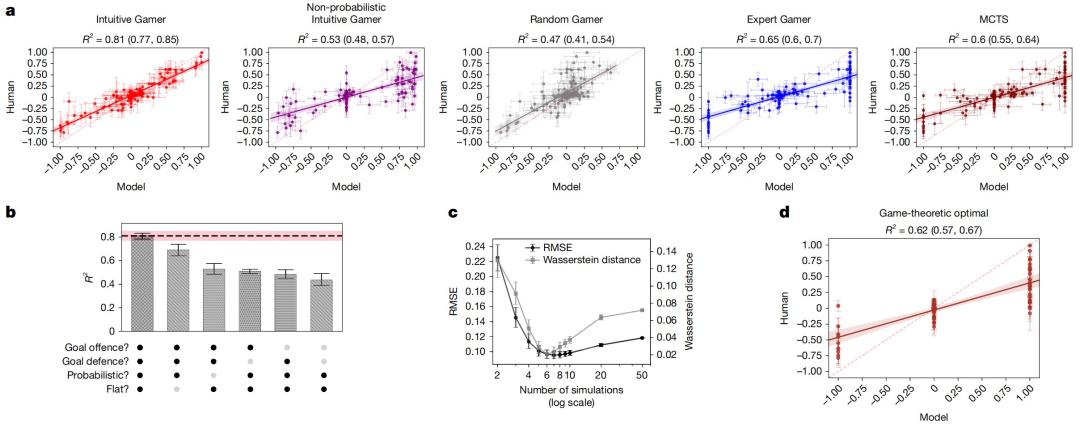
Figure: Evaluating a game without ever having played it.
2. Game Engagement
Regarding engagement judgment, the Intuitive Gamer model also approximates human ratings. The research team had 246 participants evaluate game engagement without prior experience, and extracted three features from model simulations for prediction: Balance, Decision Quality, and Game Length; when combined, the three features achieved a fitting score of 0.57, close to the interpretability upper bound of 0.60 for the human dataset itself.
The results of the Generalization Test also demonstrate that the Intuitive Gamer model based on these three features is better than Random Players, Expert Players, and models that only rely on superficial game features at predicting human judgments of game engagement.
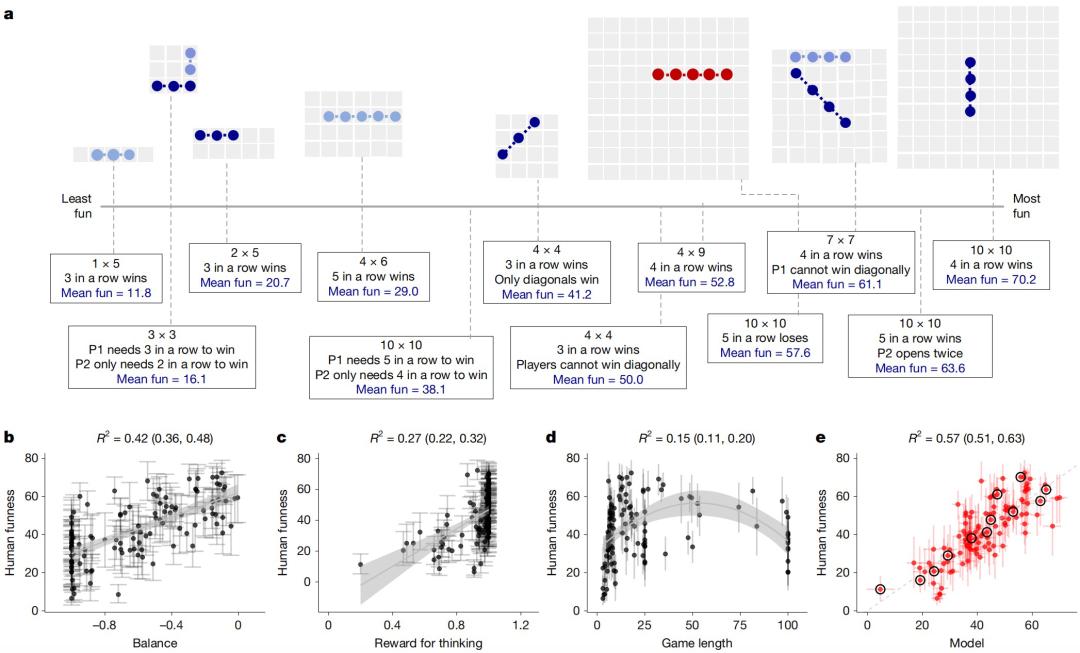
Figure: Evaluating whether a game is likely to be engaging without ever having played it.
3. First Game Action
The Intuitive Gamer model is better than Expert Players and Random Players at predicting human actions. The research team had 302 participants play one round each in 40 new games and tic-tac-toe. The results show that the Intuitive Gamer model explains 0.72 of the actual game payoffs of novice players; in action prediction tasks, this model also outperforms Expert Players and Random Players, accounting for over 50% of the action probability distribution in 32 out of 41 games.
The research team further examined the decision-making mechanism in the first game. The results show that novice actions do not conform to the deep search represented by the Expert model, but are closer to the fast shallow reasoning of the Intuitive Gamer model.
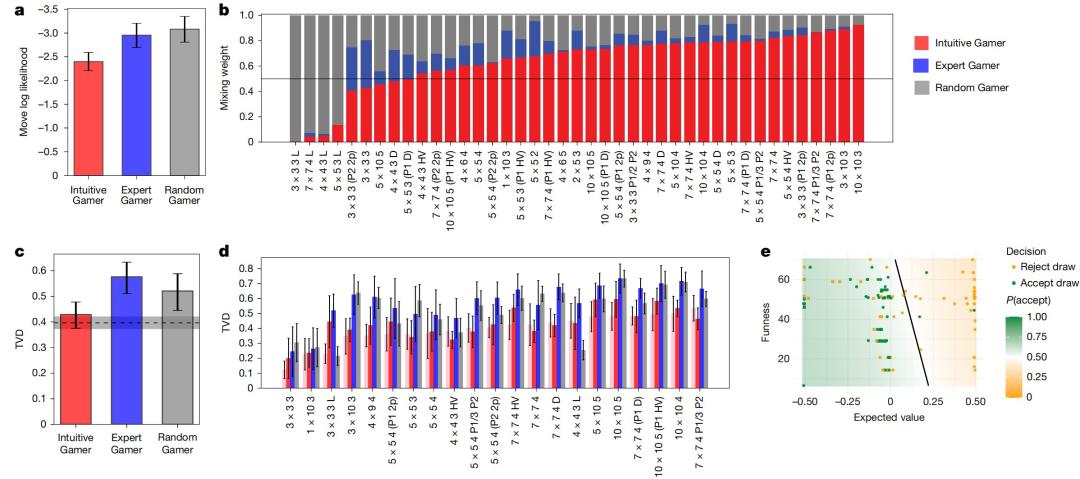
Figure: Modeling people's actions when they first encounter a new game, and the distribution of predicted actions.
4. Predicting the Next Move
The Intuitive Gamer model also better aligns with human judgments than the Expert model and Random model. The research team had new participants watch game videos of novice players and predict what moves they might take next; across 249 board states, the Intuitive Gamer model showed higher consistency with human predictions. Compared with the Expert model, the TVD difference was -0.15; compared with the Random model, the TVD difference was -0.09, both reaching statistically significant levels.
From case studies, when humans predict the next move, they usually consider several possible moves simultaneously, and sometimes show a clear preference for one of them; the predictions given by the Intuitive Gamer model often match this pattern. In contrast, the Expert model sometimes favors a small number of moves with high payoffs that are unintuitive for novices; at other times, after determining that the current situation is inevitably a losing one, its predictions are overly scattered.
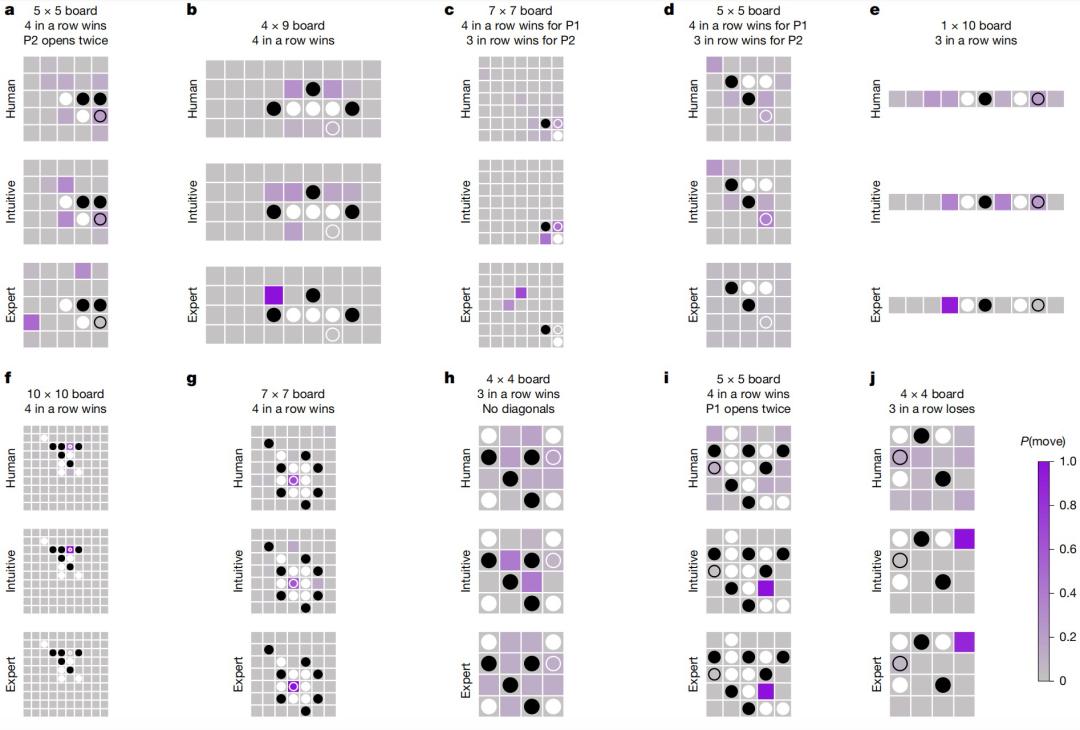
Figure: Example of prediction distributions for the next move between humans and models in a real game.
5. Willingness to Continue Playing
The Intuitive Gamer model was also used to analyze whether players are willing to continue playing. The research team analyzed a total of 142 draw requests, of which 83 were accepted and 59 were rejected. The results show that the prediction model built on features such as expected payoff of continuing to play, expected cost, and game engagement can well characterize whether players will accept a draw request; removing the evaluation function from the Intuitive Gamer model reduces the fitting performance.
Limitations and Future Directions
However, the research team points out that although the Intuitive Gamer model can explain various types of judgments and actions of people in new games, it still has limitations in terms of application scope, reasoning process, and game creation. The details are as follows:
In terms of application scope, the current model mainly studies two-player competitive board games, most of which are modified versions of line-connection games such as tic-tac-toe and Gomoku, rather than completely unfamiliar game types. Future work needs to verify its applicability in more complex games, such as Go, Chess, and multi-agent scenarios.
In terms of reasoning process, the current model still lacks more fine-grained process-level and individual-level explanations. The research team believes that future work needs to focus on several questions: whether people will stop simulations early, whether different simulations will interact with each other, whether some people do not perform simulations at all, and how the model can capture these differences.
In terms of learning and adaptation, the current model cannot yet explain how people update their judgment rules: whether they continuously refine them within the same game, or transfer their experience to other games. Future work also needs to further explore how factors such as experience, risk, time constraints, thinking cost, and strategy preferences affect game reasoning.
In terms of game creation, the current model cannot yet explain how people create and modify games. The research team notes that humans not only learn and participate in new games, but also actively design and adjust game rules. In the future, it remains necessary to explore whether models with this type of fast, shallow simulation can explain people's judgments when designing and modifying rules, and extend to more open scenarios such as scientific and mathematical exploration.
For more technical details, please refer to the original paper.
This article is from the WeChat public account "Academic Headlines" (ID: SciTouTiao), written by Xi Qiansi, and published with authorization from 36Kr.