108 chips and 261 large models are unveiled, with 9 Turing Award laureates delivering speeches | Full preview of WAIC 2026
"The world's first AI agent phone indeed comes from Nubia. This mass-produced flagship will make its debut at the 2026 World Artificial Intelligence Conference (WAIC)... See you in Shanghai!" Ni Fei, President of ZTE Terminal Business Division and President of Nubia Technology Co., Ltd., posted on Weibo on July 8.
From July 17 to 20, 2026, the World Artificial Intelligence Conference and the Global High-Level Meeting on AI Governance (WAIC) will be held in Shanghai.
This is likely the most noteworthy WAIC edition in recent years.
This year's conference features an even higher density of highlights: beyond the AI agent phone, Huawei will showcase the industry's largest-scale supernode Atlas 950 physical unit, Baidu will unveil its full-stack AI product matrix of "Chips, Cloud, Models, and Agents", and the first AI memory glasses will also make an appearance...
Meanwhile, the conference will host more than 140 forums, inviting heavyweight guests including Turing Award and Nobel laureates to discuss topics centered on "AI4S" (AI-driven scientific research) and AI governance, with an expected gathering of over 1,400 Chinese and international attendees.
According to public data, this year's WAIC has almost set new records: the total exhibition area has exceeded 100,000 square meters for the first time, with over 1,100 participating enterprises, more than 3,000 exhibits on display, and over 300 products making their global debuts.
What deserves more attention than the statistics is the transformation of the AI industry demonstrated at this year's WAIC.
WAIC 2025 took "Unlocking the Model Question" as its core theme, focusing on exploring the value of large models; WAIC 2026 has adopted the theme "Intelligent Partners, Co-Creating the Future". While large models remain the foundational support, the focus of enterprises and the market has shifted to whether models can integrate into real business processes, deliver sustainable revenue, and reduce costs while boosting efficiency, among other practical outcomes.
In other words, AI is transitioning from the technology demonstration phase to a critical stage of real-world implementation.
If we were to "preview" WAIC 2026 in advance, the two most compelling aspects would likely be: what new products are on display at the exhibition? What topics will Turing and Nobel laureates discuss in the forums? And what trends in the AI industry do these elements point to?
01
From Ascend 950 to AI Smartphones, AI Steps into Real-World Scenarios
This year's WAIC exhibition essentially presents a "panoramic view" of China's AI industry development.
It is reported that the conference will set up four themed pavilions at the Shanghai World Expo Exhibition & Convention Center: the H1 Application and Ecosystem Pavilion, which focuses on model applications, AI agents, and industry ecosystems; the H2 Technology and Innovation Pavilion, centered on computing power, chips, and supernode architectures; the H3 Embodied Intelligence Pavilion, which showcases humanoid robots, dexterous hands, and embodied models; and the H4 Global Connection Pavilion, gathering 158 startups and 22 OPC projects.
The four pavilions correspond to several booming AI sectors this year: models, applications, domestic computing power, and robotics.
One of the most technically impressive highlights in the pavilions is Huawei's physical Atlas 950 supernode.
Following the display of the Ascend 384 supernode Atlas 900 A3 SuperPoD at WAIC 2025, Huawei will unveil the industry's largest-scale supernode, the physical Huawei Atlas 950, in 2026. It is reported that the Atlas 950 leverages Huawei's self-developed UnifiedBus 2.0 all-optical interconnection protocol, taking a 64-card single cabinet as its basic unit, and can support up to 8,192 Ascend 950DT chips with high-speed direct interconnection, delivering a computing power scale equivalent to over 500,000 cards.
The most concerning aspect of this product for the public is how domestic computing power can support the training and inference of even larger-scale large models.
In the past, computing power was the behind-the-scenes infrastructure for most large model companies. Today, computing power has moved to the forefront, especially as Agent and multimodal applications become widespread, making inference costs increasingly critical.
Therefore, the debut of Huawei's physical Atlas 950 at WAIC means that on one hand, as AI accelerates to become a productivity tool, the underlying computing power infrastructure is being upgraded simultaneously; on the other hand, it signals that domestic computing power is accelerating its breakthrough, and will provide more solid support for the training and inference of domestic large models.
Another exhibit with the potential to go viral is the world's first AI agent phone.
In the view of Ni Fei, President of ZTE Terminal Business Division, the core competition for AI phones in the next stage will shift from "stacking functions" to "native agents". "It will no longer be users adapting to the phone's logic, but the phone actively understanding human needs and getting things done," Ni Fei stated.
Last year, the Nubia M153 was equipped with a preview version of the Doubao assistant, demonstrating the initial form of cross-app automatic operation, and was known as the "Doubao phone"; this year, the AI agent phone that ZTE will showcase at WAIC focuses on four core capabilities: "understanding instructions, completing tasks, retaining memory, and ensuring security", enabling it to execute complex tasks across apps by comprehending users' open-ended commands.
Over the past two years, with the rapid development of large model technology, the mobile phone industry has become a critical "entry point" for AI implementation. Manufacturers including Apple, Huawei, Xiaomi, and Honor have accelerated their layout of AI phones, enhancing their competitiveness through capabilities such as end-side large models, AI assistants, and smart imaging.
This is also a notable change in the exhibit structure of this year's WAIC: AI is no longer just a topic of discussion at the "model" level, but has begun to integrate into hardware, terminals, and operating systems.
In addition to computing power and smartphones, large AI models, Agents, and embodied intelligence are also the core focuses of the exhibition.
Public information shows that this year's WAIC will centrally display 108 chips, 261 large models, 208 embodied intelligence terminals, with over 300 physical units on site. New products including the MiniMax M3 multimodal large model, the Step Agent Operating System, near-memory computing 3D chips, as well as multiple humanoid robots and AI dexterous hands, will all be unveiled at the conference.
Among them, the Step Agent Operating System is particularly noteworthy. Developed by Step Star, this operating system is a native underlying system software designed for AI agents. Unlike traditional file/application management operating systems, this product is more like an "agent scheduling platform", which directly manages the lifecycle, memory, tool invocation, and collaboration processes of Agents, taking a step forward in exploring the field of AI's "task system".
In the humanoid robot and embodied intelligence exhibition area, the focus this year has shifted from robots "singing and dancing" to their real-world implementation scenarios.
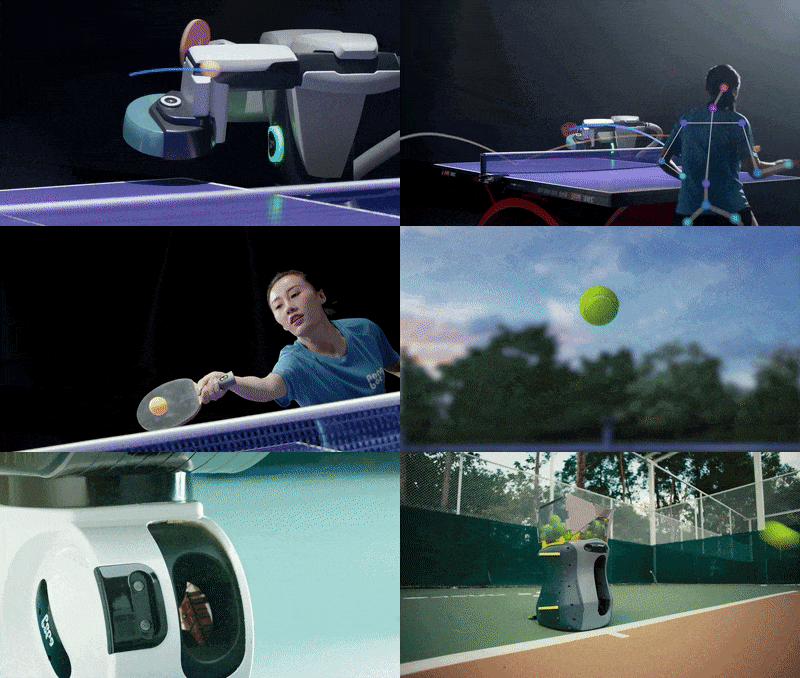
AI digital sports: with a full set of AI table tennis and smart tennis equipment, a single person can practice with an AI coach. Source: World Artificial Intelligence Conference
The H3 Embodied Intelligence Pavilion will centrally display humanoid robots, dexterous hands, industrial robots, quadruped mechanical dogs, and embodied models. The focus of the 2026 World Robotics Conference is to push robots into real scenarios, industrial collaboration, and practical implementation, echoing the market's demands for robots in 2026: can robots enter real scenarios such as factories, warehouses, supermarkets, elderly care, and service industries, and complete specific tasks including sorting, handling, loading/unloading, inspection, and grasping?
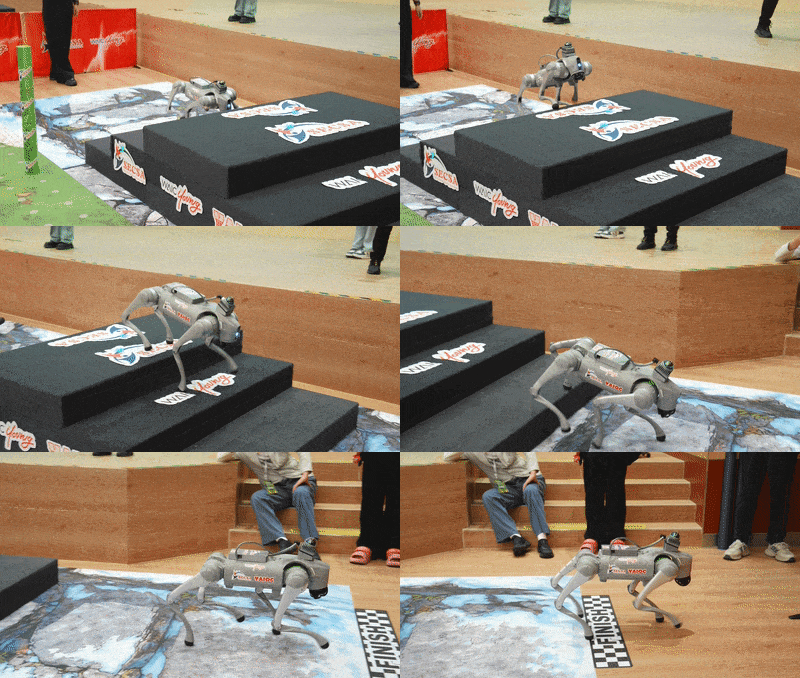
The "AI Large Model + Embodied Intelligence" autonomous navigation competition is held here, where visitors can write commands on site to direct quadruped mechanical dogs to complete obstacle-crossing tasks. Source: World Artificial Intelligence Conference
In 2026, the WAIC exhibition outlines a trend of changes in the AI industry: the focus on AI has shifted from cloud-side models to end-side devices, Agents have evolved from chat partners to operating systems, and at the same time, the market is highly concerned about the infrastructure construction such as domestic computing power and the specific scenarios of robot implementation.
02
Turing and Nobel Laureates Gather: What Will They Discuss at the WAIC Forums?
In addition to the progress of AI products demonstrated in the exhibition, the forum lineup of this year's WAIC is also a "dream team of AI experts".
According to official announcements, this year's WAIC will invite 9 Turing Award and Nobel laureates to participate, including top scholars such as Richard Sutton, the father of reinforcement learning, Yoshua Bengio, one of the three giants of deep learning, Gilles Brassard, the 2025 Turing Award winner, and Omar M. Yaghi, the 2025 Nobel laureate, to explore the new paradigm of AI for Science (AI4S).

Partial guests of the WAIC Thinkers Forum. Source: World Artificial Intelligence Conference
Richard Sutton, known as the "father of reinforcement learning", will deliver a keynote speech at the forum. Today, AI Agents are becoming a key term in the industry. A truly effective and efficient agent needs to make decisions, conduct trial and error, receive feedback, and optimize in complex environments, all of which are highly related to reinforcement learning.
While global AI development is advancing rapidly, multiple risks have also emerged: model hallucinations, data copyright issues, safety alignment, deep fakes, AI misuse, and other problems are unavoidable. Especially as AI integrates into enterprise systems and the physical world, governance issues will become even more complex.
The attendance of Yoshua Bengio means that "AI governance" will also be placed on the agenda this year.
In June 2025, Bengio launched the non-profit organization LawZero, dedicated to exploring safer artificial intelligence system design. In 2026, Bengio also presided over the release of the International AI Safety Report, which brought together contributions from more than 100 independent experts from over 30 countries, as well as organizations including the European Union, OECD, and the United Nations.
WAIC is not only a window for showcasing China's AI industry, but also, from another dimension, a platform for global AI governance discussions.
Meanwhile, Kevin Kelly, known as the "father of Silicon Valley spirit", will participate as a special guest in the sub-forum "From Digital Screens to Embodied Intelligence: New Paradigms in the Physical World" hosted by Honor at 14:00 on July 18. He said, "The current development of AI and embodied intelligence is amazing. It's such a magnificent era that we are fortunate to live in."
This year's WAIC has also launched a high-level international academic conference "WAIC Academic" for the first time, with Turing Award laureate Andrew Yao serving as the conference chairman, and the academic committee led by academicians of the Chinese Academy of Sciences and the Chinese Academy of Engineering.
Public information shows that 284 high-quality papers from 11 countries have been collected so far, and some of the award-winning authors will be invited to the conference to share their insights.
According to the forum schedule of the conference, this year's WAIC forums will be structured around four dimensions: "Cornerstone, Journey, Boundary, and Ecosystem", covering core track forums such as computing power infrastructure, large model technology, computing-power and electricity coordination, AI4S, and intelligent agents, while also focusing on directions including cutting-edge model architectures, corpus data, AI Infra, AI4S, embodied intelligence, and AI governance.
In summary, these topics point to three key questions:
First, how will models evolve in the next step? World models, multimodal models, AI4S, and reinforcement learning are all important directions for AI to continue breaking through its capability boundaries;
Second, how will AI integrate into development and production processes? Topics such as AI Coding, open-source agents, and Agent operating systems are all discussing how AI can become a system for executing tasks;
Third, how will AI establish new industrial rules? How will OPC (One Person Company), embodied intelligence, and AI infrastructure bring new rules and impacts to the AI industry and related sectors.
Combining the exhibitions and forums of WAIC, a clear trend has emerged: AI has moved beyond the technology demonstration phase to the level of practical implementation, and is becoming a new anchor for productivity.
Around this transformation, there is still much room for imagination about the future in the AI industry.
On one hand, this year's WAIC sends a clear signal that the AI industry is shifting from model breakthroughs to scenario-based value realization; on the other hand, it provides an important forward-looking perspective for observing technological evolution, industrial implementation, and the competitive landscape of enterprises.
This article is from the WeChat public account "Tencent Tech", authored by Worth Paying Attention To, and authorized for release by 36Kr.