While others are striving to develop humanoid robots, this company first equipped its quadruped robot with a robotic arm.
Chinese robotics companies are still overflowing with wild ideas.
Today's embodied AI firms either go all out to make robots look as human-like as possible — complete with two legs, two arms, and ten fingers — or follow the quadruped path, refining robotic dogs to act more and more like intelligent, obedient real canines.
However, Viti Dynamics has built a total "chimerical oddity":
A robotic dog with a single arm growing out of its back.
In July 2026, Viti Dynamics launched the "Big Head EDU Version". It is a quadruped robot platform designed for developers, laboratories, and corporate R&D teams, with reserved expansion interfaces for robotic arms and other accessories on its back.
By simply mounting a robotic arm on the expansion interface, you get a robotic dog with a functional arm on its back.
Beyond creating this "oddity", Viti Dynamics presents another interesting contrast.
Just two months ago, the company closed a nearly 500 million-yuan Series Pre-A financing round. Founded just over a year ago, its total accumulated funding has already approached 800 million yuan.
Yet up to now, Viti Dynamics still has no commercially available humanoid robot on the market.
Facing the sector's most mainstream direction that is also heavily favored by investors, the firm hasn't rushed to assemble a full human-like body for its robot. Instead, it attached a single arm to the back of a robotic dog.
What exactly does this maverick company aim to achieve?
Building a full humanoid is too hard — so just put an arm on a dog
In Viti Dynamics' released demo videos, that arm mounted on the robotic dog's back has already started doing actual housework seriously.
It can feed a cat with a spoon, draw curtains open, pick up scattered items on the floor, and water plants. It can even walk up to a washing machine, open the door, grab laundry, and press the start button.
Traditional robotic dogs were mostly limited to following, accompanying users, and patrolling. With an extra arm on its back, it can finally perform tangible actions after reaching its target.
But making a robotic arm work seamlessly with a quadruped robot is far more complex than just bolting two devices together.
A desktop-fixed robotic arm only needs to consider how to move its end effector. But every lift, extension, and rotation of the arm on the dog's back shifts the entire robot's center of gravity.
When the arm needs to reach farther, the robotic dog must adjust its stance. When it needs to grab low-lying objects, the dog actively lowers its body. Facing targets at different heights and angles like curtains or washing machines, the four legs must constantly coordinate with the arm to reposition and reorient itself.
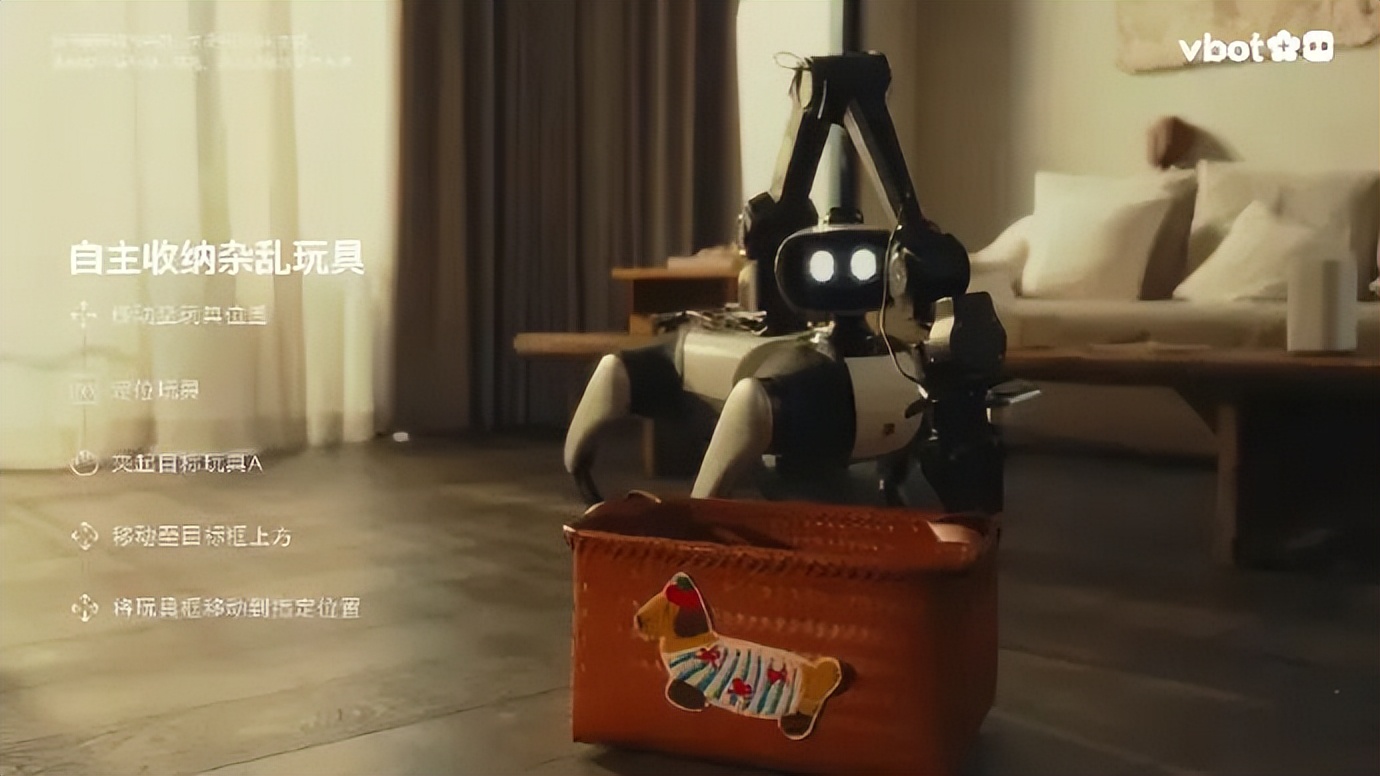
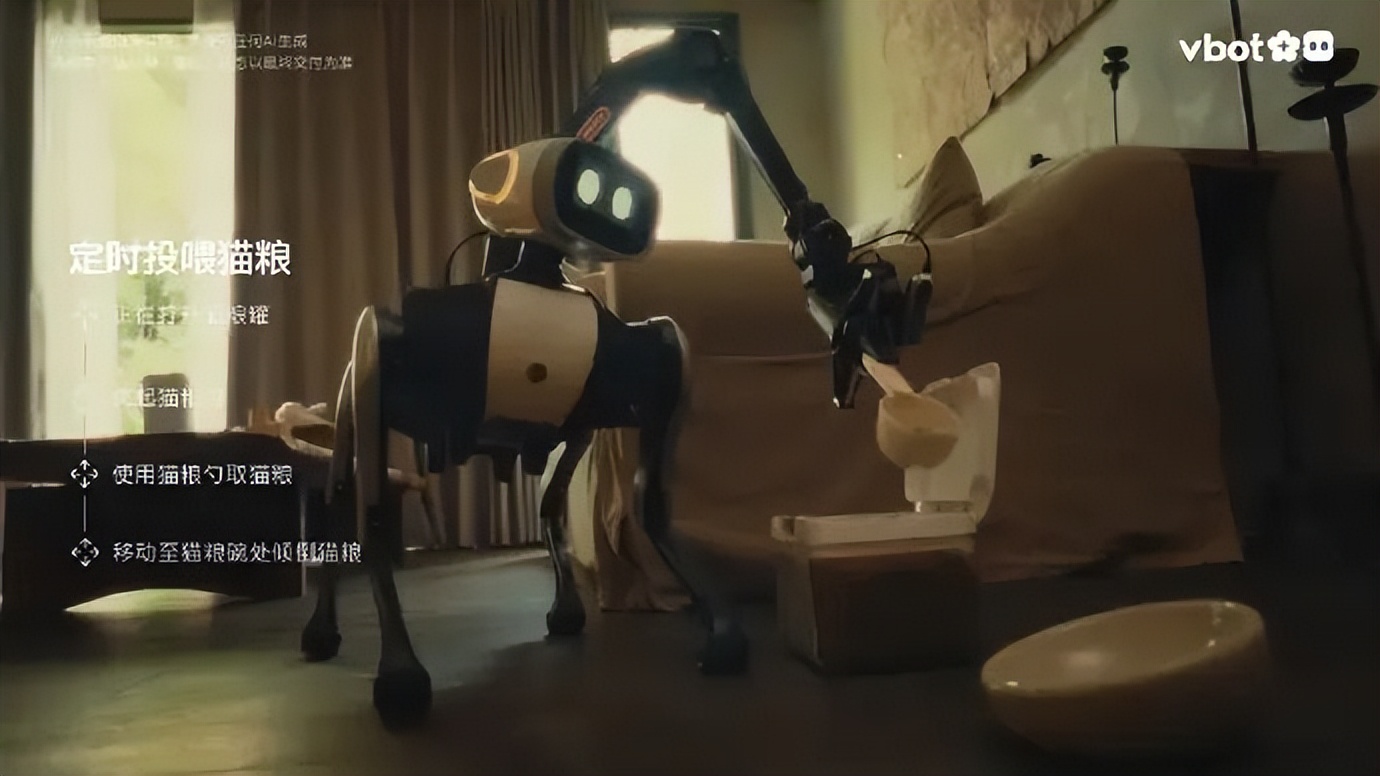
Throughout the entire process, the robotic dog must first perceive the target, judge the distance, move to an optimal position, and only then let the arm complete grasping, pulling, or pressing actions.
Viti Dynamics has put tremendous effort into ensuring this arm performs tasks reliably.
The Big Head EDU is equipped with 128 TOPS of edge-side computing power, paired with depth-sensing binocular cameras and a 16-channel LiDAR for environment perception, autonomous navigation, and target recognition.
Its back features standardized expansion interfaces that integrate power supply, data transmission, and control signals, allowing connections to robotic arms, grippers, and additional sensors. Developers can also use the ROS 2 interface to combine the robotic dog's mobility with the arm's manipulation capabilities.
In simple terms, the four legs transport the robot to the task location, and the arm on the back completes the actual work.
After solving this coordinated operation problem, Viti Dynamics has set extremely high expectations for this design.
Yu Yinan, founder of Viti Dynamics, believes that "robotic dog + robotic arm" could become the minimal viable unit for robots to enter ordinary households.
After all, for a robot to deliver items, pick up floor clutter, press switches, or open curtains, there are only two core requirements: it must be able to move freely around the home, and it must be capable of interacting with surrounding objects.
The robotic dog already solves the first requirement, and the mounted arm fills the gap for the second.
Compared with immediately tackling bipedal balance, dual-arm coordination, and dexterous ten-finger manipulation, the four-leg-plus-one-arm configuration is far more practical to start performing a subset of household tasks first.
However, even with high hopes for the "robotic dog + arm" combination, Viti Dynamics' ambitions clearly go far beyond this.
The robotic dog may be its first step into homes, but humanoid robots remain the company's ultimate north star.
Sell robotic dogs first, then tackle humanoid robots
Humanoid robots have long been in Viti Dynamics' roadmap — the company just didn't rush to make its first product a full humanoid.
This ties back to the team's background.
Founded at the end of 2024, Viti Dynamics' founder Yu Yinan previously served as President of Horizon Robotics' Intelligent Driving division. Its other two co-founders, Song Wei and Zhao Zhelun, also came from the intelligent driving teams at Horizon Robotics and Li Auto respectively.
The team's core expertise has always been enabling machines to perceive their surroundings, plan routes, and navigate safely to destinations.
Translating these capabilities to robotics, quadruped robots are clearly a far more feasible path to market.
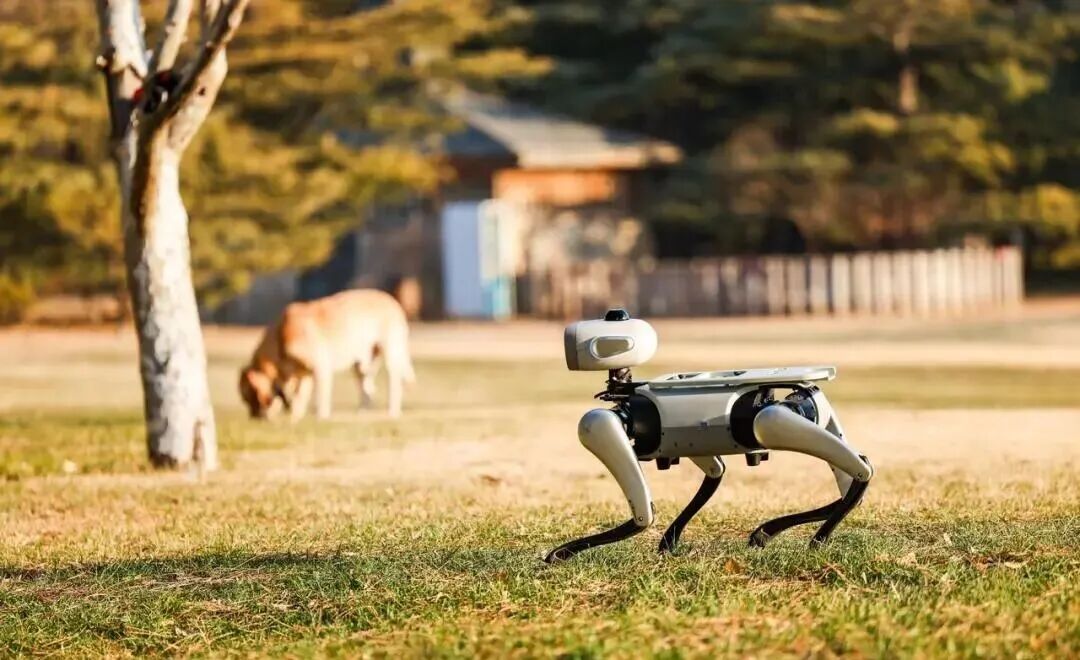
Quadruped locomotion technology is already relatively mature — these robots can step over thresholds, climb small stairs, and don't require solving bipedal balance or full-body control from day one. Viti Dynamics only needed to focus on enhancing perception, navigation, human-robot interaction, and turning the platform into a product ordinary consumers are willing to bring home.
As a result, the company first built a robotic dog that feels more like an electronic pet.
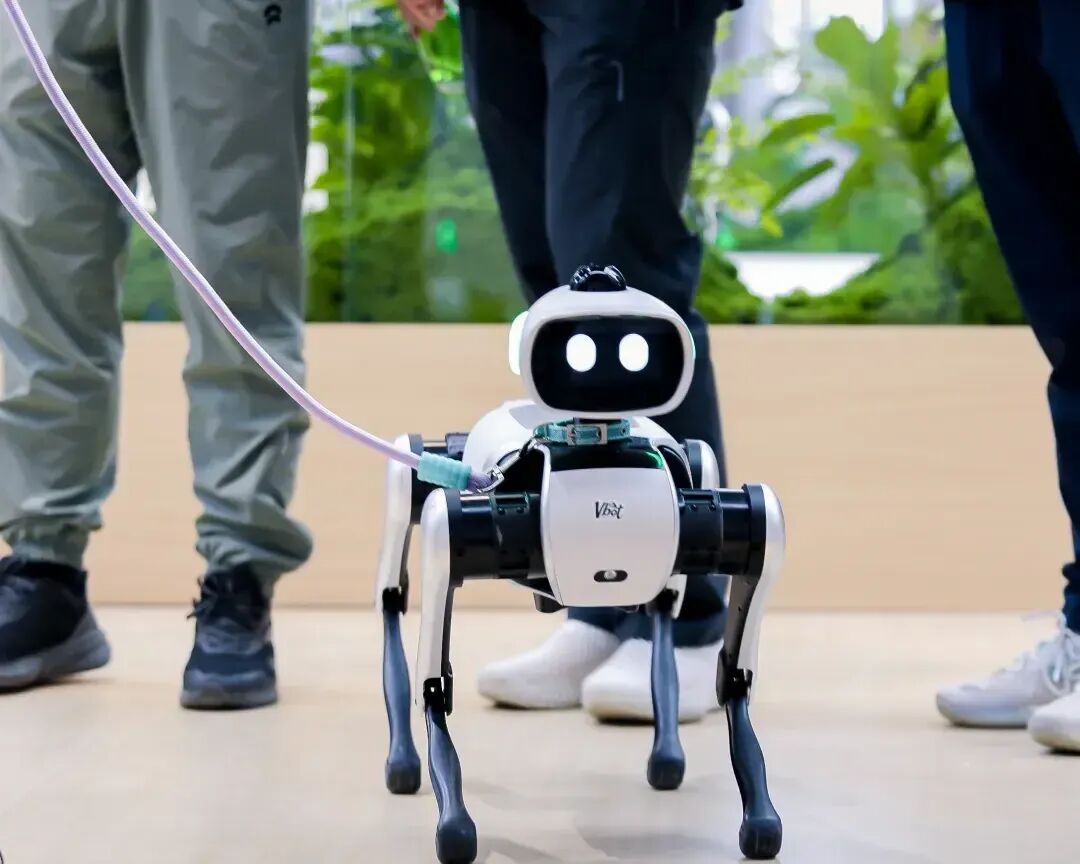
The "Big Head BoBo" features rounded contours on its head, a top-mounted screen for emotional interaction, and stands shorter than a young child. Placed in a home, it creates far less sense of intrusion than a 1.7-meter-tall full humanoid robot.
Yet Viti Dynamics didn't position it as just a playful toy that does tricks and rolls over.
Big Head BoBo is designed for untethered operation: it can autonomously follow users, perceive environments, avoid obstacles, carry payloads, record footage on the go, and monitor family members.
In December 2025, Big Head BoBo officially opened for pre-orders at a price of 9,988 yuan.
During the pre-sale period, it accumulated 6,540 orders. By May 2026, the first batch of 500 units rolled off the production line and began delivering to consumers.
In other words, while many humanoid robot projects are still stuck in demo showcases and small-batch prototyping, Viti Dynamics has already started selling its robotic dogs.
This allowed the company to go through the entire consumer robotics workflow before even touching humanoid development: learning cost control, building supply chains, scaling mass production, setting up experience stores, and convincing ordinary people to spend nearly 10,000 yuan to bring a robot home.
Now, by adding an arm to the back of its robotic dog, Viti Dynamics is evolving its product roadmap further.
The original Big Head BoBo solved the problem of "how the robot gets to the user"; with the attached arm, the company is now exploring "how the robot completes tasks once it arrives".
Moving from autonomous mobility, to physical object interaction, and eventually to full-body coordination, Viti Dynamics is breaking down the technical challenges of humanoid robots layer by layer.
All these foundational steps are paving the way for the humanoid robot Viti Dynamics has long envisioned.
In May 2026, the company closed its nearly 500 million-yuan Series Pre-A round. Aside from funding large-scale production of robotic dogs and expanding its sales network, the capital will also go toward R&D for its next-generation humanoid robot.
To accelerate this initiative, Viti Dynamics brought on board Qin Hailong, former Chief Scientist at Horizon Robotics' intelligent driving division, to lead development of world models, spatial intelligence, Agent OS, and humanoid robot systems.
At this point, Viti Dynamics' strategy has become crystal clear:
First use robotic dogs to solve mobility and product commercialization. Then add a functional arm for object manipulation. Once the supply chain, mass production capabilities, and AI models are fully mature, the company will finally tackle full humanoid robots with two legs, two arms, and coordinated whole-body control.
But this roadmap also raises an unavoidable question.
If Viti Dynamics' ultimate goal is building a humanoid robot, is mounting an arm on a robotic dog truly a smart shortcut?
A single arm — shortcut or ceiling?
At least in the current stage, it's still too early to say if mounting an arm on a robotic dog is perfect, but it is undeniably a far more pragmatic path.
A complete humanoid robot needs to simultaneously solve bipedal walking, full-body balance, dual-arm coordination, and dexterous hand manipulation. If any of these capabilities fall short, the robot will struggle to operate reliably in real-world scenarios.
Viti Dynamics decoupled these challenges.
The quadruped chassis handles mobility and stability, while the robotic arm takes charge of grasping and manipulation. Without waiting for bipedal technology to fully mature, or rushing to integrate two arms and ten fingers, the robot can already perform tasks like opening curtains, delivering items, and pressing buttons, tackling a subset of real-world use cases.
For a startup founded just over a year ago, this approach is far more realistic.
More importantly, these efforts help Viti Dynamics accumulate massive datasets for mobility, object recognition, grasping, and human-robot interaction.
When the company eventually builds humanoid robots, even though their physical form and locomotion style will change, the core capabilities — how robots understand environments, locate targets, and translate language commands into physical actions — will remain fully reusable.
But this apparent shortcut may soon hit a hard ceiling.
After all, a single arm has inherent limits on what it can achieve.
Opening curtains, picking up items, and pressing switches only require one hand. But folding laundry, making beds, cooking, and moving large objects almost always demand two hands working in tandem, or even full-body engagement.
The robotic dog's height, the arm's maximum reach, and its payload capacity also constrain its operational range. The farther the arm extends and the heavier the object it lifts, the more strain it places on the entire robot's center of gravity and battery life.
The washing machines, curtains, and pet bowls shown in demo videos are all relatively ideal scenarios. When deployed in real ordinary households, the robot will face randomly piled clutter, constantly changing lighting conditions, furniture of inconsistent dimensions, and wildly varying living habits across different homes.
This means that beyond polished demo clips, how reliably the robotic dog can complete tasks in practice remains a big open question.
The developer platform faces this exact same challenge.
The Big Head EDU already supports open interfaces for robotic arms, sensors, and ROS 2. But the ultimate scale of the platform still depends on whether enough developers are willing to build applications for it, and how many of those use cases can transition from the lab to actual paying customers.
Otherwise, the "robotic dog with an arm on its back" will easily become nothing more than an eye-catching product showcase, rather than a capability ordinary people are willing to pay for long-term.
Furthermore, the entire quadruped robotics market alone cannot match the massive growth potential projected for humanoid robots.
According to forecasts from the China Industrial Research Institute, China's quadruped robot market will reach about 850 million yuan in 2025 with total sales of 23,000 units. Meanwhile, the "Humanoid Robot Industry Research Report" predicts that China's humanoid robot market will hit 10.471 billion yuan in 2026, and surge to 119.246 billion yuan by 2030.
One is a niche market measured in hundreds of millions of yuan, the other is a track already positioned to grow to hundreds of billions — the gap clearly goes far beyond how many legs a robot has.
Perhaps this chimerical "oddity" with an arm on its back is ultimately just a transitional product.
This article originates from the WeChat Official Account "Blue Print Project", authored by the Blue Print Project, and is republished by 36Kr with authorized permission.