NVIDIA is completing the "five-layer cake" closed loop
At GTC Taipei, Jensen Huang put forward an equation: "Compute equals revenue". The underlying message is that AI companies, cloud providers, and enterprise customers are not buying hardware, but intelligent production capacity that can continuously generate returns in the future.
NVIDIA is no longer just a chip company; it is more like the "general contractor" of a large-scale token factory. And Jensen Huang aims to be the chief architect who ensures everything runs smoothly. The competition between factories does not lie in the capability of a single piece of equipment, but in the output of the entire production line under a given unit of energy consumption. Jensen Huang presented NVIDIA's answer with the five-layer cake theory: from energy to applications, each layer is redefined as a link in the Token production system. These five layers, from bottom to top, are "Energy, Chips, Infrastructure, Models, and Applications".
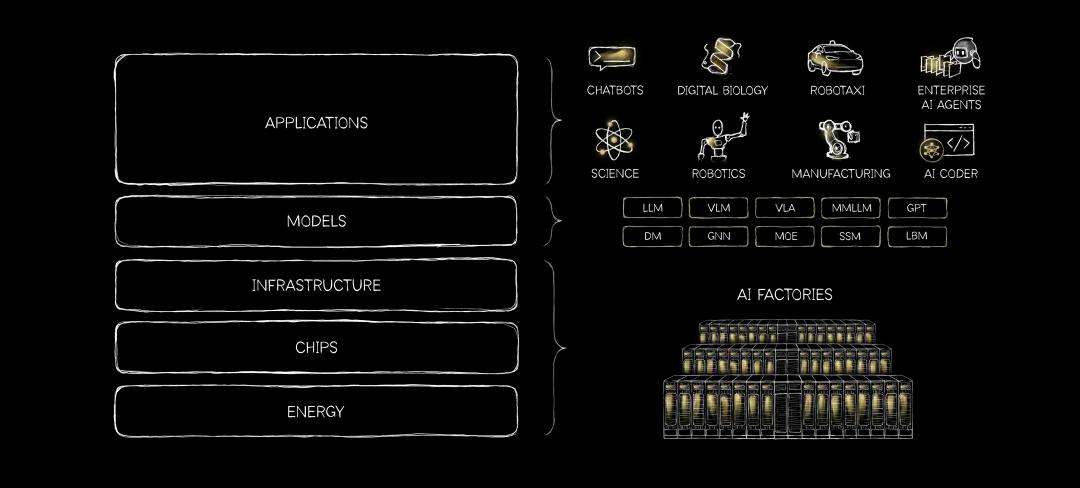
While competitors are still optimizing the parameters of a single layer, NVIDIA has been optimizing and deploying every layer of the cake, creating a multiplicative effect that leaves competitors far behind.
01 Energy: AI Factories, Where Computing Power Begins with Electricity
From AI-driven wind and solar power generation forecasting, to high-voltage direct current power distribution facilities, and then to smart energy storage and stable energy supply, the energy layer addresses how AI factories can operate efficiently and ensure stable Token production.
In the future competition of AI factories, the first priority is the competition of "how much intelligence can be produced per kilowatt-hour of electricity". Jensen Huang proposed the "Token Factory Economics", pointing out that under the premise of fixed power supply, the core measure of competitiveness is no longer peak computing power, but "Token per Watt". NVIDIA's Vera Rubin high-performance computing platform delivers a 10x improvement in performance per watt, reducing the cost per token to 1/10 of the previous level. The second priority is the competition in energy supply capacity. In 2025, NVIDIA's venture capital arm NVentures made its first foray into the energy sector, participating in TerraPower's $650 million financing round and investing in Commonwealth Fusion Systems (CFS). In addition to exploring cutting-edge clean energy, NVIDIA has also invested in large, medium, and small enterprises focused on optimizing data center power consumption solutions, including chips, computing power, and power grid management, such as Emerald AI and Utilidata. In August 2025, NVIDIA updated its list of partners for the 800V DC power architecture on its official website, with Chinese companies Innoscience and Megmeet selected.
When electricity becomes a hard constraint for AI factories, keeping pace with innovations on the energy side is equivalent to securing bargaining power over upstream raw materials. NVIDIA's investments in the energy layer, supply chain tie-ins, and technology empowerment ensure the supply stability of the entire five-layer cake.
02 Chips: The Vera Rubin Platform Completes the Full Computing Power Package
As a typical example of NVIDIA's extreme co-design, the Vera Rubin platform is integrated with Vera CPU, Rubin GPU, NVLink 6 switch, ConnectX-9 SuperNIC, BlueField-4 DPU, Spectrum-6 Ethernet switch, and Groq 3 LPU.
The reason NVIDIA combines these chips into a unified whole is that AI models are extremely sensitive to communication bandwidth and latency. NVLink 6 and CPO (Co-Packaged Optics) switches solve the communication bottleneck at the software level through tight coupling at the physical level. More importantly, in the era of co-design, the cost of mixing and matching components rises sharply.
First, let's look at the Vera CPU, NVIDIA's first CPU designed exclusively for agentic AI. The Vera CPU features 88 custom-designed NVIDIA Olympus cores, spatial multi-threading technology, and an LPDDR5X memory subsystem with a bandwidth of up to 1.2TB/s. In agent workloads, Vera completes tasks 1.8 times faster than x86 CPUs. More importantly, as part of the Vera Rubin NVL72 platform, the Vera CPU pairs with NVIDIA GPUs via NVLink-C2C interconnect technology, delivering coherent bandwidth of up to 1.8TB/s — approximately seven times the bandwidth of PCIe Gen 6 — enabling high-speed data sharing between CPU and GPU.
Next, the network: NVLink 6 provides the fast, seamless GPU-to-GPU communication required by today's large-scale MoE models. Each GPU supports 3.6TB/s of bandwidth, and each Vera Rubin NVL72 rack delivers 260TB/s of bandwidth. Spectrum-X is the world's first mass-produced Ethernet silicon photonics switch platform. The new-generation Spectrum-X switches are built on CPO (Co-Packaged Optics) technology, which integrates silicon photonic devices with switch ASICs to further reduce power consumption, improve reliability, and boost AI productivity. The ConnectX-9 SuperNIC offers up to 1.6Tb/s of throughput, breakthrough acceleration features, and optimized network performance, delivering ultra-low-latency 800Gb/s networking that accelerates data transfer, optimizes RoCE performance, and achieves consistent and predictable network performance for demanding AI workloads.
Finally, storage. The BlueField-4 DPU is NVIDIA's data center processing unit, part of the full-stack BlueField platform and also a component of the Rubin platform. Building on the BlueField-4 DPU, NVIDIA developed the BlueField-4 STX storage architecture. Its first rack-level deployment integrates the new CMX contextual memory storage platform. The CMX platform treats KV Cache as a brand-new AI-native data type, specifically designed to store and retrieve KV Cache data generated during LLM inference, turning context into a high-bandwidth resource shared across AI cluster systems. At GTC Taipei 2026, NVIDIA's newly upgraded Vera BlueField-4 STX platform also introduced the NVIDIA DOCA Security Library and microservices into the AI storage layer, helping enterprises protect data, agents, and contextual memory when deploying agentic AI into production.
In comparison, AMD's industry-leading Instinct MI350+EPYC decoupled architecture follows a modular path, but the severe CPU-GPU communication bandwidth bottleneck significantly limits data transfer efficiency between CPU and GPU, especially in agent scenarios that require frequent data exchange. Self-developed chip camps like Google TPU, AWS Trainium, and Microsoft Maia are vertically integrating their own small closed loops, but their scale cannot match NVIDIA's full-stack offering. When the Vera CPU is tightly coupled with the Rubin GPU via NVLink-C2C at 1.8TB/s of bandwidth, customers can hardly replace Vera with an x86 CPU, as such a replacement would drastically reduce Token production efficiency.
03 Infrastructure: From "Buying Servers" to "Building Factories"
Chips need to run on AI infrastructure. Jensen Huang lists infrastructure as a separate third layer, which includes land, power supply, cooling, networking, and the systems that orchestrate tens of thousands of processors into a single machine. Essentially, this is the "AI factory" that NVIDIA repeatedly refers to. NVIDIA aims to drive customers to shift from "buying servers" to "building AI factories".
So how should an AI factory be built? IBM defined the mainframe standard with System/360, and AWS defined the cloud architecture standard with its Well-Architected Framework. NVIDIA defined the AI factory standard through its AI infrastructure hardware guide and NVIDIA Dynamo. Leveraging its strong influence in intelligent computing centers, NVIDIA released a guide for building co-designed AI infrastructure, namely the Vera Rubin DSX AI Factory Reference Design. The Vera Rubin DSX AI Factory Reference Design outlines how to design, build, and operate the entire AI factory infrastructure stack, covering computing, Spectrum-X Ethernet networking, and storage, to achieve repeatable, scalable, and exceptional cluster performance. The documentation in the reference design also provides industry partners with best practices for designing, building, and operating power, cooling, and control systems, enabling seamless hardware-software integration and scalable deployment. NVIDIA clearly hopes that future AI Factories will adopt its standards, so that it can lock in its chip products in the long run. Replacing other chips is not just swapping a circuit board, but overturning the entire design logic of the factory. And the "operating system" of this factory is Dynamo. Dynamo is an open-source, low-latency, modular inference framework designed to serve generative AI models in distributed environments. It supports seamless scaling of inference workloads across large GPU clusters, providing intelligent resource scheduling and request routing, optimized memory management, and efficient data transfer.
04 Models: Accelerate Agent Deployment and Boost AI Factory Efficiency
NVIDIA not only provides hardware solutions but also actively deploys in the model layer. Nemotron is NVIDIA's most widely deployed in-house model family today. Its recently launched Nemotron 3 Ultra is a Mixture-of-Experts model with a total of 550 billion parameters and 55 billion activated parameters per inference, capable of handling orchestration and highly complex inference calls in autonomous workflows: making architectural decisions during long-running coding sessions, synthesizing insights across hundreds of research sources, and validating thousands of interdependent constraints. Cosmos is NVIDIA's world foundation model for physical AI (robotics, autonomous driving), whose main function is to generate synthetic data and motion strategies that conform to physical laws, reducing the cost of acquiring industry-specific data. Cosmos 3 solves a core challenge in physical AI: enabling robots, intelligent vehicles, or visual agents to generalize in the real world even with limited training data and fragmented simulation stacks.
NVIDIA also has corresponding models for vertical industries, such as BioNeMo, its vertical model platform for the life sciences sector. NVIDIA does not aim to become "the next OpenAI"; instead, it wants to prove that its hardware can run at a lower Token cost, demonstrate that its full-stack solution delivers the best Tokens per Watt, and persuade customers in the "Compute equals revenue" equation to choose NVIDIA hardware to run these proven, highly efficient models.
05 Applications: The Real Market
At the very top of the five-layer cake lies the domain that directly faces users and generates tangible value, including Agentic AI, enterprise automation, and applications of physical AI in fields like drug discovery, industrial robotics, and autonomous driving. This is the final monetization layer of NVIDIA's full-stack deployment, as well as the output end of the entire "AI factory". By defining Agent standards, providing physical AI development platforms, and certifying industry skill modules, NVIDIA is fostering a thriving ecosystem of AI applications built on its platform.
Agentic AI is NVIDIA's immediate priority. After OpenClaw gained massive popularity, NVIDIA quickly followed up by launching the supporting enterprise-grade secure deployment software stack NemoClaw, which adds sandbox isolation, permission control, and large-scale operation capabilities to OpenClaw, attempting to capitalize on the momentum of OpenClaw's explosive growth. To ensure security, NVIDIA also introduced Verified Agent Skills, which integrates transparency, provenance, security validation, and authenticity checks into the capability layer of agents, helping developers scale autonomous agents with greater confidence. Physical AI is NVIDIA's key focus for the future. Recently, NVIDIA collaborated with Unitree Robotics and Sharpa to launch an open humanoid robot reference design built on the NVIDIA Isaac GR00T platform. According to the official roadmap, the Isaac GR00T humanoid robot reference platform will be officially released by Unitree Robotics by the end of 2026.
From energy, chips, and infrastructure to models and applications, NVIDIA is driving innovation across the full technology stack. Today, every layer of the five-layer cake is in place. At the Blockchain Conference held in Beijing on June 22, we also saw localized deployment cases in China and the lineup of Chinese partners in its full-stack ecosystem at NVIDIA's booth. At the energy layer, vendors like Star Energy XuanGuang and Energy Singularity leverage accelerated computing and digital twin technology to advance future energy technology R&D, while JinkoSolar and Chint use NVIDIA AI technology to achieve full-lifecycle design and operations. At the chip layer, NVIDIA provides Chinese partners with solutions like the Spectrum-X Ethernet platform. At the infrastructure layer, CloudEdge Information combined NVIDIA products to develop the iMDC liquid-cooled container intelligent computing center solution. At the model layer, SGLang delivers high-performance DeepSeek-V4 inference on NVIDIA GPU servers. At the application layer, the Jianzhong Intelligent concept humanoid robot and Lingrui P1 industrial heavy-duty robotic dog, both built on NVIDIA's solutions, were showcased simultaneously.
06 NVIDIA Wants to "Sell the Entire Five-Layer Cake Together"
What NVIDIA truly wants is to build a complete closed loop that covers all five layers of the cake. The Vera Rubin platform integrates CPU, GPU, networking, and storage in the same package; Dynamo, as the AI factory operating system, orchestrates global resources; DSX digital twins verify the flow of every watt of electricity before construction begins; and the enterprise Agent Toolkit fully integrates business logic into NVIDIA's ecosystem. NVIDIA not only provides the building blocks, but also the design blueprints (DSX Blueprint), the construction team (Dynamo orchestration), and even the skilled industrial workers (NemoClaw).
Jensen Huang's ambition goes far beyond building a Token factory in the digital world. Today, agents like OpenClaw are starting to become "the operating system for Agent computers". In the future, everything from cloud-based agents to personal computers, autonomous vehicles, humanoid robots, and even satellites, base stations, and factory equipment will run agents. And the fundamental input for all these deployments is Token. NVIDIA is redefining the metrics of AI business with Token Economics, encapsulating vertical domain know-how into monetizable Agent capabilities through CUDA-X skill enablement, and making it nearly impossible for any alternative solution to generate equivalent Token output under the same power budget through full-stack co-design. Customers who choose NVIDIA's full-stack solution get proven, quantifiable intelligent production capacity; competitors who take the non-full-stack path will face endless system integration and optimization challenges.
The five-layer cake cannot afford to miss a single layer. Jensen Huang's deployment has gone far beyond chips and data centers; he is building a unified technology and business logic that integrates all five elements.
This article is from the WeChat public account "Semiconductor Industry Insights" (ID: ICViews), written by Peng Cheng, and published with authorization from 36Kr.