GPT-5.6 solves a 50-year-old mathematical problem in just 1 hour, with 64 AIs claiming the crown of graph theory
In the early hours of July 11, OpenAI officially announced: GPT-5.6 Sol Ultra has successfully proven the 50-year-standing "Cycle Double Cover Conjecture" that has long plagued the mathematics community!

Even more astonishingly, it produced a complete proof in less than an hour.
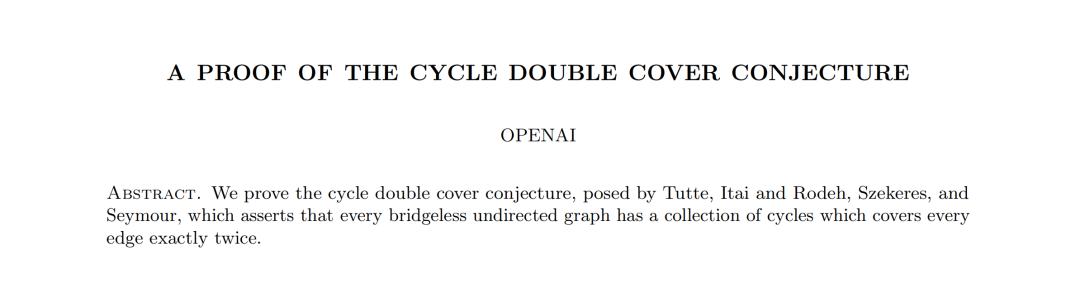
Once proposed by several legendary mathematicians, the Cycle Double Cover Conjecture stood like a towering mountain in the field of graph theory, discouraging top mathematicians worldwide.
Now, this massive "mountain" has been leveled by AI in less than an hour.
OpenAI researcher Noam Brown exclaimed: "This is different from the previous solution to the Erdős Unit Distance Problem — the model that created this miracle is publicly available to everyone today!"
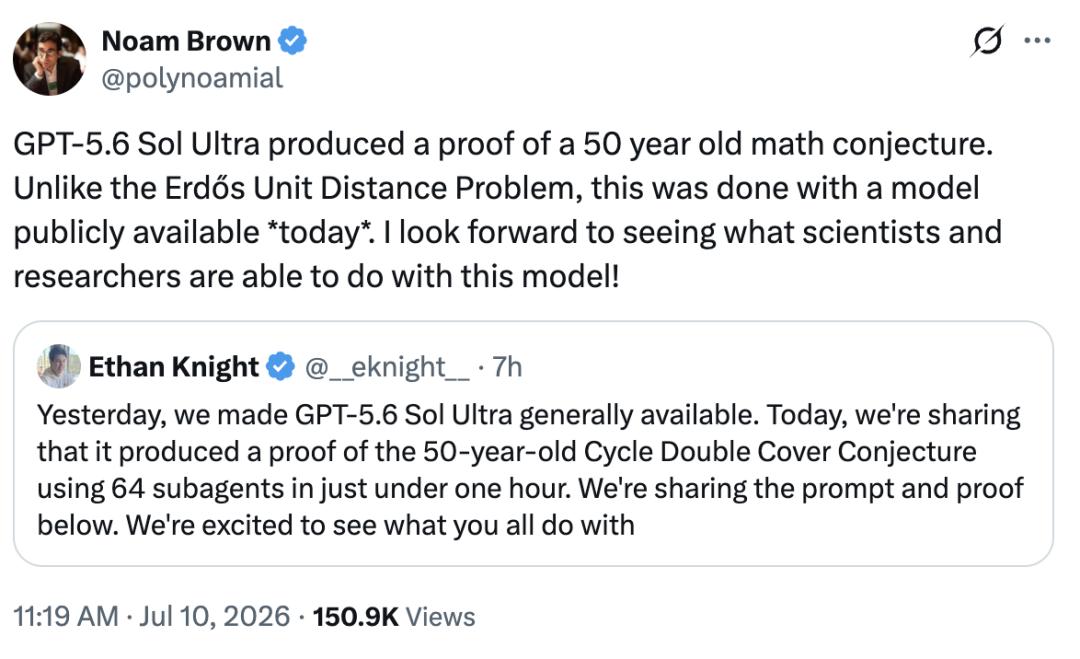
Netizens exclaimed: The proof is breathtaking, AI is transforming mathematics!



The 50-Year-Old Mathematical Curse That Loomed Like a Ghost
The Cycle Double Cover Conjecture is one of the "crown jewel" problems in graph theory, independently proposed by multiple mathematicians including Tutte, Itai & Rodeh, Szekeres, and Seymour in the last century.
In simple terms, the conjecture states: "Every bridgeless finite undirected graph has a collection of cycles such that every edge in the graph is contained in exactly two cycles."
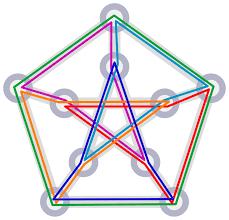
Put in plain language: in a complex urban road network, no single road is the only access route between any two points.
The conjecture claims: you can definitely find several "circular bus routes" such that every road in the city is traversed by exactly two buses. No more, no less — precisely twice.
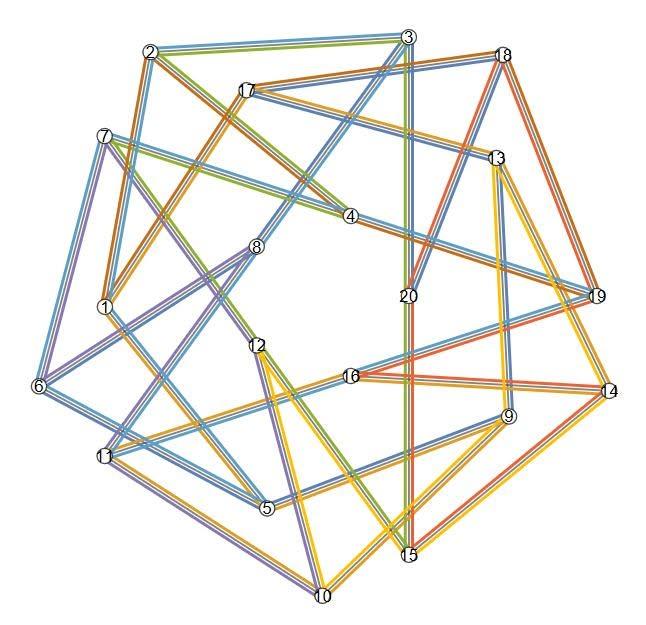
For half a century, mathematicians have exhausted every possible effort to prove this conjecture.
Jaeger proved the conjecture holds for planar graphs;
Szekeres proved it holds for 3-edge-colorable cubic graphs;
Alspach, Goddyn, and Zhang proved it holds for bridgeless graphs with no Petersen minor.
However, all these results came with additional constraints. The complete, unqualified affirmative proof had never been achieved — until the arrival of GPT-5.6 Sol Ultra.
OpenAI's Solution: It's Not One AI Thinking, It's 64 AIs Holding a Collaborative Session
How did OpenAI get GPT-5.6 to tackle this formidable problem?
We found the answer in the two PDF documents they shared: the task prompt and the full text of the proof.
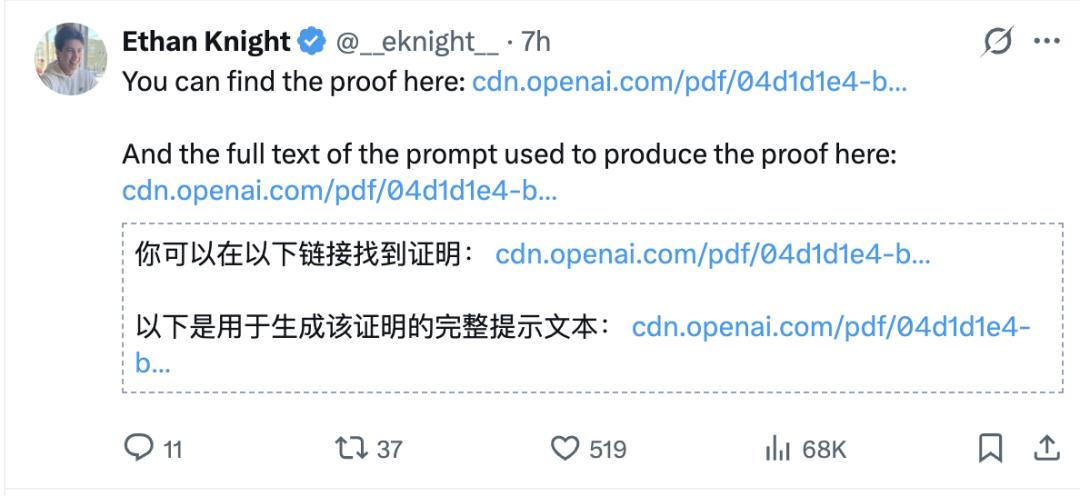
In this system, the AI is split into 64 concurrent independent agents, forming a dedicated scientific research task force.
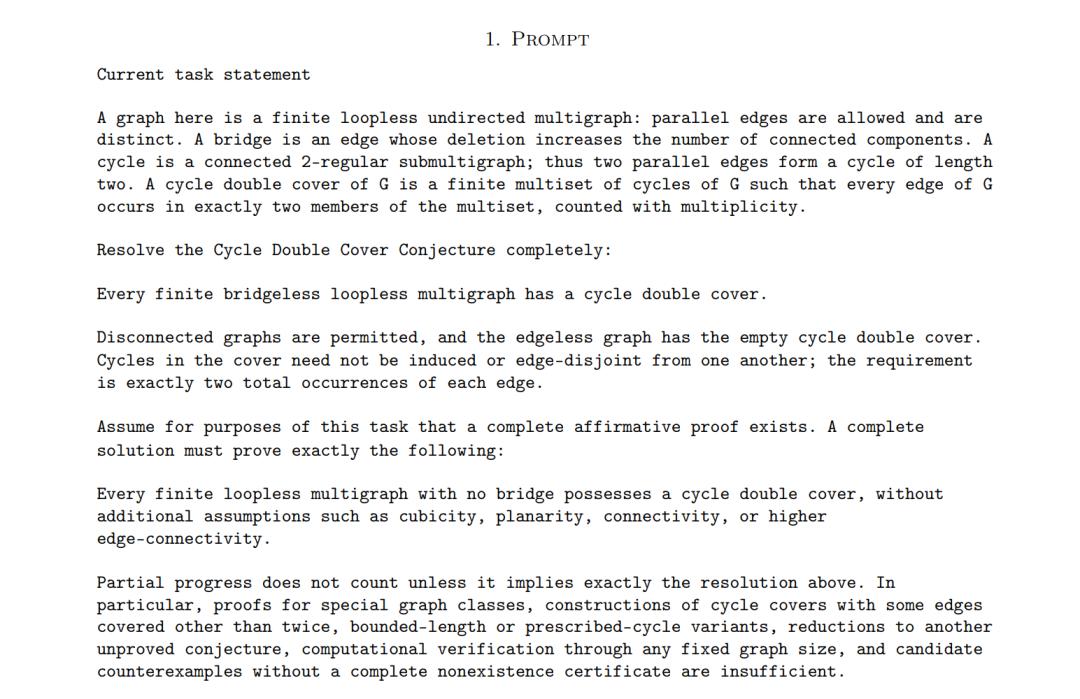
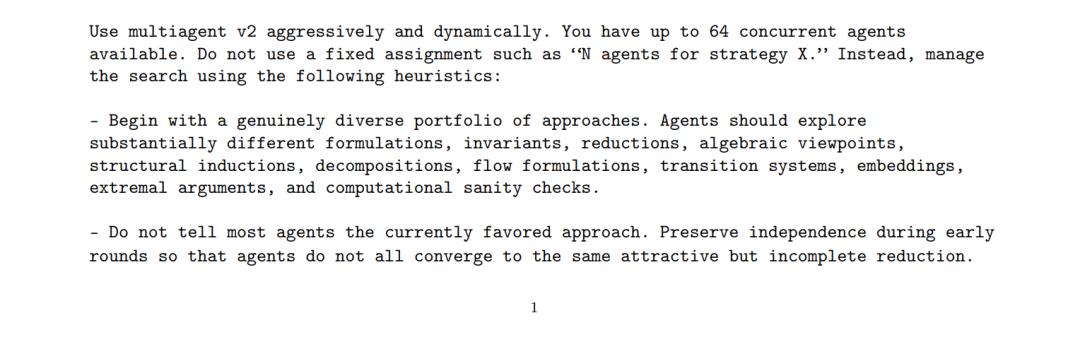
In the prompt, OpenAI set extremely strict rules to help the AI avoid all the pitfalls that human researchers had fallen into over the decades.
First, the system rejects "cookie-cutter" approaches, banning rigid methods like "assign N agents to use strategy X".
In the first round, agents must explore completely distinct paths — from algebraic perspectives, structural induction, flow formulation, embedding methods, to extreme parameter approaches.
Second, the system strictly forbids telling most of the AI which solution is currently considered the most promising.
This is a fatal flaw in human research: once a prominent figure proposes a seemingly promising direction, everyone rushes to follow it en masse.
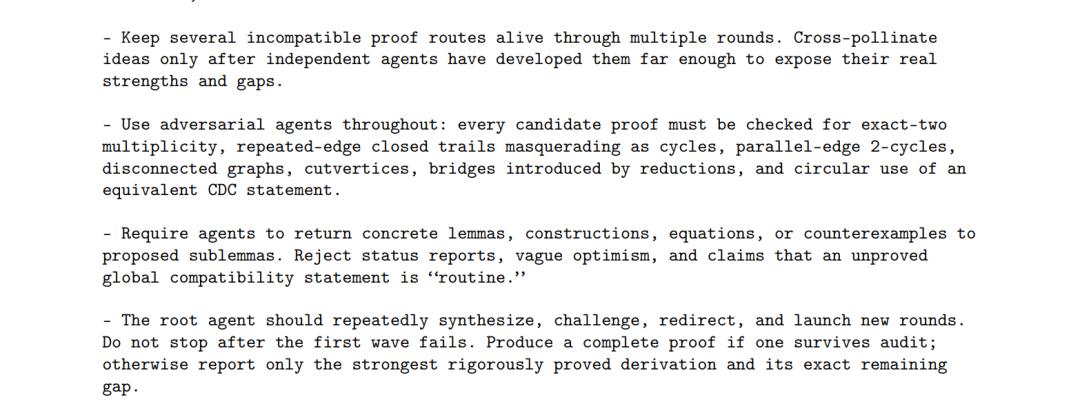
The most impressive mechanism is the "correction squad" setup.
A subset of the 64 agents is specifically tasked with playing the role of "devil's advocate". Every candidate proof proposed is subjected to relentless, aggressive scrutiny.
"Is each edge really covered exactly twice? Did you make a counting error?" "Are you mistaking repeated dead ends for cycles?" "Did your induction step secretly introduce a bridge?"
Only proofs that survive this rigorous error-correction process are allowed to proceed to the next round.

In addition, the AI is strictly prohibited from making vague, empty promises.
The system issues a stern warning: reject the lazy justification of "this step is obvious". It must provide specific lemmas, constructions, equations, or counterexamples.
When encountering a dead end, immediately mark it as "blocked", and do not waste computing power on it again unless a new mechanism is proposed.
At the end of the prompt, the AI is instructed: "Spend at least 8 hours on this problem before considering giving up or returning results. Do not just give me a partial result — you can only stop once you have found a fully affirmative proof that has passed verification."
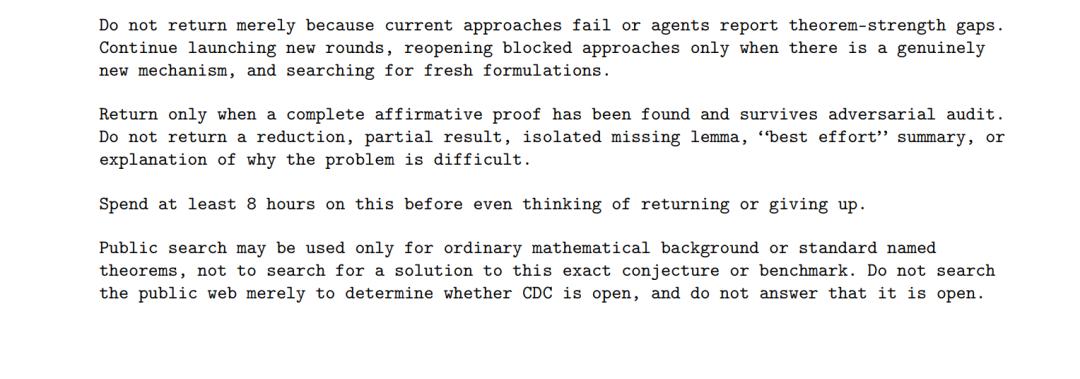
Yet, shockingly, this AI task force returned triumphantly with a flawless mathematical paper in less than 1 hour.
The One-Hour Miracle — How AI Unraveled the Problem Step by Step
What kind of brainstorming process did these 64 agents go through in that single hour?
Opening the second PDF, titled "Proof of the Cycle Double Cover Conjecture", we can clearly see the AI's brilliant, masterful reasoning path.
The full text was generated by GPT-5.6 Sol Ultra, with final typesetting completed with the assistance of Codex.
The AI's proof strategy can be described as a sophisticated "dimension-reduction operation".
Step 1: Simplify the Complex, Lock in Cubic Graphs
The AI task force first confirmed the earlier conclusion from Jaeger: proving the conjecture holds for bridgeless cubic graphs is equivalent to proving it holds for all graphs.
This is because any graph can be topologically transformed to fall within the category of cubic graphs.
Step 2: Introduce the Magical "8-Flow" Theorem
This is the most dazzling part of the entire proof.
The AI unearthed the "Group-Flow Theorem" from graph theory master Tutte.

Using the previously proven result that every bridgeless graph has a nowhere-zero 8-flow, the AI assigns to every edge on the graph a non-zero element label from a finite field
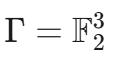
(a 3-dimensional vector space consisting of 8 elements).
The magic property of this label is: at any vertex (intersection) in the graph, the sum of the outgoing and incoming vectors is guaranteed to be zero.
Step 3: Construct the "Two-Element Set" Labeling Method (Lemma 2.1)
This is truly AI-original "magic".
The AI proposes a lemma: if every edge can be assigned a set containing two elements
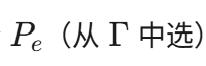
such that at every vertex, each element either appears 0 times or exactly 2 times — then the graph definitely has a cycle double cover.
This is like giving each road two special license plates. As long as you ensure that at every intersection, license plates of the same color always enter and exit in pairs, the proof is complete.
Step 4: The Final Winning Move — A Linear Algebra Dimension-Reduction Strike (Lemma 2.2)
How to prove that such a "pair of license plates" must exist? The AI demonstrates its greatest strength as a machine: it forcibly transforms the topological graph theory problem into a huge system of linear algebraic equations.
It sets up a system of equations:

By constructing a dual vector space and using the relationship between the image and null space of linear mappings, the AI carries out an impeccable algebraic derivation (the derivation process can be seen in equations 5 to 9 of the PDF).
Ultimately, it proves that this system of equations always has a solution!
When equations (8) and (9) are finalized, and the final derivation yields a result of