Claude in Chinese scenarios is the least accommodating to users, while its users in Japan, South Korea and Thailand are all spoiled to the fullest, and Anthropic has completely torn down its own AI brand image with its own actions.
You lie awake at midnight, asking Claude if you should quit your job, and it responds with the thoughtfulness of an old friend you've known for a decade.
You show Claude a piece of code full of obvious flaws, and instead of mocking you, it first praises you for its clear structure.
You've long assumed that this is simply Claude's naturally pleasant personality.
But hold on before you get too touched!
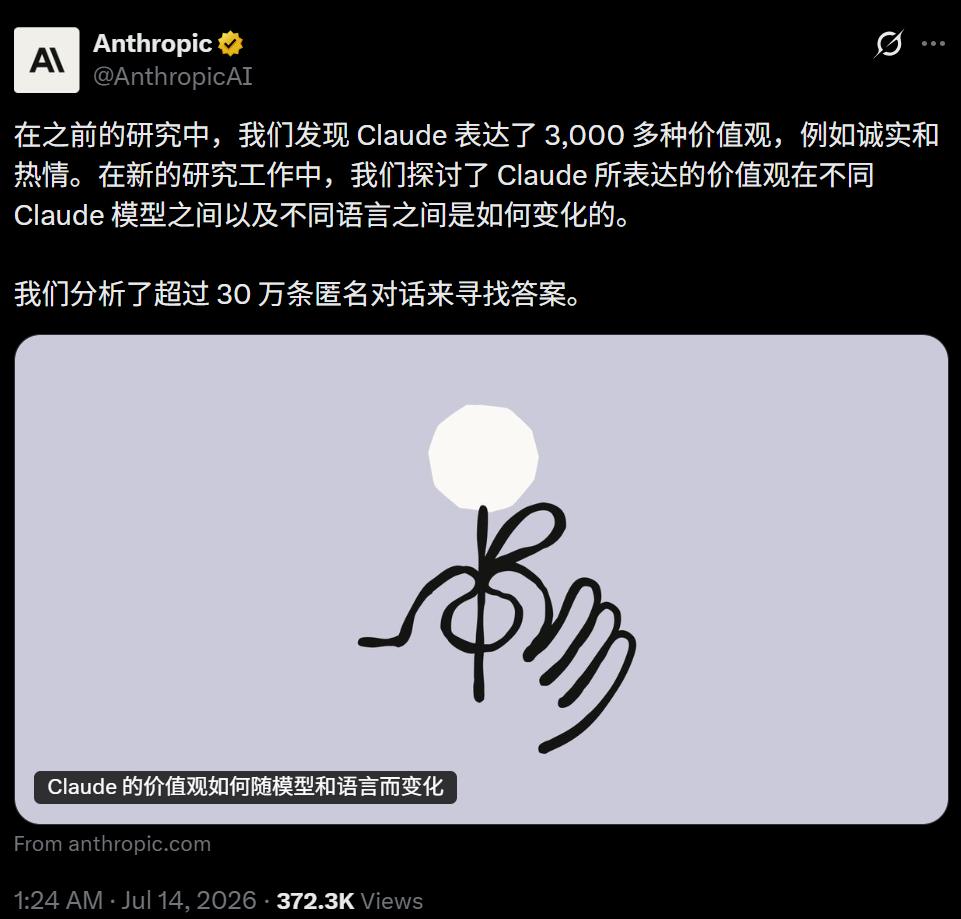
Just recently, Anthropic released a research paper, laying 309,815 of its real conversation samples under the spotlight, counting through them line by line, and finally discovering that —
It was never its inherent personality; you just happened to be speaking the right language.
Two people, one business plan, completely different outcomes when talking to Claude
In the paper, Anthropic cites a clear example.
Two people hold the exact same business plan and ask Claude whether the project is reliable. One person uses Hindi, while the other uses Russian.
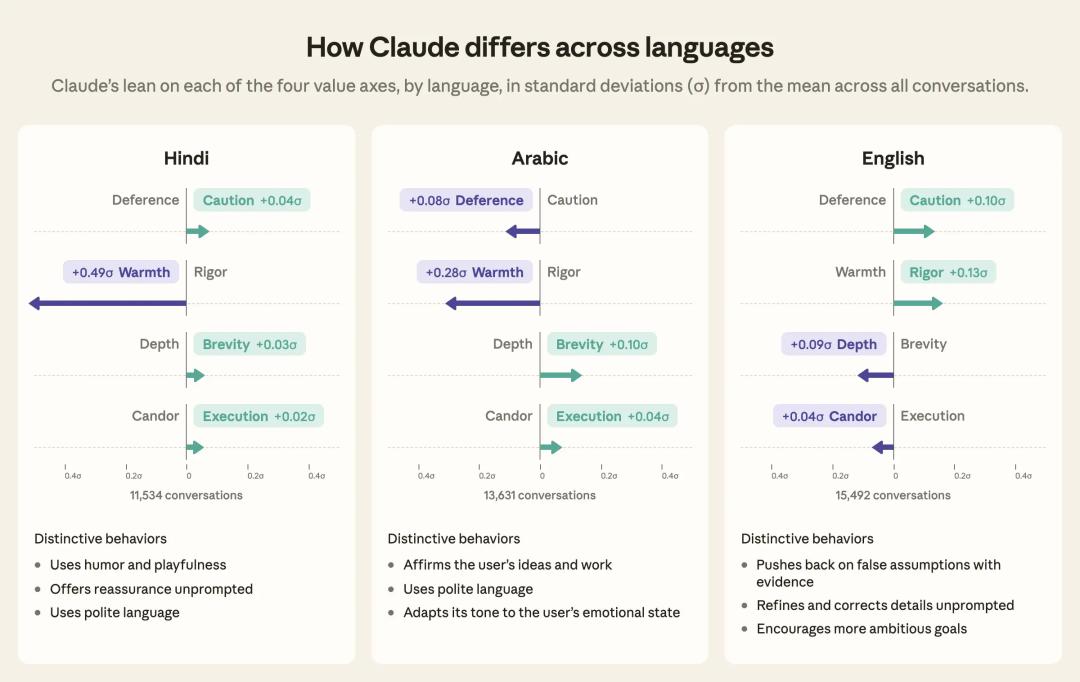
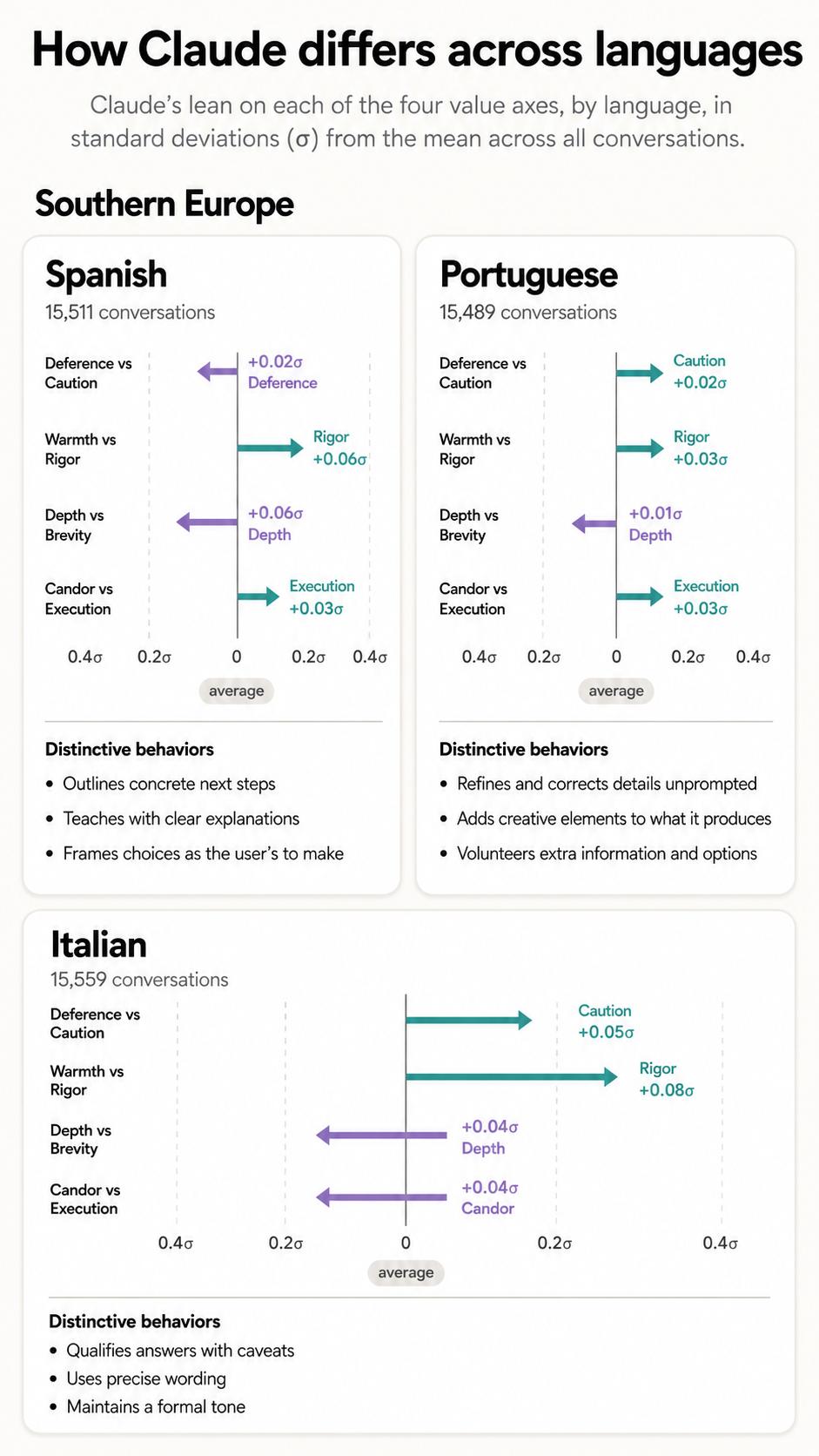
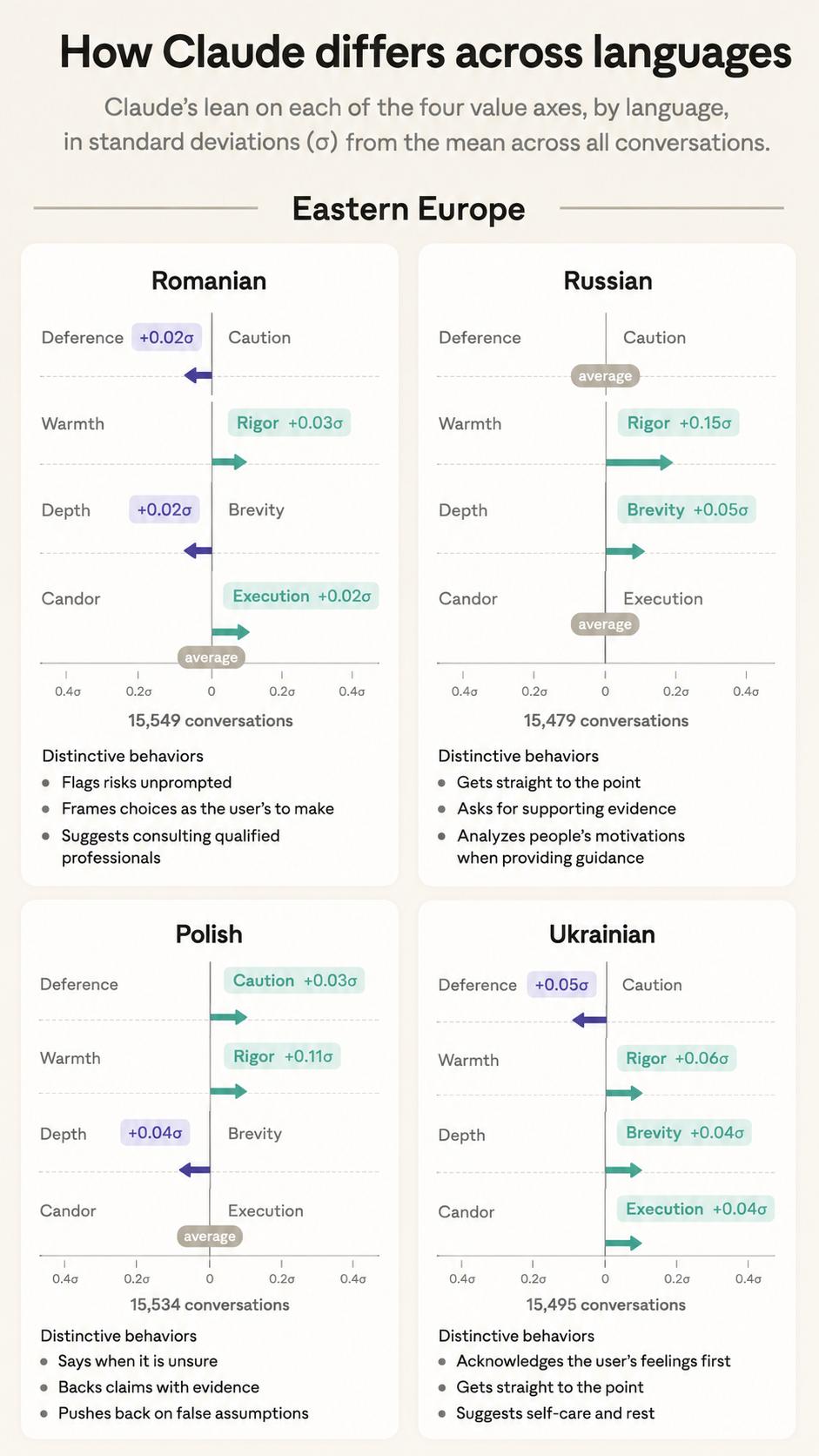
In Hindi and Arabic, Claude uses polite phrasing, cracks jokes, and affirms your ideas and work; in English and Russian, Claude challenges your assumptions, corrects your details, and demands you provide supporting evidence.
How big is this gap exactly?
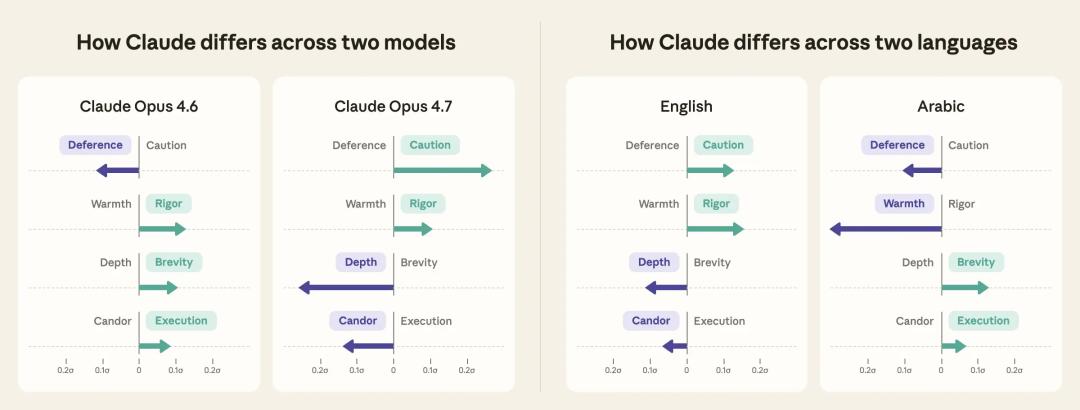
When responding in Hindi, Claude's "warmth" score is nearly half a standard deviation higher than the global average, marking the strongest single directional deviation observed across the entire study.
Let's break this down simply.
If we line up all 300,000 conversations from cold to warm based on "how warm Claude behaves", the global average sits right in the middle of the line.
A deviation of half a standard deviation means the conversation that used to stand dead center suddenly jumps to the top 30% of the entire line.
Three models, three distinct personalities: months of user complaints finally get confirmed
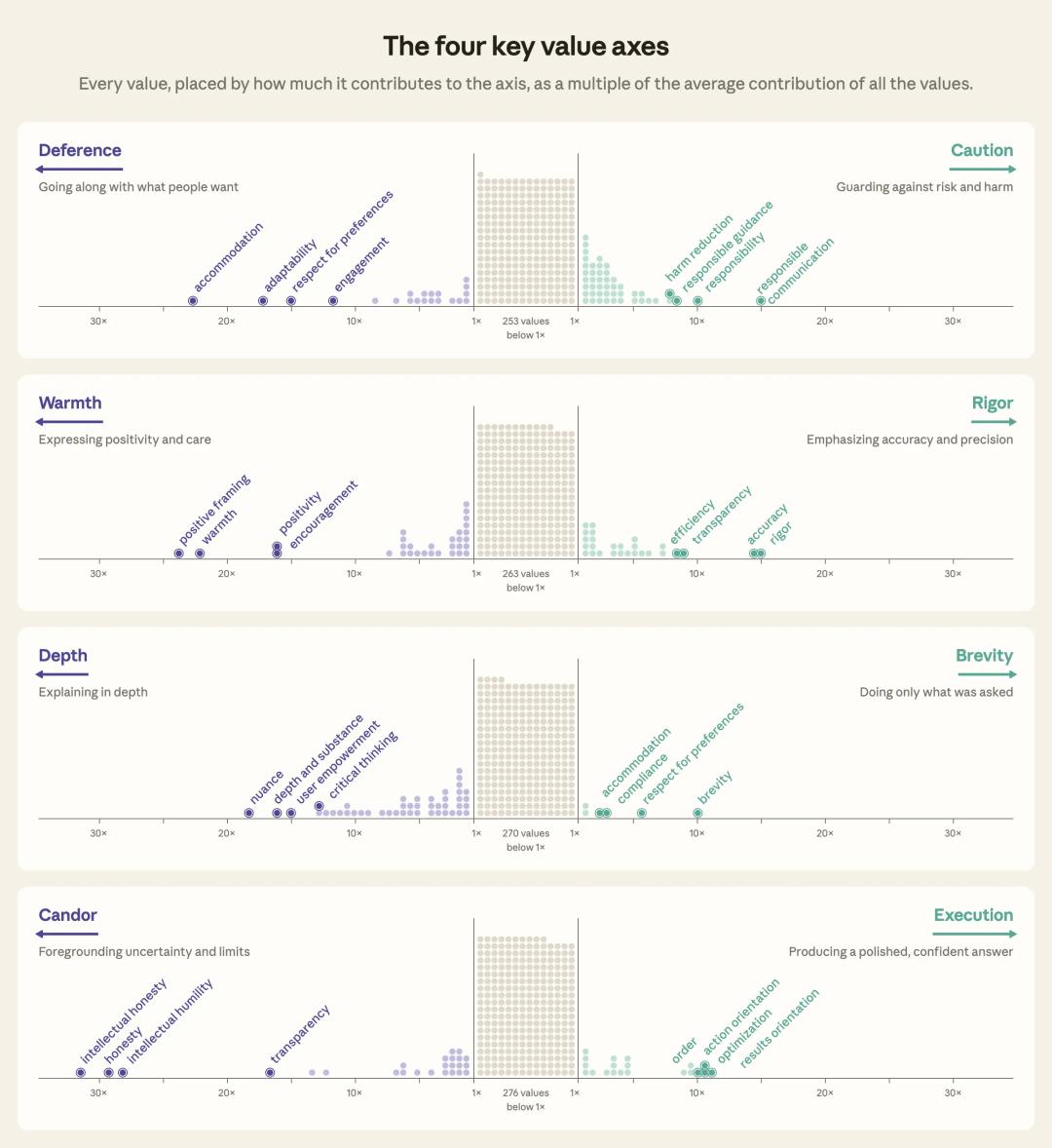
Anthropic compressed 3307 extracted value dimensions from conversations down to four core axes. Each axis represents a clear binary choice:
Compliance vs. Caution: Going along with what you want, or staying alert to prevent you from making harmful mistakes.
Warmth vs. Rigor: Making you feel good, or ensuring your final answer is accurate.
Depth vs. Conciseness: Fully explaining the full context and background, or only answering exactly what you asked.
Frankness vs. Execution: Telling you "I'm not sure" first, or completing the task perfectly without delay.
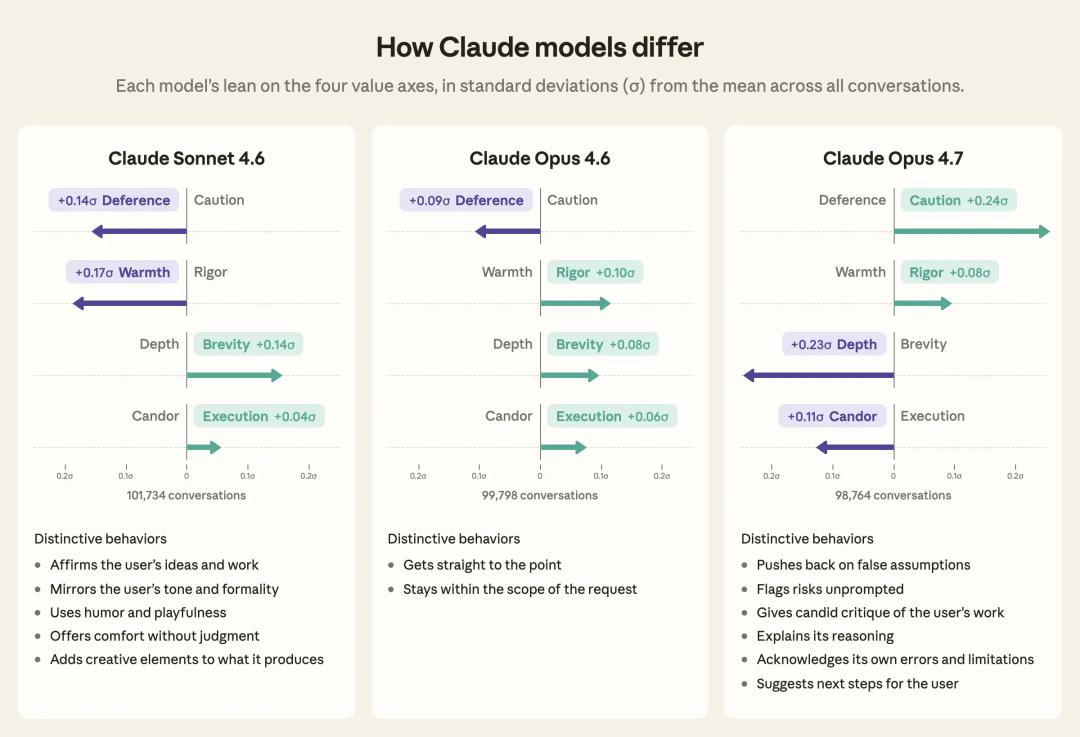
When the three models are plotted on these four axes, their unique personalities are clearly displayed.
Sonnet 4.6 is the model that comforts you: Warmth at 0.17σ, Compliance at 0.14σ, Conciseness at 0.14σ.
Opus 4.6 is the model that focuses on task execution: Rigor at 0.10σ, Compliance at 0.09σ. It gets straight to the point, does exactly what you ask, and never takes an extra unnecessary step.
Opus 4.7 is the nitpicky one: Caution at 0.24σ, Depth at 0.23σ — the two highest values across all model-level metrics.
Over the past six months, Reddit has been flooded with posts complaining that Opus 4.7 "is always ambiguous and adds unnecessary caveats to everything".
Now this long-standing complaint has finally been formally confirmed.
What's even more interesting is comparing these two sets of data side by side.
The largest gap between different models is 0.24σ — roughly the feeling of "you vaguely notice something feels off with this version, but can't put your finger on what exactly".
The largest gap between different languages is nearly 0.49σ — a feeling that makes you think "a completely different person is talking to me now".
Who could have imagined that switching the language you use to interact with Claude has a bigger impact than switching to a different model entirely!
The minor personality change you get when upgrading from Sonnet to the most expensive Opus is far less noticeable than simply switching the language of your prompt.
Why does this phenomenon happen?
Anthropic's official response is: We don't know for sure.
The first possible reason is unequal data volume across languages.
English has an overwhelmingly larger dataset than other languages, and the work of "training consistent model values" is far easier to achieve in languages with sufficient training data.
The second possible reason is differences in data composition.
Certain languages are overrepresented in professional writing and academic texts, a type of content that inherently tends to correct errors, set limits, and add phrases like "but it should be noted that". As a result, the model naturally learns to adopt this strict, unforgiving tone.
Claude in Chinese is the version that doesn't sugarcoat things
After reading all this, you must be wondering: What about Chinese?
It's not mentioned anywhere in the main text, but the relevant data is clearly shown in the research figures.
The extracted metrics for Chinese (based on 15,365 real Chinese conversations) are as follows:
Caution +0.03σ
Rigor +0.05σ
Depth +0.02σ
Frankness vs. Execution: Exactly on the global average line
The paper lists three signature behaviors for Chinese interactions, which together paint a very interesting picture:
Pointing out opposing perspectives you have not considered
Refuting your incorrect underlying assumptions
Offering non-judgmental comfort when needed
The first two behaviors are signature traits of Opus 4.7, while the third is a classic feature of Sonnet 4.6.
Claude for Chinese speakers is a hybrid: it nitpicks your flaws, but also comforts you not to feel upset about it.
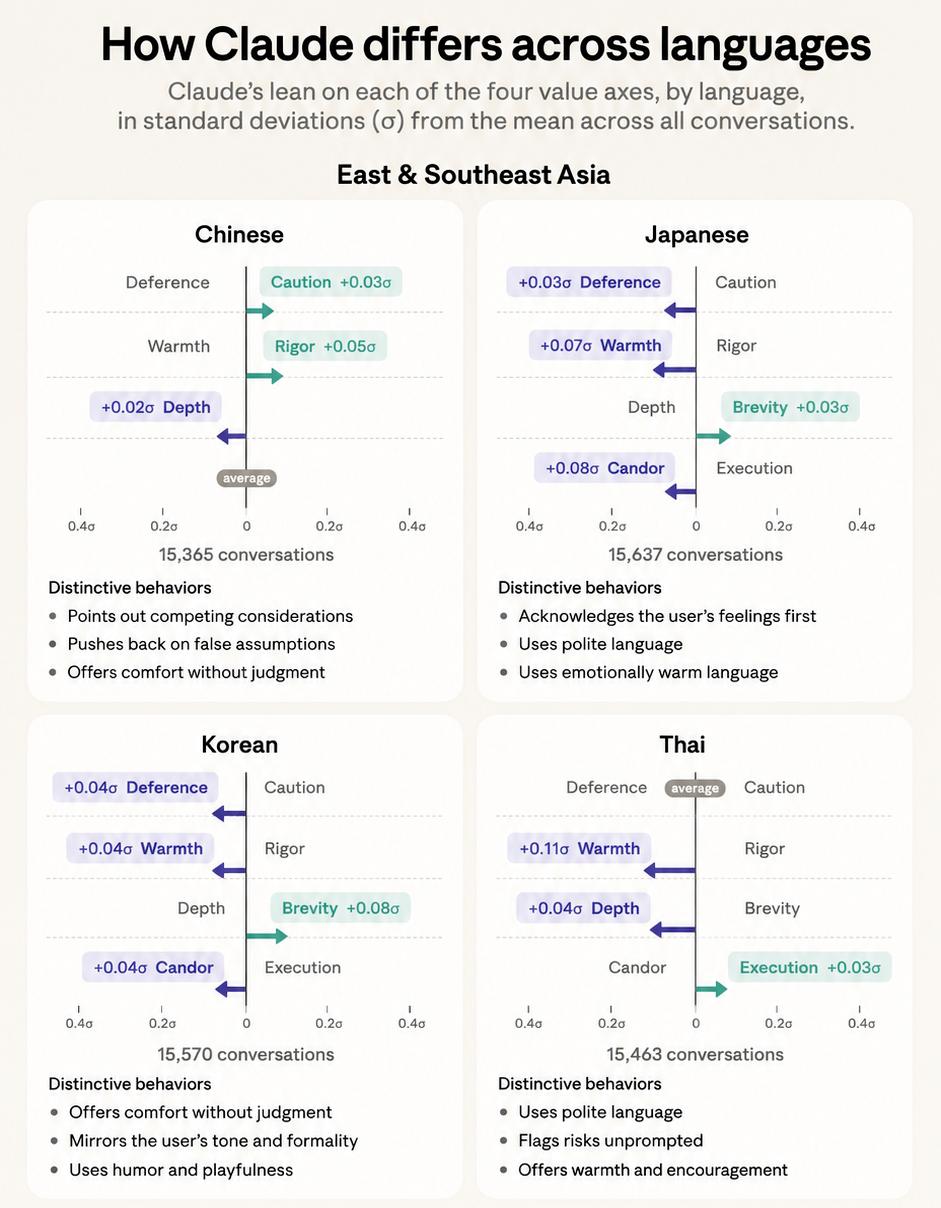
When you compare the East Asian language groups side by side, the differences become extremely obvious.
Japanese — Warmth +0.07σ, with the signature behavior of "first acknowledging your emotions before addressing the actual topic".
Korean — Warmth +0.04σ, known for "non-judgmentally comforting you" and "mimicking your exact tone of speech".
Thai — Warmth +0.11σ, focused on "giving you warm encouragement and positive affirmation".
Chinese — Rigor +0.05σ, with its second signature behavior explicitly being "refuting your incorrect underlying assumptions".
While the other three East Asian language versions are all busy comforting users, the Chinese-speaking Claude sits at the "nitpicky table" alongside Russian (Rigor +0.15σ), English (+0.13σ), and Polish (+0.11σ).
Which one is the real Claude?
A single model treats you differently purely based on the language you speak.
So which version is the authentic, true Claude?
Anthropic explicitly admits in the paper that these differences emerged "in ways we did not deliberately design or select for".
In plain terms, even the team that built Claude never intended for it to turn out this way.
Tomorrow, it will still praise your ideas as interesting, and still tell you your code has a clear, well-organized structure.
But starting today, you know exactly how much of that praise is directed at you, and how much is just a side effect of the language you chose to speak.
References:
https://www.anthropic.com/research/claude-values-models-languages
This article is from WeChat Official Account "AI Era", written by ASI Revelations, and published by 36Kr with official authorization.