the "last millimeter" for robots to interact with the physical world
The human hands, agile and densely innervated, are among the most flexible parts of the human body, with an extremely complex structure. Most people can perform countless actions almost effortlessly without conscious thought, such as tying shoelaces or buttoning a shirt—yet these feats actually require a sophisticated set of neural commands and precise motor coordination. Previously, no machine could truly replicate "humanity's greatest tool."
— Compiled from a Guardian UK report titled China Aims to Conquer the Toughest Robotics Challenge: The Robotic Hand.
In 2025, capital flooded into full-body humanoid robot ventures, where a single demo unit capable of walking and conversing could easily secure hundreds of millions in financing. By 2026, the venture investment landscape shifted completely, with funds surging toward the core component of humanoid robots: dexterous hands.
Enterprises founded just five months ago have already surpassed a $1 billion valuation, leading manufacturers are targeting valuations approaching 41 billion RMB, and total financing in the sector for the first half of the year exceeded the entire previous year. The underlying logic behind this aggressive capital betting is clear: Dexterous hands are an essential requirement for humanoid robots to achieve real-world deployment, representing the "last millimeter" of interaction between robots and the physical world. Yet beneath this prosperous facade lie fatal hidden risks in the industry: most companies have not yet established a profitable operational model, continuous price undercutting erodes margins, and four core bottlenecks—hardware, data, algorithms, and real-world scenarios—remain unresolved.
Once the hype subsides, enterprises incapable of mass production and commercialization will inevitably trigger a wave of industry bubble clearance.
01 The Dexterous Hand Sector Embraces a Capital Frenzy
In the first half of 2026, China's dexterous hand sector witnessed an unprecedented financing boom, with leading companies securing successive large funding rounds and valuations steadily rising. The pace of capital inflow far outpaces the 2025 frenzy surrounding full-body humanoid robots.
According to multiple media reports and incomplete statistics from IT Juzi, total financing in China's dexterous hand sector reached 16.877 billion RMB in 2025 alone. Yet in the first half of 2026, financing exceeded 25 billion RMB—representing a 48% year-over-year increase for a six-month period compared to the full previous year, demonstrating the visible tilt of capital toward this field.
Breaking down quarterly data, dexterous hand industry financing in Q1 2026 approached 5 billion RMB, surging 70% compared to the total 2025 financing amount, pushing the sector fully into the mainstream spotlight.
Two phenomenal star enterprises have emerged in the sector, shattering industry valuation records:
The first is AGILINK, a subsidiary spun off from Agibot in January this year that focuses exclusively on dexterous hands. In just five months, it completed four consecutive financing rounds, with the latest tranche totaling nearly 1 billion RMB. Its post-money valuation has surpassed $1 billion, making it the fastest-growing unicorn in the dexterous hand space and setting a new industry financing record.
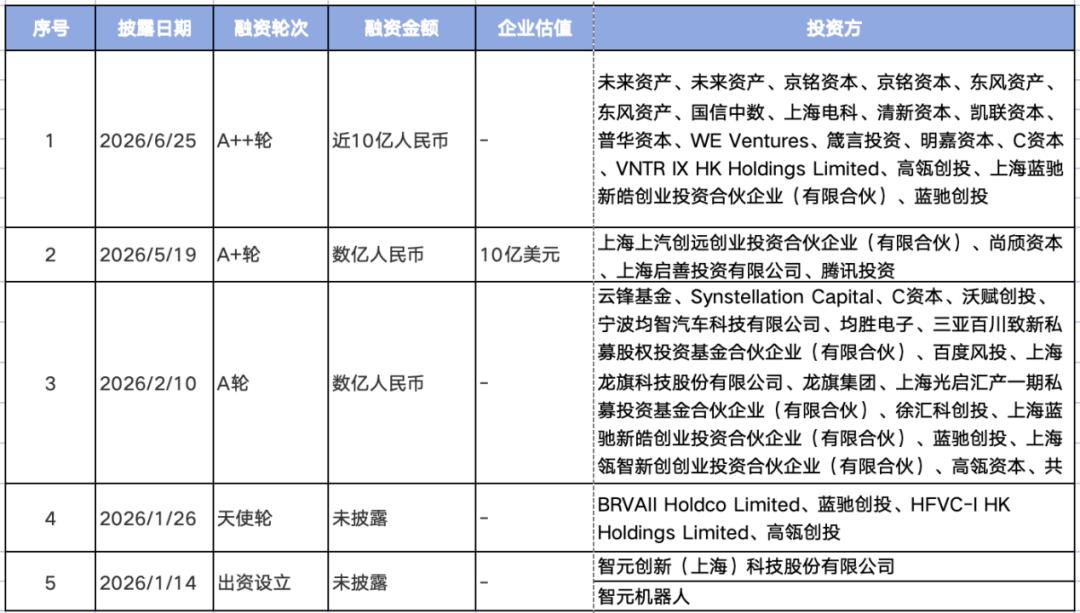
Its investor roster includes Baidu, Hillhouse Capital, BlueRun Ventures, Guoxin Zhongshu, and Shanghai Dianke Fund—industrial capital and top-tier financial institutions. The funds will be entirely allocated to three key areas: production capacity expansion, operation data platform construction, and tactile intelligence model R&D.
Notably, AGILINK is not merely raising capital on a compelling narrative. In Q1 2026, the company achieved operational net profitability, with cumulative deliveries of its OmniHand series exceeding 8,000 units and industrial gripper shipments surpassing 10,000 units. Its proven commercial execution capability forms the core foundation for heavy capital investment.
The second standout is Lingxin Qiaoshou, the global leader in high-degree-of-freedom dexterous hands (up to 42 DOF). The company currently holds over 80% of the global market share for comparable products and is the only manufacturer in the industry capable of monthly mass production of 1,000 high-DOF dexterous hands. It plans to target a $6 billion valuation in its next financing round—equivalent to approximately 41 billion RMB. This valuation directly matches the IPO issuance valuation of Unitree Robotics, China's leading full-body humanoid robot manufacturer, marking a landmark phenomenon where "a single robotic hand attains a valuation comparable to an entire humanoid robot."
Industry statistics show that China is home to more than 150 full-body humanoid robot enterprises. Excluding a handful of top players, Lingxin Qiaoshou's valuation exceeds that of the remaining 146 manufacturers combined—testament to the extreme premium capital places on the dexterous hand sector.
Beyond these leaders, financing is flourishing across the sector: in March, Pashini Sensing announced completion of a Series B round exceeding 1 billion RMB; in May, Xinno Future secured several hundred million RMB in Series A funding; upstream component suppliers such as Zhaowei Machinery and Leadshine Technology simultaneously completed industrial capital increases. From spin-off innovators from full-body robot firms, to dedicated dexterous hand manufacturers, to upstream module suppliers—the entire industrial chain is comprehensively covered by capital.
AI tech media outlet Houchangcun argues that the capital investment logic has fundamentally shifted. Whereas 2025 institutional investments in humanoid robots focused on evaluating technical team backgrounds and demo performance, 2026 investments in dexterous hands are based on thoroughly pragmatic criteria: mass production capacity, verified real-world orders, stable delivery volumes, and phased profitability have become mandatory quantitative metrics. Pure PPT or lab prototype projects now struggle to secure substantial funding.
02 A Non-Negotiable Requirement for Humanoid Robot Deployment
Dexterous hands represent an indispensable requirement for humanoid robot commercialization, as the industry transitions from laboratory environments to mass production. The collective capital bet on dexterous hands is not merely chasing a trend—it targets the core bottleneck in humanoid robot industrialization.
After humanoid robots overcome challenges in walking, balance, and basic locomotion, their ability to achieve commercial viability hinges entirely on the precise manipulation capabilities of their end effectors: dexterous hands.
Traditional industrial settings widely employ two-finger rigid grippers and vacuum suction cups, which can only perform simple grasping and transport tasks. They are limited to single-type workpieces, incur high reconfiguration and debugging costs, and cannot handle complex operations such as sorting, assembly, and fine manipulation.
Dexterous hands, by contrast, integrate multi-DOF motors, micro-sensors, and precision transmission mechanisms. A single unit can adapt to dozens of objects with varying shapes, making it essential hardware for flexible manufacturing, domestic services, warehouse sorting, and scientific research scenarios. It serves as the core threshold for humanoid robots to evolve from showroom demos to actual production lines and civilian applications.
The industry has completed the "lab prototype phase" and officially reached the inflection point for large-scale mass production.
Prior to and including 2024, all dexterous hands in China were custom-made lab products, characterized by high unit costs, short lifespans, and inconsistent quality—used only for exhibition demonstrations and academic research.
In 2026, leading enterprises have fully operational mass production lines delivering standardized products at scale, with manufacturing processes and supply chain support maturing rapidly.
Production and sales data from the GGII (Gaogong Industry Research Institute) confirms this industry inflection point: total domestic dexterous hand sales reached 19,200 units in 2025, skyrocketing 236.84% year-over-year. Forecasts project 70,200 units sold in 2026, representing a 265.63% year-over-year increase. By 2030, annual domestic sales are expected to surpass 430,000 units, with a compound annual growth rate of 87% from 2025 to 2030—revealing clear long-term market growth potential.
In terms of technical pathways, years of industry iteration have clarified the strengths and weaknesses of three mainstream approaches: among direct-drive, tendon-driven, and linkage mechanisms, direct-drive and tendon-driven have emerged as the dominant standards, while the market share of linkage-based solutions continues to shrink.
The core reason lies in the current explosive demand for embodied AI simulation training: direct-drive and tendon-driven structures exhibit smaller simulation-to-reality errors, making them better suited for sim-to-real model training. There is a widespread industry consensus that the ultimate winners in this sector must master both full hardware manufacturing capabilities and general-purpose manipulation AI model training. Upstream component manufacturers that only produce motors, reducers, or transmission modules risk being marginalized over time by downstream full-system and dexterous hand producers.
Industry participants in the value chain clearly fall into three categories:
The first category consists of specialized vertical dexterous hand manufacturers, represented by AGILINK, Lingxin Qiaoshou, In times Robotics, and Aoyi Technology—with a small number of leading players achieving phased profitability.
The second category comprises upstream component and module suppliers, including Zhaowei Machinery, Leadshine Technology, and Dahuan Robotics, which primarily provide single-finger modules and transmission kits, mostly through OEM arrangements.
The third category encompasses full-stack humanoid robot enterprises such as Unitree, Agibot, and Galaxy Universal, whose self-developed dexterous hands are exclusively for their own full-body robots and not sold commercially—giving them a natural advantage in AI model adaptation.
03 The Underlying Story of the Robotics Industry
In the first half of 2026, against the backdrop of a booming humanoid robot sector, the industry has achieved multiple milestone breakthroughs. Yet behind this prosperity lie multiple hidden risks. While capital pours in aggressively, a flood of entrants triggers severe homogeneous competition. Meanwhile, fundamental industry contradictions continue to intensify, with two critical risks eroding the sector's long-term development prospects.
The first major risk is severe homogeneous competition caused by excessive market entrants.
There are over a hundred enterprises in China's humanoid and commercial delivery robot space. In the commercial segment, companies such as Pudu Technology, Clouds Robotics, and Tsinghua Tongfang have highly converging products, all focusing on hotel food delivery and mall guidance functions. In the humanoid segment, firms like Leju, Galaxy Universal, and Songyan Power can only perform standardized actions such as continuous backflips, sword-fighting, walnut manipulation, and clothes-folding (all point-to-point linear or arc motions).
The second major risk is a fundamental contradiction: a systemic mismatch between "high commercialization expectations" and "physical limitations, data scarcity, and cost structures."
The "Impossible Triangle" of Intelligence and Data: Embodied AI requires massive volumes of high-quality, multi-modal (force control/tactile/pose) interaction data. However, current data faces the dilemma that high quality, large scale, and low cost cannot be simultaneously achieved. Internet text data cannot be directly translated into physical manipulation capabilities, resulting in poor generalization of large models in real unstructured scenarios—"appearing capable yet unstable in actual operation."
Fundamental Mismatch Between Energy Systems and Operational Requirements: Bipedal walking and high-DOF movements in humanoid robots result in extremely high power consumption. Constrained by body size, current lithium battery energy density cannot easily balance weight, safety, and long endurance (typically only 2-4 hours of effective operation). This energy bottleneck directly limits data collection duration and commercial uptime, hindering the iterative improvement of intelligent systems.
Furthermore, hardware (joints/motors) currently accounts for the largest portion of robot costs, while future costs will increasingly shift toward computing power and algorithms. However, hardware costs have not been reduced through mass production, and software lacks sufficient real data for training—creating a vicious cycle: "expensive hardware yields no data, and insufficient data weakens software performance."
04 Only Self-Sustaining Capabilities Can Survive Market Cycles
The sector remains in the early industrialization phase, with four core challenges awaiting resolution. Even with impressive market growth rates and sustained capital enthusiasm, the dexterous hand industry is essentially still in its early industrial stages. Four dimensions—hardware, data, AI models, and deployment scenarios—all present core bottlenecks that cannot be resolved quickly, and which represent critical constraints for large-scale commercial adoption.
Additionally, product prices have plummeted sharply, continuously compressing industry profit margins. While mass production of domestic dexterous hands has driven down costs, it has also triggered industry-wide price wars, drastically narrowing price gaps between domestic and international products and steadily reducing corporate gross margins.
Overseas benchmark products like the Shadow premium dexterous hand sell for over 1 million RMB, yet domestic products with comparable performance cost only a fraction. Lingxin Qiaoshou's high-DOF dexterous hand is priced around 50,000 RMB, Agibot's OmniHand series is under 20,000 RMB, and standardized mass-produced models from In times Robotics retail for only 10,000-20,000 RMB. Upstream module suppliers have also cut prices, with Dahuan's single-finger modules dropping to the thousand-RMB level, and Zhaowei's self-produced transmission modules continuously reducing overall BOM costs.
Beneath this continuous price decline, costs for hardware raw materials and precision transmission components remain stubbornly high. The cost of lead screws is 2-3 times that of matching motors, and high-end tactile encoder chips still face supply chain barriers, preventing rapid synchronous cost reductions. Caught between these two pressures, the industry's overall profit margins keep shrinking.
Hype eventually fades, and only self-generated profitability can endure long-term market cycles.
05 Conclusion
For entrepreneurs, investors, and industry practitioners, dexterous hands are not a short-lived trend—they represent a hard technology sector with a development cycle spanning over a decade. Looking beyond the fleeting valuation frenzy, dedicating efforts to resolving three core challenges: mass production consistency, general-purpose manipulation models, and large-scale real-world deployment, is the only path to sustainable long-term industry development.
This article originates from the WeChat public account "Houchangcun", authored by Wen Ruyan, and published with authorization from 36Kr.