From being ignored by all to getting an investment from the "Queen of Venture Capital", has AI revitalized this extremely niche track?
In March 2023, Genie, former Product Director of WeChat, published a farewell letter on her official account. She stated that Huayin would soon cease maintenance, saying, "This is an extremely painful decision for us, but we have to face reality."
Huayin was no unknown player. Its founder, Lin Yaqian Genie, was a core member of the WeChat team and reportedly the only female product manager at Tencent's P4 (expert) level.
Just a few years after Huayin shut down, the social track virtually "disappeared without a trace" in the venture capital circle.
The cold data from IT Juzi speaks for itself:
In 2023, financing events in China's social sector plummeted off a cliff, with top-tier dollar funds almost entirely ceasing to review social projects. Soul repeatedly failed in its IPO attempts, while both Tantan and Momo saw stagnant growth. The industry consensus was that "no one is investing in social anymore."
However, this past July, an AI dating company called "Liangpei" secured a $2 million angel round from Capital Today, led by "Queen of Venture Capital" Xu Xin. This marked a rare new investment from Xu Xin after a three-year hiatus in the social track.
Meanwhile, market rumors claimed that Pixel Rhythm, a company founded by You Zhehao, former head of social products at Douyin, had also secured backing from Sequoia China and IDG Capital. (We will reveal whether this information is reliable later.)
So what exactly has the social track been through in recent years? Are those social projects that once received heavy bets from prominent VCs still alive?
Even Zhang Xiaolong's protégé failed in social entrepreneurship
Huayin's story started with great promise. Founder Genie was an early product director at WeChat, where she spent eight years participating in the design of core products including Official Accounts and Mini Programs.
In 2018, she left WeChat to start her own business, aiming to create a "video version of WeChat" — transforming daily chats, shares, and Moments into a fully video-based format. She believed that in the 5G era, text and images would eventually become obsolete, and video would become the most natural way for people to communicate.
That same year, BAI Capital exclusively invested tens of millions of dollars in its Series A round, followed by a Series B round led by China Renaissance and Trustbridge Partners in 2021. Huayin's product was genuinely exquisite, with video calls, video moments, and video group chats — every feature exuded the restraint and meticulousness characteristic of the WeChat team's craftsmanship.
However, the barriers to video social are extremely high.
Not everyone is willing to turn on their camera at any moment, and not every message is worth recording as a video.
While Huayin's daily retention rates looked impressive, user activity never picked up, and customer acquisition costs were staggering. More fatally, it could not find a viable monetization model. Memberships? Advertising? Social e-commerce? None of them worked out.
In March 2023, Huayin announced it would cease operations. Genie wrote in her farewell letter: "We overestimated users' acceptance of video social, and underestimated the inertia of WeChat."
There was another social project called "Single Tavern" that once received financing, only to end in disillusionment.
Founder Chen Yilong had previously worked as a social product manager at Tencent and Momo before starting his business in September 2020. His idea was clever: instead of building an online swiping-based stranger social app, he created an "online-offline integrated" model — users booked taverns through the app, chatted online, and met in person once they hit it off.
This "heavy offline" model was once highly favored. In December 2021, the team officially announced it had secured a multimillion-dollar Pre-A round from GGV Capital.
But this financing quickly turned out to be a misunderstanding.
GGV later stated that "Single Tavern" was not on its portfolio list, noting that the investment came from "a startup invested long ago by a now-departed investor," and that the investment amount and product name did not match the official announcement.
In 2022, Single Tavern rebranded as "Vitality Tavern" and relaunched, but no further financing news emerged afterward. Currently, the app cannot be found on major app stores, with its last update on the App Store dating back to March 2025.
From this, we can almost draw a harsh conclusion: in the field of acquaintance social and deep friendship building, WeChat's moat is deeper than anyone imagined. Many social apps end up doing the groundwork for WeChat, ultimately unable to avoid being replaced.
The bubble of niche trends: Metaverse, women-focused, and Muslim community platforms failed to achieve large-scale growth
From 2021 to 2022, a number of more niche social projects raised funds, attempting to find gaps among specific user groups and scenarios.
In October 2021, Metaverse social company Metaverse Z completed a multimillion-dollar angel round and Pre-A round, with Matrix Partners China, Sinovation Ventures, and Qingrui Ventures all participating. In July 2022, it secured another multimillion-dollar Series A round led by Ventech China.
Its pitch was metaverse social for global Gen Z users, allowing them to chat, play games, and attend parties using avatars in a 3D world.
At the time, the metaverse concept was red-hot, and Roblox's market value skyrocketed. But the metaverse tide receded faster than expected.
After 2023, the Web3 and NFT narratives collapsed. Metaverse Z's monthly active users plateaued at 700,000, concentrated in emerging markets such as Latin America, where users had low willingness to pay, leaving the company reliant on ad revenue. No further financing news has been disclosed since.
In June 2022, Huancheng Interactive Entertainment raised tens of millions of yuan in its Pre-A round. Its core product, Gamfun, was an entertainment community built around voice social, integrating interactive games, voice chats, and live streaming, primarily targeting Muslim users in the Middle East and North Africa.
The platform has accumulated over 10 million registered users, with around 50,000 MAUs, generating revenue mainly through live stream gifting and in-game items. The company is also venturing into short drama exports, but no subsequent public financing has been announced.
There was also "Yuexin Qingxin", a female audio community invested by Sequoia Seed Fund in 2022, which became a typical representative of women-focused communities at the time. However, according to business registration information, Beijing Yuexin Qingxin Technology Co., Ltd. was deregistered in June 2025, indicating the company has most likely ceased operations.
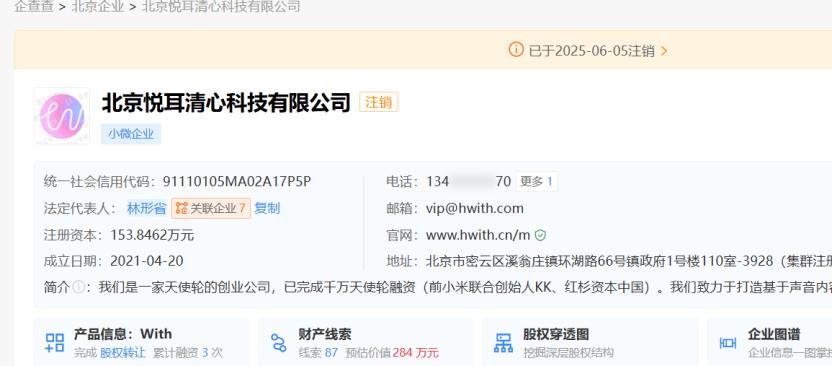
Notably, Sequoia exited early two years ago. Before the deregistration, in September 2024, Sequoia China transferred its 4% equity stake in the company to Beijing Chengyi Culture Media Co., Ltd., with the transaction amount undisclosed.
Other projects included "Xunyuanshuo" invested by MiraclePlus, which targeted the niche scenario of parents arranging blind dates for their children; "Qishui'er" audio social co-invested by BAI and Matrix Partners; and "Mars App" for young users. Most of these projects remained at the seed or angel stage, with no subsequent public financing, and their operational status is unclear.
The common trait of these projects is that they identified real demands and corresponding target user groups, but failed to validate a sustainable, scalable monetization model, nor did they build product moats. Capital was willing to provide one round of funding to test ideas, but once the path to large-scale growth appeared slim, investors walked away.
Frozen for three years, top VCs barely invest in social anymore
From the second half of 2022 to 2025, the social track entered a long freeze period, with almost no well-known institutions making moves in the social sector. This was not due to a lack of capital, but because the earlier lessons were too painful.
Soul failed its three IPO attempts, Tantan's MAUs continued to decline, and Momo became increasingly detached from its social roots after pivoting to live streaming. The entire industry was asking: if WeChat already satisfies acquaintance social, Douyin satisfies entertainment social, and Soul satisfies stranger social, what room is left for new players?
The traffic business of general social ultimately leads to winner-takes-all outcomes.
Customer acquisition costs for new apps are rising, user time is becoming more fragmented, and the regulatory environment is growing stricter. Social products involve user-generated content, real-name authentication, and minor protection, resulting in inherently high compliance costs.
For VCs, investing in social offers too low a return on effort — the same capital invested in AI foundational models or hard technology yields far clearer return projections.
AI social is not a "revival" but a "rebirth"?
But this year, the tide suddenly shifted. In July, Liangpei Technology secured a $2 million angel round from Capital Today.
Founder Zeng Xunxun was a 2012 undergraduate in the Computer Science Department at Southern University of Science and Technology. During his studies, he took a leave of absence to start a food delivery business, which achieved tens of millions of yuan in revenue. After returning to school, he joined Tencent with a special offer, working in the WeChat Search team and the TikTok Service Architecture team, before later joining Moonshot AI as head of AI search R&D.
In August 2025, he left his job to start his own business, developing the Liangpei Mini Program.
His motivation for creating Liangpei was deeply personal. Frustration after repeated setbacks on dating apps made him realize how crude the matching logic of traditional dating platforms was — relying on a few photos and a handful of tags, the probability and efficiency of finding a suitable partner was extremely low.
Liangpei's approach is to use AI to create user profiles through conversational interactions.
Users do not need to manually fill in information; the AI conducts in-depth Q&A covering dimensions such as personality, daily routines, consumption views, and family values to generate precise user portraits. The AI can also proactively initiate ice-breaking chats, provide emotional support, and even filter fake accounts.
The payment model is also counterintuitive — instead of charging based on membership subscription duration, users pay based on matching results. This represents a complete break from traditional dating platforms, where users only need to pay after successfully matching with a suitable partner.
The initial team had only seven members, scattered across five cities. Zeng Xunxun gathered everyone in Shenzhen within a month to work full-time on the project.
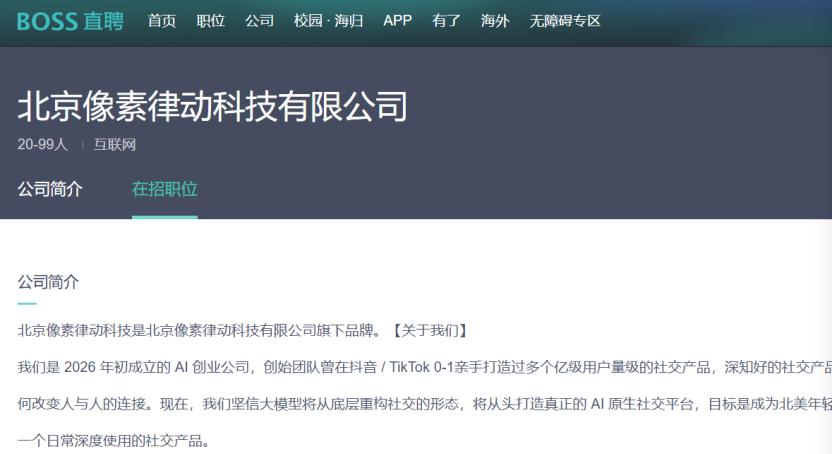
Additionally, You Zhehao, founder of Pixel Rhythm, is reportedly a post-95s former social product team lead at Douyin. He is building an overseas multi-modal social platform targeting young Gen Z users in North America, using AI to lower the barriers to creating social content.
This year, Pixel Rhythm also announced it had received investment from Sequoia China and IDG Capital. However, when IT Juzi reached out to both institutions for confirmation, neither provided a clear verification, leaving the authenticity of the investment news in doubt.
There is also a more niche project called Moobius.
In September 2023, it secured a $1 million angel round from MiraclePlus and Weilie Capital, founded by Chen Chunyu. Moobius positions itself as an AI-native group chat tool, attempting to solve group chat pain points with AI.
The common trait of these three projects is their commitment to using AI to solve specific, real pain points: Liangpei addresses "inaccurate matching + fake information", Pixel Rhythm tackles "high content creation barriers for overseas Gen Z", and Moobius solves "group chat information overload and inefficiency".
They aim to activate the social user market by targeting niche user groups with high willingness to pay, combined with AI-driven efficiency improvements.
Rather than saying AI has reignited social, it is more accurate to say a new track has been born — social products are shifting from platform ambitions to tool positioning, and investment logic is evolving from traffic-driven to pain point-driven.
Over the past five years, many failed social projects tried to build "cooler" social apps, innovating on interaction forms such as video, audio, and the metaverse. But the traffic business ultimately leads to winner-takes-all outcomes, with WeChat, Douyin, and Soul already locking up every ecological niche.
Therefore, the surviving projects and those that can secure funding in the future must find small breakthroughs: instead of targeting all users, they focus on niche groups; instead of pursuing full-featured platforms, they use AI to solve specific social pain points and monetize accordingly.
For those small, high-quality vertical social products, finding a clear positioning, staying operational, achieving profitability, and maintaining healthy cash flow are far more important than securing financing.
This article is from the WeChat Official Account "IT Juzi" (ID: itjuzi521), written by Wu Meimei, republished with authorization from 36Kr.