"We Must Act Now": 16 Nobel Laureates and Nearly 200 Scholars Jointly Warn That AI May Cause Mass Job Losses
In the past few years, discussions over whether AI will replace human jobs have never ceased. But this time, the warnings are no longer coming solely from tech company CEOs—they are being voiced by some of the most influential figures from the technology sector and the field of economics.
Recently, nearly 200 economists, AI researchers, and tech industry professionals jointly signed an open letter titled We Must Act Now, calling on governments around the world to prepare as soon as possible for the upcoming economic transformations brought by AI.
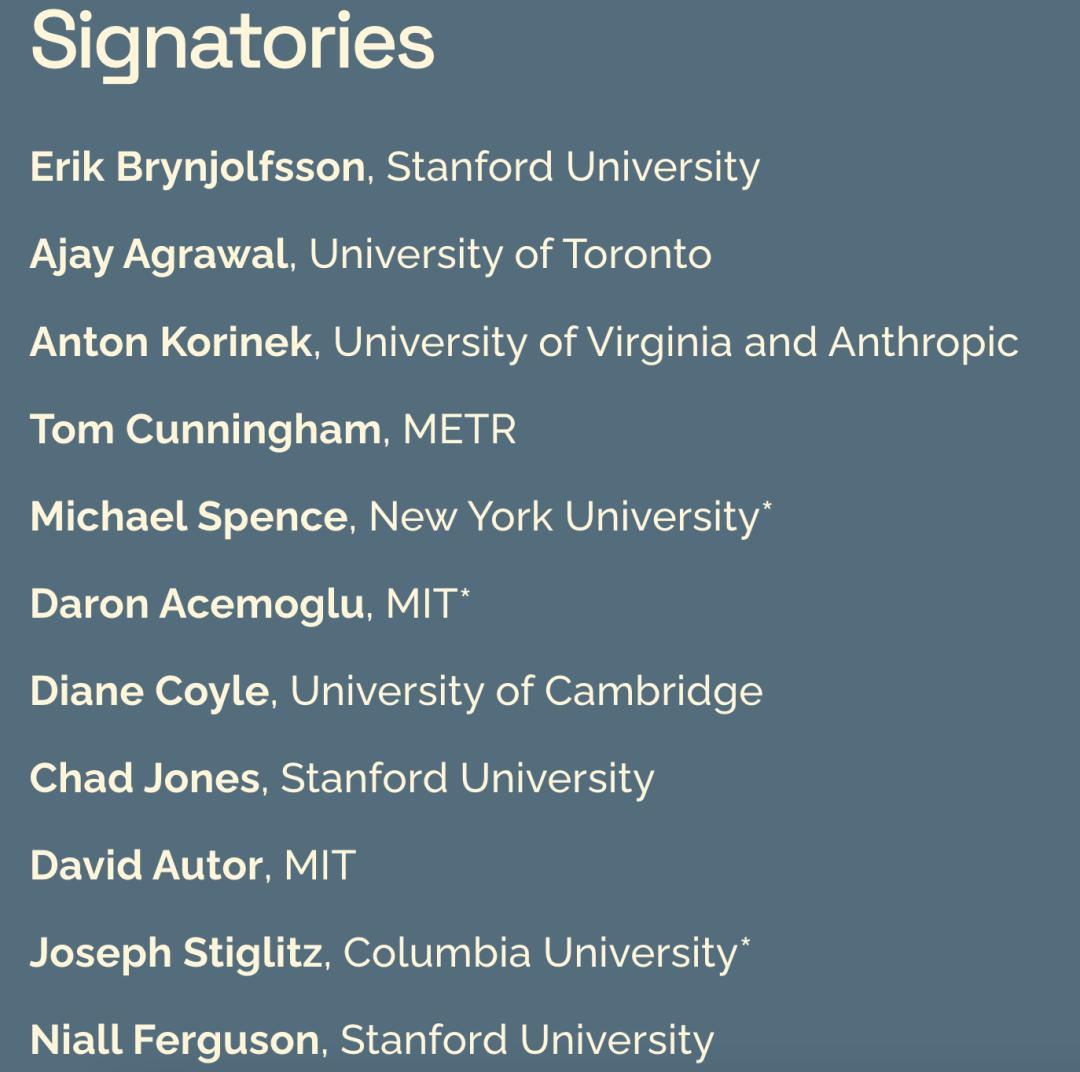
The signatories include 16 Nobel laureates in Economics, former Google CEO Eric Schmidt, OpenAI Chief Economist Ronnie Chatterji, Anthropic co-founder Jack Clark, prominent investor Vinod Khosla, and Stanford University economist Erik Brynjolfsson, among others.
Compared to past AI risk warnings that came primarily from the tech industry, the most notable aspect of this open letter is that a growing number of economists are beginning to re-examine AI's impact on employment and the economy.
The open letter points out that in the next decade, the capabilities of artificial intelligence may achieve leapfrog growth, driving an unprecedented economic transformation. Its impact could even surpass that of the Industrial Revolution, but it will unfold at a far faster pace.
From the signatories' perspective, this transformation could both lead to the displacement of large numbers of jobs and create historic opportunities to significantly improve living standards.
Therefore, they call for economists, policymakers, and the technology industry to jointly study the economic impacts brought by "Transformative AI," establish new incentive mechanisms, regulatory frameworks, and institutional systems, and guide AI to complement human capabilities rather than simply replace human labor.
It is worth noting that this open letter does not put forward specific policy recommendations; it is more like a global early warning, reminding all countries to start their preparations as soon as possible.
However, what deserves more attention than the content of the open letter itself is the shift in the signatories' stance.
For a long time, the economics community has generally believed that although new technologies will eliminate some jobs, they will eventually create new employment opportunities. From the First Industrial Revolution and the Electrification Era to the Internet Revolution, the labor market has gone through painful adjustment phases, but ultimately rebalanced with restored total employment and sustained economic growth.
As a result, many economists previously assumed that AI's impact on employment would most likely follow a similar pattern.
Yet this judgment is now changing.
Erik Brynjolfsson, the Jerry Yang and Akiko Yamazaki Professor at Stanford University and Director of the Stanford Digital Economy Lab, stated:
The pace at which AI's capabilities are advancing has far outstripped our understanding of its economic impacts. It is precisely within this gap in understanding that the greatest opportunities of our era lie. We must act immediately to guide AI to complement human capabilities rather than merely imitate them; and to ensure that the prosperity created by AI benefits the vast majority, not just a small few.
Nobel laureate in Economics and NYU Professor Emeritus Michael Spence stated:
The advances in AI are unprecedented in their scale, reach, and speed of development. At the same time, there remains enormous uncertainty over how much impact it will have across all sectors of the economy and when that impact will materialize. Therefore, concerted efforts from all sectors of society are now needed to steer AI in a direction that truly benefits the public good.
University of Virginia Professor Anton Korinek, who is currently affiliated with Anthropic, stated:
The steam engine, electricity, and computers all gave society decades to adapt; AI, by contrast, may leave us with only a few short years. We cannot wait until the transformation has already arrived to cobble together response strategies and institutional frameworks. Acting only after everything is certain will almost always be too late.
From the signatories' point of view, the real question to discuss now is no longer whether AI will transform the economy, but how to ensure that this transformation ultimately serves the majority, rather than benefiting only a select few.
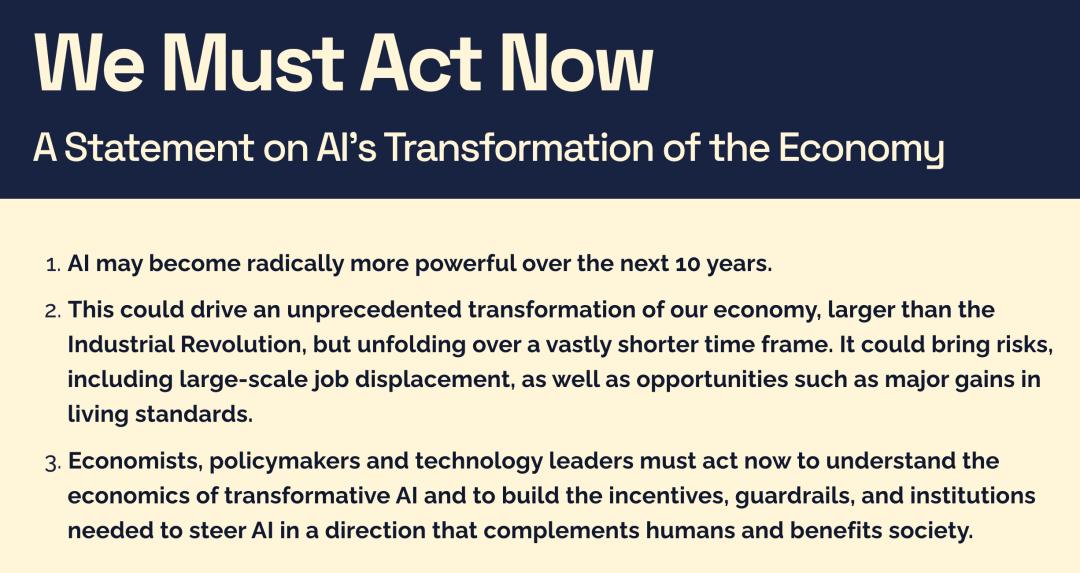
The full text of the open letter is as follows:
Joint Statement on AI and the Remaking of the Economy
1. Over the next 10 years, the capabilities of artificial intelligence could advance by leaps and bounds.
2. This could drive an unprecedented economic transformation whose impacts could exceed those of the Industrial Revolution, but happen far more quickly. This transformation could bring risks such as large-scale job displacement, as well as unprecedented opportunities to dramatically improve living standards.
3. Economists, policymakers, and technology leaders must act now to deepen their understanding of the economic impacts of Transformative AI, and put in place appropriate incentives, safety guardrails, and institutions to steer AI in directions that complement human capabilities and benefit society as a whole.
References:
https://www.wemustactnow.ai/
https://digitaleconomy.stanford.edu/news/wemustactnow/
This article is sourced from the WeChat public account "CSDN", authored by Tu Min, and republished with authorization from 36Kr.