GPT-5.6 Sol has suddenly become much less capable overnight, with its thinking budget cut from 960 to 128 — are there no models with fixed, consistent intelligence anymore?
The entire internet is saying that GPT-5.6 Sol's Max mode has gotten dumber, but OpenAI insists there's no "nerfing" — they claim it was just "running an experiment." During that test, a hidden dial was turned, dropping the Max setting's juice value from 960 to 128, a change completely invisible to users.
Woke up to find GPT-5.6 Sol had clearly gotten less sharp!
A Japanese market research team barely started their workday when they noticed something very wrong with their Codex Sol MAX instance. The team lead wrote up a full account of their morning experience and posted it as a long thread on Reddit's r/codex community.
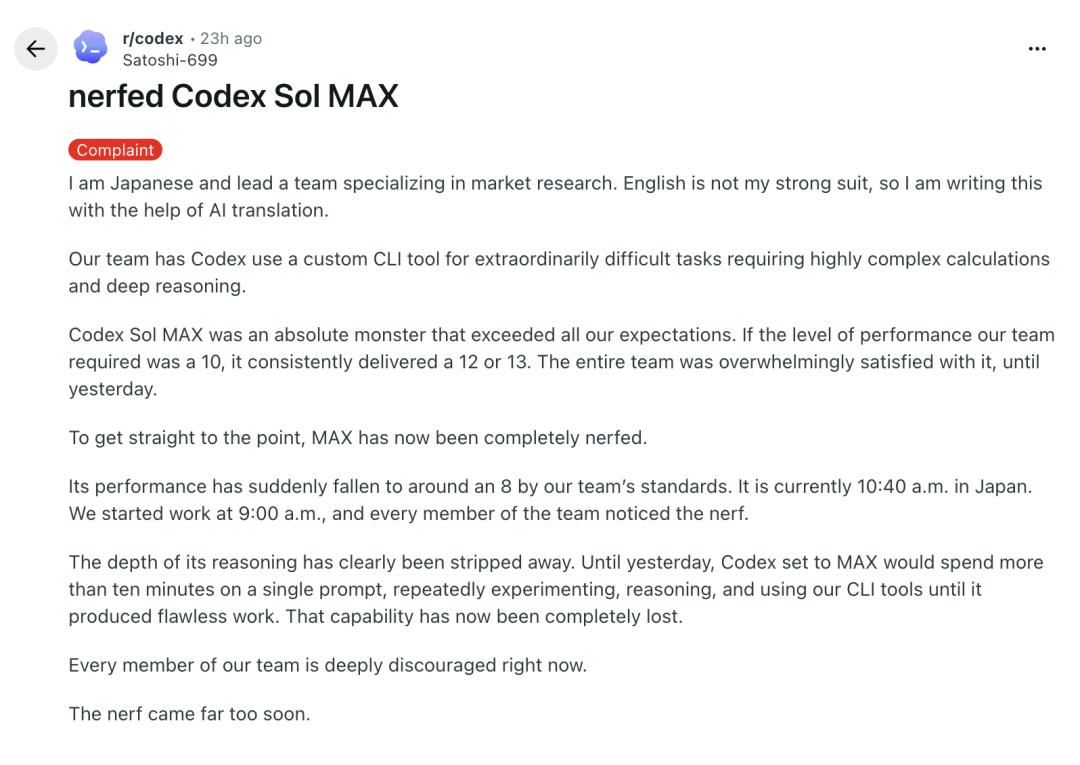
At 9 a.m., the team started their workflow as usual. By 10:40 a.m., every single member of the team had picked up on the exact same issue.
They had Codex Sol MAX connected to a custom in-house CLI tool, built specifically to handle tasks that demand extremely complex calculations and deep, layered reasoning.
Up until that morning, Codex Sol MAX had consistently overdelivered: if the required performance level for their work was a 10, it reliably turned in 12/10 or 13/10 results. It was a "monster that far exceeded all expectations," and "everyone on the team was completely satisfied with it."
But that morning, the performance of that "monster" suddenly collapsed, dropping down to only 8/10.
The depth of its reasoning capability had clearly been gutted.
Prior to this, when given a prompt, Codex Sol MAX would spend over ten minutes iterating repeatedly, testing approaches, refining its logic, and calling their custom tools over and over until the final output was completely flawless.
That level of capability, however, had "completely vanished" that very morning.
The Entire Community Is Convinced It's Gotten Dumber
The experience of this Japanese team is just one small example of what's been unfolding across the Codex user community over the past few days.
User complaints are remarkably consistent: the model is definitely faster now, spitting out responses far more quickly, but it refuses to dig deep into problems anymore. That old approach of researching thoroughly first, acting only after, and constantly correcting its own mistakes mid-process — that's gone.
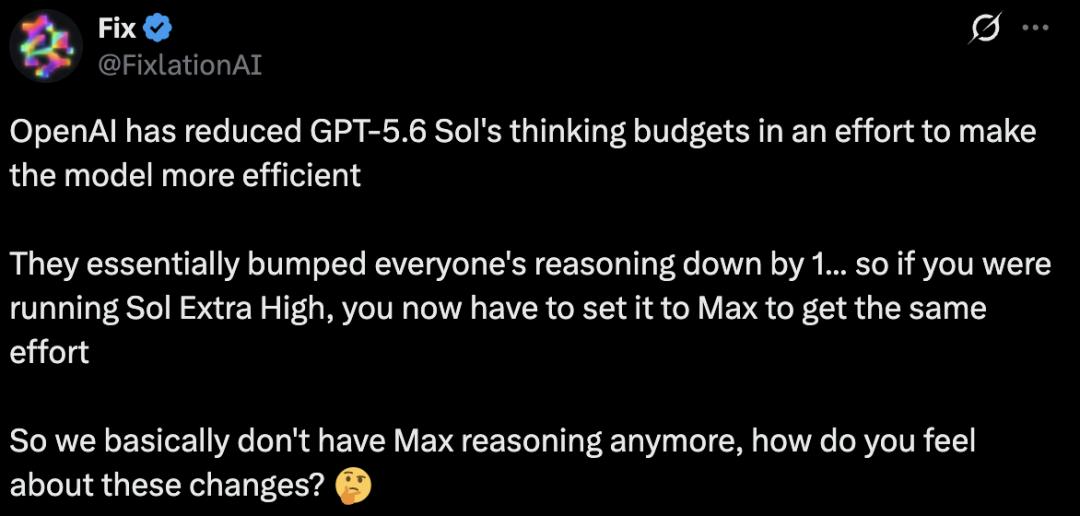
One comment from a user on X perfectly summed up the shared experience of everyone who uses the tool:
Everyone's reasoning power level has been collectively turned down a notch — you used to run on Extra High to get your desired performance, but now you have to crank it all the way up to Max just to get the same level of effort you used to get.
This kind of subtle shift is impossible for regular users to prove directly.
You can't see if the model weights have been swapped out, nor can you see exactly how much computing power the server side has allocated to your session.
The only four things you can actually perceive are: how fast it returns a response, how long it spends "thinking," whether it goes back to double-check its own work, and whether it calls on other agent tools to help finish the task.
All of these are indirect signals, none of which are explicitly documented anywhere on the official model spec sheet.
That's why community members started digging on their own, and uncovered an internal OpenAI parameter that the company had never made public: the "juice value."
A Number the Company Never Once Mentioned Publicly
The only thing OpenAI has ever publicly discussed is the reasoning effort level settings.
When GPT-5.6 launched on July 9, the official announcement stated that the new "max" reasoning intensity mode was being introduced for the first time, "giving Sol the most ample time possible to perform deep reasoning." Above that, there's the "ultra" mode, which by default spins up four separate agents to work on tasks in parallel.
In the ChatGPT interface, these correspond to the options in the model selector: Medium, High, and Extra High, all of which run on the Sol base model, while the Pro tier uses Sol Pro.
The "juice value" sits beneath all these visible tiers: it's the internal computing power budget allocated for reasoning, completely hidden from users, and OpenAI has never once published what values it can take.
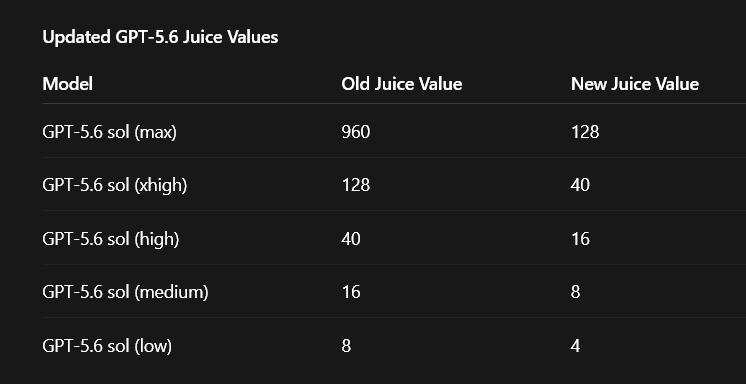
Community user ns123abc used a hidden prompt technique dubbed "model fingerprinting" to read that exact value from the system configuration: "juice."
Prior community observations had confirmed that Sol's max mode used to correspond to a juice value of 960. This time, the screen displayed a value of 128 — a drop of nearly 87%.
Nearly simultaneously, another set of screenshots began circulating: the usable context window for users in the Codex client had shrunk from around 372k back down to 272k.
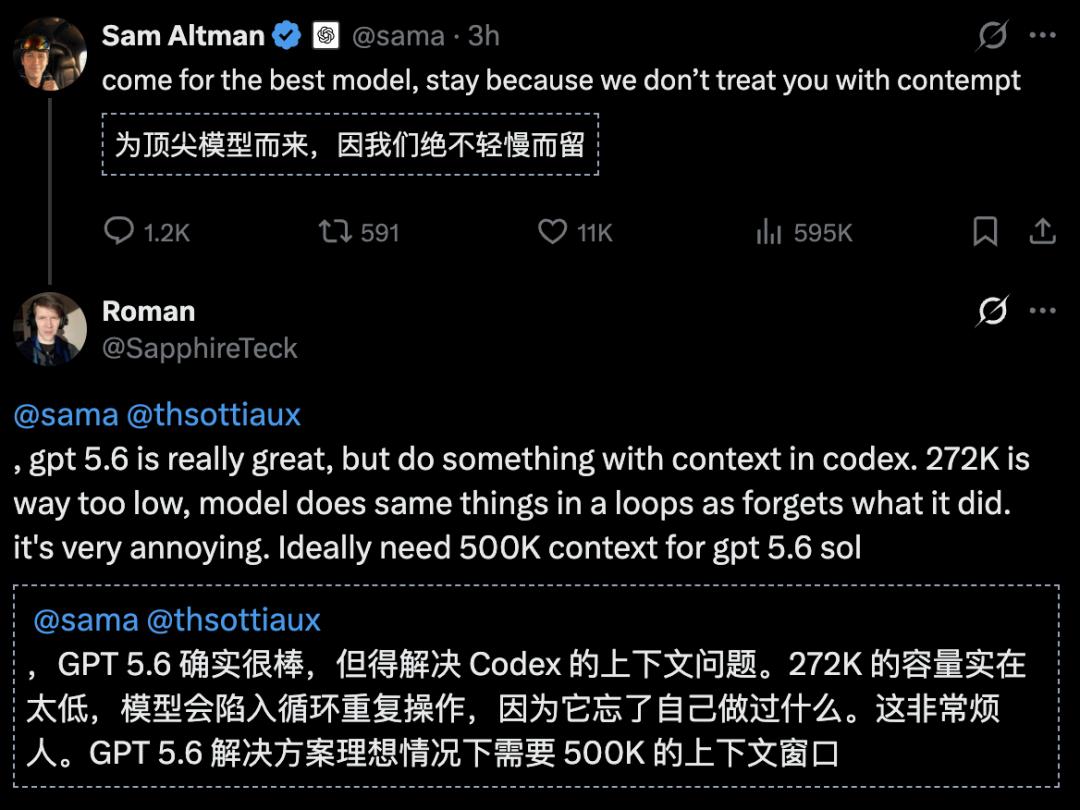
These two numbers immediately ignited the entire user community.
Tibo: There's No Nerf, We're Just Investigating Usage Metrics
That same evening, Tibo (Thibault Sottiaux), OpenAI's lead for Codex and ChatGPT Work, came out to address the issue.
Tibo posted an update on X, opening with a clear statement: there's no "nerfing" happening here, only positive improvements.
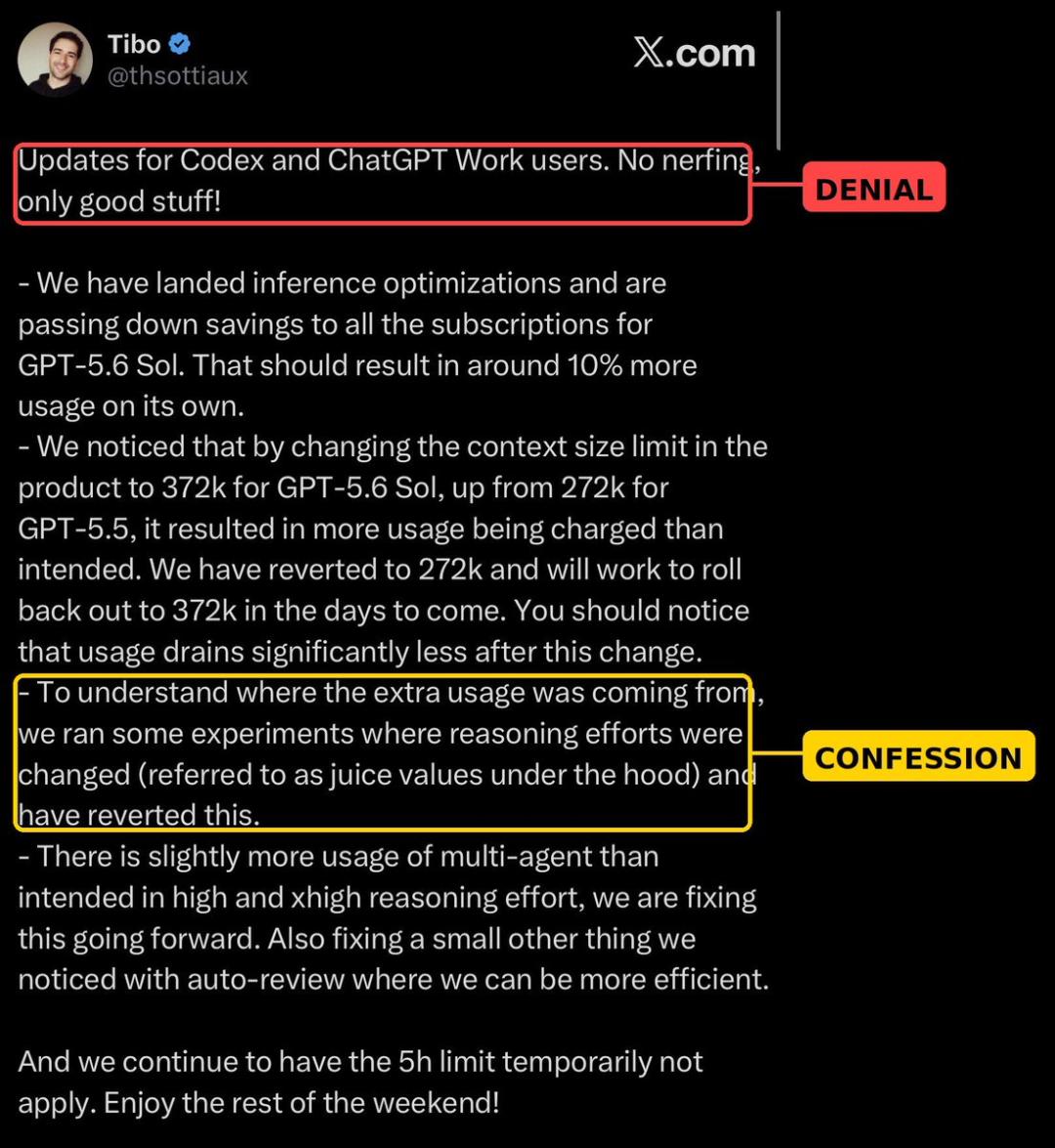
He then laid out four key points in a single post.
First: Reasoning efficiency optimizations have been rolled out, and the saved computing resources are being passed on to all subscription users, adding roughly 10% more total usage capacity across the board from this change alone.
Second: Sol's context window cap had been raised from GPT-5.5's 272k to 372k, but this led to billing calculations that were deducting more usage credits than intended. The window has since been rolled back to 272k, and the 372k limit will be reintroduced properly over the next few days.
Third: To identify exactly where the unexpected extra usage was coming from, the team ran a series of internal experiments that temporarily modified the reasoning effort level — what the team internally calls "juice values."
That setting has now been fully restored to its original state.
Fourth: The multi-agent invocation rates on the High and Extra High tiers were higher than projected, and there was unnecessary waste in the auto-review feature pipeline — both issues are currently being fixed.
The core of Tibo's message was: this isn't "dumbing down the model," it's just temporary parameter tuning.
He never confirmed whether the underlying model weights had been altered, but he did openly acknowledge that the actual configuration users were accessing had been changed during that window.
What exactly is "juice"? Based on all available public information, it appears to function as an internal system tag for allocating reasoning resources — put simply, it defines how much total reasoning capacity the system is allowed to assign to a single user task.
Even if lowering this budget doesn't technically mean the model itself has gotten "weaker," it can still quietly alter a huge range of behaviors:
How many different approaches a long-running task is allowed to explore, how many rounds of comparison the model will run between multiple potential solutions, whether it will voluntarily run self-tests after generating code, how many times it is willing to roll back after a failed attempt, and those tiny, critical "long-tail capabilities" that make or break extremely difficult tasks.
At the end of the day, it represents how much total effort the model is willing to dedicate to a single task.
To fully resolve this debate, a strictly controlled experiment would be required: using the exact same model snapshot, the exact same set of tasks, the exact same tooling environment, and only changing the juice value as the single variable.
That would show exactly how much performance degrades across complex coding work, long-running agent tasks, mathematical reasoning, and error recovery scenarios.
That definitive, controlled evidence is still completely missing as of now.
Every Token the Provider Saves Is Noticeable to Users
Circle back to that experiment Tibo mentioned. Where did it even come from?
Right after GPT-5.6 launched, user demand exploded immediately.
OpenAI even temporarily lifted its 5-hour window usage restrictions for a period, just to handle the massive surge in incoming requests.
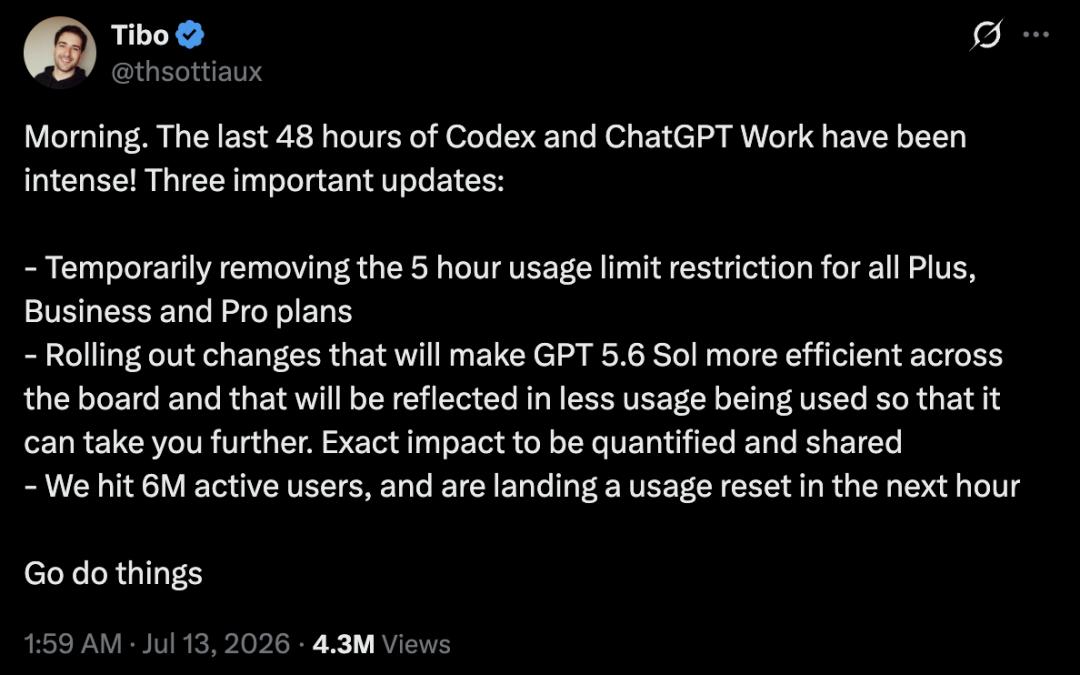
All the most prominent new features of GPT-5.6 — the longer thinking time in Max mode, the 4 default parallel agents in Ultra mode, and the vastly expanded context window — are all extremely token-intensive resource hogs.
The unexpected spike in total usage came directly from these new capabilities.
That's exactly why the experiment happened: to audit where all the extra usage was going, engineers temporarily lowered the budget variable to track consumption patterns, which is a completely reasonable troubleshooting step from an engineering perspective.
But that's precisely where the problem lies: when providers cut back on token usage, users can absolutely feel the difference. The most obvious sign is the model suddenly "stopping putting in the effort to think deeply."
That single adjusted variable was exactly the one that users would end up perceiving most clearly.
AI Stops "Working Miracles" and Starts Punching the Clock
Over the past few years, large language model companies have cultivated an almost quasi-religious sense of expectation in their user base.
People treated these models like oracles, expecting them to churn out a groundbreaking, unforeseen human insight in the middle of the night — and they were willing to put up with slower speeds, higher costs, and occasional weird outputs to get that.
But miracles that happen in a lab can operate without any cost constraints, and that stops working the second you move to a large-scale production infrastructure environment.
As a result, cutting-edge models like Sol are transitioning from being rare "prophets" that occasionally perform "miracles" in a lab, to becoming reliable engines that run nonstop within daily professional workflows.
This whole process is essentially a form of intelligent domestication, and this entire public controversy has laid that domestication process completely bare for everyone to see. At the same time, the old user illusion of a "fixed, unchanging level of intelligence" is finally coming to an end.
Subscribing to a model now feels more like buying a lightbulb: the product model number is fixed, but the brightness adjustment knob is always held entirely in the platform's hands.
That might be a commercially sensible decision, but it should never be hidden forever inside a black box.
If AI is ever going to become a standard enterprise-grade infrastructure tool, providers need to define far clearer, more concrete boundaries than just a vague model name — so users actually understand what performance guarantees they are paying for when they select the Max tier.
Without that transparency, it's nothing more than a meaningless price tag.
References:
https://x.com/thsottiaux/status/2076495156757577895
https://x.com/FixlationAI/status/2076469274441380349
https://www.reddit.com/r/codex/comments/1uuy5eq/nerfed_codex_sol_max/
This article originates from the WeChat public account AI Era, written by Yuan Yu, and is republished here with official authorization from 36Kr.