Nobel laureate Demis Hassabis made a striking statement: The impact of AGI will be 10 times that of the Industrial Revolution
Just now, Demis Hassabis, Nobel laureate and head of DeepMind, made a resounding declaration:
Artificial General Intelligence (AGI) is nearly within reach.
Hassabis stated ambitiously:
Drug discovery will no longer require decades of tedious trial and error, new clean energy breakthroughs could arrive within just a few years, and advanced materials will make "resource scarcity" a relic of the past.
We may even reach a point where — resources are no longer a limiting factor for human progress.
An awe-inspiring new era of abundance is knocking at our door.
He spoke plainly: this is a critical moment in human history, and AGI could be achieved in just a few short years!
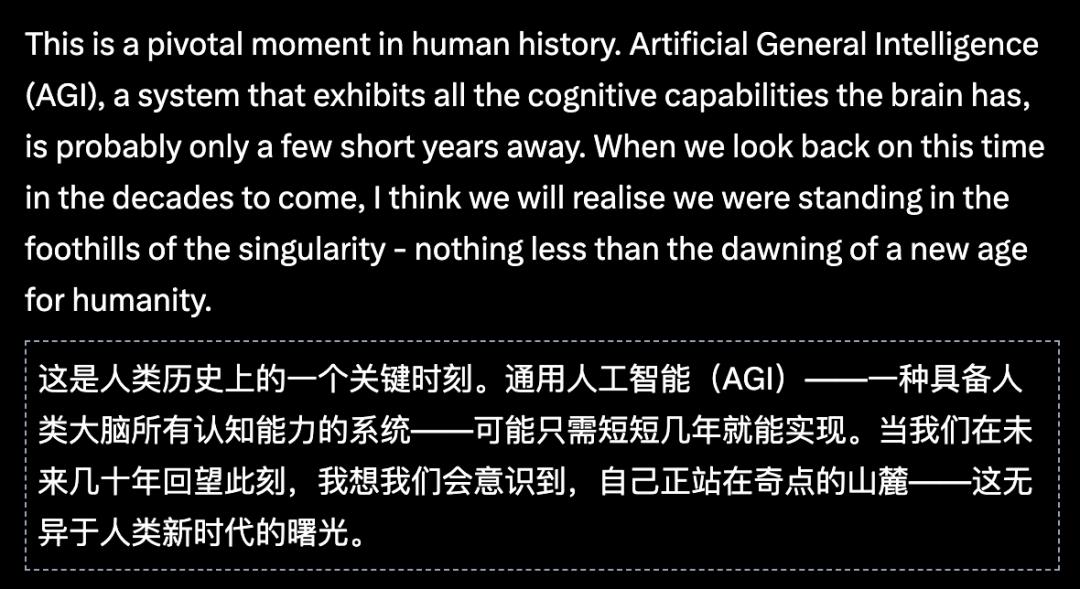
Hassabis presented a staggering calculation: The impact of AGI will be 10 times that of the Industrial Revolution, and it will unfold at 10 times the speed.
This is a "dimensionality reduction strike". It means humanity is about to enter a 100x-speed era of upheaval.
Against this bold prediction, Hassabis put forward his most controversial proposal: establishing an organization similar to the Financial Industry Regulatory Authority (FINRA), requiring all "frontier labs" to undergo a 30-day "pre-release review period" before launching new models.
In extreme scenarios, this body would even have the authority to coordinate global labs to collectively slow down the pace of research and development.
But Hassabis did not stop there.
He broadened his perspective to address humanity's deepest uncertainties: "Even if we solve these formidable technical challenges, far more complex economic and philosophical problems will remain to be addressed."
In this post-scarcity era, what kind of new economic model is needed to enable shared prosperity for all? What values should we uphold? What will meaning and purpose look like? And crucially, how will the human condition itself be transformed?
Below is the translated text of Hassabis's article — "A Framework for Frontier AI and the Dawning of a New Age".
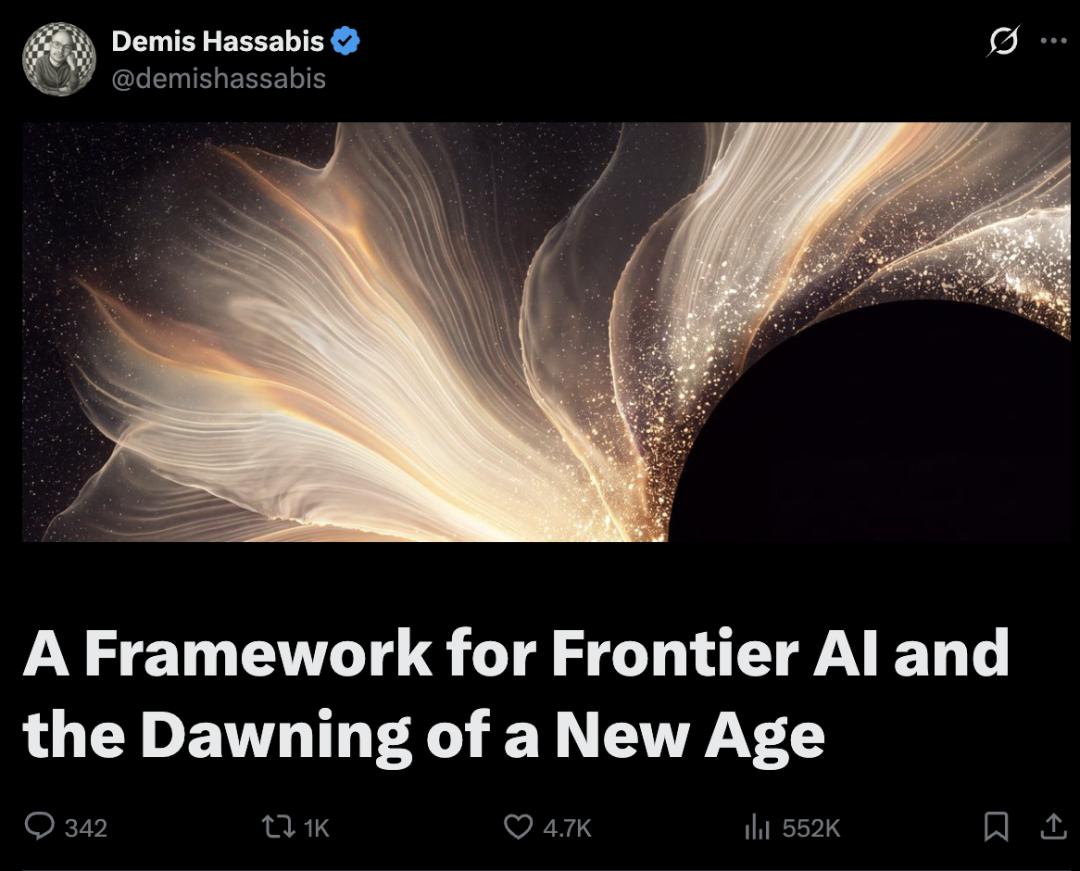
A Framework for Frontier AI and the Dawning of a New Age
This is a pivotal moment in human history.
Artificial General Intelligence (AGI) — a system capable of matching the full cognitive capabilities of the human brain — may be just a few years away. Looking back decades from now, I believe we will realize that we were standing at the foot of the singularity, and it is no exaggeration to say that we are witnessing the dawn of a new epoch for humanity.
I have dedicated my life to researching AGI because I have long believed that if built and deployed responsibly, it will prove to be one of the most beneficial and transformative technologies humanity has ever created. AGI cannot be compared to ordinary technological breakthroughs — not even far-reaching innovations like the internet or mobile internet. It is more akin to the moment humanity discovered electricity or learned to harness fire.
Stop and reflect: we have essentially found a way to make sand think. That is a miracle.
The scale of this technology's impact will be unprecedented — perhaps 10 times the magnitude of the Industrial Revolution, unfolding at 10 times its speed. It will help us solve some of society's greatest challenges: from accelerating new drug discovery, to developing new clean energy sources, to creating entirely new classes of advanced materials.
We may even reach a point where resources are no longer a constraint on human progress, and an extraordinary new era of abundance will begin.
Challenges at the Frontier
AI is already delivering tangible real-world benefits, but to fulfill its enormous promise, we must navigate this critical phase of development thoughtfully and cautiously. As we draw ever closer to AGI, urgent action is required to address the risks that may accompany it.
We have already seen the cybersecurity challenges posed by frontier models; as capabilities continue to advance, other threats including nuclear and biological risks could soon emerge. Looking further ahead, we will need robust safeguards to maintain control over increasingly agentic, recursively self-improving systems — and to address unknown issues that will only become clear over time.
I have always believed that human ingenuity and creativity are sufficient to solve any problem. I am confident that mitigating AI-related technical risks is a challenge we can meet together. But that requires us to give ourselves the time and space to get this critical next step right. Right now, neither as a field nor as a broader society are we positioned to do that.
We are currently caught in an extraordinarily intense, multi-layered commercial and geopolitical race. While this competition drives rapid progress and accelerates the delivery of remarkable benefits, the pace of frontier advancement has outstripped our understanding of the technology itself.
No one in the world can say with certainty what will happen next, and experts themselves hold widely differing views. When uncertainty is this high and the stakes are this great, proceeding steadily with "prudent optimism" is the wise and responsible path. This requires public policy that fosters innovation while incentivizing responsibility and safety; promotes international collaboration on critical safety issues; and encourages thoughtful consideration of how AI can best be deployed to benefit society.
The "Frontier AI Standards Body": A Proposed Framework
The rapid progress of AI today demands a fundamentally new way of testing the capabilities of frontier AI models — one that is dynamic, flexible, and rigorous.
The United States is uniquely positioned to take the lead in establishing such a framework: creating a new "Standards Body" modeled after federally supervised public-private partnerships or industry self-regulatory organizations — similar to the Financial Industry Regulatory Authority (FINRA) — whose board would include independent leading technical experts and representatives from the open-source community.
Funding must be substantial, most likely coming primarily from the industry, to attract world-class technical talent and provide the computational resources needed for large-scale testing.
Models that meet specific thresholds on a set of benchmark tests defined by the Standards Body will be classified as "Frontier-class"; these benchmarks will be regularly updated to keep pace with evolving AI capabilities.
Organizations identified as operating "Frontier Models" under these benchmarks will be designated as "Frontier Labs" and encouraged to adopt a set of best practices, such as releasing model cards with technical details, maintaining robust internal cybersecurity, conducting background checks for key personnel, and devoting sufficient resources to safety and security research.
In the initial phase, Frontier Labs will voluntarily submit their models for review by the Standards Body up to 30 days before release. Once assessment protocols are proven effective and sufficiently robust, they can be rapidly formalized.
At that stage, Frontier Models will be required to pass assessment before being deployed in the U.S. market. Labs will also collaborate with the Standards Body to address any significant vulnerabilities discovered after model release.
Model assessments will include rigorous scientific evaluations of capabilities in cybersecurity, biological threats, and other high-risk domains.
Specialized tests for agentic AI can detect whether models attempt to bypass safety guardrails or exhibit deceptive behavior, and ensure best practices are implemented. For example, adding digital watermarks to AI-generated images and producing human-readable output tokens to help interpret the model's reasoning process.
These assessments will be updated regularly: initially perhaps quarterly, with outdated or "saturated" benchmarks (where maximum scores are consistently achieved) retired and replaced.
In the early stages, assessments can be co-developed in consultation with Frontier Labs; eventually, the Standards Body should build its own technical capacity to develop "held-out tests" independently of the labs, to prevent models from overfitting to test data.
It can also work with the government to cultivate an ecosystem of third-party auditors to assist with evaluations and contribute to the creation of new benchmarks and assessments.
The advantage of this approach is that it is technology-based, while still supporting innovation and incentivizing responsible behavior. It is designed to keep pace with the field's acceleration and adapt as the greatest risks are identified; if the severity of the situation demands, safeguards can be escalated incrementally, including, when necessary, coordinating all Frontier Labs to collectively slow development speeds.
A "Frontier Lab" designation will carry significant prestige, and the door will be open to any organization that builds a model meeting the benchmark criteria. This framework can apply to all "Frontier-class" models, regardless of their country of origin, or whether they are open-source or closed-source; all non-frontier models, such as those from startups or academia, will be exempt from this process.
Given that this technology will eventually impact the entire planet, ideally this framework can foster global consensus on how to manage the most severe risks while ensuring everyone can access and benefit from the opportunities AI brings.
The Future Remains Unwritten
AGI has the potential to become the ultimate tool for advancing science and medicine, delivering enormous productivity gains and economic growth.
But to achieve all this, we must first strengthen our technical foundations: acting collaboratively under a globally shared framework, applying the most rigorous scientific methods, and bringing together the best minds to collectively address the challenges ahead.
Even after these formidable technical challenges are resolved, far more complex economic and philosophical questions will remain:
In a "post-scarcity" world, what kind of new economic model is needed to allow everyone to thrive? What values do we want to live by? Where will meaning and purpose reside? And even, how will "the human condition" itself be transformed?
The answers to these questions clearly cannot — and should not — be left to technologists alone. They require every segment of society to come together to define this new chapter.
There is both enormous excitement and enormous uncertainty around AI — and both are justified.
But the future remains unwritten. We must seize this precious window before AGI arrives to shape this technology into a force that benefits all of humanity. Our collective actions today will determine how the next phase of our civilization unfolds. If we safely guide AGI into the world, we can enter a golden new era of scientific discovery and progress, and build a bright future of unprecedented human flourishing.
References:
https://x.com/demishassabis/status/2076957440109625718?s=20
This article is from the WeChat public account "AI Era", authored by David Solomon, and published with authorization by 36Kr.