36Kr Exclusive | Former Core Business Partner of Flexiv Launches Vertical Industrial AI Agent Startup, Secures Tens of Millions Yuan in Seed Round Financing
Author | Qiao Yujie
Editor | Yuan Silai
36Kr has learned that Shanghai Zhui Zhi Engineering Technology Co., Ltd. (hereinafter referred to as "Zhui Zhi Engineering") recently completed a multi-million-yuan seed round financing, jointly invested by L2F Light Source Entrepreneur Fund, Shangrong Capital, and Yicun Capital. This round of financing will be mainly used for core product R&D, team building, and market expansion.
Founded in February 2024, Zhui Zhi Engineering is a technology enterprise focused on vertical-domain industrial agents, and it is also a commercialization spin-off of Shanghai Jiao Tong University and a strategically incubated enterprise of the Shanghai AI Institute. The company aims to introduce artificial intelligence technology into industrial manufacturing scenarios to enhance the automation and intelligence of complex foundational process links, with a focus on solving issues such as flexible production shortages and severe skilled labor shortages in the manufacturing industry.
The company's founder, Yuan Lin, previously served as a business partner at Neura Robotics, driving the company's growth into a unicorn; before that, he served as Executive Assistant to the Chairman/CEO and Group Sales Director of Huachangda, a listed intelligent equipment group, and earlier led hundred-million-yuan production line projects for Changan Ford and Geely Automobile at ABB China.
The company's core team possesses dual benchmark strengths in technology and industry. In terms of material mechanics, Professor Li Zhuguo is a distinguished professor at the School of Materials Science and Engineering of Shanghai Jiao Tong University and one of the top 2% of scientists globally. In the field of artificial intelligence, Dr. Cao Guangzhi previously served as the principal computer vision scientist for Tesla Autopilot and CTO of a domestic OEM autonomous driving team, with profound technical and industrial experience in autonomous driving perception and end-to-end systems.
Yuan Lin introduced to 36Kr that traditional industrial automation has already addressed a large number of standardized, clearly rule-based production tasks. However, there are numerous non-standard, highly complex process links in the current manufacturing industry that traditional automation solutions relying on preset rules struggle to solve, which is also a key direction for the further development of AI in industry.
Based on this judgment, Zhui Zhi Engineering has not taken the general-purpose humanoid robot path, but instead focused on the foundational material processing processes in industrial manufacturing, starting with process scenarios such as grinding and welding. These processes directly affect manufacturing precision, processing efficiency, and product yield, and they are also customer pain point segments with relatively low current automation levels, high reliance on worker experience, and high labor hour costs.
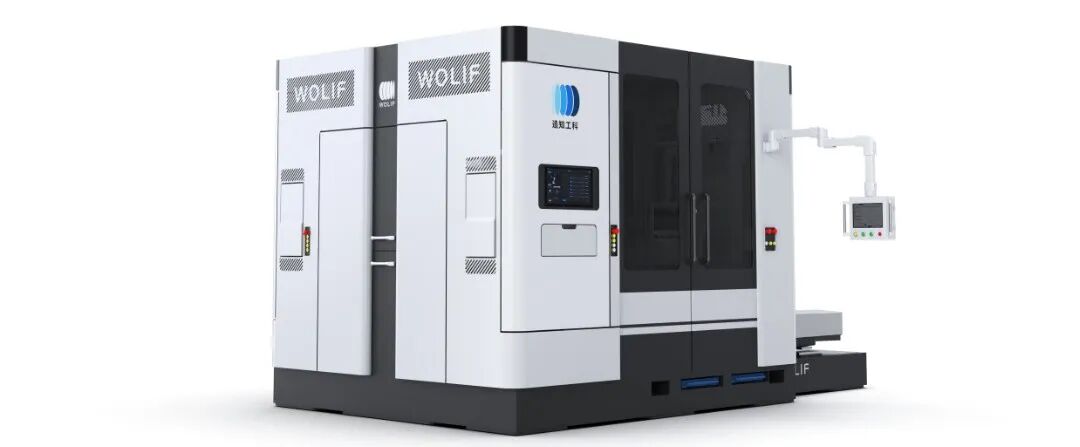
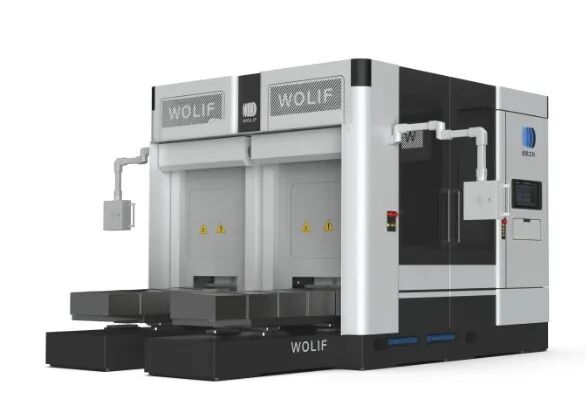
For the above scenarios, Zhui Zhi Engineering has launched the WOLIF Industrial Agentic Robot. Unlike traditional industrial robots that rely on engineers to pre-set process parameters, its product adopts a self-developed industrial brain real-time closed-loop control architecture, which achieves closed-loop autonomous control of the entire process operation through prior judgment of autonomous strategies, continuous perception of processing status, and dynamic autonomous adjustment of process and motion control parameters, rather than executing actions according to fixed programs.
(Image source / Enterprise)
The company has proposed a self-developed AI industrial control system called "Industrial Brain + Process Cerebellum". This closed-loop control system does not simply combine sensors, industrial robots, and AI algorithms, but builds a complete system of prior strategy, perception, decision-making, and self-adjusting execution around the entire physical interaction process of real industrial mass production processes, and has now formed independent intellectual property rights.
(Image source / Enterprise)
In terms of commercialization, at present, Zhui Zhi Engineering has completed its first order cooperation with an A-share listed company and achieved delivery, and has also obtained a ten-million-level order in the aerospace manufacturing field. Its self-developed first-generation surface treatment industrial agent FAST and the self-developed AI industrial control system have been verified in high-precision scenarios such as aerospace component manufacturing. The company is accelerating the formation of an original three-layer product sales system of "Hardware Entity + Industrial Brain + Process Data Services" in its business model.
The following is an excerpt from the conversation between 36Kr and Yuan Lin, founder of Zhui Zhi Engineering:
36Kr: What is the biggest technical difficulty in enabling vertical-domain industrial agents to have learning, generalization, and transfer capabilities?
Yuan Lin: The biggest difficulty in industrial AI is not a single point technology, but a complete capability system.
First of all, we need to make artificial intelligence truly understand the mechanism of material processing. Zhui Zhi Engineering is currently focusing on material processing scenarios such as grinding and welding. Different materials, such as glass, carbon fiber, aluminum, and steel, have completely different processing mechanisms. Only by understanding the principles of materials, processes, and physical interactions can we well define which data should be collected, what kind of data is high-quality data, and establish an effective training and self-evolution evaluation system.
Secondly, algorithms cannot be separated from hardware support. The robot body, end effector, motor, sensor, and the AI brain-cerebellum control system all need to be continuously optimized around specific processes. We believe that material mechanics, hardware systems, and algorithms are all indispensable, and the algorithm is built on the basis of the former two. Therefore, the company has not only deployed the "Industrial Brain + Process Cerebellum" AI industrial control architecture, but also relied on the scientific research accumulation of the School of Materials of Shanghai Jiao Tong University to combine materials science and engineering, agent ontology, and AI to form a complete technical barrier.
36Kr: What is the company's future development plan? Will it expand to more industries starting from aerospace?
Yuan Lin: Our strategy is to solve the most real and most urgently needed problems first. From an industry perspective, high-end manufacturing hotspots such as aerospace and new energy have the strongest demand for processes such as grinding and welding, and in the future we will gradually expand to manufacturing scenarios such as automobiles, 3C, robots, and drones.
However, our expansion logic is not based on industries, but on material and process capabilities. For example, a mature carbon fiber processing capability can be transferred to multiple industries such as automobiles, sports and musical instruments, and consumer electronics. True generalization comes from a deep understanding of the underlying processes, not from chasing to cover more product industries.
General AI pursues universal applicability to everything, while industrial manufacturing requires precision and specialization. True industrial intelligence cannot only understand motion control; it must understand the physical changes of metals and composite materials during processing, so that the equipment has process cognition and can evolve from an "execution machine" to an autonomously iterating "intelligent craftsman".