"Code Leap" Completes Tens of Millions Yuan Seed Round Financing to Build Quantum Computing Infrastructure Integrated with Quantum and AI
Recently, Shanghai Magic Code Leap Quantum Technology Co., Ltd. (hereinafter referred to as "Magic Code Leap") has completed a seed round financing of tens of millions of yuan. This financing is led by L2F Light Source Entrepreneurs Fund, with joint participation from Yunqi Capital and Xiaomiao Langcheng, while Light Source Capital also serves as the incubator. The funds from this round will be mainly used for core talent team building, full-stack software R&D for quantum computing, quantum artificial intelligence technology R&D, and the construction of a cross-platform quantum computing industrial ecosystem.
Magic Code Leap focuses on the integrated innovation of quantum computing and AI, positioning itself as a domestic provider of system-level software and application solutions for quantum computing systems, dedicated to building software infrastructure and agent platforms that support fault-tolerant operation, large-scale deployment, and industrial applications. The company aims to transform heterogeneous quantum hardware capabilities into new types of computing power that can be invoked, evaluated, and verified by industrial users through the path of "underlying software stack + upper-layer algorithm applications + AI-driven R&D tools", accelerating the transition of quantum computing from experimental validation to engineering and industrialization.
A Full-Stack Team Spanning Algorithms, Engineering, and Hardware
The Magic Code Leap team simultaneously possesses in-depth algorithm theory, understanding of mainstream hardware, software engineering capabilities, and industrialization experience. Core members come from leading enterprises and universities such as QuEra, Baidu, Harvard University, the Hong Kong University of Science and Technology, the University of Maryland, and the University of Waterloo. They have experience in mainstream hardware paths including neutral atoms and superconductivity, and have deeply participated in multiple national key scientific research projects in the field of quantum computing. Currently, the company has established a R&D team of dozens of people, covering key areas such as quantum algorithms, quantum machine learning, hardware-aware compilation, quantum software stacks, and agents.
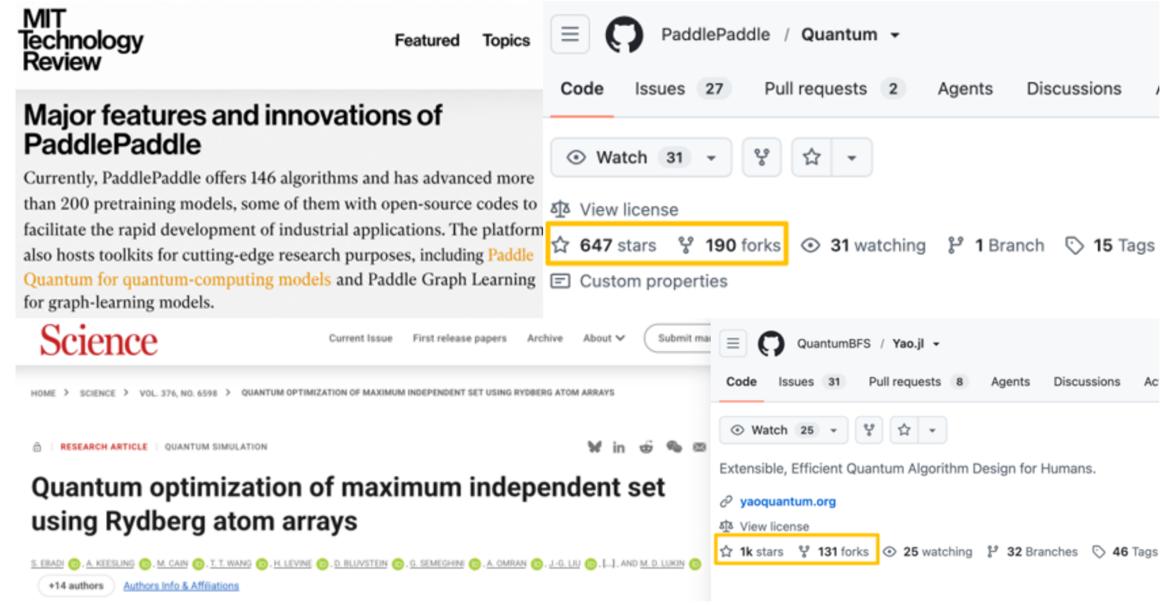
Two chief scientists provide critical technical depth. Wang Xin, former Tech Leader of the Baidu Quantum Computing Institute, led the R&D of the industrial-grade quantum software platform "Paddle Quantum", and has long been engaged in research on quantum algorithms, quantum information, and quantum artificial intelligence. He has published more than 100 papers in top journals and conferences such as PRL, PRX Quantum, Nature Computational Science, IEEE TIT, NeurIPS, AAAI, ISCA, HPCA, and MICRO. He has presided over and participated in major national natural science research programs and national key R&D programs in the fields of quantum algorithms and quantum-AI integration, and was invited to give a keynote speech at TQC, the top international conference on quantum computing theory. His achievements have been reported by authoritative media such as CCTV News and MIT Technology Review. Liu Jinguo once conducted postdoctoral research in the Lukin Group at Harvard University, the world's leading team in neutral atom quantum computing, and served as a full-time consultant at QuEra, the world's top neutral atom quantum computing company incubated by the group, deeply participating in QuEra's team building and software stack construction, systematically accumulating comprehensive experience from theory and software to hardware mapping. Liu Jinguo has long been dedicated to neutral atom system simulation, quantum algorithms, and combinatorial optimization. He is one of the core evangelists of China's open-source quantum software community and one of the main contributors to Yao.jl. The two chief scientists have maintained long-term and stable cooperation at the Hong Kong University of Science and Technology (Guangzhou), endowing Magic Code Leap with extremely rare full-stack capabilities in China.
Yao Hongshun, CEO, joined the Baidu Quantum Computing Institute in 2021 to participate in the R&D of core modules of PaddleQuantum, and is one of the first researchers in China to explore quantum algorithm applications on self-developed superconducting quantum processors. He has accumulated extensive experience in technology R&D and engineering management at Baidu Quantum, and can effectively coordinate the coordinated implementation of algorithms, software, and hardware to ensure that technical decisions are precisely aligned with business execution. Zhu Chenghong, Chief Architect, has long focused on quantum architecture, hardware-aware compilation, and AI-driven quantum software optimization. His related achievements have been published in top architecture and design automation conferences such as ISCA, MICRO, HPCA, and DAC, supporting the company to form engineering capabilities in compilation scheduling, architecture optimization, and AI for Quantum.
The Magic Code Leap team covers mainstream paths such as superconductivity, neutral atoms, ion traps, and photonic quantum computing. It has formed capabilities in hardware-aware algorithm design, cross-platform compilation, resource estimation, and scheduling optimization, and has accumulated experience in open-source ecosystems, national research projects, hardware manufacturer cooperation, and industry scenario validation. Currently, the company has carried out research cooperation with multiple hardware manufacturers, including exploring quantum application implementation scenarios based on hardware characteristics, and hardware performance improvement solutions based on software algorithm design. It is promoting scenario validation in high-value fields such as financial optimization and biomedicine, and has established in-depth cooperative relationships with leading business customers. In the future, the company will continue to advance its business around infrastructure software for hardware manufacturers, developer toolchains, and industry algorithm solutions.
Quantum Computing Is Transitioning from Hardware Demonstration to System Engineering
The industrial value of quantum computing is shifting from individual scientific breakthroughs to the continuous accumulation of system engineering capabilities. In the past few years, the market has mostly built expectations around the number of physical qubits, hardware paths, and experimental progress. Entering the next stage, what truly determines whether quantum computing can become usable will be indicators closer to engineering delivery, such as logical error rate, error correction efficiency, resource cost, system reliability, and the maturity of algorithm applications.
The application value of quantum computing also needs to be continuously released through modelable and verifiable industrial workflows. Although quantum hardware paths have not yet converged, the software stack for the fault-tolerant era has gradually become clear. Critical layers such as application traction, algorithm design, compilation optimization, error correction support, operation scheduling, and hardware interfaces are forming a systematic support framework that connects industrial demands and underlying hardware capabilities.
Building a Full-Stack Quantum Computing Software Platform Through Quantum × AI Integrated Innovation
Facing fault-tolerant quantum computing and large-scale deployment, Magic Code Leap positions itself as a domestic provider of quantum computing software infrastructure and application solutions, forming a full-stack platform of "underlying software stack + upper-layer algorithm applications + AI-driven R&D tools".
l The underlying software stack connects diverse hardware paths such as superconductivity, ion traps, neutral atoms, and photonic quantum computing, providing system-level capabilities including hardware abstraction, compilation optimization, error correction interfaces, operation scheduling, resource evaluation, and benchmark testing, helping hardware manufacturers improve usability and lowering the threshold for industrial users.
l Upper-layer algorithm applications focus on high-value scenarios such as material simulation, financial optimization, logistics scheduling, and AI model optimization, translating real industrial problems into modelable, verifiable, compilable, and runnable quantum computing workflows.
l The AI-driven R&D technology stack runs through the entire chain of applications, algorithms, compilation, error correction, and scheduling. Through agent orchestration, Magic Code Leap will improve the efficiency of problem modeling, algorithm generation, circuit compilation, resource estimation, hardware invocation, and result verification, promoting quantum computing from an expert-driven experimental system to gradually become a new type of computing infrastructure that can be accessed, managed, and verified in the industrial R&D system.
Magic Code Leap's core judgment is: The key to the industrialization of quantum computing lies not only in hardware breakthroughs, but also in encapsulating heterogeneous, noise-sensitive, and resource-scarce quantum hardware into new computing power that can be invoked, evaluated, and delivered by industrial users, and implementing applications in real scientific research and industrial scenarios. Taking this round of financing as a starting point, the company will continue to promote the construction of a full-stack quantum computing software platform, further expand cooperation with quantum hardware manufacturers, scientific research institutions, and industrial users, promote the transition of quantum computing capabilities from experimental environments to real scenarios, and become a new type of computing infrastructure for future industrial R&D systems.
Zheng Xuanle, Founder and CEO of Light Source Capital, said: "We are honored to deeply accompany the development of Magic Code Leap from the early stage of the project, with the dual identities of incubator and investor. Quantum computing is an important direction for the next-generation computing paradigm, and software infrastructure is a key bridge connecting hardware breakthroughs and industrial applications. The Magic Code Leap team has accumulated rich practical experience in long-term scientific research and industry, combining academic depth, engineering capabilities, and industrial awareness, enabling them to grasp the key software ecosystem during the transition from the Noisy Intermediate-Scale Quantum era to fault-tolerant quantum computing. We look forward to the Magic Code Leap team making important contributions to the industrialization of quantum computing, and Light Source Capital will continue to support the team in advancing core technology R&D and industrial ecosystem construction through full-process incubation and capital services."
Mao Chengyu, Founding Managing Partner of Yunqi Capital, said: "Quantum computing is gradually transitioning from the early stage dominated by hardware indicators and experimental breakthroughs to a system engineering stage that emphasizes hardware-software collaboration and targets real applications. The Magic Code Leap team combines quantum algorithm research, understanding of mainstream hardware, and software engineering capabilities, and attempts to use AI to improve the efficiency of quantum R&D and application development, possessing the rare ability to build a cross-hardware full-stack software platform. We are optimistic that the team will continuously lower the development and usage thresholds of quantum computing, and become a key infrastructure connecting underlying quantum computing power and industrial applications."
Yang Yuanjie, Investment Director of Xiaomiao Langcheng, said: Quantum computing is transitioning from hardware breakthroughs to the coordinated development of software and hardware, and the importance of software infrastructure is rising rapidly. The Magic Code Leap team has comprehensive capabilities combining academic background, industrial experience, open-source practice, and engineering capabilities. It can understand different hardware paths and form differentiated advantages in areas such as compilation, error correction, and AI-assisted algorithm R&D. We are optimistic that the company will continuously promote the construction of quantum software infrastructure and become an important platform connecting quantum hardware, AI capabilities, and industrial applications.