Raised $400 million in funding, Shenzhen's leading embodied intelligence unicorn is nearing IPO
The largest embodied intelligence financing deal of the second half has emerged.
On July 14, general-purpose humanoid robot company LimX Dynamics announced the completion of a nearly $200 million Pre-IPO financing round, with a lineup of investors including strategic investments from IDG Capital, global leading AI hardware manufacturing giant Lens Technology, pan-European diversified industrial and investment groups GGG Group and Redstone VC, Hua Capital, and Hefei Binhu Industrial Development Group.
In addition, UAE-based Stone Venture has heavily invested in multiple consecutive rounds, while existing shareholders including Oasis Capital, Jiwei Capital, Nanshan Strategic Emerging Industry Investment, Shangqi Capital, and Nio Capital have made over-allocated additional investments.
With this, LimX Dynamics, one of the "Eight Great Titans of Shenzhen", has secured nearly $400 million in financing in just half a year, with a post-investment valuation reaching 15 billion yuan.
"When it comes to financing, we prioritize a steady rhythm and long-term alignment of our shareholder structure, rather than simply stacking up short-term funding amounts," Zhang Wei, founder of LimX Dynamics, told Investment.com in Shenzhen in early July. A professor at Southern University of Science and Technology who has researched humanoid robots for over a decade, Zhang founded LimX Dynamics in Nanshan, Shenzhen in 2022. Over four years, the company has built a full-stack self-developed humanoid robot brain system and its supporting skeleton—a three-layer technical architecture that coordinates the cognitive layer, skill layer, and motion control layer. It has also developed a diverse product matrix spanning R&D to commercial interaction, positioning itself as a formidable Chinese competitor to Figure.
With thousands of bulk overseas orders in hand, LimX Dynamics' global footprint has left a deep impression on the industry. The company completed its share reform as early as March this year, and according to insiders, it is steadily advancing its IPO preparations.
Securing $400 Million in Funding with a $150 Billion Valuation, Backed by Renowned Global Investors
To a certain extent, LimX Dynamics' global DNA traces back to its founder Zhang Wei.
The professor from Southern University of Science and Technology previously served as a tenured professor in the Department of Electrical and Computer Engineering at The Ohio State University in the United States. Having researched humanoid robots for more than a decade, his team was the first to achieve reinforcement learning-based walking for bipedal humanoid robots across indoor and outdoor scenarios back in 2021—earlier than Elon Musk's entry into the humanoid robot industry.
Over the past few years, while the embodied intelligence industry has been bustling with activity, LimX Dynamics' financing pace has been measured, yet every step has been remarkable: in October 2023, it completed its angel and Pre-A rounds with investments from Foresight Capital, Matrix Partners China, Oasis Capital, Lenovo Capital, and K2VC; in July 2024, its Series A round introduced industrial investors including China Merchants Venture and SAIC Motor; in early 2025, Alibaba and Nio Capital joined in, marking Alibaba's first investment in a humanoid robot company, with Nanshan Strategic Emerging Industry Investment also participating at this time. In July 2025, JD.com led the round strategically.
The real transformation unfolded in 2026. During this year's Series B financing in February, UAE's Stone Venture (Stone Venture) made its first appearance, alongside new investors including Oriental Fortune Capital, Jiwei Capital, Tianchuang Capital, GF Xinde, Hefei Innovation Investment, Guotai Junan Innovation Investment, CITIC Securities Investment, and industrial players such as Zhongding, Guangyang, and Beijing E-Town Control.
The latest Pre-IPO round continues this impressive lineup.
Investment.com notes that nearly 70% of the funding in this round comes from overseas institutions across Europe, the Middle East, and North America, including Middle East-based Stone Venture, Silicon Valley's Hua Capital, and Europe's GGG Group and Redstone VC.
This kind of global capital structure is rare among domestic embodied intelligence enterprises in China. It means LimX Dynamics will significantly reduce barriers to expanding its products into overseas markets, accelerating its entry into global markets with a focus on Europe, the Middle East, and Asia.
Lens Technology's participation carries even greater strategic significance. A humanoid robot contains roughly a thousand components, and while its manufacturing threshold is lower than that of a full vehicle, large-scale mass production, structural design, and precision assembly rely on a mature consumer electronics manufacturing ecosystem.
As a leading player in the consumer electronics supply chain, Lens Technology is known as the "jewel in the crown of Chinese manufacturing." Its backing allows LimX Dynamics to leverage the efficiency of the local supply chain while gaining high-end manufacturing quality control capabilities, supporting the delivery of its growing volume of bulk overseas orders.
For a general-purpose humanoid robot company aiming for stable mass production and global expansion, this is far more valuable than simply securing capital.
Looking back over the past four years, LimX Dynamics' shareholder roster has gradually taken shape, evolving from early-stage market-focused funds to a full chain of industrial capital, and now to global investment institutions. Following the Pre-IPO round, the company's post-investment valuation has climbed to 15 billion yuan, making it another super 10-billion-yuan unicorn among the "Eight Great Titans of Shenzhen".
The Strongest Chinese Competitor to Figure
"The embodied intelligence company with the strongest AI product DNA," remarked one investor who has participated in multiple follow-on funding rounds, describing their impression of LimX Dynamics.
This recognition points to LimX Dynamics' self-developed full-stack three-layer technical architecture and rich product matrix applicable to diverse scenarios. Zhang Wei likens this three-layer architecture to a complete brain system.
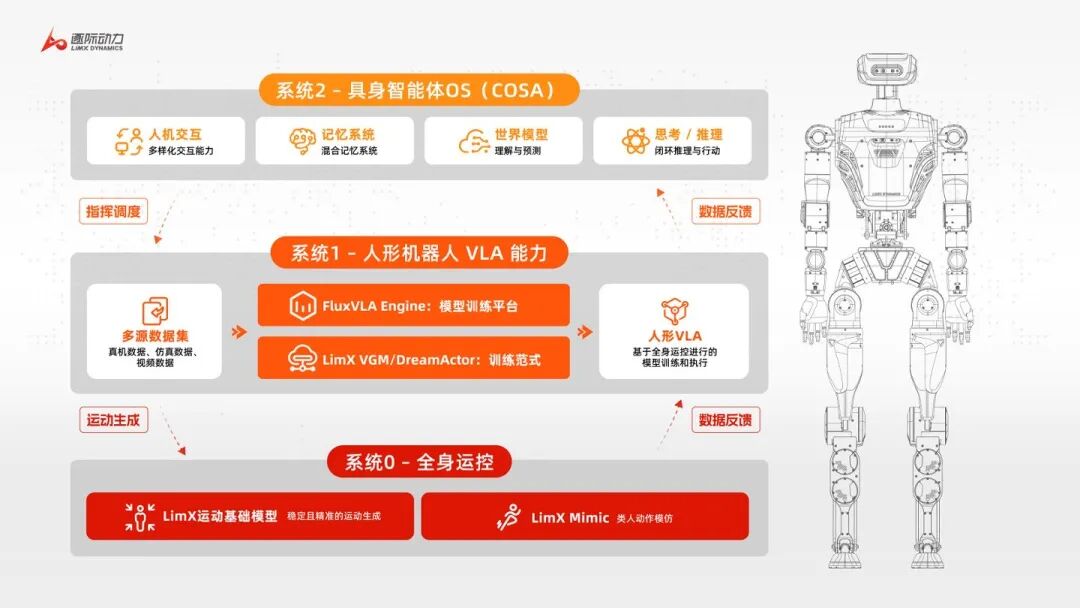
The bottom layer, System 0, functions as the cerebellum, responsible for full-body motion control. This is the area where LimX Dynamics first established its competitive advantage: while most models in the industry could only "walk blindly" on flat ground and couldn't adjust their gaits in real time based on the environment, LimX Dynamics' full-size humanoid robot could already climb stairs based on real-time perception.
The middle layer, System 1, handles VLA/WAM skills for specific tasks such as opening doors, greeting guests, and delivering items. This January, LimX Dynamics open-sourced the FluxVLA Engine, providing global developers with a standardized engineering infrastructure for model training, iteration, and deployment. This frees developers to focus on model innovation itself rather than repeatedly building underlying systems, pushing the industry from "training a single model" to "enabling everyone to train models."
The top layer, System 2, acts as the cerebrum. In January 2026, LimX Dynamics launched the embodied agent system COSA, enabling full-size humanoid robots to achieve a brain system that can "think, move, and work while reasoning."
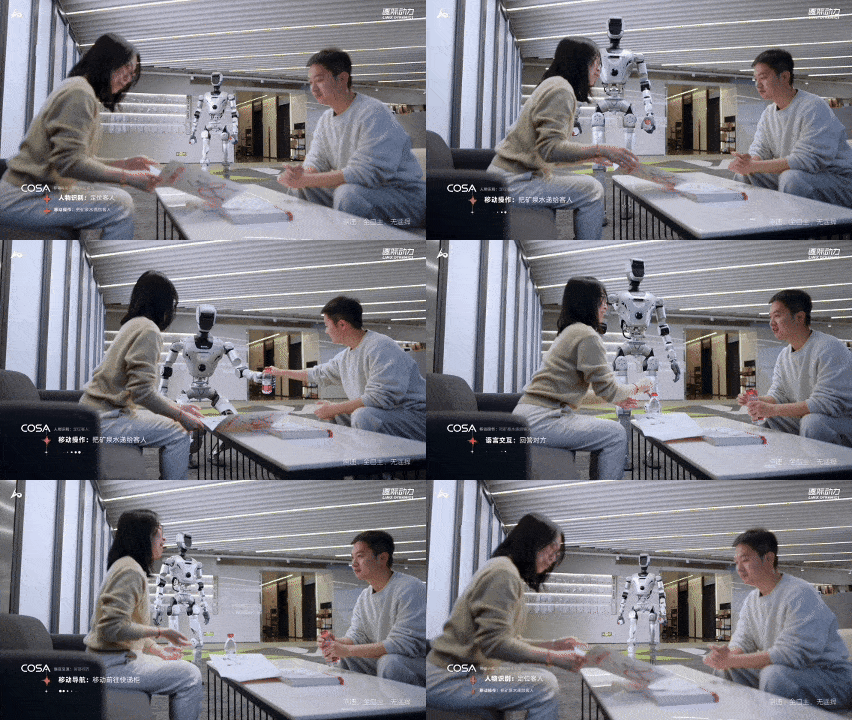
This architecture is familiar to the industry: across the Pacific, Silicon Valley humanoid robot company Figure, valued at over $39 billion, adopted the same "System 0—System 1—System 2" layered architecture in its Helix 02 system launched in January 2026.
While the two architectures appear similar, they are fundamentally different. Figure's System 1 and System 2 remain end-to-end systems at the model level; LimX Dynamics argues that models are just skills, while the system is the real brain—a complete agent operating system integrating perception, memory, scheduling, skills, and full-body motion control, rather than a single model.
In a sense, LimX Dynamics is emerging as Figure's most formidable Chinese competitor.
It has even moved ahead on the timeline. As early as 2023, LimX Dynamics had achieved integration of the cerebellum and cerebrum, with real-world validations including its full-size humanoid robot Oli autonomously picking up tennis balls and completing the Guangzhou Tower stair challenge. Figure did not achieve full-body motion control until early 2026.
The two companies also differ in their commercialization paths. Figure focuses on factories and warehouses, while LimX Dynamics chose to start from commercial service scenarios.
Zhang Wei's reasoning for not prioritizing factories is that humanoid robots are ultimately meant to enter households, and factory deployment is not the most efficient path. "It's not that entering factories is wrong—it's a choice. We will still sell our robots to factories and provide technical support, but we won't focus our own deployment efforts on factories."
As a result, LimX Dynamics is almost obsessively committed to "Serve People, Not Process."
This system is now being validated through productization.
In May this year, LimX Dynamics launched LimX Luna, a full-size interactive humanoid robot standing 160cm tall with 27 degrees of freedom, targeted at commercial service and interaction scenarios. It was delivered to domestic and overseas customers in less than a month. The LimX Oli, launched in 2025, is positioned as a full-size general-purpose humanoid robot, serving as a universal platform for research and industry development.
The TRON series consists of multi-form embodied robots. The TRON 2 can switch between three configurations: dual-arm, bipedal, and wheeled-legged, and supports morphological reconfiguration into humanoid and quadrupedal forms.

Overall, LimX Dynamics' full product line has accumulated thousands of orders, over half of which are from overseas, and the first batch of hundreds of units has already been shipped. The company is working with global developers and ecosystem partners to advance commercial deployment in more scenarios including research education, commercial services, all-terrain inspection, industrial applications, and construction.
A Model for Globalized Chinese Embodied Intelligence, Kicking Off an IPO Race
"You can't use linear thinking to deduce exponential change," Zhang Wei repeatedly emphasized during this conversation.
Having witnessed the ups and downs of multiple technology cycles, he believes the public tends to use linear thinking to predict exponential development, which often leads to overestimating short-term progress and underestimating long-term potential. In his judgment, the current humanoid robot industry is at a stage comparable to GPT-3, standing on the eve of a full-scale industrial boom.
As the inflection point approaches, the core competitive logic is being rewritten. Technology may no longer be the only threshold; mass production delivery and global distribution channels are becoming the new dividing line.
The gap is already emerging. Leading Western players are constrained by shortcomings in their local supply chains, resulting in long delivery cycles and high overall unit costs; in contrast, most domestic counterparts can only complete standardized demonstrations such as walking and performing, with obvious gaps in product maturity. Few models can operate stably in complex unstructured scenarios without remote control, and even fewer enterprises can achieve large-scale bulk delivery overseas.
Having deep experience in the global robotics industry, Zhang Wei has firsthand insight into the competitive landscape of the global market. He believes that the starting lines for the Chinese and U.S. humanoid robot tracks are roughly aligned, but China has the world's most complete hardware supply chain and advantages in rapid engineering iteration, which will allow it to pull ahead in the long run.
"This must be won in China," Zhang Wei stated bluntly, but this does not mean limiting development to the domestic market. The competition for humanoid robots is a global game, and to maintain long-term industry leadership, overseas expansion is essential. This is the underlying logic behind LimX Dynamics' firm commitment to its globalization strategy.
LimX Dynamics has already proven the feasibility of this global path through its product deployments and overseas orders. The company has built a complete robot product matrix covering research and commercial services.
At this moment, the humanoid robot industry is continuing to heat up, with an increasing number of companies preparing for IPOs. Going public has quietly become a make-or-break race—whoever lands on the capital markets first will have a far greater chance of staying in the game.
Bubbles always burst, and the market clearing point is approaching. At that time, the divide between two types of enterprises will become increasingly clear: one type only has prototype demonstrations, lacks stable orders, and relies on continuous financing to survive; the other has a complete technical closed loop, a user-centric product matrix, bulk orders, and a healthy capital structure, with the ability to generate self-sustaining revenue.
For LimX Dynamics, its differentiated humanoid robot brain, precise commercial product positioning, thousands of bulk overseas orders, and capital structure dominated by overseas investors set it apart from most other players in the industry.
Industrial and commercial registration information shows that LimX Dynamics quietly completed its share reform in March 2026. According to sources, the company is steadily advancing its IPO process.
Admittedly, the ultimate destination of the humanoid robot industry is still far away. But looking back years from now, this moment may very well be the dividing line.
This article originates from the WeChat public account "Investment.com" (ID: pedaily2012), written by Zhou Jiali, and published by 36Kr with authorization.