Twenty years have passed, why is master data still so popular
A manufacturing enterprise with annual revenue of tens of billions stores 420,000 supplier records in its master data system, with a data accuracy rate exceeding 98%. From a KPI perspective, this is an impressive performance report.
However, last year, one of its suppliers suddenly encountered a major operational crisis, forcing the production line to shut down for three days and resulting in direct losses of over 20 million yuan.
Post-incident reviews found that the supplier's qualification documents, business registration information, and historical transaction records were all stored in the system—fully compliant, complete, and free of obvious errors.
Where did the problem lie?
The data itself was correct, but the system did not understand what that data meant. It simply left the risk signals lying dormant, waiting for someone to look them up—and no one ever did.
This is exactly why Master Data Management (MDM) has been a topic of discussion for over 20 years: it solved half the problem, but the other half has always remained unresolved.
Today, artificial intelligence is finally closing that gap.
I. Four Stages Over 20 Years: From "Part-time Management" to "AI Forging"
Master Data Management is not a new concept. If we trace its origins back to the 1990s, it has been evolving for 30 years. Even counting from the early 2000s when the concept formally took shape, it has been over 20 years.
These two decades can be divided into four distinct stages.
Stage 1: ERP as Part-time Manager (1990s to Early 2000s)
In the 1990s, enterprises began large-scale deployment of ERP systems. SAP and Oracle entered the enterprise market with modules for material master data, customer master data, and supplier master data.
The problem at that time was simple: ensure data consistency within a single system.
The master data modules built into ERP systems were sufficient for part-time management. Back then, enterprises only had a small number of systems, so maintaining data properly in ERP and having all departments pull data from there kept operations running smoothly.
But this golden period did not last long.
Stage 2: Multi-system Chaos (Mid-2000s to Early 2010s)
CRM systems emerged, followed by SCM, MES, PLM, and shared financial services. Large enterprise groups suddenly found themselves running dozens or even hundreds of business systems.
The same supplier might be recorded as "Shanghai XX Technology Co., Ltd." in the procurement system, "XX Technology (Shanghai)" in the financial system, and only listed by an abbreviation in the CRM. Their tax ID had inconsistent versions, there were three sets of contact information, and two historical versions of their bank accounts were mixed together.
No one knew which version was correct.
This is not an extreme case. It is the inevitable wall that almost all mid-sized and larger enterprises hit once their digital transformation reaches a certain depth.
Data became chaotic, and the chaos accelerated exponentially.
Built-in ERP modules could only manage data within their own system, with zero cross-system integration capabilities. Data warehouses solved analytical layer problems but could not govern the full lifecycle of master data. Manual work with spreadsheets was manageable for small data volumes, but as scale grew, errors multiplied exponentially.
Stage 3: Rise of Specialized MDM (2010s to Early 2020s)
After 2010, market demand spawned independent master data management systems. SAP MDG, Informatica MDM, and IBM InfoSphere MDM successively entered the Chinese market, while domestic vendors including Yixin Huachen, 3Vlife, and DataLinkage quickly followed suit.
In this phase, the core mission of MDM was to establish an enterprise-level "Single Source of Truth"—ensuring every business system calls upon the same validated set of data, fundamentally eliminating the root cause of data chaos.
A complete full-lifecycle management system gradually took shape, covering modeling, data cleansing, duplicate record merging, quality inspection, version control, publishing, and synchronization.
Around 2020, a large number of major enterprise groups completed their master data system construction, essentially achieving the "golden record" goal. Finally, data had a unified, accurate, and complete version.
But it was precisely after this "baseline completion" that new problems quietly emerged.
Stage 4: AI Reshaping (2020s to Present)
In April 2026, Petro-CyberWorks Information Technology Co., Ltd. launched Yingma AI, an intelligent industrial material master data governance product. Powered by Petro-CyberWorks' domestically developed industry-specific large language model for industrial materials, the solution builds a trinity cognitive hub of "Agent + Large Model + High-Quality Dataset", covering the full lifecycle of material management and providing five out-of-the-box intelligent applications: intelligent creation, intelligent cleansing, intelligent review, intelligent search, and knowledge Q&A.
Yingma AI reduces manual master data operation costs by over 60%, improves efficiency by more than 80%, and increases the number of material codes processed per person per day by over 4 times. It significantly unlocks internal enterprise productivity, fully empowers core business systems such as ERP, MES, and SRM, connects the entire value chain from design and procurement to manufacturing and maintenance, and comprehensively reinvents the new industrialization engine.
In July 2026, 3Vlife released its AI-native Zhiqian Master Data Management Platform V14 (MDM GenAI), redefining the underlying logic of MDM across seven core processes.
This is not a simple feature addition—it is a paradigm leap.
The following table summarizes this transformation:
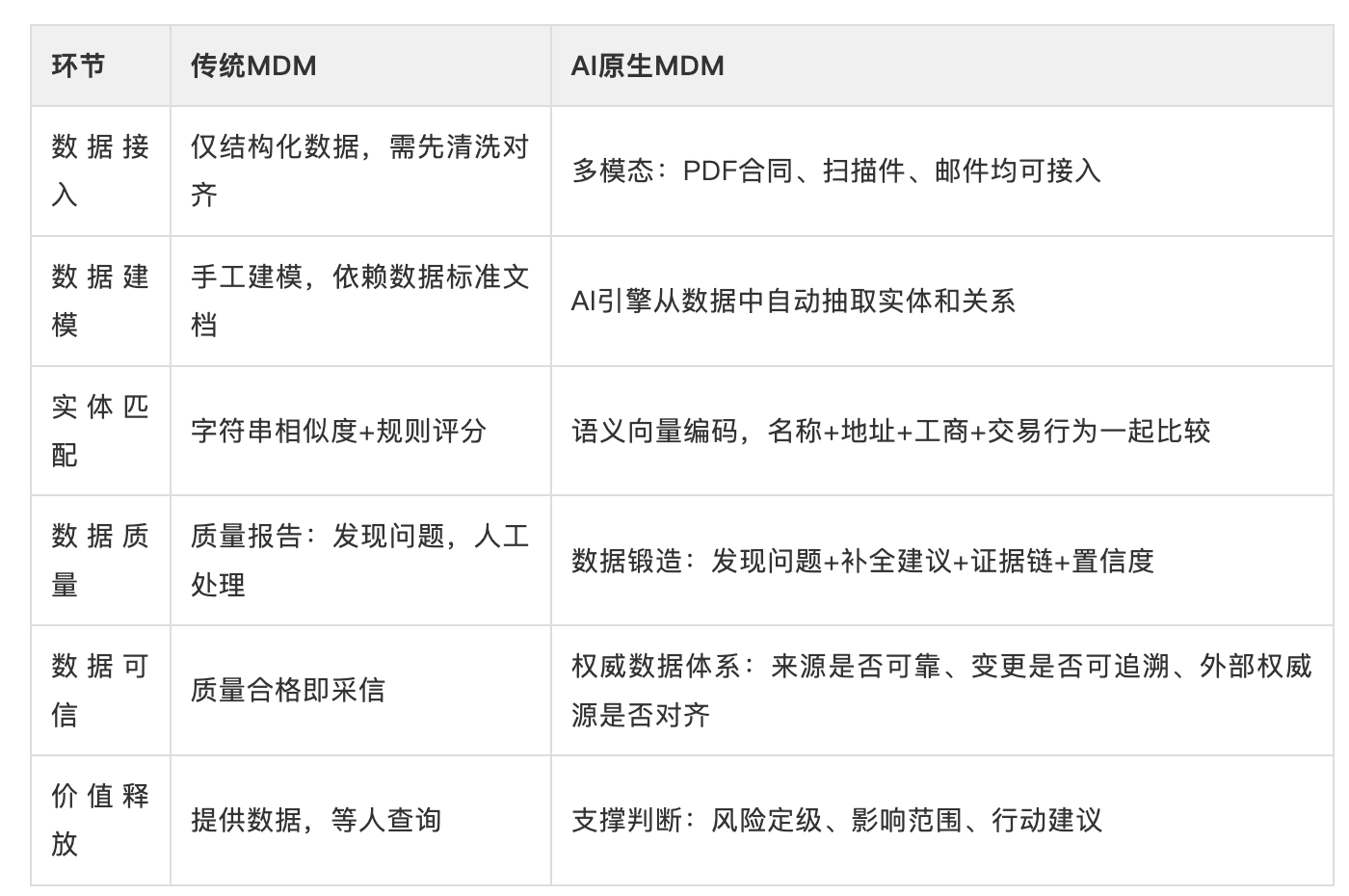
The first four changes focus on building high-quality master data, while the last two elevate master data from "passive records" to "active decision support".
Moving from "golden records" to "intelligent decision-making" defines the direction of master data management for the next two decades.
II. Why It Remains So Popular After 20 Years: Three Structural Reasons
Many people ask: Why is a concept that has been around for 20 years still being discussed repeatedly? Why is the market continuing to grow rapidly?
Because demand is not shrinking—it is expanding. Three structural factors explain this:
Reason 1: More Systems, More Chaotic Data
20 years ago, an enterprise might only have two core systems: an ERP and a financial system. Today? ERP, CRM, SCM, MES, PLM, WMS, OA, shared financial services, BI, data middle platform, AI platform... Large enterprise groups often operate dozens or even hundreds of systems simultaneously.
The more systems you have, the more data silos form, and the wider the scope of master data chaos. This is not an occasional problem caused by poor management—it is a structural contradiction inherent in the multi-system era.
As long as enterprises keep adding new systems—and cloud-native architectures, microservices, and SaaS adoption will only accelerate this trend—the demand for master data management will not disappear; it will continue to grow.
Reason 2: Data Factor Marketization Makes Master Data the "Asset ID Card"
In 2026, policies for incorporating data assets into financial statements were further implemented, the national standard DCMM 2.0 officially took effect on July 1, and operational guidelines for data property rights registration were issued.
What is master data? It is the unique and authoritative identifier for core business objects such as customers, suppliers, materials, organizations, employees, and products—in other words, it acts as the "ID card" and "root directory" for an enterprise's data assets.
Before you can record data assets on your balance sheet, you must first clarify exactly what data assets you own. Before you can value data assets, you must ensure their accuracy and consistency. Before data can be circulated and traded, you need a standardized, verifiable data source.
Master data is the starting point for all of this.
Without clean master data, incorporating data assets into financial records becomes a confusing mess. Without standardized master data, there are no "registrable objects" for data property rights registration.
Reason 3: Trustworthy AI Requires Master Data as Its "Foundation"
This is the newest and most powerful driving force.
For large language models to produce reliable reasoning results, they must be built on a single, accurate master data source. If AI pulls data from a "data swamp" filled with duplicates, contradictions, and outdated information, its outputs will inevitably follow the "garbage in, garbage out" principle.
MDM is evolving from a "back-end data management tool" to a "foundational enabler of enterprise AI strategy".
At the same time, AI is reshaping MDM itself:
Traditional MDM relies on manually configured rules for entity matching, while AI uses semantic vectors to automatically recognize that "St. John's Hospital" and "Sheng John Hospital" refer to the same entity
Traditional MDM generates quality reports and waits for human intervention, while AI directly provides data completion suggestions with confidence scores
Traditional MDM requires data administrators with specialized skills, while AI enables business users to query and manage master data using natural language
Traditional MDM can only process structured data, while AI-native MDM can automatically extract entities and attributes from PDF contracts, scanned documents, and emails
With expanding demand, technological upgrades, and policy support working in tandem, master data management is positioned for sustained growth.
III. Market Data Speaks: MDM Is One of the Fastest-Growing Software Segments
Perceptions aside, let's look at the actual market dynamics:
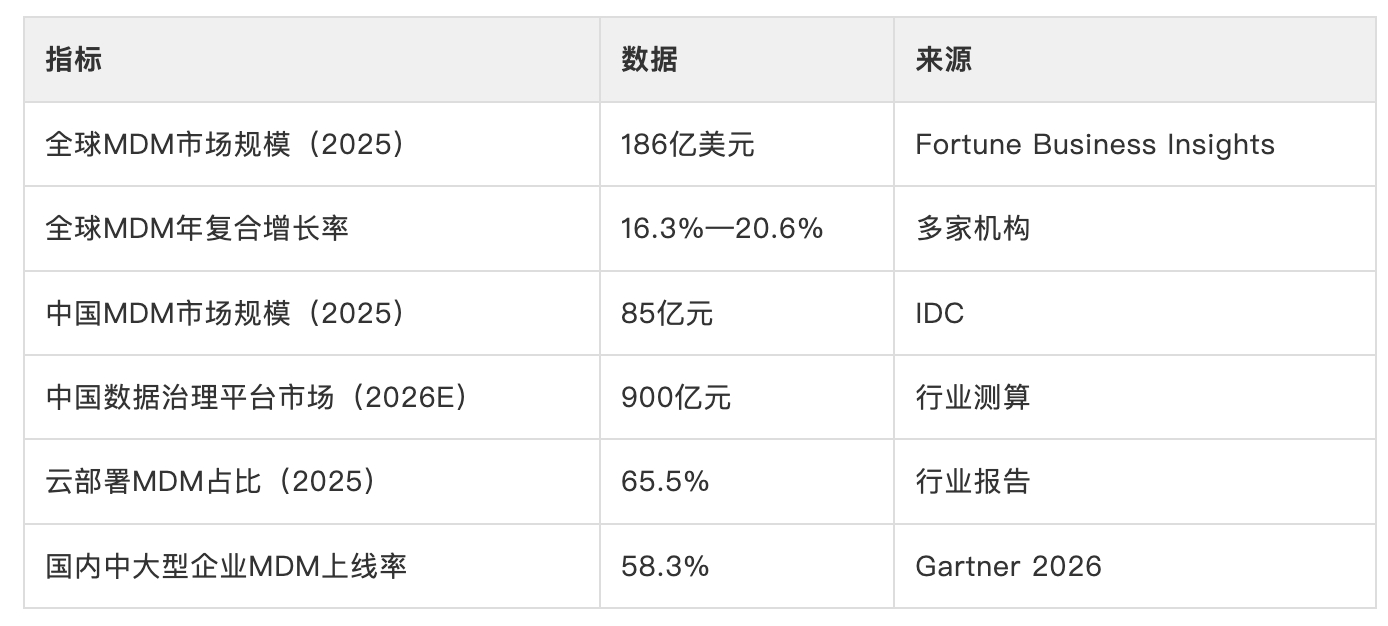
Several key signals stand out:
First, growth far outpaces the average for enterprise software. While the global enterprise software market grows at an annual rate of roughly 7-8%, MDM's growth rate of over 16% is more than double that average. This means MDM is not just growing alongside the broader market—it is accelerating its penetration.
Second, cloud deployment has become the absolute mainstream. A 65.5% cloud adoption rate indicates that MDM is shifting from "heavy implementation, long cycle" customized projects to "out-of-the-box, rapid iteration" SaaS models, significantly lowering the barriers for small and medium-sized enterprises to adopt MDM.
Third, there remains massive room for penetration in the domestic market. The 58.3% adoption rate among mid-to-large enterprises may seem decent, but it means over 40% of these enterprises have not yet implemented professional MDM. Combined with the near-zero adoption among SMEs, the incremental market potential is enormous.
Fourth, Asia-Pacific is the fastest-growing region globally. The digital transformation progress in China and India is the core driver, making Asia-Pacific the world's leading region in MDM growth.
A software segment that can stay popular for 20 years while maintaining over 16% growth is extremely rare in the enterprise software industry. This alone demonstrates that master data management is not an optional extra—it is critical infrastructure.
IV. The Domestic Localization Wave: Four Constraints for Chinese Enterprises
If the global MDM market is a grand game of chess, the Chinese market is its most unique board.
For Chinese enterprises, especially those in key sectors such as central SOEs, finance, government, and healthcare, selecting an MDM solution is not merely a technical choice—it is a strategic decision shaped by four layers of constraints:
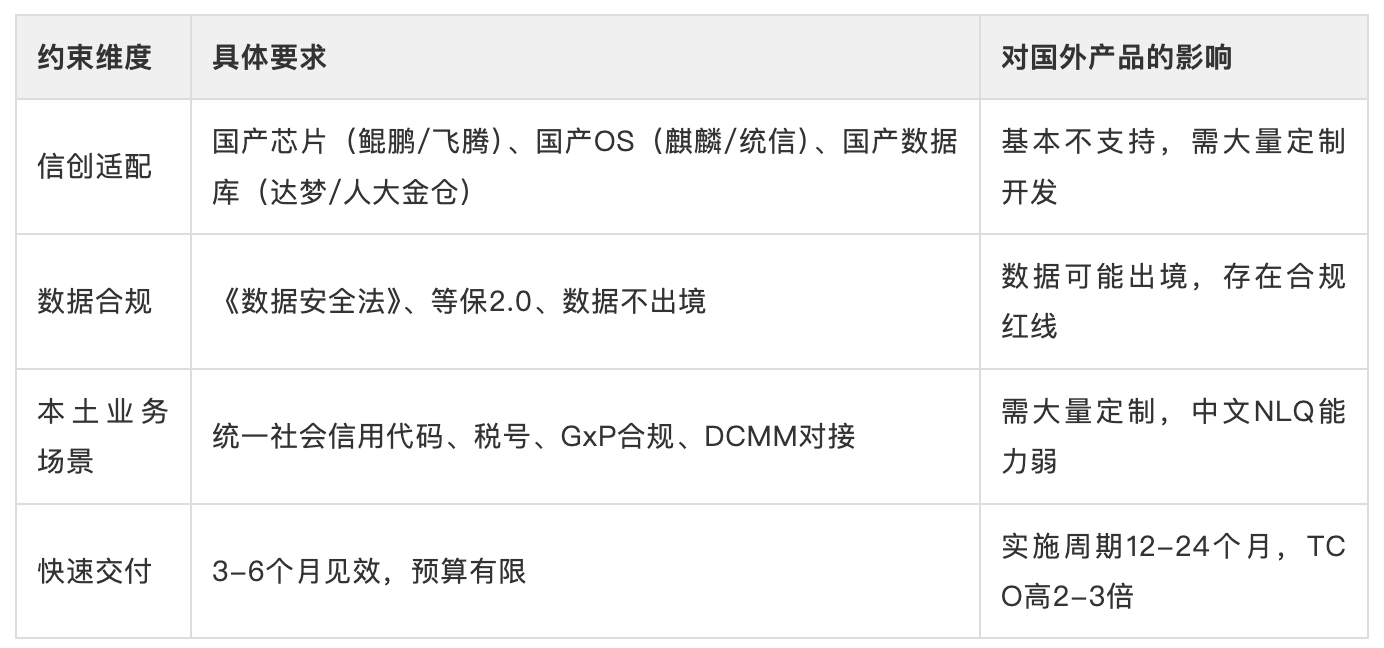
These four constraints are not soft "preferences"—they are hard "entry tickets".
Data shows that domestic MDM vendors are continuously gaining market share, and adaptation to the information technology application innovation ecosystem has evolved from an optional feature to a mandatory requirement. Yixin Huachen has ranked first in China's data governance solutions market share for four consecutive years and has been recognized by Gartner as a representative vendor in data asset management, data governance, and data fabric technologies. 3Vlife launched its independent MDM platform in 2002 and has iterated it for over 20 years to reach the current AI-native V14 version.
This is not a domestically driven substitution out of sentiment—it is an inevitable choice driven by practical constraints.
Objectively speaking, international leading products still hold accumulated advantages in global multilingual support, ultra-large multinational enterprise scenarios, and ecosystem integration with mainstream international cloud platforms. For enterprises operating globally that are deeply tied to the Salesforce/Workday ecosystem, foreign products may remain the better choice.
But for the vast majority of Chinese enterprises, the direction is already clear.
V. From "Golden Records" to "Intelligent Decision-Making": The Second Phase of MDM
Let's return to the opening case.
420,000 supplier records with 98% accuracy, yet one supplier crisis caused 20 million yuan in losses. The data was "correct", but the system did not "understand" it.
Traditional MDM was designed as a "system of records"—its task was to ensure data was accurate, complete, and consistent. Traditional architectures never truly covered what that data meant, what signals it was sending, who should be alerted next, or who should take action.
This is the fundamental reason why MDM has always felt "one step short" over the past 20 years.
AI-native architectures are filling this gap, manifesting in three dimensions:
Dimension 1: From "Qualified Quality" to "Authoritative and Trustworthy"
Meeting basic data quality standards does not guarantee that the data content is trustworthy. A field may be non-empty and formatted correctly, but if its source has never been verified, it should not be accepted unconditionally.
AI-native MDM introduces an "authoritative data system"—tracking whether each data source is reliable, whether changes are traceable, and whether the data remains aligned with external authoritative sources. The standard is no longer "formatted correctly" but "sourced reliably".
Dimension 2: From "Providing Data" to "Supporting Judgment"
A highly trustworthy, complete, and traceable golden record only delivers potential value if it remains passively waiting for someone to look it up.
AI-native MDM builds a domain knowledge model (ontology) on top of the standard master data model, giving the system a foundation for reasoning. Instead of merely "providing data", the system understands the business implications behind changes and translates that understanding into actionable recommendations tailored to different roles.
Business teams no longer receive just a master data approval request asking them to "review"—they get a decision brief that already includes risk ratings, impact scopes, evidence chains, and recommended actions.
Dimension 3: From "Expert Tool" to "Full Participation"
Traditional MDM was the work of a small number of experts—requiring data administrators to configure rules, write scripts, and execute cleansing processes.
AI-native MDM makes natural language interfaces possible. Business users do not need technical expertise—they can simply ask the system "Show me the most recent audit date for all Class A suppliers in East China" and get an accurate, real-time answer.
Data governance transforms from "an IT department project" to "a practice in which everyone participates".
These three layers of change extend the value realization path of master