ByteDance Reinvents "Baidu Apollo"
A month ago at Beijing's 751 Park, AIVA rolled a concept car named Origin Concept onto the stage. A bold line was displayed on the screen: Integrate AI life forms into the physical world and let them grow freely.
This was no ordinary new car launch event. Instead of starting with range, chassis or 0-100 km/h acceleration, AIVA announced a partnership with Volcano Engine to jointly define, design and build an "AI car". What Volcano Engine offered was more than just a chat-enabled Doubao assistant: it aimed to connect large models, cloud services, in-vehicle infotainment systems and various onboard services, enabling an Agent to understand human intentions and then call up navigation, vehicle control and even driving-related capabilities.
A month later, another puzzle piece fell into place. On July 13, 36Kr reported that ByteDance was exploring autonomous driving, with the project involving the Seed team's world model and unmanned delivery, potentially advancing under Volcano Engine's automotive business line, currently in the preparation and recruitment phase. ByteDance's response was restrained: Physical AI is an early research direction of the Seed team, and the company has no plans to develop intelligent driving businesses.
As if the final pieces of a puzzle had been tipped out of the box, industry insiders began to wonder: Is ByteDance trying to recreate Baidu Apollo?
The answer is unlikely to be as simple as "ByteDance wants to develop its own autonomous driving algorithms". What ByteDance truly aims to replicate may not be Apollo's technical stack, but the industry position Apollo sought in 2017 before gradually ceding ground: becoming an external AI hub for automakers.
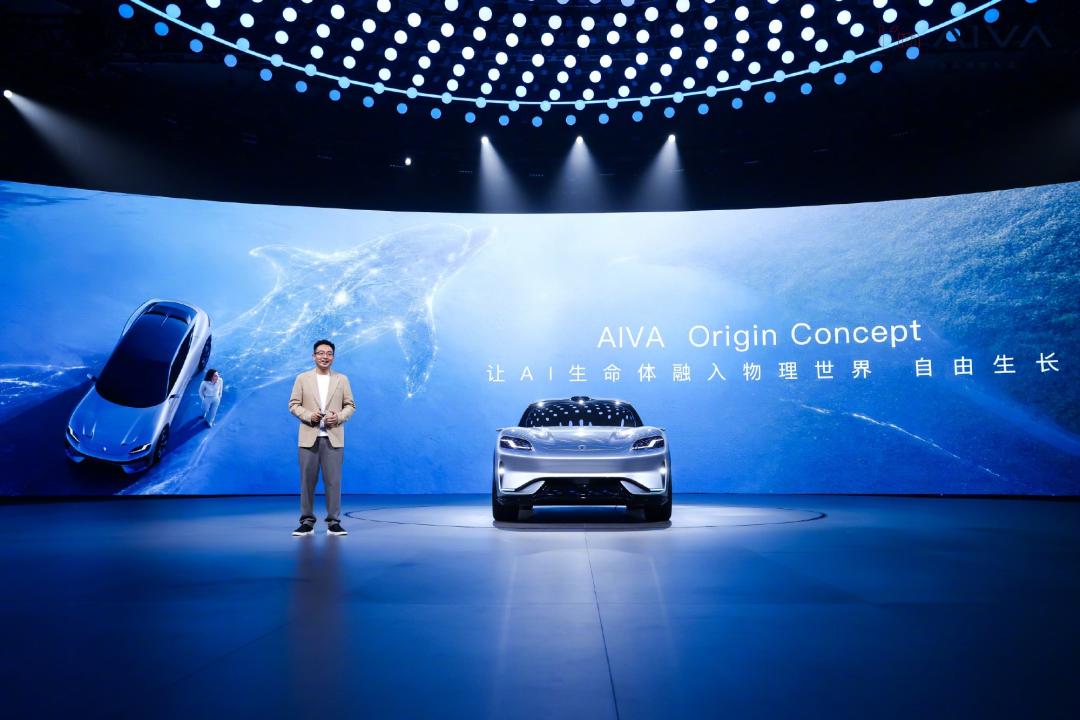
Figure 1: AIVA Origin Concept unveiled on June 9, 2026
Half of Apollo is already in the car
If you only focus on "whether ByteDance is doing autonomous driving", you'll easily underestimate how far it has come in the automotive space.
The automotive solutions showcased on Volcano Engine's official website already cover automotive data, smart cockpit and autonomous driving data closed-loop. Its autonomous driving cloud extends from data storage, analysis and labeling all the way to training, simulation and evaluation. In other words, the cloud toolchains automakers need to train driving models are not something ByteDance is building from scratch.
On the user-facing side, Doubao has already made its way into vehicles. Volcano Engine disclosed during the 2026 Beijing Auto Show that the Doubao large model has been deployed in over 7 million vehicles, covering more than 50 brands and 145 models, with over 30 million daily in-vehicle interactions. An important distinction must be made: 7 million vehicles equipped with Doubao do not equal 7 million vehicles feeding driving data back to ByteDance. Most connections currently occur at the voice, content, navigation and service layers, not at the perception, planning and control layers.
Yet the value of this entry point is evolving. Traditional in-vehicle voice assistants only answered questions; Agentic AI aims to first determine where you want to go and why, then call up maps, air conditioning, seats, entertainment and other in-vehicle capabilities to complete tasks. Volcano Engine summarizes this architecture as "One Car, One AI", with the core being three engines - conversational reasoning, goal-driven operation, and learning evolution - sharing a single "brain". In AIVA's narrative, this brain will further extend to vehicle control and intelligent driving.
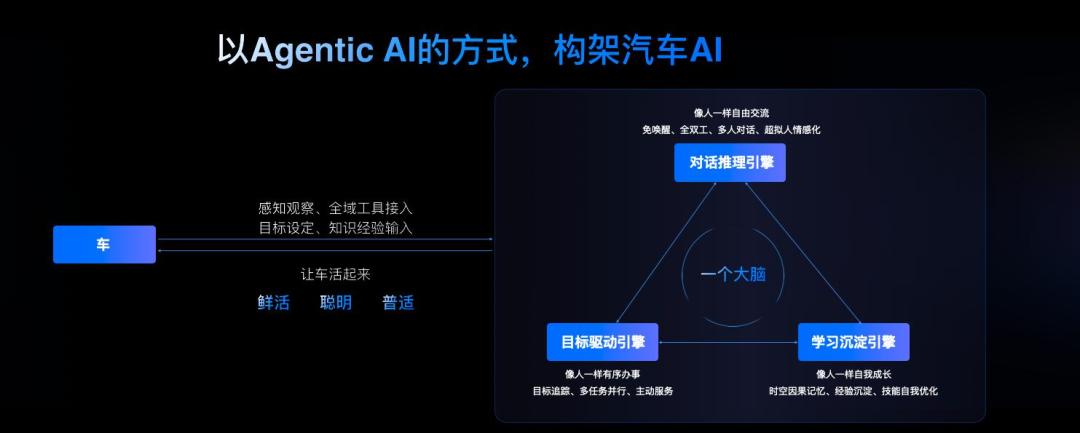
Figure 2: Volcano Engine's 2026 automotive AI architecture. Image source: Volcano Engine launch event, reposted by Beijing Daily
The Seed team complements this with another set of capabilities. Its official research directions already include multimodal interaction and world models; Seed3D 2.0 emphasizes generating 3D assets usable for simulation, while Seedance 2.0 is used by Volcano Engine to demonstrate embodied interaction data, robot tasks, and the ability to synthesize long-tail scenarios like extreme weather and collisions.
Stepping back, ByteDance is accumulating three non-negotiable building blocks for automotive AI: models that understand humans, cloud infrastructure for training and simulation, and the ability to generate physical world data. The unmanned delivery exploration reported by media may add real-world mobility to its portfolio.
However, generating a video of rain and snow is a far cry from enabling a car to drive reliably in those conditions - the gap includes sensor calibration, planning and control, vehicle engineering, safety validation and liability for accidents. World model papers are not production-ready solutions, and synthetic data cannot automatically turn into effective driving data. So far, the public has not seen ByteDance's public road test fleet, a complete perception-prediction-planning-control stack, or a designated production driving project by automakers. This means the Seed team's solutions are indeed still some distance from real-world deployment.
So a more accurate statement is: ByteDance has already built half of Apollo. It has the cockpit entry point, cloud tools and model capabilities, and is testing whether these can be connected into a "perception-understanding-action-feedback" closed loop; what's missing is exactly the heaviest, slowest and most accident-prone half.
Baidu failed to build "Android for cars"
To understand how ByteDance arrived here, we need to go back to 2017.
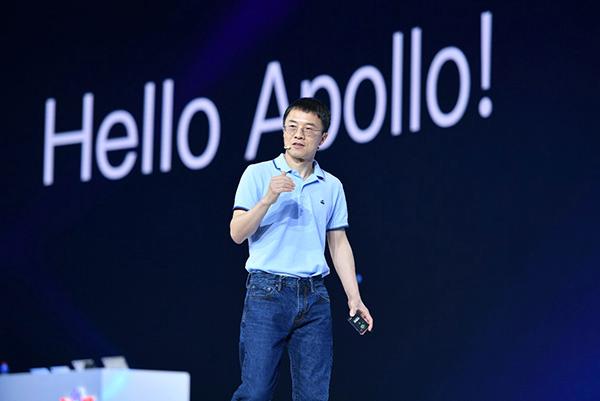
Figure 3: The 2017 Apollo launch event. Image source: Baidu
In July of that year, Baidu Apollo 1.0 was officially open-sourced. Standing at the launch site, Lu Qi called Apollo the "Android system for the automotive industry". This claim was not an exaggeration at the time. Smart cars lacked a widely accepted technical foundation, and most automakers could not independently develop high-precision maps, perception, decision-making, control, simulation and cloud platforms. Baidu connected vehicles, hardware, software and cloud services into a blueprint, and open-sourced some code and capabilities to the industry - essentially drawing a city plan on a blank construction site.
Apollo thus got off to a blazing start. In September 2017, Baidu announced a 10 billion yuan "Apollo Fund" to be invested over three years, adding 17 new partners at the same launch event. Official disclosures showed that less than two months after Apollo's opening, over 1,300 institutions had downloaded the open-source code, and nearly 100 had applied for open data. Back then, Baidu had both the AI talent accumulated from its search era and high-precision mapping and cloud capabilities - there was hardly another organization of comparable scale among Chinese internet companies.
But cars are not phones, and autonomous driving is not just a skinned version of Android.
Mobile operating systems can encapsulate relatively stable hardware differences and form network effects through app stores. Autonomous driving, however, is directly tied to cameras, LiDAR, chips, steer-by-wire chassis and vehicle parameters. When an algorithm is ported to a new vehicle, it often requires re-calibration, testing and certification; while code can be open-sourced, automakers' road data, takeover records and long-tail accidents will not naturally flow into a public pool. Open source lowered the threshold for building prototypes, but it did not absolve anyone of production liability.
Even more intractable was Baidu's own identity conflict. Apollo wanted to be a neutral open platform, while also selling maps, cockpit and driving solutions to automakers, and operating its own Robotaxi fleet. For automakers, handing over data, user entry points and product definition rights to a partner that might one day become a competitor made them hold back. Baidu later formed Jidu with Geely and launched vehicles under the Ji Yue brand, hoping to use its own "demonstration car" to connect products and data; when Ji Yue fell into operational crisis in 2024, this shortcut to showcase platform capabilities was cut off.
Apollo certainly did not disappear. It is still updating its open platform, and Apollo 11.0 has formed a four-layer architecture of hardware devices, software core, applications, tools and cloud; Baidu's mapping, cockpit and assisted driving capabilities are still present in the industry. But its position in Baidu's public narrative has clearly shrunk.
In its Q1 2021 earnings report, Baidu was still listing L4 testing, Apollo Go, Jidu, autonomous driving solutions adopted by over a dozen automakers, and DuerOS automotive business when talking about Apollo; in Q3 2022, ANP, AVP, high-precision mapping and Apollo Go still appeared side by side. By Q2 2025, all intelligent driving progress in the earnings report was centered on Apollo Go's orders and urban expansion; in the full-year results released in February 2026, the relevant section was simply titled "Robotaxi".
This does not mean Apollo suddenly became a single business, but that Robotaxi became Baidu's only fully controllable, continuously measurable closed loop that was easiest to present to the capital market. The vehicles are its own operating assets, the algorithms are updated in-house, road data flows back to its own servers, and dispatching and passengers are all within its system. In Q4 2025, Baidu stated that Apollo Go provided 3.4 million fully driverless rides, with over 20 million total orders; by Q1 2026, the business had expanded to 27 cities, with cumulative orders exceeding 22 million. At least here, Baidu does not have to wait for automakers to return data.
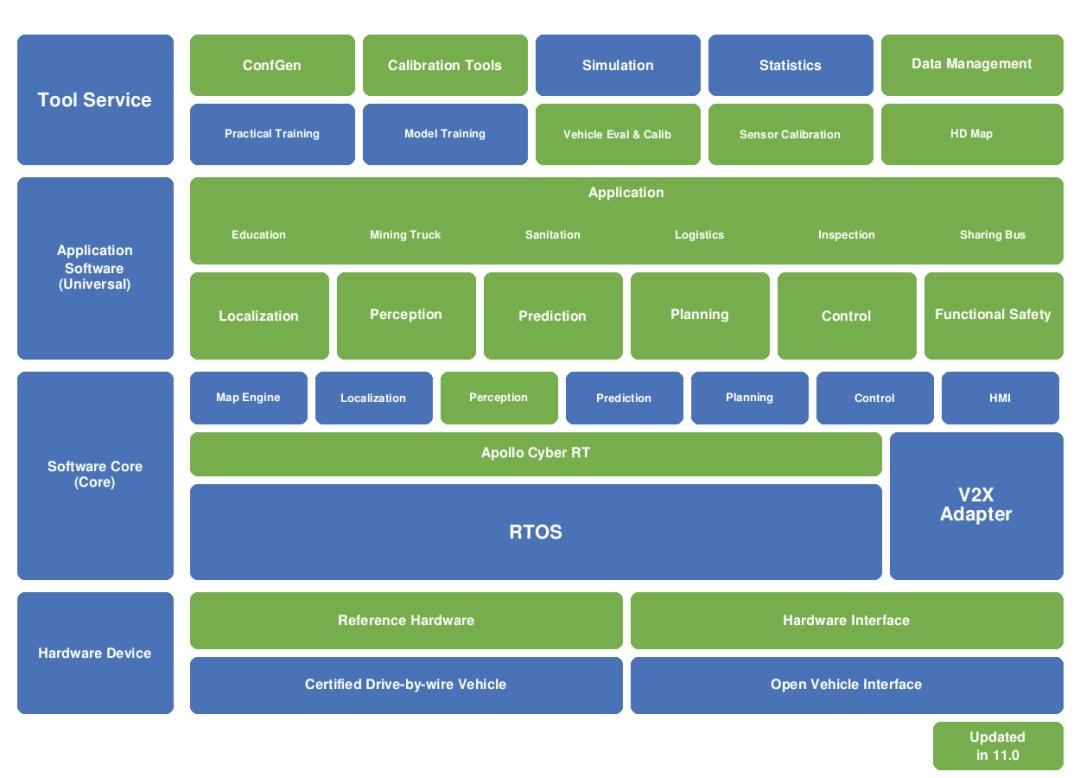
Figure 4: Apollo 11.0 open platform architecture. Image source: Baidu Apollo official documentation
Therefore, what "disappeared" over the years was not Apollo's technology, but the grand promise of "Android for cars". A platform that aimed to serve the entire industry ended up with its strongest business being Robotaxi, which fully owns its vehicles, scenarios and data. This lesson from the transition is more valuable to ByteDance than Apollo's code.
Will ByteDance repeat Baidu's mistakes?
ByteDance and Baidu started from exactly opposite directions.
Baidu dived deep into the core of autonomous driving, working on perception, planning and control first before expanding to mapping, cloud and cockpits; ByteDance secured cloud, large models, content ecosystem and cockpit interaction first, then worked its way down to find vehicle control and driving interfaces. The former moved outward from the steering wheel, the latter pressed down from screens and servers toward the wheels.
The advantage of this approach is its light footprint. ByteDance does not need to build a Robotaxi fleet from day one, nor commit to full vehicle safety responsibility. It can serve automakers through Volcano Engine, enter cockpits via Doubao, and validate deeper in-vehicle capabilities through AIVA or unmanned delivery. As long as the Agent masters user intentions and can call up sufficient in-vehicle tools, it can become a "task dispatcher" in the car. Whoever controls task dispatching gets the chance to redistribute entry points for maps, content, services and even driving functions.
Coincidentally, technological maturity has also given ByteDance an opening to enter intelligent driving: traditional autonomous driving relied more on hybrid software-hardware solutions combining vision models and LiDAR, but as large model research and technology have matured in recent years, world models (or physical models) are offering vehicles a potentially lower-cost path. Of course, this cost advantage only applies after a winner takes all, as R&D costs remain extremely high. But for ByteDance, which already leads in multimodal interaction and world models and has an exceptionally strong talent pool, seizing a market that has already been validated by players like Baidu, Pony.ai and WeRide is no impossible feat.
On the other hand, the risks ByteDance will face are almost all written into Apollo's history.
First, automakers will not automatically hand over data and control just because models are smarter. Today's large automakers are more wary of internet platforms than they were in 2017, and more willing to develop their own intelligent driving and cockpit systems. Second, there is a liability wall between cockpit data and driving data: when a user says "speed up", the Agent can understand their intention, but cannot bypass traffic rules, vehicle status and safety redundancies to execute the command directly. Third, the closer ByteDance gets to planning and control, the harder it will be to maintain its identity as a "neutral cloud service provider". It needs all automakers to feel safe connecting to its systems, while gaining model advantages from cross-brand data - two inherently conflicting goals.
There is also a counter-argument: the so-called ByteDance autonomous driving initiative may just be an extension of Physical AI research and Volcano Engine's business, prematurely packaged by the market as a strategic project. This judgment holds up for now. ByteDance has explicitly denied plans to develop intelligent driving businesses, AIVA remains a concept car, and the team reported by media is still in early preparation. The fact that world models, video generation and autonomous driving share the technical term "understanding the physical world" does not mean they will automatically merge into a single business unit.
Therefore, what we should actually watch for in the next 1-3 months is not whether ByteDance will announce a flashy new brand, but three more concrete actions: whether Volcano Engine recruits leaders for perception, planning and control, and simulation closed-loop; whether AIVA or the unmanned delivery project sees real road testing and safety driver systems; and whether automakers connect Doubao from cockpit Q&A to navigation, vehicle control and even intelligent driving functions, allowing training feedback to flow back into ByteDance's model systems.
Without these actions, ByteDance remains a cloud and model supplier entering the automotive space, and "recreating Apollo" is just a fantasy. If these actions happen one after another, what it is competing for will be more than just an in-vehicle screen - it will be the AI control plane of the next generation of automobiles.
What's interesting is that ByteDance is not facing a blank field like 2017 today. Huawei has proven that automakers are willing to pay for an external intelligent system that can be mass-produced, sold in vehicles, and continuously upgraded; NVIDIA, Qualcomm and Horizon Robotics have secured their positions in chips and toolchains; large automakers regard data closed-loop as their lifeline. Whether ByteDance can catch up depends not on whether it can write another version of Apollo, but on whether it can design a partnership model that can access sufficient data without making automakers feel like they are giving away their "souls".
Baidu open-sourced code back then, but ended up retaining its fleet. ByteDance has models, cloud and entry points today, but still lacks feedback generated from real-world operations.
The hardest part of Apollo to replicate was never the code - it was who ended up with the data when the wheels started turning.