Humanoid robotics company LimX Dynamics completes $200 million Pre-IPO financing, reaching a post-money valuation of 15 billion yuan | Frontline
Author | Huang Nan
Editor | Yuan Silai
36Kr has learned that LimX Dynamics, a general-purpose humanoid robotics company, has announced the completion of its Pre-IPO funding round, raising nearly $200 million. Investors in this round include IDG Capital, Lens Technology, GGG Group & Redstone VC, Hua Capital, Hefei Binhu Industrial Development Group, among others. In addition, UAE-based Stone Venture has followed on in multiple consecutive rounds, while existing shareholders including Oasis Capital, Jizhi Capital, Nanshan Strategic Emerging Investment, Shangqi Capital, and Nio Capital have made over-subscribed additional investments.
The raised funds will be primarily allocated to advancing breakthroughs and commercialization in brain-cerebellum fusion technology, driving large-scale deployment of thousands of fully autonomous humanoid robots, and accelerating global market expansion. The company will further enhance its global manufacturing and delivery capabilities, accelerate its layout in key markets including the Middle East, Europe, and other regions across Asia, and continue to build an open ecosystem for global developers.
Following the completion of this funding round, the company's post-money valuation has reached 15 billion RMB, with total financing over the past six months amounting to $400 million. LimX Dynamics completed its share reform in March 2026. According to sources familiar with the matter, the company launched its IPO process earlier in early 2026.
In recent years, as embodied intelligence has entered a critical phase of large-scale development, LimX Dynamics, based on a full-stack technology roadmap, has maintained continuous R&D investment in robot hardware, AI infrastructure, and embodied agent operating systems, establishing a complete technical system covering motion generation, model training, cognitive decision-making, and real-world deployment.
Currently, the company has developed a three-tier technical architecture that encompasses the System 0 full-body motion foundation model, System 1 humanoid robot VLA/WAM capabilities, and System 2 embodied agent operating system (COSA) powered by large language models and world models.
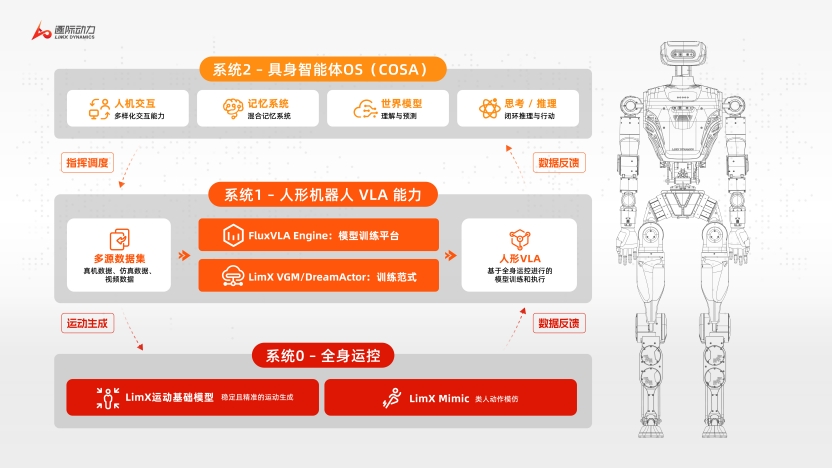
LimX Dynamics' three-tier technical architecture (Source / Company)
As a core component of LimX Dynamics' System 1, the FluxVLA Engine is positioned as an enterprise-level open-source platform, providing global developers with a complete end-to-end infrastructure that covers data processing, simulation training, real-robot iteration, and hardware deployment.
For a long time, most R&D teams in the industry have had to invest massive manpower to repeatedly build underlying engineering pipelines when training embodied models. The FluxVLA Engine integrates all these processes through a standardized, modular toolchain, allowing developers to focus on algorithm innovation in VLAs, world motion models, and other areas, rather than expending effort on reconstructing underlying engineering systems.
According to LimX Dynamics' vision, the future of embodied intelligence will not be dominated by a single unified super model that covers all scenarios, but will feature a large number of vertical, small-to-medium specialized model applications tailored for different tasks. The FluxVLA Engine is designed to drive the industry transition from a state where "only a small number of teams master model training capabilities" to an inclusive, low-barrier embodied intelligence R&D ecosystem.
Leveraging the aforementioned technical system, LimX Dynamics is accelerating product R&D and commercial implementation. Since the launch of its robot product line, the company has secured thousands of orders in total, over half of which come from overseas markets. The company is collaborating with global developers and ecosystem partners to advance commercial deployment across scenarios including scientific research and education, commercial services, all-terrain inspection, industrial applications, construction, and more.
In May this year, LimX Dynamics officially launched LimX Luna, a full-size interactive humanoid robot. Luna features a 160cm full-size human-proportion design, is equipped with 27 degrees of freedom, and runs the in-house developed System 0 full-body motion control foundation model, enabling precise coordinated control of all its body's degrees of freedom.
Backed by the upgraded motion control system and optimized motor performance, Luna can not only stably execute a variety of highly complex movements, but also perform model-style catwalks and dances in multiple styles. Less than a month after its product launch, batch deliveries to domestic and international customers were completed, demonstrating the company's rapid capability to transition from product release to mass production delivery.

LimX Dynamics' full-size interactive humanoid robot Luna was officially launched in May (Source / Company)
The TRON 2, a new-generation multi-form embodied robot launched concurrently, targets developer communities in scientific research, industry, inspection, and related fields. Its core innovation lies in the original "full-body modular architecture", which features a single robot body that can be freely combined into multiple forms. Through modular assembly, it can flexibly switch between configurations such as dual-arm, bipedal, and wheeled-legged forms, adapting to diverse needs ranging from precise manipulation to complex terrain navigation. Equipped with comprehensive development interfaces and supporting training tools, TRON 2 grants developers full secondary development access, and has already secured batch orders from domestic and international markets since its release.
Moving forward, LimX Dynamics will continue to strengthen its technological advantages in brain-cerebellum fusion, advance the construction of its robot mass production system and global layout, further improve its global supply chain and delivery capabilities, and accelerate the technological innovation and industrialization of embodied intelligence.