Dialogue with ZHAO Tiancheng from Om AI: Years of Persistence, Betting on the "Streaming" Future of Physics-Native AI
A multimodal model that has never been exposed to surveillance footage outperforms veteran small models trained on surveillance data for years in understanding monitoring scenarios. This is not a scene from a sci-fi movie, but an unexpected breakthrough achieved by Om AI in 2023. It also marked a pivotal moment where Dr. Zhao Tiancheng, CEO and Chief Scientist, became more convinced that "multimodal training methods can bring generalization capabilities to the open physical world." Back then, the AI industry was fully focused on pursuing generative AI centered on large language models.
Three years later, this multimodal model has evolved into VLX — the world's first edge-side streaming multimodal model series dedicated to physical AI. It pioneers the brand-new "edge-native streaming multimodal" architecture, which was designed from day one to adapt to the computing constraints of edge devices. With this architecture, the VLX model has for the first time closed the full-loop of physical AI on edge devices: "continuous perception + precise localization + action decision-making".
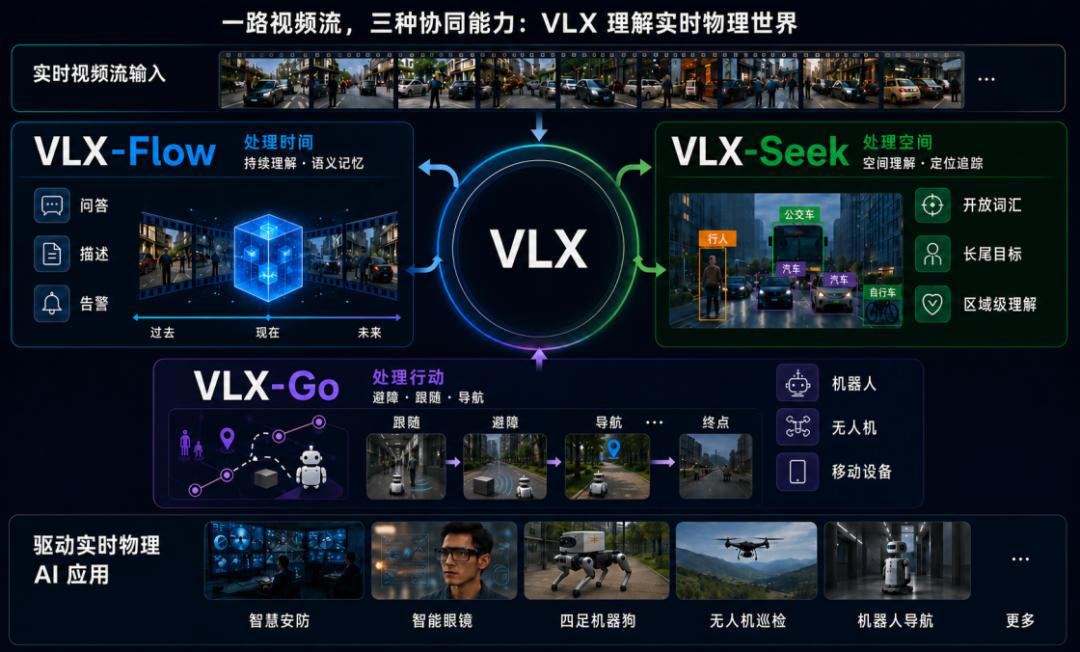
VLX Overview Diagram
Undoubtedly, as we stand at the summer of 2026, the AI industry's focus has begun shifting from digital AI to physical AI. Unlike 2023, which was the boom year for digital AI, physical AI today is gaining widespread attention but remains in an unconsolidated state with multiple technical paths coexisting, still far from large-scale production deployment: language-centered VLA, pixel-centered video generation, simulation centered on 3D structures, and JEPA centered on visual representations... The industry is still wavering over the two mainstream conceptual paths of VLA and world models — will one replace the other, will they coexist, or will they eventually merge?
While the industry is still debating which path represents the ultimate answer for physical AI, Om AI's VLX series has already completed the commercial closed loop of physical AI from simulation experiments to industrial implementation. By equipping robots, drones, wearable devices, security cameras, AI PCs and other physical end devices with the "cerebellum" for autonomous perception and the "cerebrum" for cognitive decision-making, these devices can achieve a leap from "passively executing commands" to "actively adapting to scenarios".
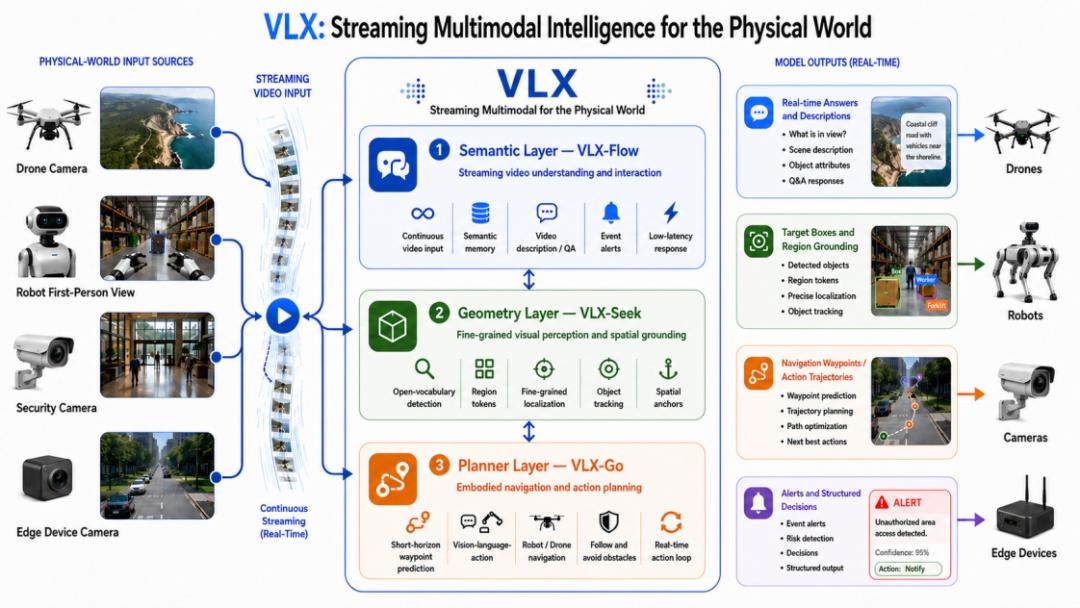
VLX Architecture Diagram
This is no accident — it is the inevitable outcome of Om AI's years of focused dedication.
In 2019, when Zhao Tiancheng graduated with a doctorate from Carnegie Mellon University's Language Technologies Institute, his resume was already impressive: his lab advisor Maxine Eskenazi was the founding pioneer of dialogue systems, who developed the world's first practical conversational agent back in the 1990s. Zhao himself was the creator of the lab's third-generation system, and in 2016, he led the transformation of the 20-year-old legacy system into an end-to-end generative model using neural networks. At that time, becoming a professor in academia or joining a top tech company would have been easily within his reach.
But he chose the third path — entrepreneurship. And it was a path that almost no one understood at the time: instead of developing pure text large models or chasing the generative AI boom, he focused relentlessly on "vision + language" streaming multimodal technology. Even today, this is not a mainstream technical path. The industry's dominant narrative is "offline frame sampling": video is treated as a sequence of extracted images for processing, with inference being batch, discrete, and question-answer based. But from the very beginning, what Zhao Tiancheng aimed to build was "streaming": video flows into the model continuously like a stream of water, and the AI keeps observing on its own, without waiting for human queries.
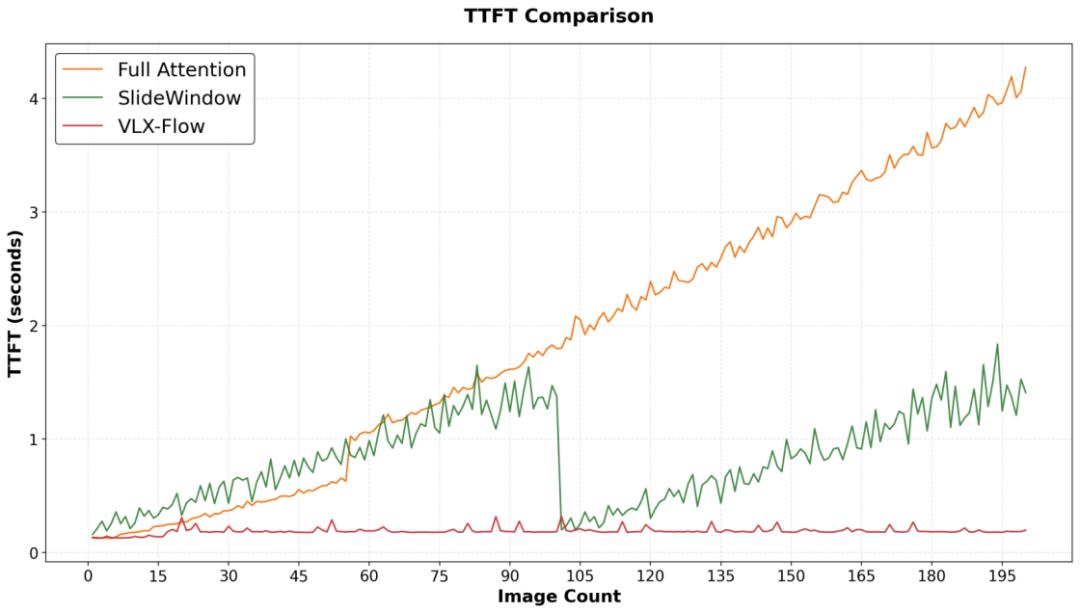
Flow Inference Speed Advantage
This was Zhao Tiancheng's own judgment. During his time at CMU, he participated in Yahoo's $1 billion multimodal agent project, "which made me realize that the upper limit of multimodal value is far higher — it truly makes you feel like you're interacting with something alive, not just a dialogue system." After returning to China, he did not follow the generative dialogue model trend that most domestic AI companies were flocking to, but firmly committed to integrating vision and language, "these two are the primary modalities, covering at least 90% of all physical information."
Over the past five years, the AI industry has seen at least three or four waves of "hottest tracks" come and go, from text generation to text-to-image, from VLA to world models. When language models exploded in 2023, someone asked him, "You used to work on language models, why not build your own?" At every wave, capital and peers advised him to "switch tracks for faster monetization."
"Our technology never became the hottest thing before the physical AI era," Zhao Tiancheng admitted. "There was always something trendier in front of us." Some team members lost confidence and left, but more core partners stayed. The remaining team members, day in and day out, kept delivering results centered on the two core pillars of "V (vision) and L (language)".
Five years later, the AI industry is now calling for a shift "from the cloud to the ground", to dive into real industries and deliver tangible value, making physical AI the most popular concept: in the first half of 2026, global financing in the physical AI sector exceeded $6.4 billion in a single quarter. Physical AI has also begun to be deployed in multiple scenarios, with the intelligent upgrading of industrial robots, the large-scale adoption of urban autonomous driving NOA, and the rapid penetration of edge-side intelligent terminals... But in this wave of physical AI, the VLX series is one of the very few streaming multimodal models that run on edge devices. It answers a fundamental question: what architecture does AI in the physical world really need?
The VLX series is one of the few solutions that has successfully closed all three core loops: the model loop, where VLX's Flow+Seek+Go forms an integrated system for perception — localization — action, not three separate models, but three inseparable capability layers on a single video stream; the data loop, where millions of cameras, drones, robots and other real business scenarios continuously feed back edge-side data to fuel iterative model improvement; the commercial loop, where product-market fit (PMF) is achieved, driving the company's revenue to the hundred-million-yuan scale.
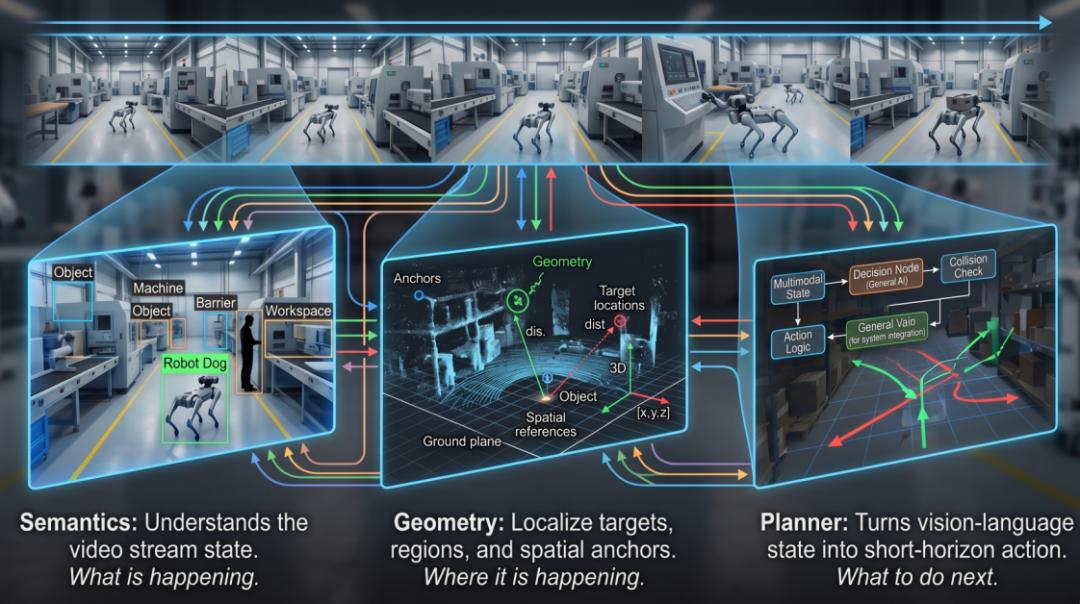
VLX Three-Tier Definition
As the industry's demand curve intersects with the technology accumulation curve in 2026, a "mutual realization between long-termism and industrial inflection point" is officially unfolding. Now that physical AI has finally moved from the "concept hype phase" to the "scenario validation phase", Zhao Tiancheng and his team appear remarkably calm. This is not a story of trend-chasing, but a business case that demonstrates judgment, perseverance, and a years-long validated "anti-consensus" insight.
Below is the edited conversation between 36Kr and Zhao Tiancheng:

Dr. Zhao Tiancheng, CEO and Chief Scientist of Om AI
The Essence of Physical AI: Modality, Semantics, Geometry, Prediction and Decision-Making
36Kr: Physical AI is extremely popular this year, and the world model is its hottest technical path, but the field is fragmented with conflicting views. How do you see this situation?
Zhao Tiancheng: Physical AI itself is a grand theme. From the model perspective, no matter which path you take, the key is to enable the model to understand the world, which is not a single-point task. Just like the blog post Li Feifei published recently, she discussed three paths for physical AI, and these three paths will eventually merge rather than remain discrete.
According to our definition, physical AI must have at least four capabilities: first, the model needs to recognize the content within the data, that is, semantic information; second, it needs to understand geometric space, knowing what 3D shapes look like; third, it must be able to make decisions and control actions; fourth, based on the first three capabilities, it must be able to predict the future.
The reason why our newly released model is called VLX is that X represents infinite possibilities, which at least encompasses the four capabilities I just mentioned. The popular claim online right now that "VLA is dead, and the world model has arrived" is mostly hype. How could the three modalities of VLA become obsolete? The concept of Vision-Language-Action will never become outdated, but the specific implementation methods will definitely keep evolving. It is fundamentally wrong to equate implementation methods with the core concept. Therefore, our philosophy is to focus on the essence rather than superficial trends. The essence is the four core modalities we mentioned: when we master all four capabilities — semantics, geometric space, perception and planning, and prediction — physical AI will truly arrive.
Physical AI is a multidimensional matter. For example, prediction is just one of its dimensions, but this dimension has rarely been explored before and is extremely difficult. Predicting how future scenes will evolve is what the world model focuses on, which is a trending topic now, but this capability is essentially a new function built on the basic capabilities of semantics and geometry.
36Kr: What should be the first principle of physical AI?
Zhao Tiancheng: The first principle of physical AI essentially depends on what you aim to achieve. At Om AI, we want to build physical agents that can perceive, make decisions and execute actions in the physical world. I hope drones, quadruped robots, and other physical end devices can become highly intelligent, interact with each other, and complete tasks effectively. The most important thing is to figure out what capabilities are still missing to achieve this goal. Currently, language interaction has become increasingly mature and rarely causes problems, but when it comes to open environments, whether these devices can navigate autonomously, operate dexterously, and interact with different objects was almost impossible before.
For example, physical interaction scenarios have extremely high real-time requirements for end devices, which need a decision-making center to make quick decisions. Through the visual center, they receive external information in real time, and then the decision-making center can independently decide what to do at the moment, such as opening a door or speaking.
Therefore, the current physical AI is like a building that only has a frame but lacks many bricks, requiring different teams or enterprises to contribute to building a complete physical AI system. It is unrealistic to expect a single model to solve all physical AI problems, which also violates the first principle. The human brain is divided into different functional regions. Even the current powerful large language models are divided into different functional modules at the application layer. Physical AI is far more complex, so it requires the collaborative effort of the entire industrial ecosystem.
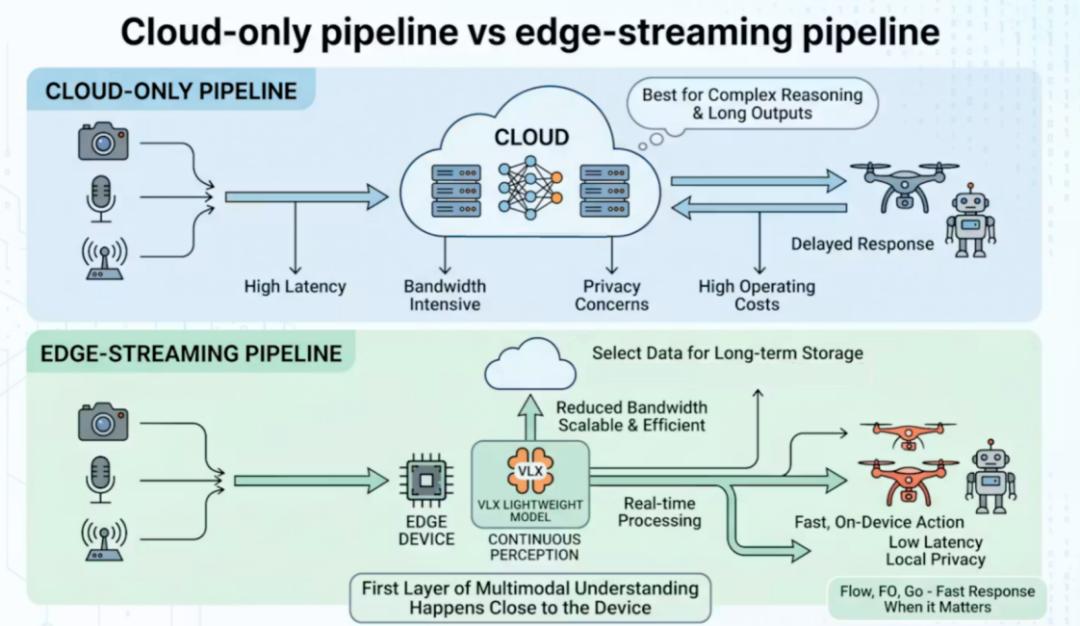
The Difference Between Cloud AI and Edge AI
36Kr: In your opinion, what is the biggest bottleneck for different technical paths in the implementation of physical AI at the methodological level?
Zhao Tiancheng: World models or other cloud-based models have great value. But in the end, when physical AI is widely adopted, it will definitely require strong edge-side intelligence — this is what we firmly believe. Because the physical world is all about interaction, which can lead to serious consequences. A typo in code may not cause much harm, but if a robot suddenly freezes or falls, the consequences can be severe, just like autonomous driving, where a sudden malfunction while the car is running is unthinkable. In the future, many physical end devices will become partners in our daily lives, and having all of them controlled by a single central brain would be terrifying, just like the villains in sci-fi movies: once you take control of one AI, all devices become tools to hold humans hostage.
Therefore, we advocate for distributed intelligence, just like humans, where each brain is independent and autonomous. The core is that beyond cloud models, every edge device in physical AI has distributed intelligence, with the ability to respond quickly and securely locally — this is a relatively stable outcome. This is why we believe edge-side intelligence is so valuable.
Physical AI is in the Cambrian Explosion Era, and Streaming Multimodal is Om AI's Most Fundamental Core Capability
36Kr: What is your view on the competitive landscape of physical AI?
Zhao Tiancheng: Physical AI feels very much like 2016, when deep learning language technologies had just made breakthroughs. Back then, I also released one of the earliest generative language models. At that time, there were many ideas and many unsolved problems, and no one knew what the final converged outcome would be. So I think current physical AI is in a Cambrian period, similar to the era of explosive species diversification. The opportunities in physical AI are so enormous that I don't believe there is only one path, one method, or only robots as the carrier — it will definitely be a hundred flowers blooming.
From a technical perspective, in recent years, the VLM (Vision-Language Model) multimodal approach has made significant breakthroughs in perception, understanding, and reasoning, enabling many capabilities that were impossible before. But for areas like world models or physical interaction, the optimal methods are still uncertain. Right now, we have technologies that have achieved breakthroughs from 0 to 1, and we also have many points that need to make breakthroughs from 0 to 0.5. This is exactly a transition point: the technologies that have achieved 0 to 1 have not yet been applied on a large scale, and there are still many unsolved problems from 0 to 1. At this stage, there are many possibilities, and opportunities exist both in underlying technological breakthroughs and application layer innovations.
36Kr: Did Om AI's bet on streaming multimodal come from scenario-driven pressure or independent choice?
Zhao Tiancheng: Streaming multimodal is our independent choice. Starting from the nature of the problem, the core computing unit of language models is Token processed in the form of character strings. Text streaming works fine for chat scenarios, as information comes in as linear strings, but in the physical world, the native input is video streaming. Video streaming is very different from text streaming: every character in text is important, but video streaming contains a lot of redundant information, and many frames show no significant changes. Just like human vision, we don't focus on every pixel or every frame — our brain automatically captures key points. Video streaming is highly dynamic and directly interfaces with the physical world. Any technology that works well in the physical world must have smooth interaction and fast response. The physical world is a highly multimodal streaming interaction scenario. Using only text tokens as information units in this scenario is obviously inappropriate, and we need a more native way to understand multimodal information streams. I believe we need a different technology stack and different methods to achieve a more native solution. If we approximate the information stream with