Yadea defends its stronghold, Segway-Ninebot breaks out of the niche, Niu makes a comeback: The landscape reshaping of the two-wheeled electric vehicle industry
In 2026, several notable shifts emerged in the two-wheeled electric vehicle market.
According to AVC (Ovi Cloud), the combined market share of the established giants Yadea, Aima, and Tailin showed a declining trend in May this year, while emerging players Segway-Ninebot and Niu Technologies saw their shares rise.
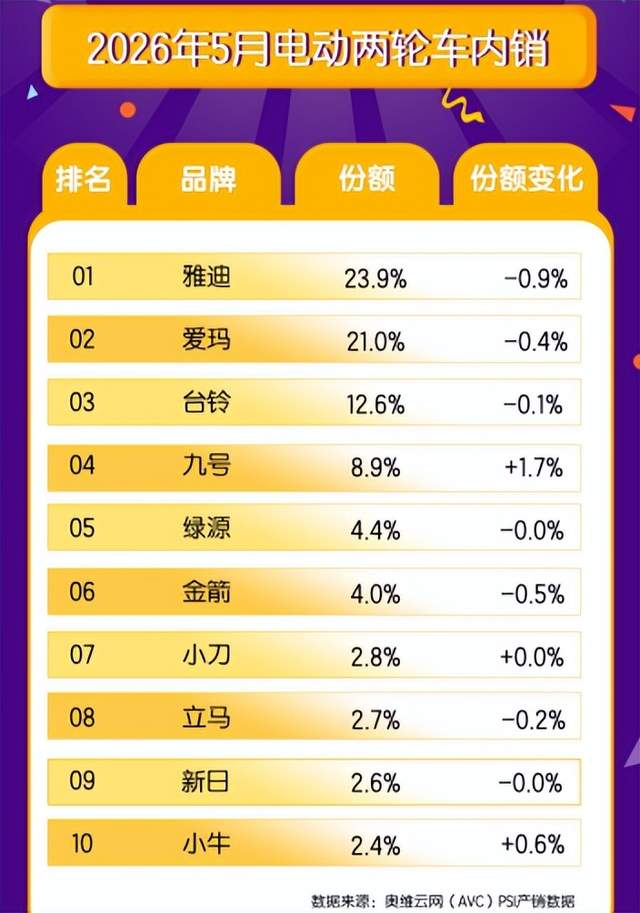
Image source: AVC Official WeChat Account
On April 30, the Beijing Municipal Administration for Market Regulation summoned 8 two-wheeled electric vehicle enterprises for a regulatory meeting, which further reshaped the industry landscape. The administration laid down the "Two Implementations, Five Prohibitions" regulatory bottom line, and launched targeted crackdowns on illegal speed limit removal and unauthorized battery modifications. Enforcement of the new national safety standards has been continuously strengthened.
Clearly, the overarching tone of the industry has shifted, forcing all enterprises to explore new paths for development.
Yadea: The Unshakable Leader of E-bikes
In the two-wheeled electric vehicle sector, Yadea has long occupied the leading position, never overtaken by competitors.
Yadea boasts a remarkable "scale effect": its total revenue reached 37.008 billion yuan in 2025, ranking firmly first in the industry. Its net profit attributable to shareholders hit 2.912 billion yuan, marking a substantial 128.8% year-on-year increase — a strong performance even among civilian manufacturing sectors.
Yadea has a full-spectrum product matrix, covering nearly all price segments from 1,000-yuan commuter models to over 7,000-yuan flagship vehicles. When competitors attempt to disrupt a single price tier, Yadea can counterattack using adjacent product lines.
The depth of Yadea's distribution network is its core competitive advantage, with more than 40,000 offline terminal stores nationwide, the largest number in the industry. It has achieved a high-density sinking layout of "three stores per county, one store per town", with more outlets in townships than its rivals.
With annual sales exceeding 10 million units, Yadea gains significant supply chain cost advantages. Its large procurement volume drives down component prices, and the acquisition of Huayu New Energy and Lingbo Electronics has established an in-house supply system for batteries and motors, securing full control over its core supply chain.
However, due to pressure from the new national standards, Yadea faces inventory backlogs in some regions. In the second half of last year, some Yadea dealers heavily discounted older models, inevitably squeezing the company's profit margins.
Additionally, its brand image shows signs of aging: Yadea is jokingly referred to by some young consumers as "dad's commuter bike", and recognition of the brand among the new generation of users needs further improvement.
Aima: The Ingenious Strategy of a Trendy Brand
While Yadea excels in the breadth of its market scale, Aima stands out in the depth of segmented markets.
Aima has adopted a clever business philosophy: building a "trendy brand" for electric bikes, with women and young users as its core marketing targets.
Its core strategy is empowering products with emotional value. In the early stage, Aima entered the market with the sensory marketing slogan "Aima e-bike, fashion follows me", securing a solid foothold in the female consumer market. Later, it launched co-branding campaigns with trendy IPs to align its products with the fashion circle, successfully creating several viral hits on Xiaohongshu. Currently, Aima enjoys high brand awareness among female customers.
Aima's advantage also lies in its service system: it has built a "3-hour response" after-sales network in first- and second-tier cities. For most urban women who lack professional maintenance knowledge, this targeted service is highly valued, keeping Aima's user reputation at the top of the industry.
Aima's financial fundamentals remain healthy. Financial reports show that Aima Technology's total revenue reached 25.095 billion yuan last year, up 16.1% year-on-year, with a net profit attributable to shareholders of 2.035 billion yuan, a 2.34% year-on-year increase. Such results are commendable amid the industry adjustment period.
However, this "she economy" identity-focused marketing strategy lacks substantive product barriers, making it easy for competitors to replicate. Previously, Segway-Ninebot and Yadea launched high-appearance models, putting Aima under strong competition in both high-end and entry-level segments, which could divert its female customer base.
More problematic is that Aima's quality management needs improvement. During spot checks by the Nanjing Municipal Market Regulation Bureau in May this year, 6 batches of Aima products were found unqualified. Since the second half of last year, its e-bikes have repeatedly failed market sampling inspections in Wuhan, Zhejiang, Chongqing and other regions, directly eroding consumer trust.
Tailin: The Down-to-Earth "Wuling of Two-Wheelers"
Different from other mid-to-high-end brands, Tailin is known by many consumers as the "Wuling of two-wheelers", following a people-centric, mass-market route closest to ordinary users.
Tailin has a clear and pragmatic positioning: long range is its distinct brand label. Over the years, it has focused on energy efficiency optimization and battery management technology, upholding the slogan "Choose Tailin for long range". For users with rigid commuting needs who do not want to pay extra for unnecessary product features, Tailin is a reliable choice.
In terms of products, Tailin adheres to a cost-effective strategy, with leading range performance in its price tier and generally affordable pricing. It runs frequent and aggressive promotions, gaining a large user base in the sinking markets.
Tailin's operational style is relatively stable. In the first three quarters of 2025, its total operating revenue reached 14.84 billion yuan, a substantial 38.6% year-on-year increase, exceeding its full-year revenue of 2024. Although affected by the new national standards, there are no major fluctuations in its financial performance so far.
Yet maintaining this straightforward positioning is not easy, as the two-wheeled e-bike industry is currently extremely saturated with cutthroat competition.
Tailin's biggest current dilemma is that its single selling point of long range is being diluted. As brands like Yadea and Aima increase investment in long-range technology, 100-kilometer range has become a standard feature for mid-to-high-end models, rapidly eroding Tailin's differentiated advantage.
Most e-bike commuting scenarios are within 10 kilometers, where the marginal utility of excessive range is low. Except for high-intensity scenarios like food delivery, few customers are willing to pay a premium for redundant performance.
Brand upgrading remains a long-standing challenge. Tailin's products carry strong "utility tool" attributes, leading users to perceive the brand as a pure commuting device. Many of its high-end intelligent products have received lukewarm market responses, with sales and brand premium far behind smart new players like Segway-Ninebot.
Segway-Ninebot: The Leader of Smart E-bikes
Unlike the traditional three giants fighting for existing market shares, Segway-Ninebot has taken a counter-cyclical path, exploring incremental opportunities in the intelligent and high-end segments.
Segway-Ninebot is the smart king of two-wheeled electric vehicles. An iResearch report shows it has ranked first in sales in the high-end e-bike market above 4,000 yuan for two consecutive years, becoming the preferred brand for high-end consumers. A 2025 report from Master Lu's Lab noted that Segway-Ninebot's user repurchase rate reached 42%, far exceeding the industry average of 18%.
After building solid product reputation and user loyalty, the brand's "breakthrough into the mainstream" became inevitable. By the end of 2025, Segway-Ninebot's cumulative domestic shipments exceeded 10 million units, successfully transforming from a niche premium brand to a mass mainstream brand.
Alongside the company's rapid expansion, Segway-Ninebot has also faced mounting profit pressure. In the first quarter of 2026, its net profit attributable to parent company shareholders reached 203 million yuan, down 50% year-on-year, with net profit margin dropping to 3.56%, 5 percentage points lower than the same period last year.
Due to misjudged market expectations, Segway-Ninebot has also experienced periodic inventory pressure. At the end of 2025, its inventory stood at about 3.1 billion yuan, a 72.14% year-on-year increase, with electric two-wheeler inventory reaching 420,000 units, up 92.3% year-on-year. In the first quarter of 2026, the company's inventory size remained at 3.052 billion yuan, a 73.96% year-on-year growth, staying at a high level.
Niu Technologies: The Dark Horse's Counterattack
In May this year, Niu Technologies made its first appearance in the top 10 sales rankings, marking the biggest change in the industry.
Niu Technologies' successful counterattack began with its first step of product sinking. The newly launched NXT series with a starting price of 3,999 yuan successfully entered the mainstream price band, breaking Niu's long-term restriction to the high-end market and driving up its market share.
The second strategy is a bold expansion of distribution channels. Earlier this year, Niu opened up township franchise opportunities, entered 3C retail stores such as JD Home and Suning, and vigorously expanded offline networks in third- and fourth-tier cities. It plans to open more than 1,000 new stores this year, a 40% increase from the end of last year.
The third move is innovative marketing. In the past, Niu was positioned as a "geek toy" for users pursuing unique lifestyles. To gain broader recognition, it stepped out of its marketing comfort zone, launching the "bestie bike" endorsed by female celebrities and carrying out cross-border collaborations with the automotive industry.
Niu also has shortcomings: it carries historical compliance burdens. After being exposed on the 2023 315 Gala for illegal speed limit removal issues, Niu has remained on the regulatory authority's key monitoring list. Stricter compliance standards will further increase its operating costs.
The brand also faces a "mid-market sandwich" dilemma: in the high-end market above 4,000 yuan, Niu's intelligent features lag behind Segway-Ninebot; in the entry-level market around 2,000 yuan, it cannot match the extreme cost-effectiveness of Yadea and Tailin, leaving it in an awkward, unpositioned middle ground.
Future Trends: Four Core Lines Define the Outcome
Analyzing the five enterprises together, we can see that the key to success in the 2026 e-bike industry largely centers on four main development lines.
The first line is the emergence of multi-polar competition, as the traditional three-strong pattern is bound to be shaken. The declining market share of Yadea, Aima, and Tailin is a structural diversion rather than a cyclical fluctuation. Segway-Ninebot targets young male consumers and the high-end market, while Niu focuses on female users and the mid-range segment, setting the stage for a seesaw battle between the old giants and new players.
The second line: compliance determines survival. The Beijing Municipal Market Regulation Bureau's introduction of the "Two Implementations, Five Prohibitions" regulation signals that future regulators will maintain a zero-tolerance attitude toward speed limit removal, illegal modifications, and unregulated stores, requiring manufacturers to increase investment in compliance costs.
The third line: the main battlefield lies in intelligentization. Segway-Ninebot's rise proves that intelligent e-bikes have strong appeal to high-purchasing-power, loyal young male users. The level of product intelligence will become the key differentiator between brands.
The fourth line, according to data from the General Administration of Customs, overseas expansion represents a historic opportunity. China's two-wheeled e-bike exports increased by 40% in 2025, and maintained a high growth rate of over 30% in the first quarter of 2026. Domestic manufacturers must seize the emerging markets in developing countries.
As for how the two-wheeled electric vehicle market will develop in the future, we can only wait and see what unfolds.