Zhipu, afraid of becoming the next MiniMax
Author | Huahua
Over the past six months, Zhipu AI has been the most high-profile company in China's AI industry.
Its market capitalization once exceeded 1 trillion Hong Kong dollars, the ARR of its MaaS platform reached 1.7 billion yuan, marking a 60-fold increase over the past year. The open-source GLM-5.2 boasts core metrics that closely trail Claude Opus 4.8 and GPT-5.5. When the first batch of shares was lifted from the lock-up period on July 8, the stock price withstood market pressure and avoided a catastrophic pullback.
In this scenario, what would a company typically do?
Celebrate achievements, thank the team, and sprint forward for the second half of the year.
But Tang Jie, the founder of Zhipu AI, did not.
On July 11, he sent an internal letter of nearly 4,000 words, titled *The Giant Wave Has Arrived*.
There is barely a single celebratory remark in it. No figures are mentioned to discuss revenue. No paragraphs look back on the achievements of the past six months.
The key terms repeated throughout the letter are: Long Horizon Task planning, Autonomous Agent, Self-Evolving, AGI (Artificial General Intelligence), and safety governance.
An even more unusual detail is that he barely mentioned Coding.
Coding, the very factor that directly drove Zhipu AI's market capitalization from 100 billion to 1 trillion Hong Kong dollars, seemed deliberately avoided in this letter.
Why?
Tang Jie's biggest concern is no longer whether Zhipu AI's market value can continue to rise.
Instead, he worries that the capital market will begin to price Zhipu AI's assets using the traditional internet SaaS (Software as a Service) model, or the financial metrics of general internet platform enterprises.
This is the real reason why he wrote this letter.
I. MiniMax Has Walked Through the Minefield for Zhipu AI
A few days before Tang Jie sent the letter, MiniMax gave the entire industry a lesson on valuation restructuring.
After the lock-up expiration in early July, MiniMax's stock price plummeted consecutively, and its market capitalization fell below 100 billion Hong Kong dollars.
The reasons for the plunge are complex: model iterations fell short of expectations, overall market risk appetite declined, and the broader backdrop was that global AI concept stocks collectively faced pressure in Q2 2026, with rising expectations of the Federal Reserve's interest rate hikes, widespread contraction in enterprise IT budgets, and capital becoming generally prudent toward high-valuation, low-profit AI companies.
But the fundamental reason is that the capital market has adopted a new set of scoring criteria.
The lock-up expiration means early investors get their first chance to exit on a large scale. The secondary market and institutional LPs (Limited Partners) will also re-ask a question: how much is this company actually worth? The underlying logic of the valuation model has completely changed, and the measurement has shifted to metrics like ARR size, growth rate, user retention, and the payback period of customer acquisition costs.
This system is entirely the valuation logic for internet and traditional SaaS companies.
Once entering this system, MiniMax's valuation anchor was downgraded from the first tier of China's large model companies with unlimited imagination space to a C-end AI application tool company with an annual revenue of several hundred million yuan.
100 billion Hong Kong dollars? Too expensive.
Zhipu AI certainly noticed this. The timeline is extremely obvious: MiniMax's plunge happened just a few days ago, and Tang Jie sent his letter on July 11. Zhipu AI's own stock price also dropped from 1 trillion to 730 billion Hong Kong dollars after the lock-up expiration.
The same scenario could repeat at any time. The only difference is that Tang Jie decided to take the lead.
II. The Trillion Market Capitalization Rides on Coding, Yet Tang Jie Has Put It on the Back Burner
Let's go back to a year ago.
In early 2025, the entire industry was still immersed in the Reasoning revolution brought by DeepSeek. Whether it was the chain of thought (CoT) from reinforcement learning or the shift of computing resources to the reasoning end, everyone was talking about Reasoning. Zhipu AI made a seemingly inconspicuous decision at that time: to reallocate resources and fully shift its R&D focus from general chat capabilities to Coding.
Many people did not understand.
Later, Tang Jie gave his explanation: after the emergence of DeepSeek R1, the Chat paradigm has basically come to an end. What truly determines the competitiveness of the next-generation model is no longer who chats more like a human, but who can actually get work done.
Coding is the most efficient verification scenario.
Facts have proved that he bet correctly. Over the past year, the fastest commercialization track for AI has not been chat and search, let alone video generation, but AI-assisted software development.
The reason is straightforward: programmers work 8 hours a day on average, and AI saves them 2 hours, making this ROI (Return on Investment) clearly calculable. For the first time, large models have found a user group that is truly willing to pay continuously.
On a global scale, Anthropic is the most extreme case. Its ARR was less than 100 million US dollars in early 2024. With Claude's breakthroughs in code generation and engineering capabilities, its commercial revenue exploded, exceeding 470 billion US dollars in June 2026. GitHub Copilot has become one of Microsoft's fastest-growing commercial products in the past year, with a significant year-on-year increase in enterprise customers.
Zhipu AI also reaped the benefits of this same wave.
If the story stopped here, Zhipu AI should continue to talk about Coding and revenue. Capital is most willing to listen to these topics.
But Tang Jie barely mentioned them.
Why?
There is an unbreakable unwritten rule in the capital market: Once a story starts to be realized, it is no longer the future.
When Apple first launched the iPhone, the market was trading on the smartphone story. After smartphones became popular, the market began to trade on service revenue. After service revenue was realized, Apple started trading on AI. The same goes for Microsoft: it traded Office during the Office era, the cloud during the Azure era, and AI after Copilot came out.
Capital never pays the highest premium for already realized stories for a long time; it is always looking for the next target.
The more successful Coding is today, the closer Zhipu AI gets to the positioning of traditional IT infrastructure and mature software services.
Once the market defaults that AI Coding is a stable, standardized software service, capital will ask: after Coding, what's next? MiniMax had no answer, so it was re-priced.
Tang Jie needs an answer. And he must speak it out before the market asks.
So in the entire letter, Coding is hidden. The real protagonists have become Long Horizon Task, Autonomous Agent, and Self-Evolving.
This is not a technical route shift, but a narrative switch regarding Zhipu AI's valuation model.
The only goal is to secure the "AGI company" label before capital has time to stick the "Coding company" label on Zhipu AI.
The valuation logic for an AGI company is completely different. In the short term, the capital market can ignore revenue, retention, and unit economics. It only cares: how far are you from AGI? Where do you rank on this path?
Following this logic, Zhipu AI's peers are OpenAI, Anthropic, and Google DeepMind. Both OpenAI and Anthropic have valuations at the trillion-dollar level.
III. Agent Is Not Just Technology, But Also a Chip for the Next Round of Valuation
Zhipu AI is not the only company talking about Agent at this point in time.
Looking back at the actions of global leading players over the past year.
Starting from GPT-5, OpenAI has fully shifted its product focus to Operator, Deep Research, and Computer Use, moving from answering questions to completing tasks. Almost all of Anthropic's updates this year revolve around Computer Use and the Agent loop. What Google promotes the most is no longer chat, but the Agent ecosystem.
Global leading players are shifting almost simultaneously, not just because the technology has matured, but for a more practical reason: Coding has become the present, and Agent needs to become the future.
In Tang Jie's letter, this logic is clearly laid out. He proposed an evolution of concepts: From OPC (One Person Company) to NPC (No People Company).
Coding solves the problem of AI writing code for programmers. Agent solves the problem of AI doing work for the entire organization. From writing code to building products, to running enterprises.
In the letter, he breaks down this path into three milestones: Long Horizon Task, planning and execution spanning weeks and months; Autonomous Agent System, a self-driven, collaborative group of agents; Self-Evolving, AI training AI, with evolution speed breaking free from human constraints.
Then he announced the "Touch High" initiative, a strategic investment over the next two years, and directly stated: no pursuit of short-term application monetization.
From a technical perspective, this is a R&D direction choice. From a capital perspective, this is a valuation system choice.
These concepts share a common feature: none of them have been commercialized yet. Without commercialization, the market cannot price based on revenue. If revenue-based pricing is not possible, pricing can only be based on future potential.
This is exactly the game rule that OpenAI and Anthropic have played most skillfully over the past two years. Every time the market asks about revenue, they throw out a new technical milestone; when the milestone is digested, they throw out an even bigger vision. Always staying half a step ahead of capital, keeping capital in a chasing rather than scrutinizing state.
Tang Jie is learning this strategy.
In the letter, he even cited Google DeepMind's *From AGI to ASI* report, stating that even if the capability of a single model stays at the human level, as long as computing power continues to grow, superintelligence could be forced out.
When investors hear this statement, should they feel excited or fearful? It depends on what they prefer to hold: an internet company with revenue, or an AGI company that has the potential to change the world.
IV. China's Large Model Industry Is Entering a Knockout Round Heading for Two Extremes
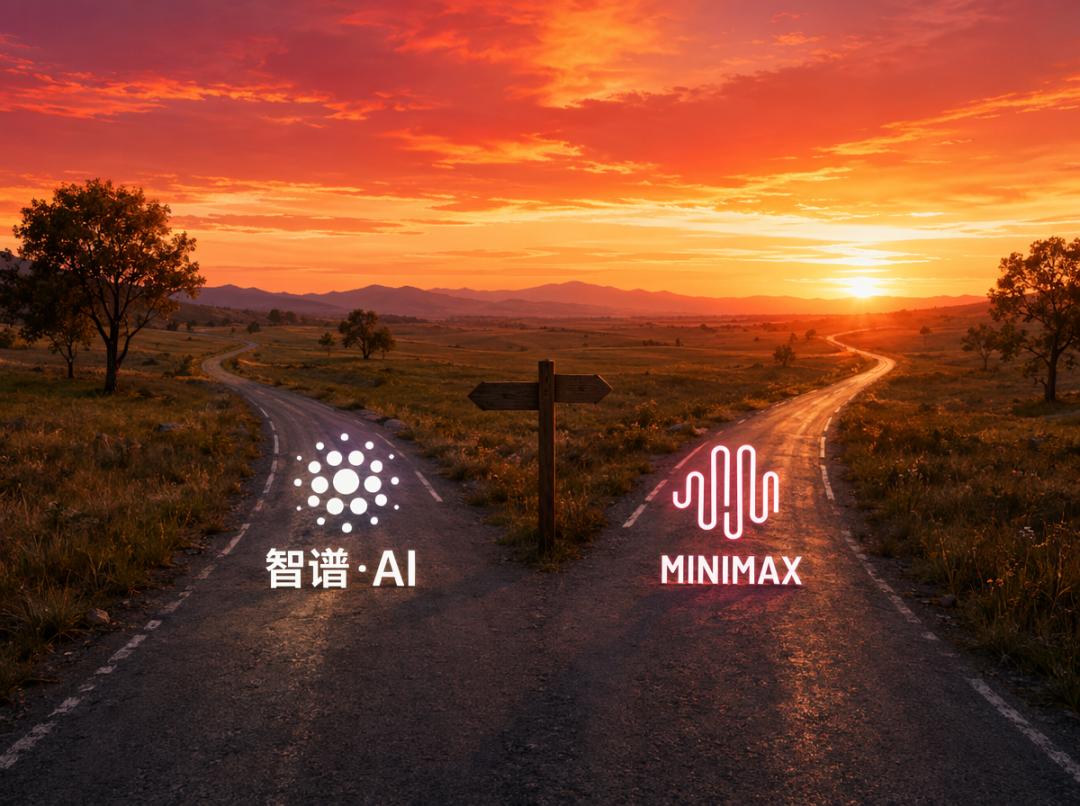
Standing in July 2026, the fork in the road for China's AI industry is clearer than ever.
The first path: the monetization path represented by MiniMax.
Package the model into products, target the C-end market, launch subscriptions, and prove business closure through revenue growth. The market focuses on MAU, ARPU, renewal rate, and gross margin. MiniMax's plunge has proved that when an AI company takes this path, capital will scrutinize it with the most stringent mobile internet traffic metrics and financial leverage.
The second path: the infrastructure path represented by Zhipu AI.
Continue to build models, platforms, and infrastructure. Maintain valuation through technological breakthroughs rather than revenue growth. Its peers are OpenAI and Anthropic.
The two paths correspond to two sets of valuation rules, two types of investor expectations, and of course, two types of failure scenarios.
Taking the first path, failure comes when user dividends peak or commercialization growth falls short of expectations.
Taking the second path, failure comes when technological R&D enters a plateau, and breakthroughs cannot be realized for a long time.
Tang Jie chose the second path. He used a very strong statement in the letter: not reaching the summit means failure.
This is a military order he set for himself, as well as expectation management for investors: don't measure me by revenue, measure me by AGI.
The most noteworthy part of Tang Jie's letter is not what he said, but when he said it.
Choosing to release this AGI declaration at the time window after the lock-up expiration, when the stock price starts to fluctuate and MiniMax has just plunged, is itself a precise expectation management move.
He is seizing the right to define. Before the capital market has time to label Zhipu AI as an AI product company, he is firmly branding Zhipu AI as an AGI company.
But this letter also reveals a deeper issue: The valuation of AI companies is shifting from technological belief to commercial realization. This shift is irreversible. MiniMax has been caught in it first, and Zhipu AI will inevitably face the same questioning sooner or later.
What Tang Jie's "Touch High" initiative can buy is probably just time.
For an AI company, when revenue starts to be realized, is that the starting point of success, or the beginning of another crisis?
MiniMax has been forced to answer this question. Zhipu AI is trying to bypass it.
As for whether it can bypass it, it depends on whether what "Touch High" eventually reaches is the real technological ceiling, or the ceiling of capital patience.
This article is from the WeChat public account "Beyond the Layout", author: Huahua, published by 36Kr with authorization.