A tracking report of 26,000 students: Is AI specifically targeting top students?
A research paper covering 26,811 middle and high school students over a 30-month period reveals an education crisis unfolding in the AI era.
What is even more surprising is that the group hit hardest by this crisis is not average students, but top performers who previously achieved excellent academic results.
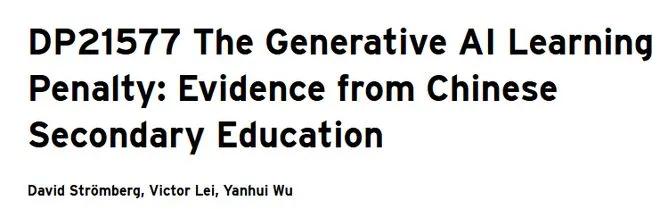
This is not alarmist talk — it comes from a research paper jointly completed by Stockholm University and the University of Hong Kong, published by the Centre for Economic Policy Research.
To cut to the conclusion, this study finds that AI can create an illusion of academic improvement for students in the short term, but long-term negative impacts will cause students who rely on AI to see their scores in high school entrance exams or college entrance exams drop significantly by 18% to 24%.
Why does this happen?
In fact, this was not the case at the very beginning: after using AI, students' homework grades were quickly increased by 18%, and their homework completion time was drastically reduced by 30%.
Faster, better, more efficient — it seemed absolutely perfect.
But this is only superficial. When these students sat for their monthly exams without AI's assistance, their average scores dropped by 20% within six months, and when it came to the high school entrance exam and college entrance exam, their scores fell by 24% and 18% respectively.
Researchers specifically pointed out that it is almost impossible to identify this pattern if only short-term tracking is conducted. The impact of AI on exams is like a delayed bomb — by the time it detonates, the window for remediation has already closed.
Some parents might think, "My child is a good student, so they won't be affected." Unfortunately, AI specifically targets top students: the better their academic performance was, the more severe the setback they may face.
The data shows that top students with strong self-learning abilities saw their scores drop by as much as 24% after overusing AI.
It sounds extremely counterintuitive that AI specifically undermines top students, right?
The researchers' explanation is that top students' strengths lie in their ability to derive conclusions independently, make repeated attempts and correct their own mistakes. AI's one-click answers directly skip this entire process, abruptly breaking the chain through which students build mental models for complex knowledge on their own.
If this continues for a long time, top students' thinking will become sluggish, because what AI deprives them of is not learning time, but the act of thinking itself.
In addition, the impact of AI varies across different subject categories, age groups and genders.
At the subject level, social science fields that require in-depth logical elaboration and critical thinking, such as politics and geography, are also severely affected, with average scores dropping by 27% — far more than STEM and language subjects.
At the age level, middle school students' scores dropped by 24%, making them more vulnerable than high school students;
In terms of gender, male students' scores fell by 21.6%, significantly higher than the 18.4% drop among female students.
Why is AI so "damaging" to middle and high school students?
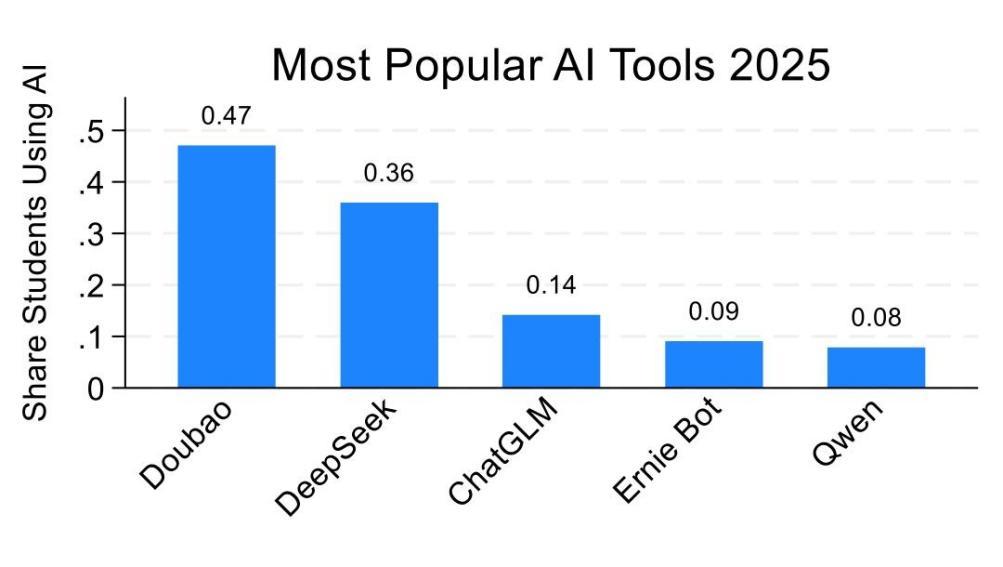
The research findings of this paper show that the fundamental reason is that as many as 81% of students use AI to directly generate answers, copy and paste them to submit, skipping the thinking steps of understanding, derivation and internalization.
In essence, students have reduced themselves to "homework outsourcers".
Of course, not all students who use AI see their scores decline — 20% of students have consistently maintained stable academic performance. They share a common feature reflected in their homework duration: the time they spend on homework is almost the same as that of their peers who do not use AI.
What does this indicate? It means that these students first complete independent thinking and problem-solving attempts, then use AI for supplementary reference and verification. They use AI to examine their thinking, not to replace it.
At present, Norway has announced an almost full ban on generative AI for primary school students aged 6 to 13; France has explicitly banned the use of ChatGPT in primary and secondary schools starting in 2025; Sweden has implemented a digital isolation policy.
However, the real challenge is not to block AI, but to redesign homework, exams and evaluation systems, so that AI can return to its supporting role, and make thinking the core of learning once again.
Take this seriously — don't let AI ruin children's academic development.