Ant Group Lingbo: Overturning the large model shortcut for robots with embodied native technology
This year marks the third year of embodied intelligence, and the industry's landscape and development trends are undergoing qualitative changes.
The robot body has attracted the vast majority of market investment. From dexterous hands and motion control to complete machine design, humanoid robots are constantly breaking through physical limits. They can not only appear on the Spring Festival Gala stage, stunning the world with their fluid dance and martial arts performances, but also are being intensively deployed in real scenarios such as factories, logistics, and retail, entering workplaces to attempt commercial implementation.
When robots truly begin to face the complex physical world, their bottlenecks have also emerged: in the face of dynamic environments, unknown tasks, and continuous interactions, robots still rely heavily on data demonstration and manual fine-tuning. They have agile limbs, but lack a brain that can make autonomous decisions step by step based on real-time observations.
More forward-looking industry practitioners have noticed this bottleneck and are trying to break the deadlock.
Since the beginning of this year, large amounts of capital and attention have been accelerating to pour into the World Model and Robot Foundation Model. According to media statistics, by mid-June this year, financing in China's embodied intelligence sector reached about 438 billion yuan, of which more than half of the funds went to "brain-focused" companies that focus on intelligent layers such as foundation models and world models, while traditional robot body companies accounted for less than 15% of total financing.
Global technology companies have also begun to collectively deploy Physical AI — NVIDIA launched the Cosmos World Foundation Model and the Isaac GR00T system; Google DeepMind released Gemini Robotics to explore the integrated capabilities of robots from understanding the physical world to executing actions.
The importance of robot brains is forming an increasingly clear consensus.
But consensus does not mean a unified answer has been reached.
As more and more enterprises begin to invest in robot foundation models, a new problem has emerged: should the robot brain continue to evolve along the development path of large language models, or be completely reconstructed around the physical world?
Facing this watershed, the industry has quickly split into two paths. One faction adheres to the inertia of the existing large model paradigm, making patches and performing transfer fine-tuning on existing models; the other firmly believes that the data logic of the physical world is completely different from that of the Internet, and everything from the underlying architecture, data to pre-training objectives must be restarted from scratch.
At a critical juncture when the industry is moving into deep waters, major domestic tech companies have taken the lead in proposing a paradigm-shaping answer.
From July 7 to 10, Ant Group's Lingbo Lab successively launched six large models, upgrading the full-stack technical levels from vision, space, manipulation to world models. This is not just a saturated product iteration, but a direct response to the fundamental proposition of how to build a robot foundation model.
Moreover, Ant has also proposed a new technical concept of "Embodied Native", and with the grand unveiling of LingBot-VA 2.0 on July 10, Ant Lingbo is trying to draw a clear dividing line in the second half of the embodied intelligence industry.
01. Robots entering factories expose the real bottleneck
The robot body has been the main theme of the past two years.
From body design, core components to motion control, the industry has carried out rapid iterations around robot movement. Humanoid robots have evolved from being able to stand and walk to being able to run, jump, and complete increasingly complex actions; more and more enterprises have also begun to step out of laboratories and carry out pilot verifications in scenarios such as manufacturing, logistics, warehousing, and retail. A large number of robots have entered factories, aiming to create productivity beyond just demonstrating technology.
But when robots truly enter real environments, people soon realize that robots do not truly understand their surroundings.
After a large number of real-machine demonstrations and trainings, they can perfectly complete pre-set standard processes. However, once faced with the ever-changing physical world, reality brings a rude awakening: minor adjustments to conveyor belt speed, unintended movement of objects on desktops, slight deviations in shelf positions, or even just the appearance of never-before-seen obstacles, may cause the robot to instantly freeze up.
Next, enterprises have to face the tedious cycle of re-collecting data, re-demonstrating, and re-training.
The more complex and open the scenario is, the more obvious the capability boundary brought by rote memorization will become.
The reason may lie in the technical route. Previously, the industry widely adopted technical routes such as Imitation Learning, using large amounts of real-machine data to let robots learn human behaviors. This approach had remarkable early effects, helping robots cross the first threshold of industrialization and enabling more and more robots to enter real scenarios.
However, as the application scope continues to expand, the cost of collecting real robot data is getting higher and higher, and limited by the data scale, the generalization ability of the model in unfamiliar environments and for new tasks is still constrained by the demonstration data itself.
This is why more and more researchers are starting to place their bets on the World Model.
The solution of the World Model is to endow robots with the ability to "predict future environmental changes" and internalize this ability into their decision-making logic. This means that in the face of the rapidly changing reality, robots will no longer mechanically repeat pre-recorded actions, but can perceive the evolution of their surroundings, continuously adjust their behaviors like humans, and achieve truly autonomous iteration.
However, how to truly implement the World Model? How to break the existing technical deadlock? The entire embodied intelligence industry is waiting for a new paradigm.
02. When the industry begins to rethink robot brains
The rapid evolution of ChatGPT relies on massive amounts of text and images from the Internet, while robots are facing a living physical world. They need to understand real physical causality — how far a box will slide when pushed, how much force is needed to grab a paper cup without crushing it, and what kind of feedback the surrounding environment will generate after the robotic arm moves.
These implicit physical laws simply do not exist in Internet data, and they are highly dependent on interactions in the real physical world.
Data collected through real machines and teleoperation demonstration is not only high-cost and low-efficiency, but also far inferior to Internet data in scale. Continuing along the traditional path of "transfer + fine-tuning" is becoming increasingly difficult.
This is the background against which Ant Lingbo officially proposed the "Embodied Native" model design concept this week.
In the view of Ant Lingbo, the common view in the industry — that robot large models are an application branch of large models in the physical world — is completely incorrect. Robots should be a brand new type of intelligent agent. Since the learning object has changed, the starting point of the model must be completely restarted. Instead of mechanically applying and patching Internet large models, it is better to reconstruct a set of foundation models starting from the real tasks that robots need to complete.
Specifically, Embodied Native differs from the original model concepts at multiple levels.
At the data level, the focus of model learning expands from Internet text and images to the vision, actions, and environmental interactions of robots in the physical world, allowing the model to truly contact the objects that robots work with; at the training level, the focus shifts from generating content to understanding how actions affect environmental changes, allowing the model to learn causal relationships in the physical world rather than staying at the prediction of visual correlations; at the model architecture level, the computing method is reorganized around the requirements of robots for real-time perception, real-time reasoning, and real-time control, so that the model can meet the requirements of continuous operation of real robots, instead of simply following the development paradigm of content generation models.
These changes seem to act on the three links of data, training, and architecture respectively, but essentially they all revolve around the same goal: to allow robots to learn according to the laws of the physical world from the very first day.
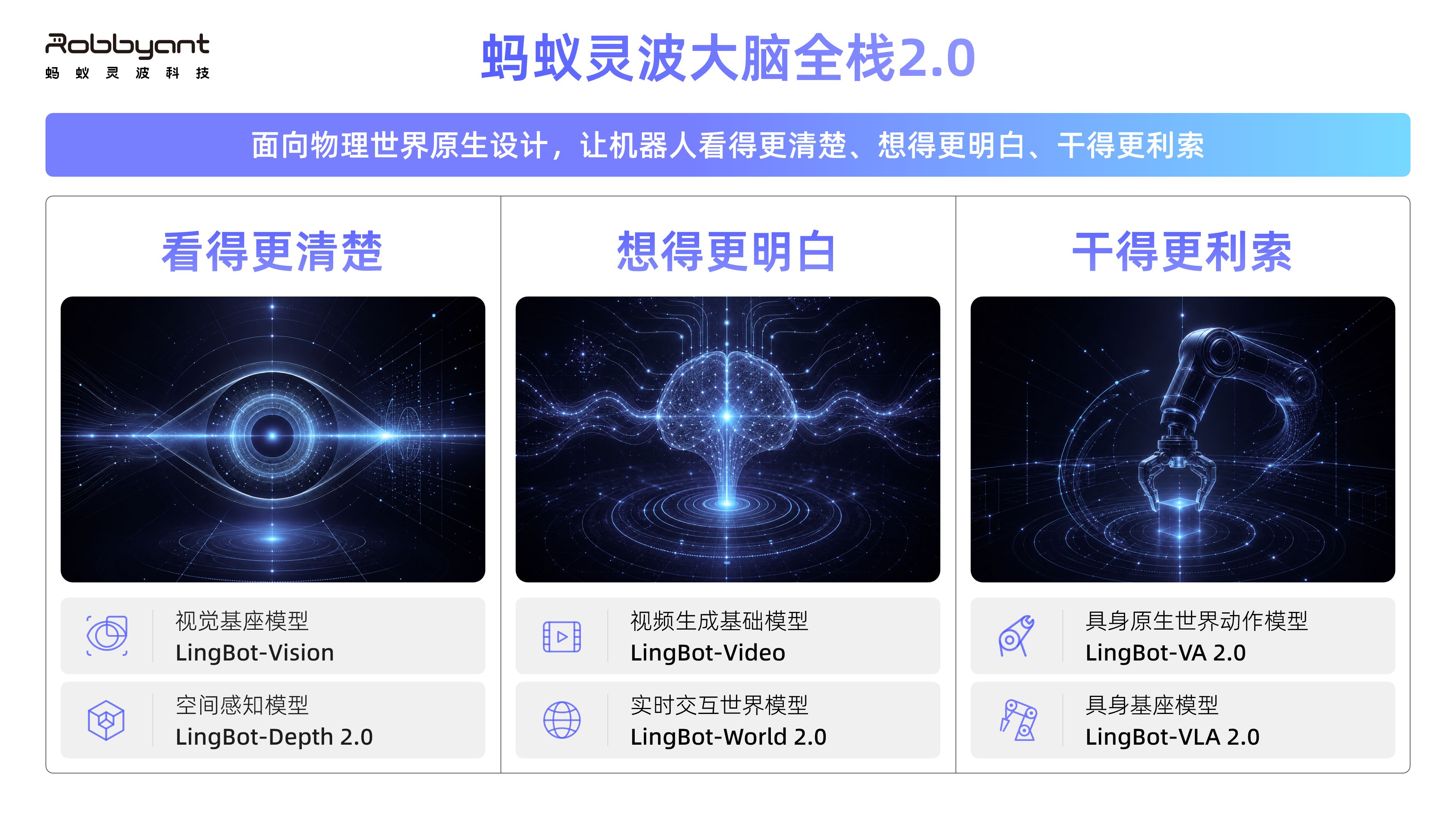
This is the overall consideration of Ant Lingbo in releasing six consecutive models this time: starting from three closely linked native technical dimensions, using "Embodied Native" to reconstruct the complete closed loop of robots' perception, cognition, and execution.
The first step is to enable robots to see more clearly. Ant Lingbo builds native spatial intelligence starting from sensors, represented by LingBot-Vision and LingBot-Depth 2.0, equipping robots with native eyes adapted to the physical world.
The next step is to enable robots to think more thoroughly. Ant Lingbo rewrites the model's learning paradigm through a native architecture. Among them, LingBot-Video introduces the MoE architecture to balance model scale and reasoning efficiency, while LingBot-World 2.0 ensures physical rationality through Causal Pretraining. As the culmination of this architecture, the grandly unveiled LingBot-VA 2.0 delivers a complete solution: the semantic tokenizer integrates vision and action in the same space, causal pretraining allows the model to understand the physical world from scratch, the MoE architecture keeps reasoning costs well below the real-time control line, and Foresight Reasoning aligns prediction and execution without mutual waiting.
Finally, robots can perform tasks more efficiently, which requires native data for support. As a representative of performing tasks in the physical world, LingBot-VLA 2.0 has begun to adapt to more configurations and higher degrees of freedom under the reverse drive of industrial implementation.
From spatial intelligence and native architecture to native data, the six models are closely interconnected. Ant Lingbo not only fully covers the complete closed loop of robot perception-understanding-prediction-action, but also directly addresses the data problem, trying to use this native full-stack system to drive a new path of industry co-construction.
03. Embodied Native changes the way robots learn about the world
Proposing a concept is not difficult; the difficulty lies in how to practice it and transform it into a robot learning paradigm. LingBot-VA 2.0 is the most complete practice of this concept.
LingBot-VA 2.0 first changes how robots learn.
In the past, most robot models were built on existing LLM or general video models, and gradually adapted to robot tasks through transfer learning. LingBot-VA 2.0 takes a different path — Full Pre-training, based on an autoregressive video generation model, allowing the model to directly learn the data and laws generated during the interaction between robots and the physical world. For robots, this means they learn directly from the environments, actions, and feedback in the real world.
After the learning object changes, the model's learning objectives also change accordingly.
Traditional video models usually predict the next frame, which is inconsistent with the action objectives of robots. Therefore, LingBot-VA 2.0 further focuses its learning on the causal relationship between actions and environmental changes, allowing the model to understand how actions change the world, rather than just observing how the world changes. At the same time, it introduces foresight reasoning, allowing robots to continuously predict future states during action execution, and constantly adjust decisions according to new environmental changes. For tasks such as dynamic grasping, desktop interaction, and continuous operation, robots can also continuously correct their behaviors according to environmental changes.
To support this capability, the model itself also needs to be redesigned around the way robots operate.
Unlike content generation models that can take several seconds to complete reasoning, robots need to continuously observe, reason, and execute. Focusing on this feature, LingBot-VA 2.0 adopts the MoE architecture to improve reasoning efficiency while ensuring model capabilities; it also introduces an asynchronous reasoning mechanism to decouple and parallelize environment observation, model reasoning, and action output, enabling robots to reason while executing, without missing the best operation timing while waiting for model calculation to complete. These designs ultimately serve the same goal — to allow robots to truly operate in a real-time, continuously changing physical environment.
Finally, the link from robots understanding tasks to completing actions has been reconnected.
For a long time, there has been a typical gap in the robotics field: models can understand language instructions, but cannot stably map semantics to accurate actions. LingBot-VA 2.0 further enhances the alignment capability between semantics and Action through a new generation of VAE, establishing a more direct connection between "understanding" and "execution", allowing robots not only to know what the task is, but also to complete the task more accurately.
Full pre-training, causal modeling, MoE and asynchronous reasoning, and a new generation of VAE seem to correspond to four different technical innovations, but essentially they all point to the same goal: to allow robots to get rid of simple reproduction of existing actions, truly learn to understand the physical world, and autonomously complete tasks in a constantly changing environment.
This change is ultimately reflected in model capabilities. LingBot-VA 2.0 can complete post-training adaptation with only a small amount of data in new scenarios, and can support complex tasks such as dynamic grasping, desktop confrontation, and continuous operation, showing stronger generalization capabilities when facing unfamiliar environments.
04. The discussion about "robot brains" has only just begun
Looking back, the timing when Ant Lingbo proposed "Embodied Native" is no accident.
In the past two years, the robotics industry has completed rapid iterations of body capabilities, and more and more robots have begun to enter real scenarios; at the same time, the industry has gradually realized that what determines the upper limit of robot capabilities is whether robots can turn every real interaction into reusable intelligence, and continuously learn and generalize across different robots, tasks, and scenarios.
Behind this, there is still an undiscovered problem: robots do not have their own Internet.
Unlike large language models that can continuously expand their capabilities by relying on massive amounts of Internet data, the cost for robots to obtain real interaction data is always high, and the data scale is naturally limited. If this problem cannot be solved, the growth rate of robot capabilities will eventually be restricted. For this reason, a new round of exploration around pre-training methods, world models, and robot foundation models is becoming a new competitive focus in the industry.
In this context, the value of "Embodied Native" is not only that it proposes a new technical concept, but also that it attempts to answer a more fundamental question: when the learning object changes from the Internet to the physical world, should robot foundation models also have their own set of design paradigms.
From this perspective, LingBot-VA 2.0 represents the first systematic demonstration by Ant Lingbo of another development path for embodied intelligence — from perception, prediction to action, from model training to system architecture, everything is centered on how robots understand and learn the physical world.
It is still too early to conclude whether this path will become the mainstream of the industry in the future. But every technological paradigm shift starts when the industry begins to re-discuss a fundamental question.
Today, when the entire robotics industry begins to pay attention to, discuss, and debate the technical route of robot brains, Ant Lingbo has already taken the lead in presenting its own answer.