The era of large language model-powered Agents has arrived — where exactly do domestic AIs fall short?
"Codex Step-by-Step Setup Tutorial" and "Claude Code Zero-Basics Environment Configuration" —— recently, tutorials for overseas AI Agents have become one of the most viral content categories on Chinese social media.
China's domestic AI large model market is clearly red-hot: Doubao counts hundreds of millions of daily active users, DeepSeek has driven API pricing down to a "bargain basement" level that has caught Silicon Valley's full attention, and press releases from every major vendor claiming their models "surpass GPT-4" are everywhere.
By all conventional logic, in this hyper-competitive domestic market where models are locked in a cutthroat race to outdo one another, users should have access to a rich, low-cost, and user-friendly range of options. Yet a huge number of domestic users are willing to invest time navigating cumbersome network barriers, pay steep monthly subscription fees, and stubbornly stick to overseas AI Agents — to the point that a hidden industrial ecosystem has sprung up around this demand.
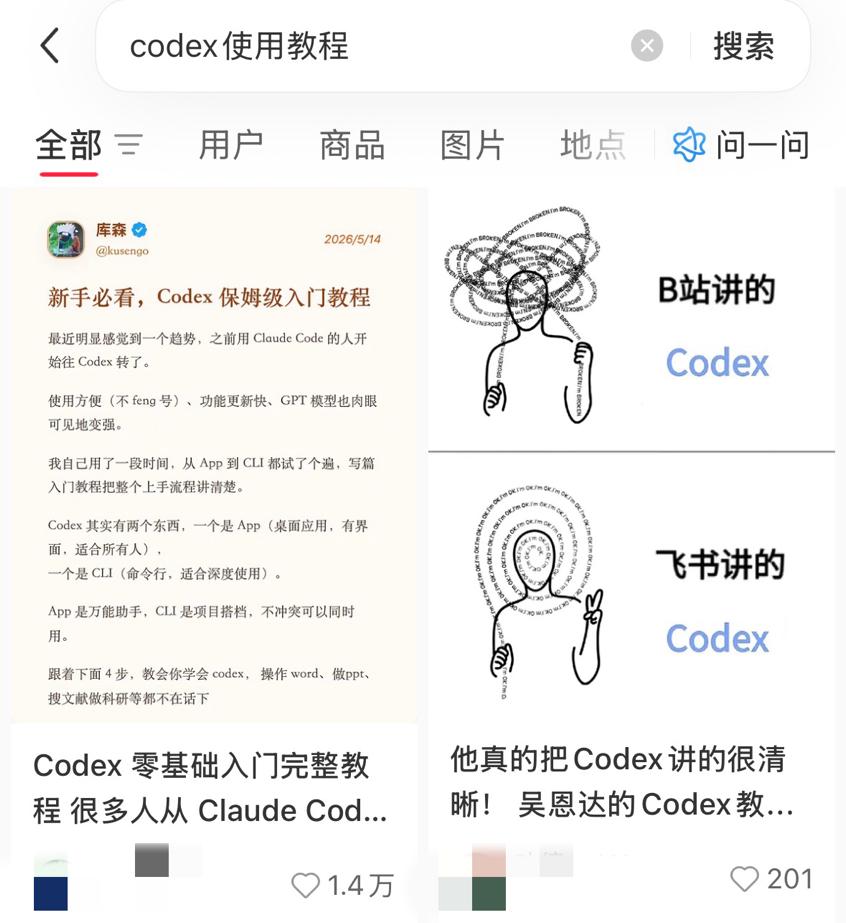
▲ Note: Image sourced from Xiaohongshu
This fragmented, peculiar market phenomenon naturally sparks curiosity: now that large models have stepped into the Agent era, is the perception that domestic AI products "fall a little short" among Chinese users just a stale stereotype, or is there in fact an unmissable generational performance gap between Chinese and global AI systems?
Domestic Agents: Strong Strengths Persist, Key Weaknesses Remain
In reality, aggregated data from industry benchmarks and real market feedback shows that over the past three years, domestic large models have not fallen comprehensively behind — they have even pulled off strong overtakes in multiple niche use cases and specific capability dimensions.
Text comprehension and processing are the core tests of a large model's localization capability and underlying logic, since language is not just a symbolic tool, but also a carrier of culture, modes of thinking, and commercial reasoning.
Top overseas models such as GPT-5 and Claude Opus can speak fluent Chinese, but when tasked with in-depth creative writing, they almost always reveal an obvious "translationese" awkwardness. Their expressive logic is rooted in Western linear narrative conventions, which makes them poorly adapted to handling nuanced Chinese social etiquette or culturally specific business documents.
At this stage, domestic AI Agents hold a uniquely natural advantage in Chinese contextual understanding and text processing.
On April 29, in the April 2026 SuperCLUE-VLM Chinese Multimodal Vision-Language Model Evaluation, ByteDance's model took first place in the overall rankings with a score of 90.66. Alibaba's Qwen3.5 series, SenseTime's SenseNova, Zhipu AI's GLM, and other domestic large models all ranked near the top, while well-known overseas models including OpenAI's GPT-5.4 and X.AI's Grok landed only in the mid-tier positions.
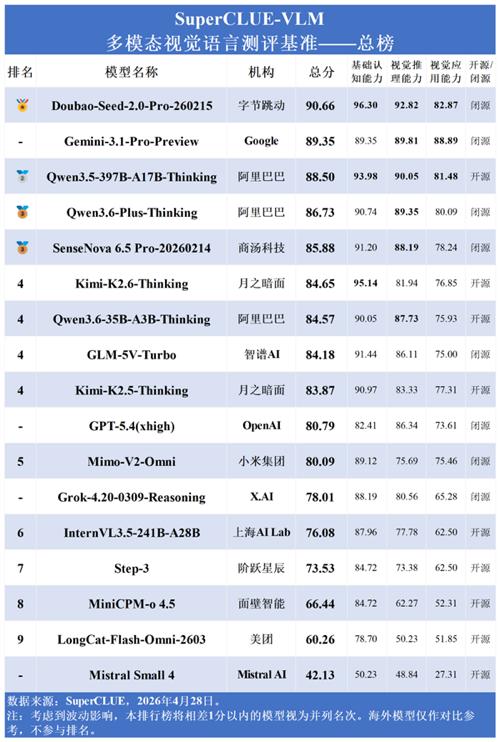
▲ Note: Image sourced from Sina Finance
This domestic large model resurgence in Chinese-language contexts is primarily fueled by training on massive volumes of high-quality local corpora, as well as deep integration with China's unique internet ecosystem.
Whether drafting year-end performance reviews that perfectly capture unspoken workplace social norms, or generating the high-energy, emotionally charged live-stream e-commerce sales scripts of the style "Hey everyone, click the link!", domestic models can precisely grasp subtle linguistic nuances and viral internet memes — capabilities that overseas products still cannot match today.
Beyond that, domestic foundational models also demonstrate clear market competitiveness in high-demand technical capabilities such as ultra-long text processing and code reasoning.
While flagship overseas models are generally still limited to a 128K to 200K context window range, China's Kimi has pushed lossless context parsing up to the 2-million-character level, and Tongyi Qwen's Qwen3-Max reaches a 10-million-character capacity. This means domestic Agents can ingest dozens of pages of dense, complex Chinese documents like industry research reports or legal case files in a single session, then accurately perform cross-reference checks and targeted information extraction.
Meanwhile, the code and mathematical logic moats that overseas tech giants once prided themselves on are now being filled in by domestic models including DeepSeek V4 Pro and Doubao 2.1 Pro.
On June 23, ByteDance officially launched the Doubao Large Model 2.1 series. Across nine authoritative benchmarks including Terminal Bench 2.1, SWE-Pro, and SciCode, Doubao 2.1 Pro outperformed Anthropic's flagship Claude Opus 4.7 on multiple key metrics, earning a solid spot in the global top tier of models.
Yet even with these impressive partial achievements, as the scope of AI Agent capabilities extends beyond text and code processing to the physical world and multimodal visual tasks, the gap between domestic models and leading overseas offerings remains impossible to ignore.
This past April, OpenAI officially released GPT Image 2. Within hours of launch, it claimed first place on the Image Arena text-to-image leaderboard with a dominant score gap. The model can independently break down complex tasks, plan its own workflow, and self-audit outputs — and it can even generate properly formatted Chinese typography directly. By contrast, mainstream domestic models at the time still suffered from widespread bugs in visual rendering quality, physical law simulation, and spatial consistency.
For future Agents designed to manage complex end-to-end workflows, lagging multimodal capabilities mean more than just subpar image or video generation results. More critically, it leaves Agents lacking the robust visual processing and physical world common sense needed to understand graphical user interfaces on desktops, handle complex cross-software visual inputs, and eventually power embodied intelligent systems.
This one-sided weakness in core multimodal generation architecture creates the first layer of experience gap that Chinese users notice when comparing domestic and overseas large models.
Divergent Development Paths Drive Tangible User Experience Differences
As large models evolve from simple chat boxes to full intelligent agents, the strategic paths chosen by global tech giants to roll out AI use cases have a far greater impact on real-world daily user experience than the relative strengths and weaknesses of underlying technology.
Leading overseas AI companies represented by OpenAI and Anthropic have always centered their core development vision on achieving artificial general intelligence. In their strategic roadmaps, an Agent is not just a Q&A bot confined to a web browser — it should be a "silicon-based collaborator" with high-level autonomous thinking ability that can operate every digital tool humans use.
Codex officially launched its computer operation capability this year. It no longer relies on API interfaces; instead, it uses its powerful visual multimodal capabilities to directly "read" every pixel on a computer screen, automatically moving the mouse, clicking desktop icons, and typing input commands exactly like a human user.
When a user submits a complex multi-layer task covering data organization, detailed analysis, and document distribution, Codex does not respond like a traditional AI assistant by just offering a list of suggested steps or snippets of code for the user to run manually. Instead, it directly launches relevant software on the desktop to pull and process the required data, then opens an email client to send the final output to designated contacts, completing a fully automated end-to-end closed loop.
Under this development paradigm, users no longer perceive the tool as a smarter search engine — they experience it as a "digital collaborator" that can discuss underlying technical architectures, independently plan full task pipelines, and even demonstrate independent reflection and error-correction capabilities.
According to public data from OpenRouter, in May 2026, the self-reflection enabled Hermes Agent recorded a single-day token consumption of 291 billion. This figure confirms that a huge user base is already deeply leveraging Agents that can autonomously execute long, complex task workflows far beyond the limits of a basic chat interface.
Looking at the domestic AI Agent track, Chinese tech giants, leveraging China's one-of-a-kind app ecosystem built around WeChat, Feishu, Douyin, and Taobao, have positioned Agents from the very start as commercial efficiency-focused tools.
ByteDance's Coze platform hosts over 2000 official plugins, with an exceptionally well-built visual workflow system that allows even users with zero coding experience to set up custom bots without writing a single line of code. Tencent's WorkBuddy integrates more than 80,000 skill modules, reaches up to 8.85 million monthly active users, and is deeply interoperable with WeCom and Tencent Docs.
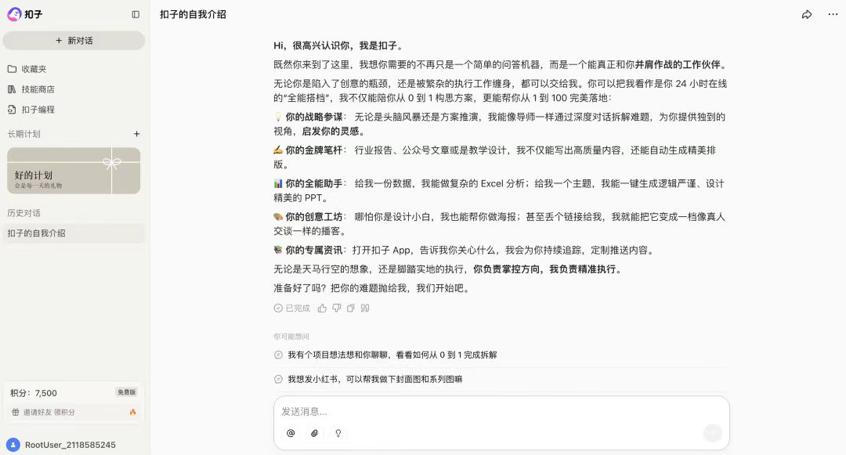
▲ Note: Image sourced from Coze
These tools are highly optimized for high-demand ToB use cases and commercial cost-reduction scenarios, including e-commerce operations, marketing copywriting, official document drafting, and presentation creation — they can minimize repetitive manual labor within specific business workflows to an extreme degree.
Yet for all their thriving plugin ecosystems, domestic Agents have still not broken out of the basic chat box product paradigm. When a user assigns a complex system-level task that spans multiple local software apps, a domestic Agent cannot directly take control of the mouse to execute the task the way Codex does; it can only offer suggested steps and supporting code snippets.
Users go into the experience expecting to hire a "deep-level partner" that can handle tedious low-level operational work, only to find that domestic Agents act more like over-eager "intern assistants" — polite, full of standard canned responses, but ultimately only capable of reading documents and drafting official texts within a limited set of specific web pages.
Business Models Define the Upper Limit of Agent Capabilities
All divergences in technology and development paths ultimately play out in the commercial marketplace. Setting aside abstract technical idealism, the ultimate factor that determines whether an Agent feels genuinely capable or underwhelming is hidden in the server computing power cost statements.
A truly high-performance Agent is far more than a tool that accepts prompts and spits out answers. A mature Agent operates on at least four distinct backend layers: task planning, execution, state and contextual memory management, and validation with rollback functionality. Every full cycle of this closed-loop system consumes massive volumes of tokens. For an apparently simple code debugging task, an Agent may have already run dozens of hidden self-iterations and API calls in the background.
With this extreme level of computing resource consumption, the well-established paid software market ecosystem in overseas regions provides the foundation for Agents to perform these "deep-thinking" operations.
On the consumer side, ChatGPT Plus and Claude Pro personal subscriptions cost as high as $20 per month, yet millions of users continue to sign up. As of March this year, ChatGPT's weekly active user base has surpassed 900 million, with roughly 50 million paid subscribers. A Semi Analysis report also notes that Anthropic's annualized operating revenue has grown nearly fivefold since the end of 2025, driven primarily by strong Claude Code adoption and explosive enterprise demand.
When users pay sufficient subscription fees, overseas vendors feel confident allocating abundant computing resources in the backend. High average revenue per user gives Agents the headroom to run extended long-term memory management and multiple rounds of self-correction, ensuring high reliability for full task workflows.
Shifting focus back to the domestic market, major Chinese vendors have almost universally adopted free-to-use Agent product models to compete for consumer traffic, and the price wars on API endpoint access costs have reached staggering levels.
In April 2026, DeepSeek lowered the V4-Pro standard input pricing to 3 RMB per million tokens, with output priced at only 6 RMB per million tokens — roughly one-twelfth the cost of equivalent GPT-4o access. Even the paid professional tier of Doubao costs just 68 RMB per month, with an exclusive 38 RMB monthly student discount available.
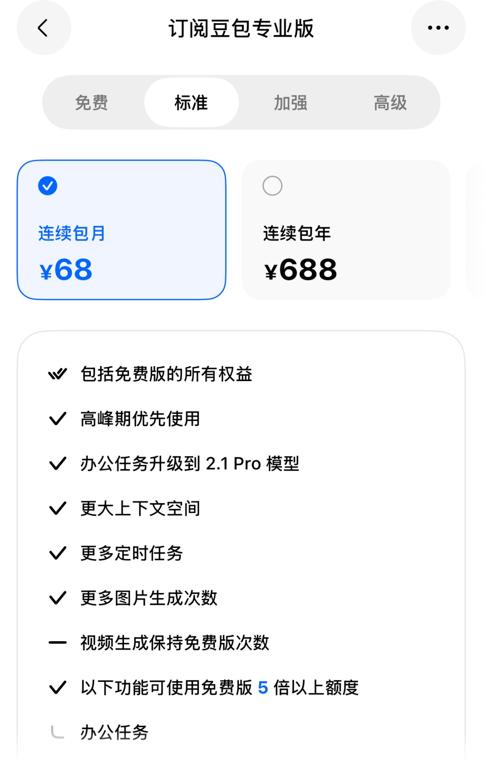
▲ Note: Image sourced from Doubao
When average revenue per user is compressed to rock-bottom levels, or cannot even cover the basic inference operating costs of running an Agent, domestic vendors are forced to make engineering compromises on backend computing power allocation to stay afloat and rein in runaway server expenses, or drastically cut the number of rounds for which long-term memory is retained.
Agents stripped of backend validation and error-retry mechanisms will no longer repeatedly test and debug unworkable code or verify mismatched data when they encounter issues. Instead, they will confidently output incorrect conclusions, or even begin generating nonsensical, hallucinated content.
Thus, in the Agent era, the experience gap that domestic products face in user reputation is not purely a limitation of algorithm capability. It is far more a systemic issue shaped by overlapping factors: technical prioritization choices, development path constraints, and business model limitations. After all, according to Stanford University's 2025 AI Index Report, the performance gap between top-tier Chinese and U.S. large models has already narrowed from 9.3% in January 2024 to just 1.7% by February 2025.
If domestic Agents hope to fully close this "last mile" of experience generational gap in the future, the more critical step may be to explore a reconstructed path that aligns operational workflows with sustainable commercial loops. Building a healthy business model that supports heavy computing power investment will allow domestic AI Agents to break free from the constraints of low pricing or free services, and evolve into genuinely capable "digital partners".
Images are sourced from the internet, and copyright claims will be addressed upon notification.
This article was originally published on the WeChat public account "Yidu Pro", authored by Wen Bo, and republished with official authorization from 36Kr.