After three years of "disappearance", Zuckerberg posted a message just for it: Meta's most powerful Agent model is marching into the programming field.
Three months after launching its first AI model under the leadership of AI chief Alexandr Wang, Meta has rolled out another major upgrade, aiming to compete head-to-head with OpenAI and Anthropic in critical segments of the AI market.
Yesterday, Meta officially released the new Muse Spark, a multimodal AI model tailored for agentic coding, designed to rival comparable offerings from companies including OpenAI and Anthropic. In an interview, Wang stated that Muse Spark 1.1 is "the most capable model available today for agentic tasks and programming."
Over the past few years, Meta has successively launched multiple foundational AI models. The release of Muse Spark is evidently significant enough to prompt CEO Mark Zuckerberg to post on X for the first time in three years. Zuckerberg's last post on the platform was in July 2023, shortly after the service was rebranded from Twitter to X.
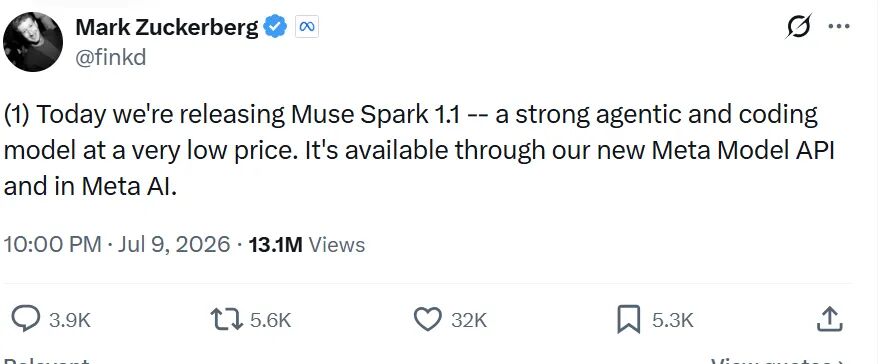
In his post, he described Spark as "an extremely low-cost yet powerful agent and coding model," noting that it "excels at agent performance, tool calling, and computer operation." Zuckerberg also revealed that "there is more to come soon," signaling Meta's plan to continue rolling out additional models.
Remarkable Performance Leap in Three Months, "Outperforming Competitors on Agentic Tasks"
Meta's core selling point to users is Spark's ability to handle large-scale agentic tasks, including fixing code vulnerabilities and assisting with large-scale code migrations—capabilities that an increasing number of enterprises are looking to AI companies to deliver. As a multimodal reasoning model built for agentic tasks, Muse Spark 1.1 delivers major improvements in tool and computer usage, coding, and multimodal understanding.
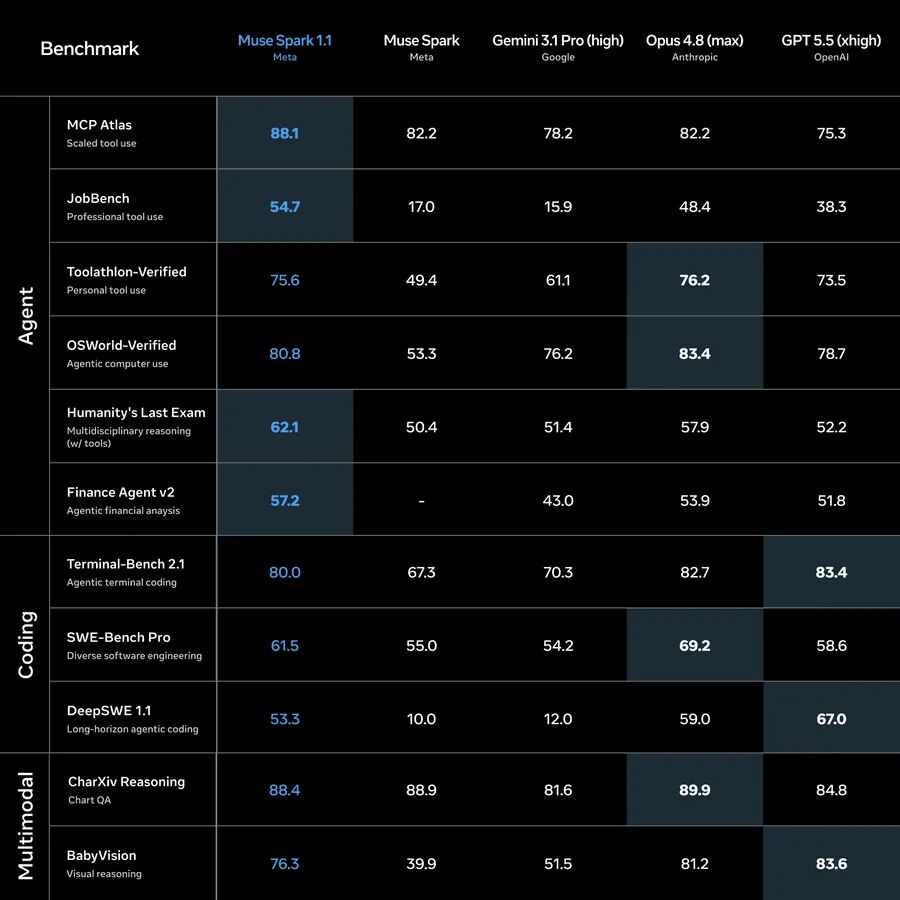
In a blog post, Meta wrote: "Muse Spark 1.1 demonstrates exceptional performance in personal agent tasks, especially suited for scenarios that require planning and coordination across multiple external applications and services." In multi-app computer usage workflows, Muse Spark 1.1 performs excellently by retaining context across long sessions and intelligently choosing between scripts, direct interface interactions, and batch operations at each step. It can navigate unfamiliar interfaces with minimal human intervention. Wang disclosed that in certain tasks requiring interaction with various third-party programming products and services, Muse Spark 1.1 outperforms competing models.
According to his introduction, Meta Superintelligence Labs (MSL), led by Wang, trained Muse Spark 1.1 on programming-related tasks, as this ultimately enhances the overall capabilities of AI agents, enabling them to autonomously perform multiple tasks like "a cohort of human interns." "You have to build programming capability as part of the overall agent capability," Wang stated.
Wang also shared that he has been "dog-fooding" the latest version of Muse Spark internally, and is excited about its potential as a personal health enhancement tool. For example, the model can help users search the web, read academic papers, and access personal health-related data. Speaking about his experiments using AI for assisted health management, Wang said, "This is the kind of use case that I think truly demonstrates the demand for agent systems."
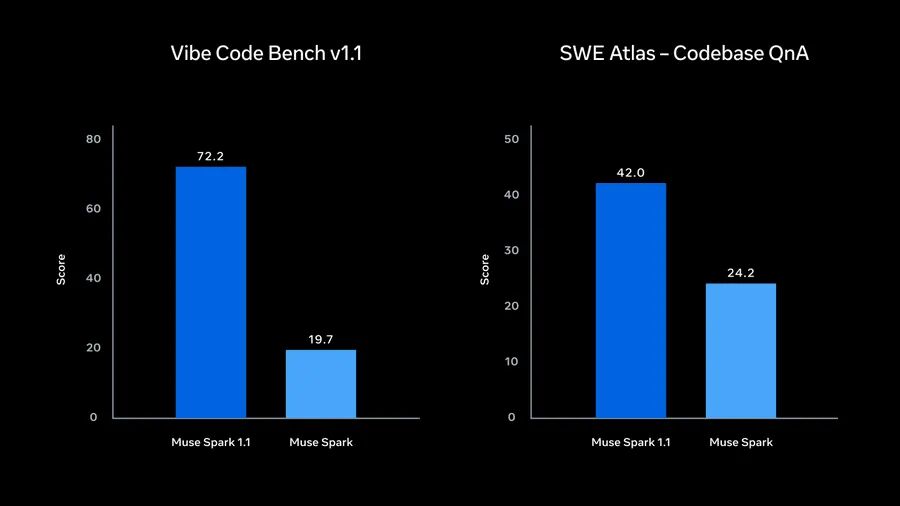
It is understood that Muse Spark originally had the internal codename Avocado, with its first-generation version launched in April this year. Meta stated that the first Spark 1.1 version announced in April this year has multi-step reasoning capabilities, can handle complex workflows, manage digital workflows, and deploy new features in enterprise systems. Compared to the first-generation model, Muse Spark 1.1 delivers a significant performance leap in complex feature implementation, end-to-end development tasks, and codebase search and understanding.
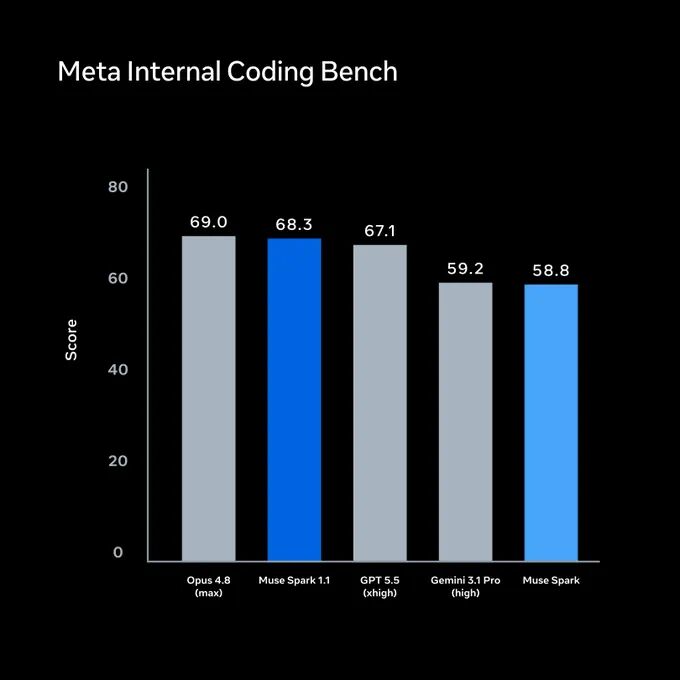
Meta revealed that Muse Spark 1.1 is currently widely used in Meta's coding and research workflows, competing against leading models in Meta's internal coding benchmarks. Its researchers now use Muse Spark 1.1 in their workflows to automate model development and evaluation tasks. In perception and multimodal reasoning, Muse Spark 1.1 also performs excellently, capable of examining visual and audio inputs, retaining details across long workflows, and acting in real execution environments. It demonstrates particular strengths in visual-to-code generation, rich image/video captioning, and intelligent computer usage.
Entering the AI Coding Market, With "Extremely Aggressive and Attractive" Pricing
In this segment, Meta is currently slightly behind its competitors. Anthropic and OpenAI have offered similar models for some time. However, this does not mean Meta's entry will not pose a threat.
A core longstanding competitive point in the AI industry is the usage cost of models, and Meta appears to be attempting to penetrate the market with a price advantage. According to foreign media reports, Meta will charge $1.25 per million input tokens and $4.25 per million output tokens for Spark. This price is higher than OpenAI's entry-level model GPT-5 mini and Anthropic's low-cost model Claude Haiku 4.5, roughly on par (slightly higher) with GPT-5.6 Luna, but lower than Anthropic's higher-end Claude Sonnet 4.6.
Wang stated that compared to similar offerings from labs like Anthropic and OpenAI, the updated pricing for Muse Spark is "extremely aggressive and attractive." It is reported that every new API account receives a $20 free credit for model testing before switching to a pay-as-you-go billing model. "Our goal is to deliver truly attractive pricing that can scale to support massive usage demand."
Furthermore, Wang noted that when training Muse Spark 1.1, Meta ensured it "works seamlessly with all the mainstream toolchains that developers currently use," which Meta believes is the best way to achieve maximum widespread adoption of the model.
"If Muse Spark 1.1 can genuinely compete with Claude and GPT in programming capabilities, Meta may finally have found a clearer commercialization path to convert its AI models into paid developer tools," said Shay Boloor, chief market strategist at Futurum Equities.
Planned to Replace Some Llama Models, Open-Source Version Under Development
Previously, the first-generation Muse Spark was only available to "select partners," who could access the technology exclusively via a "private API preview." At present, U.S.-based developers can access Muse Spark via the public preview on Meta Model API to test prompts, compare model outputs, and develop prototype integrations. Meta has now opened the public preview of the new model's API through its developer portal, where users can register and review integration guides. A Meta spokesperson stated that some early partners already have API access, while new users "can join a waitlist and gain access incrementally over time."
The new model is now live in the "Thinking Mode" of the Meta AI app and website. In addition, Muse Spark is expected to replace some existing Llama models that currently power the chatbots on WhatsApp, Instagram, Facebook, as well as Meta's smart glasses product line. Meta noted that it is still restricting API access to its own product ecosystem, and has not opened it to third-party platforms like the popular OpenRouter model marketplace. "This service will run on the computing infrastructure we have already built," Wang said.
Notably, Meta's previous AI strategy primarily focused on opening the Llama series of models to the open-source community, while the company is now shifting toward selling access to its self-developed AI models. However, Wang stated that Meta remains "committed to open source," and revealed that his MSL team is developing a "variant version of Muse Spark" that is planned to be open-sourced in the future, though he declined to disclose a specific release date for that version.
In addition to Muse Spark, Meta recently released a new AI image generation model called Muse Image, which was previously codenamed "Mango." The model is designed to help Meta attract creators and advertisers to use its AI products.
According to Wang's latest disclosure, Meta is currently training an even more powerful AI model codenamed Watermelon, which has caught up with OpenAI's GPT-5.5 on key benchmarks, though no release timeline has been announced.
References:
https://techcrunch.com/2026/07/09/meta-enters-the-crowded-ai-coding-battle-with-muse-spark-1-1/
https://www.reuters.com/business/meta-debuts-muse-spark-11-with-preview-open-developers-2026-07-09/
This article is sourced from the WeChat public account "AI Frontline", compiled by Hua Wei, and published with authorization from 36Kr.