In-depth Review | Reinterpreting Codex: Coding is Just a Form, Task Execution is the Essence

The AI that truly makes me stay isn't how eloquently it talks, but its ability to push a pile of unfinished work forward.
When I evaluate AI tools now, I am no longer easily impressed by a beautifully crafted response.
There are far too many polished AI-generated answers on the market. Ask a question, and it can deliver a complete, ready-to-use framework;
Or task it with writing an article, and it can quickly lay out a solid opening, logical structure, and well-rounded closing — all looking pretty great at first glance.
But real work is never that simple or ideal; it is usually complex, with multiple overlapping threads running at the same time.
On your desktop, there are old drafts, images, videos, a recently failed script, a poorly formatted draft, a heap of unnamed assets, and a goal that isn't even fully clear yet.
At this point, what I care about is not whether the AI can keep spouting theories, but whether it can step into the actual work context and help push the task a little further.
This is exactly why I've grown to prefer Codex lately.
OpenAI positions Codex as a coding agent, primarily targeting tasks like writing, modifying, reviewing, and delivering code.
This definition is perfectly reasonable, but I think it would be a waste if we only see it as a "programmer's tool".
My feeling about it is more like: it has pushed AI one step further out of the chat window and into the real workspace.
It can read files, modify files, run commands, check error messages, generate images, and save outputs directly to the project directory.
It doesn't just answer "what you should do" — it starts participating in "how this task actually gets finished".
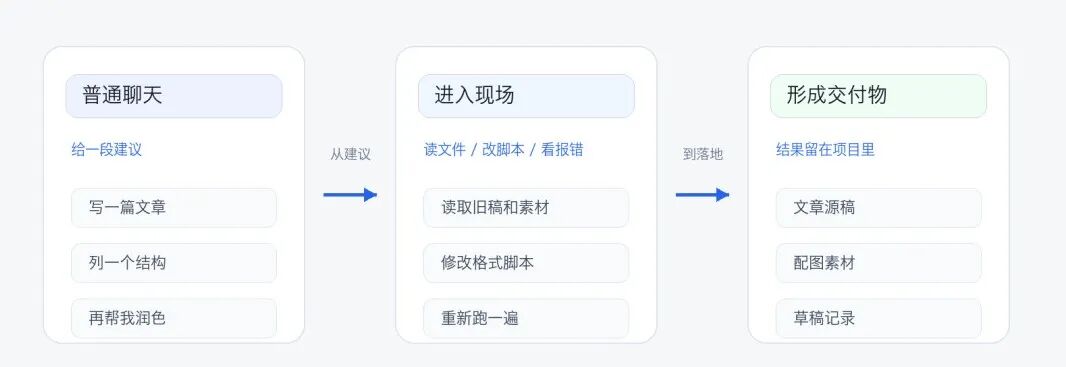
For the same task, the difference lies in whether the tool can access files, assets, commands, and existing drafts.

Being able to give answers alone is no longer enough
In the past, when using AI, I often stopped at "ask a question, get an answer".
This is definitely useful: it saves time when you need to look up concepts, make lists, write a short copy, or explain an error message.
But as soon as the task gets slightly longer, problems start popping up.
For example, to create an official WeChat public account article, writing the main text is only one intermediate step. Before that, you need to define the topic, organize assets, review the original draft, and validate your viewpoints; after that, you have to make matching illustrations, adjust formatting, generate the final draft, check the title and summary, and even consider whether it can be published, how to publish it, and if the content can be reused next time.
A regular chatbot can write the main text for you, but it usually won't organize all the related files properly, won't help you check local file paths, and certainly won't keep modifying the script and regenerating content when your draft formatting gets messed up.
These tasks sound trivial, but they are exactly the small, draining operations that wear people out in real work.
The writing process itself isn't that scary. What's scary is being interrupted right when you get into the flow, by trivial tasks like "copy this, upload that, rename the file, look up the error code, export a new version".
Codex shines in exactly these intermediate, overlooked areas.
It can take over those task-pushing operations that used to require manual work. It doesn't make judgments for you, but it lets you avoid constantly switching back and forth between low-value trivial actions.

I value its ability to handle "unfinished work" far more
Many tools are great for generating content from scratch: give it a topic, and it writes a paragraph; give it a requirement, and it creates an image; give it a headline, and it produces ten different versions.
What makes Codex stand out to me is its ability to work on unfinished drafts — which is the normal state of real-world work.
An article never starts from a completely blank page. It might come from a voice recording, an old draft, a few screenshots, and some temporary supplementary notes.
A web page also never starts from a vague idea of "designing a beautiful website". It might already be built on an existing old project, with pre-built components, established styles, and a bunch of non-negotiable constraints that can't be changed randomly.
Codex first observes the actual context. It reads existing files to see what's in the directory; it modifies content based on existing writing styles instead of inventing a completely new style out of thin air; after a failed run, it keeps checking the error details instead of just saying "you can check your configuration".
This point is extremely important to me. A lot of AI outputs look perfectly complete, but they are almost impossible to use when imported into a real project. They don't understand what you already have, and just generate a piece of content that "looks like an answer" out of nowhere in the chat window.
Codex is more like stepping into the room, first taking a look at everything on the desk, then deciding where to start working.

A proper delivery should leave reusable assets behind
I've increasingly realized that a good AI tool shouldn't only deliver a single block of text.
It should ideally leave behind a full set of assets: where the article is stored, where the matching illustrations are saved, where the scripts are located, what the draft upload result is, which steps failed before, and which workflow segments can be reused next time.
These assets are not as noticeable as a polished final draft, but they determine whether you will have to start all over from scratch the next time you do a similar task.
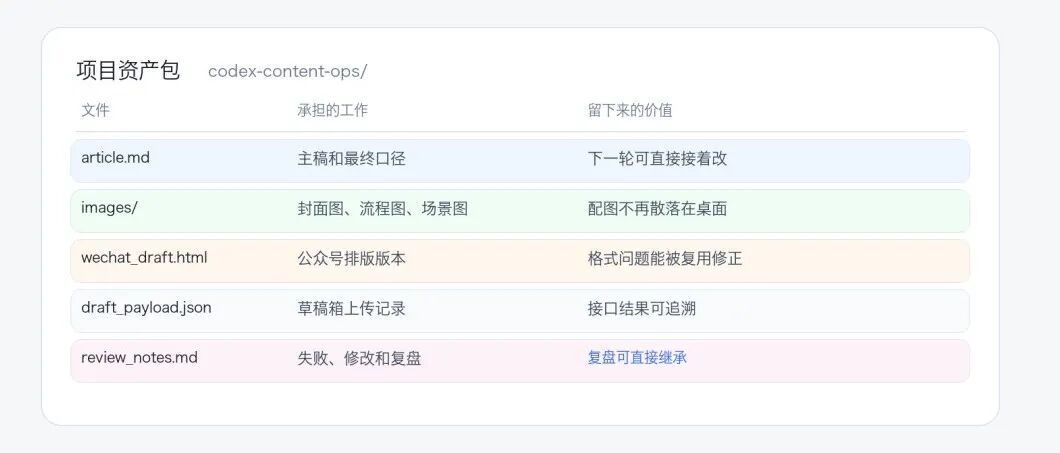
Reusable work doesn't only consist of a single main text — it preserves the full package: the article, images, scripts, draft records, and post-task reviews all together.
In the past, I often treated AI as a "temporary external brain". I would ask it for help when I needed something, then close it right after finishing the task.
But Codex is more like a real team member working on the project. Its outputs don't just stay in the chat history — they land directly in your file system.
This sounds like a tiny detail, but it has a huge impact. Once content is saved as actual files, it can be reviewed, modified, and reused freely.
The next time you work on a similar task, you don't need to re-explain the entire background from scratch, or dig through pages of old chat records to find previous content. This is also my core standard to judge whether a tool is worth keeping long-term.
Does it make your work more accumulative? If every output is a one-off disposable result, no matter how polished it is, it will easily be forgotten right after use. Only workflows that can be solidified and preserved will truly transform the way we work.

You can only tell if it's truly useful when things go wrong
I never buy into the marketing story of tools that are "perfect on the first try".
In real work, the first version almost always has issues: the WeChat public account draft is uploaded, but its formatting is completely broken; the script can run, but the data table gets corrupted; the image is generated, but its aspect ratio doesn't fit the main text; the API can be called, but your request is blocked by the whitelist; the article is finished, but it reads exactly like a dry instruction manual.
These are all very common problems. The key is not to avoid failures entirely, but to be able to keep troubleshooting and fixing things after a failure occurs.
A tool that can only chat will usually turn into a suggestion machine at this stage: it will tell you "you can check your configuration", "you can re-layout the content", "you can optimize the script".
What makes Codex far more useful is that it can keep moving forward with the task.
When it sees broken formatting, it checks the conversion logic; when it finds corrupted code blocks, it modifies the rendering rules; when the API returns an error, it looks up the error code and checks local configurations; when the image is placed incorrectly, it regenerates the image or adjusts the insertion position.
It doesn't get every step right, but it keeps the problem within the workflow instead of dumping the whole mess back to you to fix manually.

A truly useful agent doesn't never make mistakes — it can handle those mistakes and keep the task going.

This is not just a thing for programmers
Developers are of course the group that can most easily understand the value of Codex.
Fixing bugs, running tests, refactoring code, checking dependencies, writing documentation — these are all its home turf. But I believe a lot of non-development work is also gradually becoming more project-like.
Creating an article is never just writing the text itself. Behind it there are assets, images, multiple versions, publishing channels, formatting rules, and post-task reviews. Building a campaign landing page is never just writing an introductory copy. Behind it there are page structures, visual assets, forms, links, tracking points, and pre-launch checklists.
Creating a small product prototype is never just describing your idea. Behind it there are interactive pages, data structures, interaction flows, state management, and a working demo that can actually run.
Not all of this work requires writing code, but all of it needs to be organized, reviewed, and delivered properly. That's why Codex's value is not limited to the fact that it "can write code".
Its more valuable advantage is that it integrates all those scattered small operations into a single continuous workflow: reading materials, generating files, modifying structures, processing images, running scripts, checking results, and then going back to fix issues.
This is extremely meaningful for content creators, product managers, operations staff, and independent creators.
Not everyone needs to write code, but more and more people need to turn their ideas into something visible, usable, and continuously improvable.

The value of its image processing capability is not just "generating an image casually"
I also highly value Codex's ability to process image assets.
It's not because the fact that "AI can draw images" is some groundbreaking new innovation. It's because in real delivery workflows, images never exist as isolated standalone files.
An article needs a cover image, flow charts, comparison diagrams, and checklists. A web page needs a hero banner, icons, and placeholder images. A project proposal needs architecture diagrams and process illustrations to make it instantly understandable for others.
If AI can only generate the main text, your delivery will get stuck halfway through the process.
A smoother workflow should be: as you write the article, the tool automatically knows what kind of image is needed, which directory to save it in, how to reference it in the main text, and how to display it properly in the final draft — all handled in the same continuous workflow.
This is exactly what I love about Codex. Images are no longer just "a pretty generated picture" — they become a fully integrated part of the entire project assets.
They serve the purposes of understanding, reviewing, and reusing the entire project later.

Humans still need to take charge of core judgments
I don't think Codex will replace humans to make important decisions, and it shouldn't.
Decisions like whether a topic is worth writing about, whether the viewpoints are too radical, whether the assets can