The world's first humanoid robot has entered the operating room, where doctors controlled it to complete a living surgical operation.
Researchers report in the July 8 issue of the journal Nature that two remotely operated humanoid robots have been used for the first time to complete two surgical procedures in a preclinical trial.
The study is the result of a collaboration between a team of engineers and a team of surgeons at the University of California, San Diego.
In one surgery, a human-robot team consisting of a humanoid robot and a human surgeon acting as assistants successfully completed a gallbladder removal operation.
The second successful surgery was performed by two humanoid robots working side by side, representing a robot-and-robot team surgical procedure. Both operations were performed on large non-human primate mammals.
According to the researchers, this proof-of-concept experiment is the first step toward bringing humanoid robots into the operating room.
These robots can initially serve as assistants during surgical procedures, and in the future, they can be remotely operated by surgeons to perform operations.
Michael Yip, a professor in the Department of Electrical and Computer Engineering at UC San Diego and one of the senior authors of the paper, noted that the shortage of surgeons coexists with growing patient demand, leading to longer wait times, reduced access to care, and greater disparities in the distribution of medical resources.
"Remotely operated and autonomous humanoid robots have the real potential to expand access to critical surgeries for patients who would otherwise not have access to them. This will not only help address the healthcare crisis in the United States but also alleviate medical challenges on a global scale."
The researchers point out that unlike specialized surgical robot systems that can only perform a single function, humanoid robots are versatile and can be used to carry out a wide range of surgical operations and general tasks.
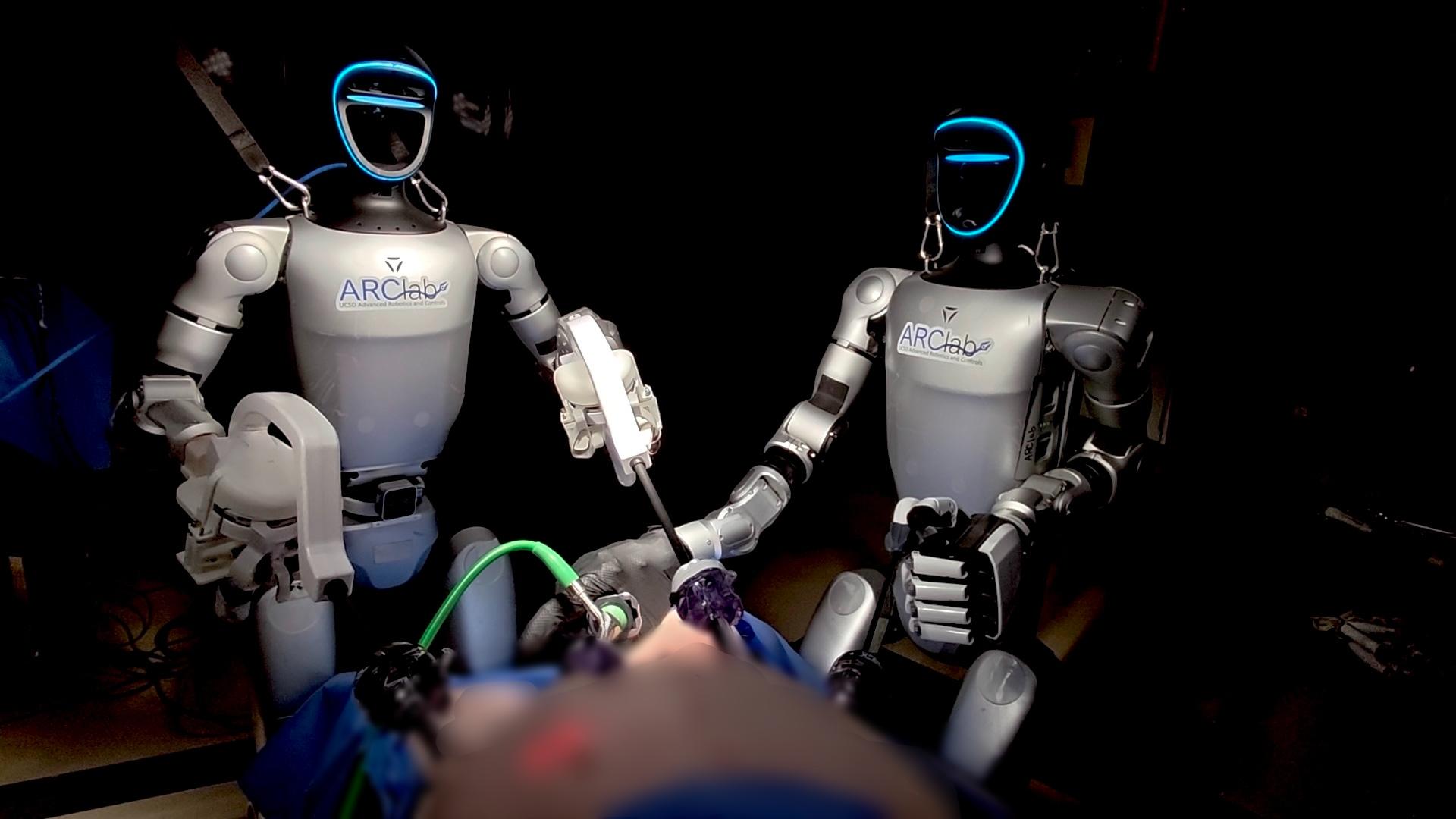
These robots are also easier to deploy to remote areas and other challenging environments where versatility is particularly critical.
"This study demonstrates that humanoid robots have a viable future in surgery. You can imagine these robots being deployed in remote communities that struggle to staff adequately, or in harsh environments such as search and rescue scenarios where large-scale field medical deployments are needed in a short amount of time," said Yip, who is also a professor at the UC San Diego Jacobs School of Engineering.
What advantages do humanoid robots bring to the operating room?
In fact, humanoid robots can address a major problem in healthcare: access to medical services.
Specialized surgical systems are typically equipped with three to four mechanical arms, dedicated tools, and proprietary software.
These systems weigh approximately 1,800 pounds, require a large team to set up, and take up considerable space in the operating room, which often needs to be renovated to accommodate them.
In contrast, humanoid robots are mobile and more compact. The robot used in this study, nicknamed Surgie, is 5 feet tall and weighs 60 pounds. (The experiment used a G1 humanoid robot produced by Chinese company Unitree Robotics.)
These relatively lightweight, compact robots are especially useful in remote and resource-limited settings.
According to Yip, in these environments, the cost of building dedicated operating rooms for surgical robot systems or finding large teams to operate specialized equipment would be prohibitively expensive.
Unlike typical surgical operating systems, humanoid robots can seamlessly integrate into the operating room.
While the researchers did have to fabricate adapters to allow Surgie to hold traditional surgical tools, operating the humanoid robot also feels more natural, especially for those who have not received training on specialized systems.
"We were surprised how well Surgie fit into our workspace and workflow," said Nikita Thareja, M.D., a general surgery resident at UC San Diego School of Medicine and co-author of the study.
Shanglei Liu, M.D., one of the senior authors of the paper and an assistant professor of surgery at UC San Diego School of Medicine, who remotely operated the robot during the study, stated that the surgeries performed by the remotely operated humanoid robot were as precise as those performed by specialized remote surgical robot systems.
"It costs a fraction and takes up a fraction of the space in the operating room. So it's easy to deploy, whether in remote areas or even in space," Liu said.
What comes next?
There are still issues to resolve with remote operation. The robot had to be recalibrated multiple times during the surgery.
As a result, the procedures took much longer than those performed with existing specialized surgical systems.
But Liu noted that this was also common with early specialized robot systems and is likely to improve over time. The first robotic laparoscopic surgery took six hours, and now it only takes 30 minutes.
The time lag between the surgeon moving the controller and the robot moving is an issue the team is working to improve as they explore longer-distance surgical operations to remote communities.
The researchers also envision different roles for Surgie. Because it can walk and perform most physical tasks that humans do, it can fetch tools for surgeons and clean up the operating room after procedures.
"One of our goals is to develop autonomous surgical assistants," Yip said.
"Many communities face shortages of surgical team staff, which means patients cannot receive care. Our goal is to build the operating room of the future, where humanoid robots and humans work side by side as an integrated team to deliver surgical care to those in need, whether in a traditional hospital setting or in non-conventional medical scenarios."
The researchers emphasize that this work could not have been done without close collaboration between engineers and surgeons, and the role of the UC San Diego Center for the Future of Surgery.
"This achievement embodies the power of bringing engineer and surgeon innovators together to solve meaningful clinical problems in our world-class training and research labs," said Ryan Broderick, M.D., interim director of the Center for the Future of Surgery and associate professor of surgery at UC San Diego School of Medicine.
"Our center bridges engineering innovation and clinical expertise, enabling transformative ideas to be rigorously developed, tested, and refined."
This article originates from the WeChat public account "RobotPrologue", authored by RobotPrologue, and is published with authorization from 36Kr.