I didn't expect that the company which ranked first in financing in this hard-core track in the first half of the year is actually located in Hefei.
Brain science, quantum technology, photonic computing, nuclear fusion — these seemingly high-end, hardcore, futuristic terms are now becoming the "top-tier narrative" in China's primary market startup landscape.
Even more exciting is that a growing number of investment institutions are recognizing and deploying in this still-niche cutting-edge track, driving the total industry financing volume steadily upward, jumping from the previous scale of tens of billions of yuan in half a year to the current 100-billion-yuan range.
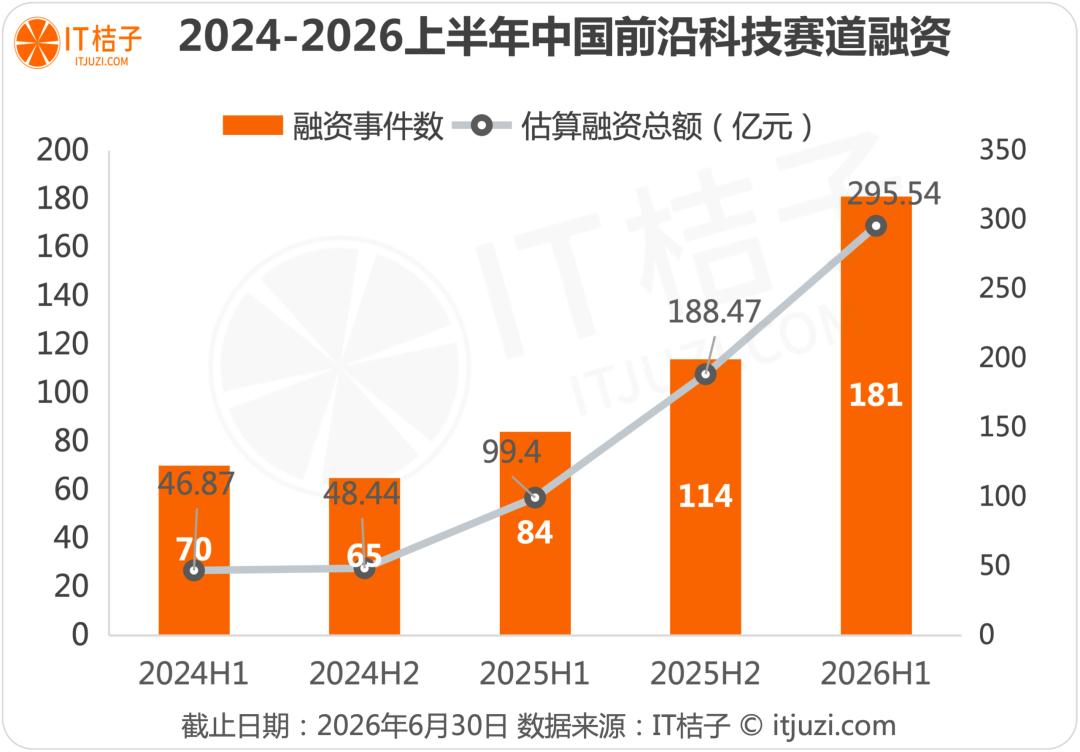
Especially in the first half of 2026, China's cutting-edge technology tracks including brain science continued their high prosperity, with both the number of financing events and total amount hitting new highs in the past two years.
Data Statement:
1. The data screening standard is entries categorized under "Cutting-edge Technology" in the "Event Database" of IT Juzi's database
2. The statistical scope is limited to equity financing events in the primary market, excluding company IPOs, post-listing refinancing, and M&A transactions
3. The analysis is based solely on publicly disclosed primary market financing data, excluding unpublicized financing transactions.
IT Juzi data shows that after starting from 65 financing events in H2 2024, the number of financing events in China's cutting-edge technology track has maintained growth for four consecutive cycles, reaching 181 events in the first half of 2026 — a 115% increase year-on-year compared to 84 events in H1 2025. Startup activity in the track continues to rise.
Meanwhile, the financing amount of the cutting-edge technology track in the first half of the year reached 295.54 billion yuan, a substantial 197% year-on-year increase from H1 2025, marking a qualitative leap in capital investment in the track.
I. Dual Core Leadership of Shanghai and Beijing, Hefei Emerges as a Dark Horse
First of all, the two core cities of Shanghai and Beijing together contribute over 48% of the total financing amount, leading the country.
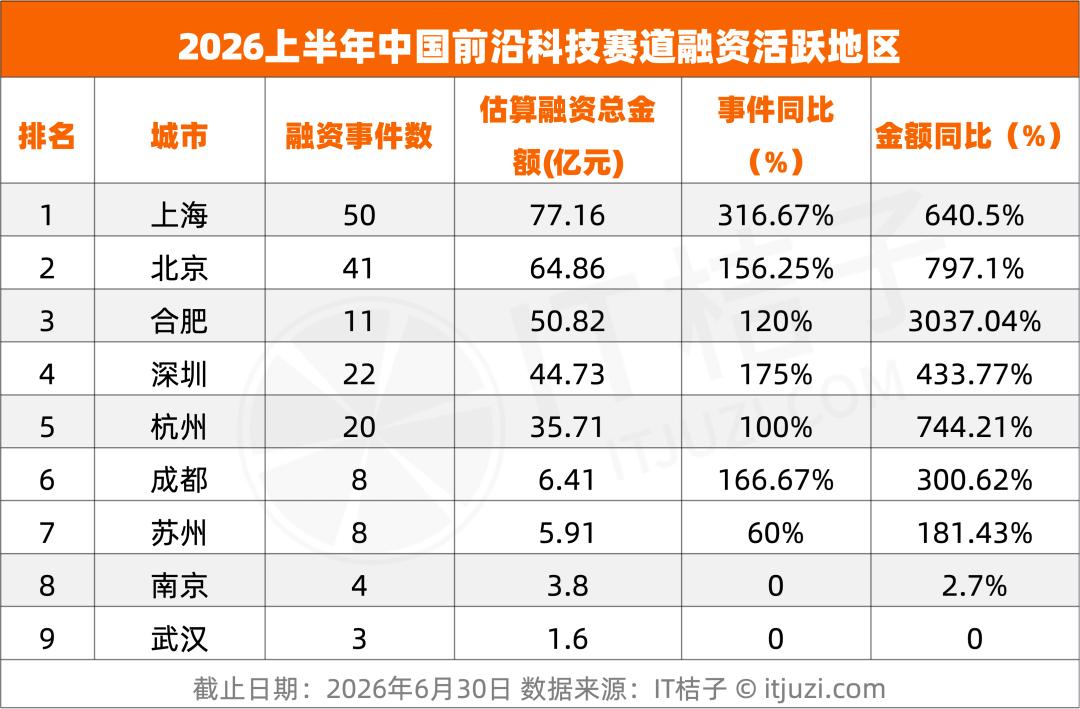
Shanghai ranks first: with 50 financing events and a total financing amount of 77.16 billion yuan, it leads the country in both event count and total amount. Shanghai boasts remarkable advantages in the two hardcore tracks of nuclear fusion and quantum technology, with leading enterprises such as Energy Singularity, East Fusion, and Turing Quantum all based in the city, forming a complete cutting-edge technology industrial ecosystem.
Beijing follows closely: 41 financing events with a total financing amount of 64.86 billion yuan. Leveraging top scientific research resources including the Chinese Academy of Sciences, Tsinghua University, and Peking University, Beijing stands out in quantum technology, synthetic biology, and brain science, with leading enterprises such as Microyuan Synbio and Boson Quantum located in the city.
Secondly, Hefei has emerged unexpectedly to become the strongest dark horse in cutting-edge technology.
Hefei ranks third nationwide with 11 financing events and a total financing amount of 50.82 billion yuan, with its financing amount skyrocketing 30 times year-on-year, making it the biggest dark horse in the cutting-edge technology track.
The single-round 3-billion-yuan Pre-IPO financing of Origin Quantum has a significant pulling effect, coupled with intensive financings of nuclear fusion enterprises such as Stellar Fusion and Stellar Energy. With the model of "government guidance + industrial fund", Hefei has achieved corner overtaking in the two hardcore tracks of quantum technology and nuclear fusion, becoming the third pole of China's cutting-edge technology industry.
Finally, Shenzhen and Hangzhou steadily occupy the second echelon, with a prominent agglomeration effect in the Yangtze River Delta region.
Shenzhen and Hangzhou rank fourth and fifth with financing amounts of 44.73 billion yuan and 35.71 billion yuan respectively. Shenzhen excels in quantum technology, brain science, and future display fields, while Hangzhou has formed a distinctive layout in brain science and quantum computing.
Overall, Yangtze River Delta cities including Shanghai, Hefei, Hangzhou, Suzhou, and Nanjing recorded a total of 93 financing events with a total financing amount of 173.40 billion yuan, accounting for 58.67% of the entire track. With complete hard technology industrial supporting facilities and an active industrial fund ecosystem, the Yangtze River Delta region has become the most core agglomeration area of China's cutting-edge technology industry.
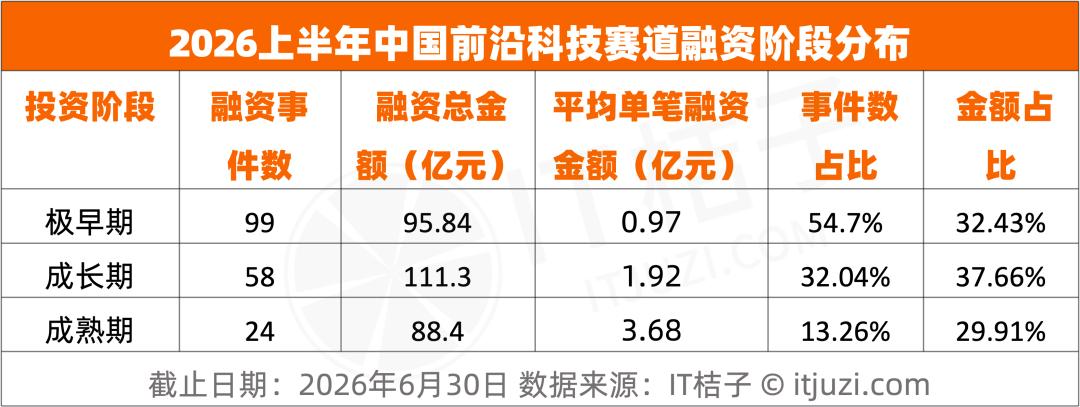
In the first half of the year, the total number of events in the extremely early stage (seed round, angel round, Pre-A round) of China's cutting-edge technology track reached 99, accounting for over 50% at 54.70%, remaining the stage with the highest startup activity, with new startups continuously emerging.
The average single financing amount is 97 million yuan, significantly higher than the early-stage average of the low-altitude economy track, reflecting that capital is willing to give extremely high valuation premiums to top teams in cutting-edge technology. "Betting on top scientists + original technology" has become the core logic of early-stage investment.
The total number of events in the growth stage (Series A, Series A+, Series B, Series B+, etc.) reached 58, accounting for 32% of total events; the financing amount exceeded 100 billion yuan, accounting for 37.66%.
Growth-stage leading enterprises such as Microyuan Synbio, Energy Singularity, and BrainCo have all completed large-scale financings ranging from hundreds of millions to 2 billion yuan, reflecting that leading enterprises in the cutting-edge technology track have entered the stage of large-scale expansion, and the pace of industrialization implementation continues to accelerate.
The mature stage (Series C and beyond + Pre-IPO + strategic investment) recorded a total of 24 events, with an average single financing amount of 368 million yuan, the highest among the three stages.
II. Analysis of Segmented Tracks
1. Quantum Technology: The Largest Track, Financing Amount Skyrockets 20x Year-on-Year
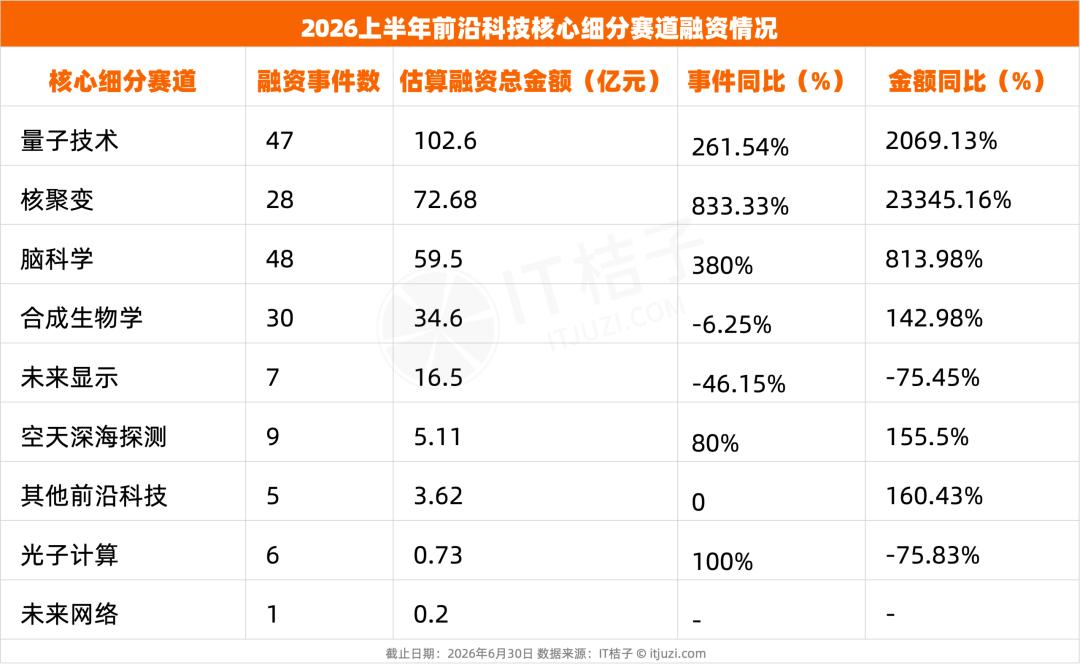
Among these segmented tracks, quantum technology ranks first with a total financing amount of 102.60 billion yuan, accounting for over one-third of total financing. Its event count increased 261% year-on-year, and its financing amount surged over 20 times year-on-year, making it the absolute core mainline of the cutting-edge technology track.
Leading enterprises including Origin Quantum, SpinQ, Boson Quantum, and Turing Quantum have all completed large-scale financings, covering the entire industrial chain of quantum computing, quantum sensing, and quantum communication. As quantum computing moves from the laboratory to commercial implementation, quantum technology is becoming the core track that attracts the most capital attention in the hard technology field after AI.
2. Nuclear Fusion: The Biggest Dark Horse, Financing Amount Surges 233x Year-on-Year
The nuclear fusion track was the biggest dark horse in the first half of 2026, with 28 financing events and a total financing amount of 72.68 billion yuan. The number of events increased 8 times year-on-year, and the financing amount skyrocketed 233 times year-on-year, rapidly becoming the second largest track in cutting-edge technology.
Nearly 30 nuclear fusion startups including Energy Singularity, East Fusion, Stellar Fusion, and Nova Fusion have completed financing, with Shanghai and Hefei becoming the core gathering places for nuclear fusion enterprises. Continuous breakthroughs in the commercialization of controlled nuclear fusion, coupled with the global energy transition context, have quickly turned nuclear fusion from a "sci-fi concept" into a hot investment target in the primary market, as capital is placing bets in advance on the next-generation energy revolution.
3. Brain Science: The Largest Number of Financing Transactions, Highest Startup Activity
The brain science track ranks first in transaction activity with 48 financing events, accounting for 26.52% of total events, with the highest startup activity, and its financing amount increased 8 times year-on-year.
Leading enterprises such as BrainCo, NeuroX, and Step Medical have all completed large-scale financings, covering fields including brain-computer interface, neuromodulation, and brain disease diagnosis and treatment. With continuous breakthroughs and commercial implementation of brain-computer interface technology, brain science is becoming the most active startup track in the cutting-edge technology field.
4. Synthetic Biology: Slight Decline in Financing Events, Financing Amount Driven by Leading Players
In the first half of the year, the synthetic biology track recorded 30 events, a slight 6.25% year-on-year decrease, with a financing amount of 34.6 billion yuan; although this represents a 142.98% year-on-year increase, a single enterprise — Microyuan Synbio — alone contributed 21 billion yuan (completed in three rounds, including a 1.5-billion-yuan Series B financing). Other financed enterprises are generally small in scale, showing obvious differentiation in the track.
Founded in 2021 with headquarters in Beijing, Microyuan Synbio has a globally original "one-step fermentation" technology for producing sugar alcohols such as allulose, replacing traditional chemical synthesis with biological fermentation to reduce production costs and environmental pollution. Meanwhile, it independently developed AI biological computing platforms (such as PoseX) to optimize enzyme design and metabolic networks, improving biomanufacturing efficiency.
III. The Top 20 Star "Contender" Camp
According to statistics from IT Juzi, the total financing amount of the top 20 enterprises with the most financing in the first half of the year reached 211.08 billion yuan, accounting for 71.42% of the total financing amount of the cutting-edge technology track. Nearly 70% of capital flows to the top 20 enterprises, showing an extremely strong Matthew effect.
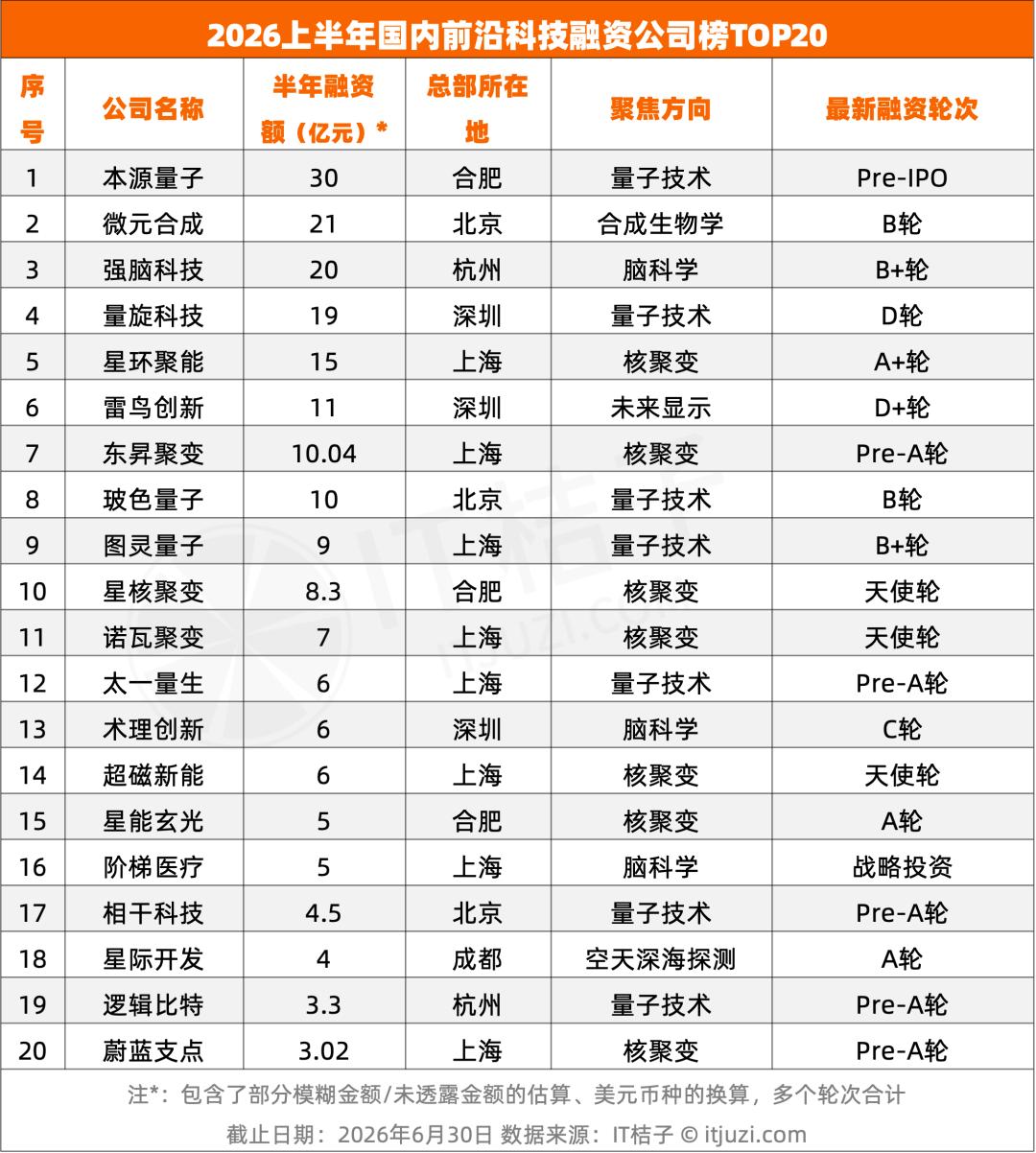
From the top 20 list, the core characteristics of these enterprises are quite prominent.
1. High Track Concentration: Quantum + Nuclear Fusion Take 14 Seats
Among the top 20 enterprises, there are 7 quantum technology enterprises and 7 nuclear fusion enterprises, totaling 14, taking 70% of the list's seats, with a total financing amount of 138.36 billion yuan, accounting for 65.55% of the top 20 total financing.
This reflects that in the first half of 2026, capital prefers to bet on the most hardcore original technology tracks with the greatest long-term imagination. Quantum computing and controlled nuclear fusion represent the next-generation computing power revolution and the next-generation energy revolution respectively. They are the two tracks with the highest barriers and largest market space in the cutting-edge technology field, and also the absolute core of capital's high-stakes bets.
2. High Geographic Concentration: Shanghai Takes 9 Seats, Leading the Country
Among the top 20 enterprises, 9 are located in Shanghai, 3 in Beijing, 3 in Shenzhen, 3 in Hefei, and 2 in Hangzhou. Shanghai alone occupies nearly half of the top 20 list, forming an absolute industrial agglomeration advantage in the two hardcore tracks of nuclear fusion and quantum technology.
3. Early-stage Projects Can Also Obtain Large Amounts of Capital
It is worth noting that multiple startups including East Fusion, Stellar Fusion, Nova Fusion, Supermag New Energy, and Taiyi Quantum have made it onto the top 20 list with only one or two angel/pre-A round financings, with a total half-year financing amount of over 500 million yuan.
This reflects that capital is willing to give extremely high valuation premiums and large-scale financial support to top teams and original technologies in the cutting-edge technology track even at the extremely early stage. Investing early, investing in hard technology, and investing in scientists have become the core logic of cutting-edge technology investment.
IV. Camp of Leading Active Investors
IT Juzi data shows that from January 2024 to June 2026, the total number of institutions participating in equity investment in China's cutting-edge technology track reached 862, covering all types of capital including leading VCs, state-owned background institutions, industrial capital, and early-stage investment institutions. The track's investment and financing ecosystem continues to improve.
A notable trend is that more and more capital is voting with real money to show trust in the long-term value of this track.
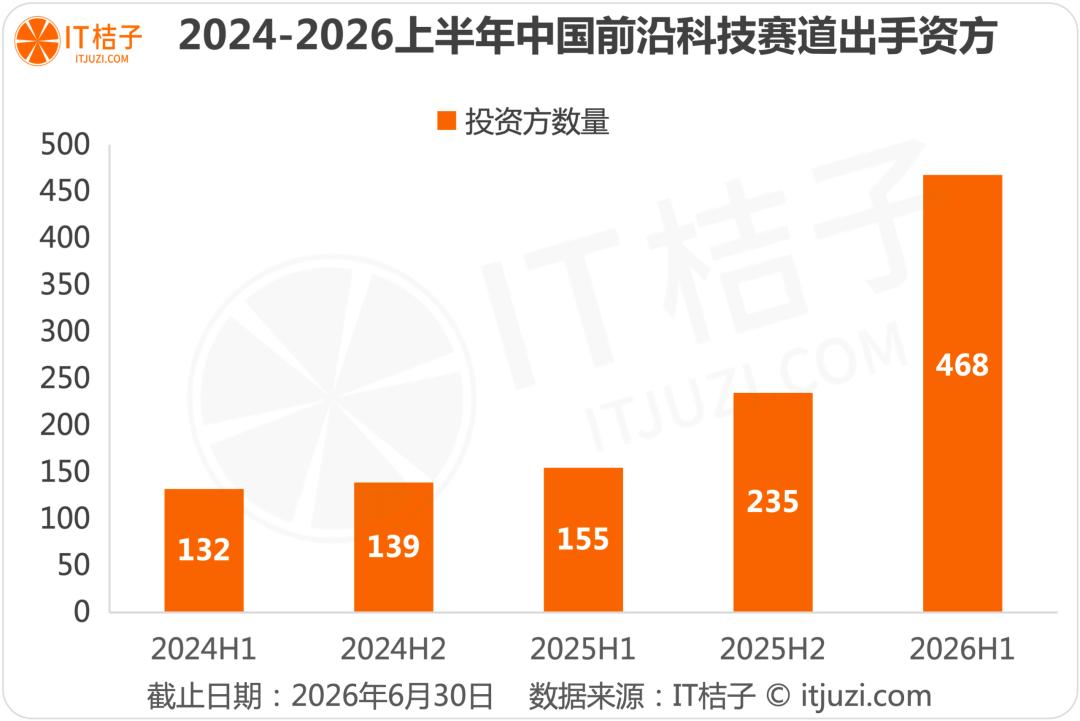
From 132 participating institutions in H1 2024 to 468 in H1 2026, the number of participating institutions continues to expand. The number of participating institutions in H1 2026 increased 2 times year-on-year, with a significantly accelerated growth rate, highly echoing the explosive growth of the track's financing scale.
In particular, hard technology early-stage funds represented by CAS Star, InnoVision Fund, and Shuimu Qinghua Alumni Seed Fund continue to bet on early-stage scientist entrepreneurship projects in the angel round of the cutting-edge technology track, serving as the "first driving force" for the transformation of cutting-edge technological achievements.
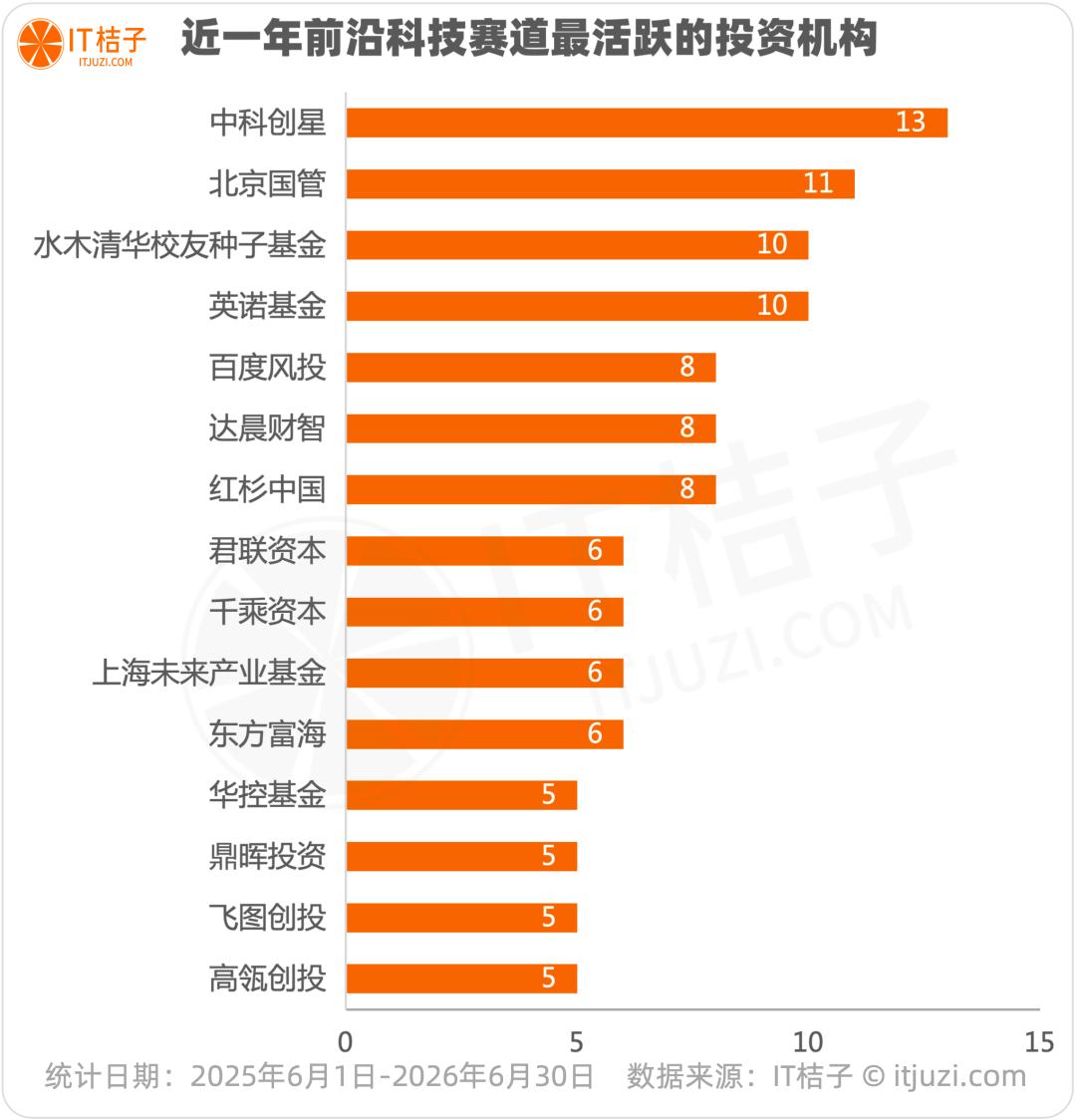
The number of investment deals can more directly reflect the deployment breadth of institutions in the track. From the perspective of the deployment breadth echelon in