A historic drop: China achieves its first-stage recovery of a large rocket for the first time
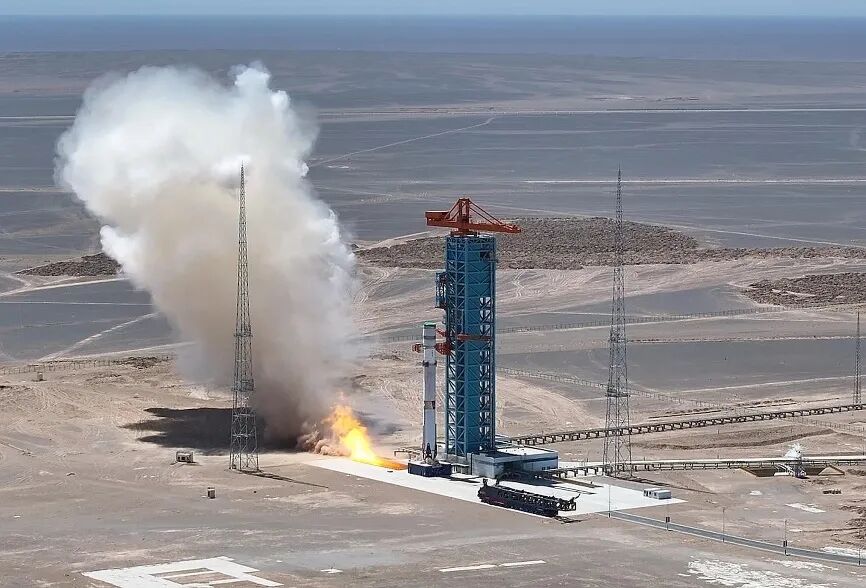
At 12:15 PM Beijing Time today, China's new-generation large liquid-fuel rocket, the Long March 10B, lifted off from Pad 2 of the Hainan Commercial Space Launch Site, successfully delivering its payload to the designated orbit, marking a flawless maiden flight.
Beyond the launch mission itself, one experimental feature of this rocket has drawn exceptional attention: the first-stage core recovery.
In the South China Sea, 430 kilometers downrange from the launch site, the mission-completed core first-stage flew back, descended vertically, and landed steadily within the giant net deployed from the offshore platform *Pilot*.
Standing 36 meters tall and mounted on a vessel with a full-load displacement of 25,000 tons, this net was purpose-built to catch the returning rocket.
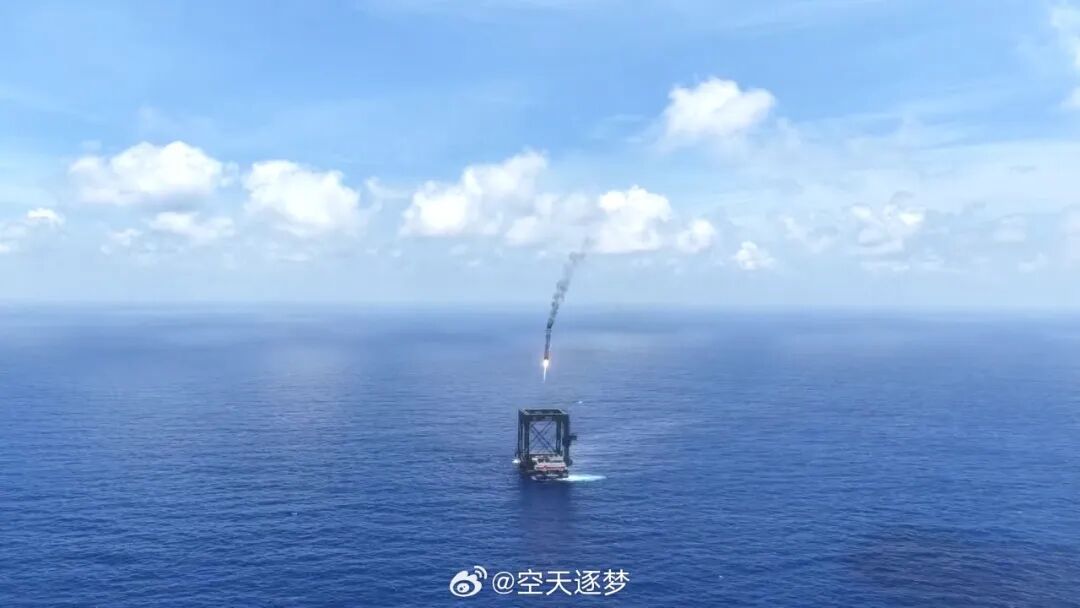
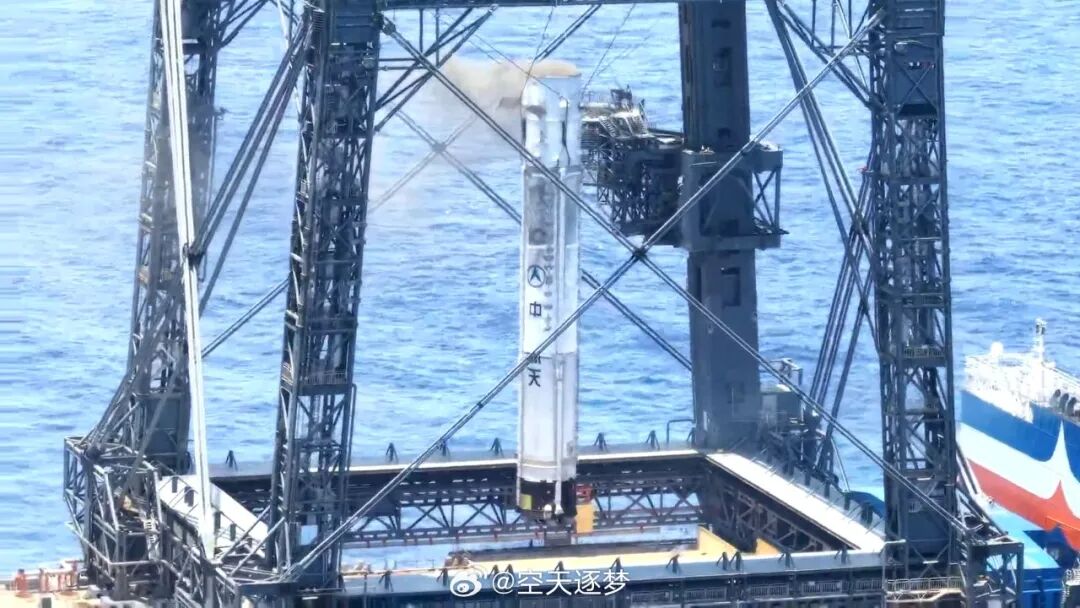
Net-capture of the Long March 10B core first-stage | Weibo @Aerospace Dream Chaser
This single catch set two new records. China has become the second country after the United States to successfully complete flight verification of core first-stage recovery for a large liquid launch vehicle. And catching a rocket with a net is a world-first achievement.

Anthropomorphic illustration of the Long March 10B core first-stage net capture | stainless_squid
Why Recover Rockets?
The most straightforward reason is cost reduction.
To draw an analogy: a commercial airliner flies from Beijing to Shanghai, refuels after landing, undergoes routine checks, and is ready for its next flight. Traditional rockets cannot do this—they are single-use vehicles. After the first stage boosts the payload into space, it falls back to Earth and is discarded, requiring an entirely new rocket to be built for every subsequent launch. This is equivalent to throwing away an entire aircraft after every single trip, and the associated costs are self-evident.
Yet the first stage is one of the most expensive components of the entire rocket: it is the largest, houses the most engines, and incorporates the most complex technology. If it can be recovered, refurbished, and reused multiple times—dozens of times even—the per-launch cost can be drastically reduced.
Beyond cost savings, there is another key benefit: speed. Constructing a large rocket typically takes months, or even years. Single-use design means you can only launch one rocket after you finish building it, with launch cadence strictly limited by production speed. If recovered stages can be reused, launch tempo can be dramatically accelerated.
This approach has already been proven successful: SpaceX's Falcon 9 in the United States, through repeated first-stage reuse, has achieved a launch cadence of over 100 missions per year.
As a result, reusability has become the global mainstream direction for rocket development in recent years. While the goal is universal, there is more than one path to reach it.
Why Net-Based Recovery?
The current most mainstream international recovery method, represented by SpaceX's Falcon 9, allows the rocket to land back and "stand" on its own. During its return, the first stage deploys four large hydraulic landing legs, and finally descends vertically onto a land-based or offshore recovery platform.
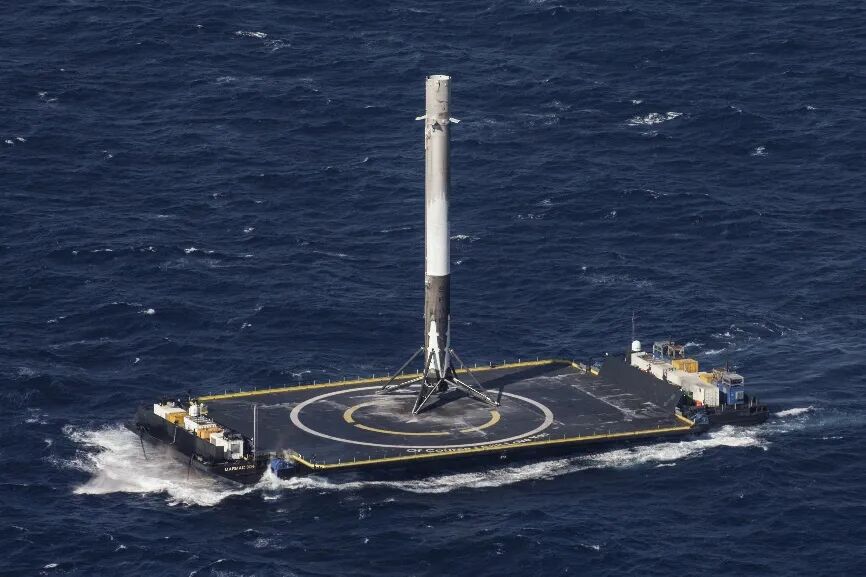
Falcon 9 first stage landing on an offshore recovery platform | SpaceX
This system is already highly mature, but it carries an unavoidable tradeoff: the four large landing legs, paired with complex supporting buffer mechanisms, significantly add to the rocket's own dry mass.
The rocket has to carry all this extra weight from the moment of liftoff, with the landing legs only serving their purpose in the final seconds before touchdown. Every second spent carrying this unnecessary mass wastes valuable launch payload capacity. The sturdier the legs are built, the less cargo the rocket can carry.
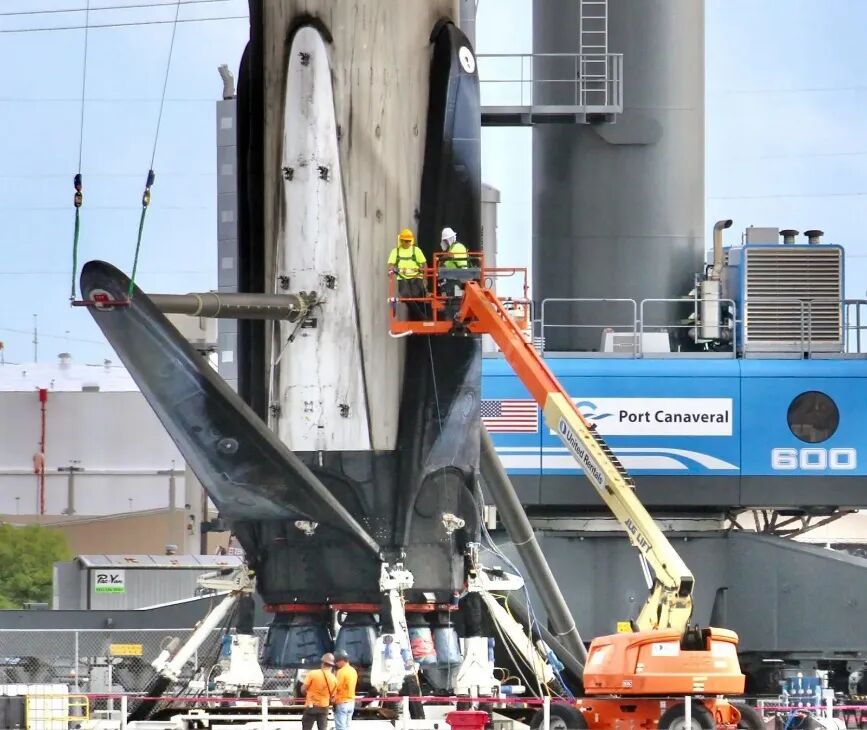
Falcon 9 landing legs | Ken Kremer
The Long March 10B takes a completely different approach.
For most of its return trajectory, there is no fundamental difference from other recoverable rockets. After first-second stage separation, the core first-stage deploys grid fins (lattice-like small wings mounted on the rocket body, designed to control flight attitude in the atmosphere), reignites its engines to decelerate, and flies toward the waiting *Pilot* platform in the South China Sea.
The *Pilot* is not idle during this process: using its dynamic positioning system, it holds steady against wind and waves, maintaining its exact position in the designated recovery zone.
The real difference lies in the final step. While the Falcon 9 would extend its landing legs to prepare for touchdown, the Long March 10B does no such thing. It hovers above the platform, reduces its horizontal velocity to zero, then descends vertically. On the platform, a rope net forms a grid-like "well" shape. As the arresting bars protruding from the rocket body make contact with the net, the net and buffer systems dissipate the kinetic energy layer by layer, gradually eliminating the rocket's downward momentum before securely cradling it.
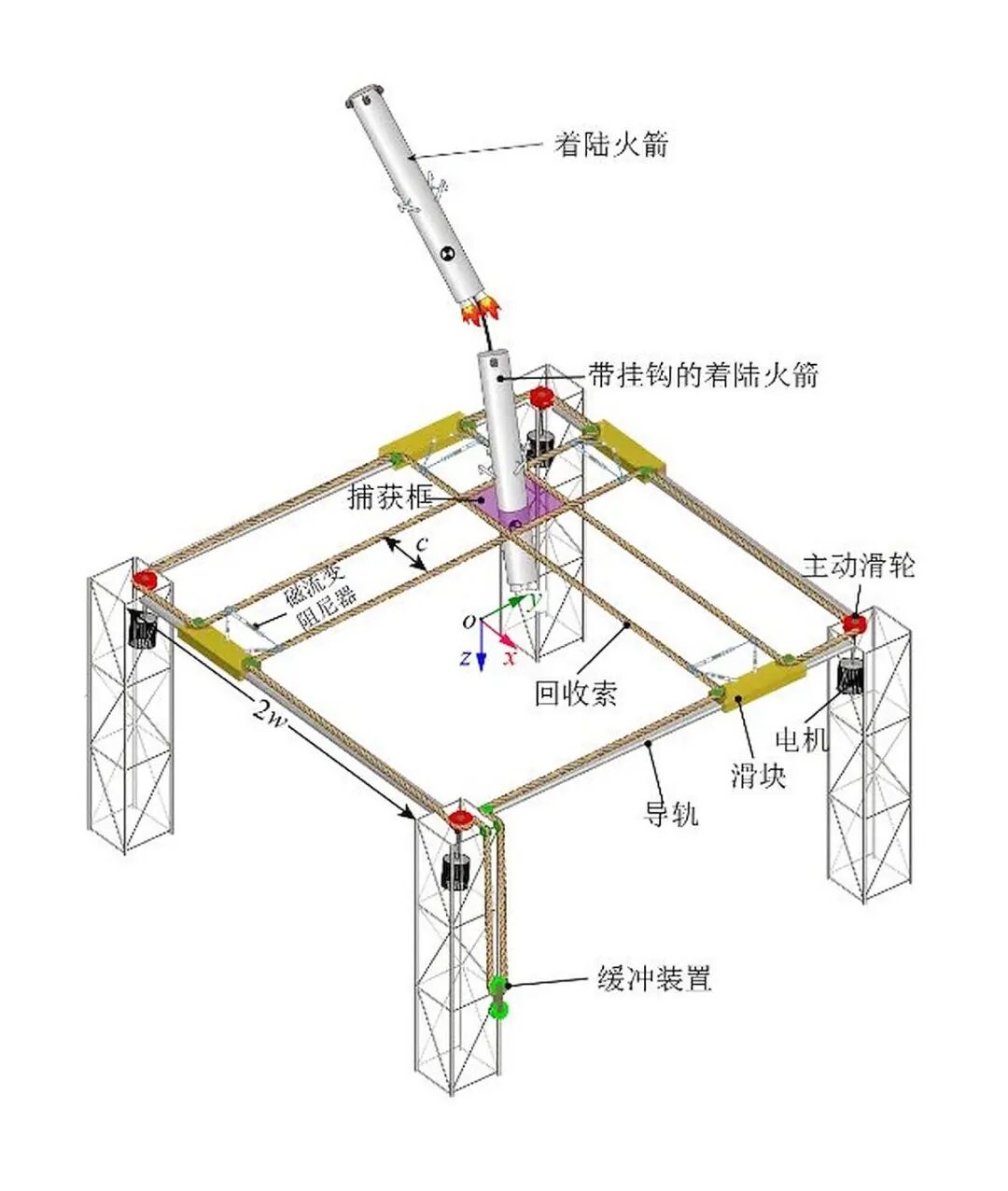
Schematic diagram of the rocket net recovery system | China Academy of Launch Vehicle Technology
This process closely resembles a carrier-based aircraft landing on an aircraft carrier. Fighter jets landing on carriers use their tail hooks to catch arresting cables on the deck, being brought to a rapid stop by the drag force. The Long March 10B is also "arrested" to a halt—the difference is that the jet arrives horizontally at high speed, while the rocket descends vertically.
This design shifts the mass of the landing system from the rocket itself onto the offshore platform. The rocket only needs to carry a few lightweight arresting bars, and all the saved mass can be reallocated to increase payload capacity.
Why Did It Succeed on Its Maiden Flight?
A rocket flying for the very first time not only successfully reached orbit, but also completed a net-based recovery that no other nation in the world had ever achieved before.
This outcome was not due to luck.
Prior to today, almost every single step in this entire sequence had been rehearsed independently.
Back during the ground testing phase, the seven engines of the first stage had already undergone two static fire tests: the rocket was fixed to the launch pad, ignited without lifting off, to rigorously verify its performance under the combined thousand-ton thrust of all seven engines operating simultaneously. Even the reignition sequence needed for return deceleration was fully rehearsed on the ground.
An even more critical rehearsal took place on February 11 this year. China conducted the low-altitude demonstration and verification flight of the Long March 10 launch vehicle system (the maximum dynamic pressure escape test for the Mengzhou crewed spacecraft system) at the Wenchang Space Launch Site, marking the first ever flight of the Long March 10 series in its prototype configuration.
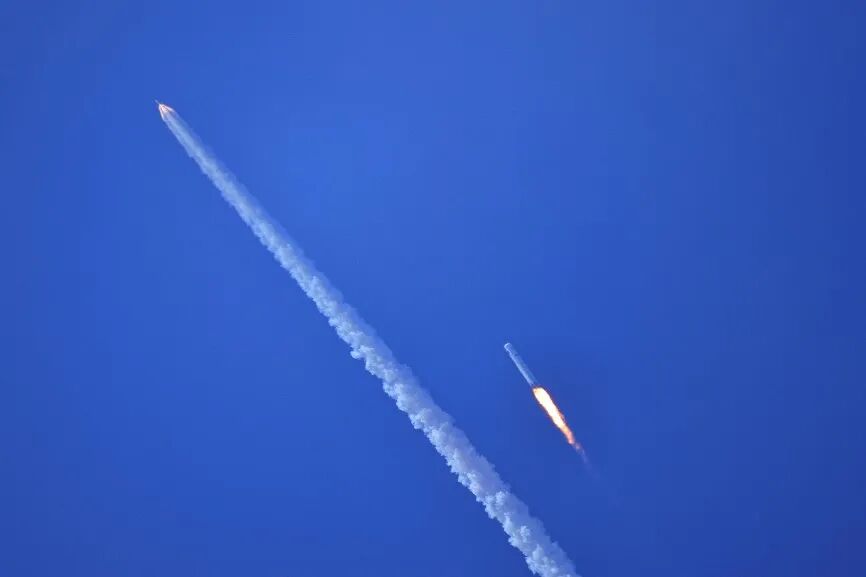
The Long March 10 low-altitude demonstration test and Mengzhou spacecraft maximum dynamic pressure escape flight test conducted in February this year | Xinhua News Agency
During that test, the rocket's first stage flew to an altitude of approximately 105 kilometers before beginning its return, continuously adjusting its attitude and decelerating, nearly hovering at a height of just 5 meters above the sea surface. The engines then shut down, and the rocket body descended vertically into the pre-designated sea area, splashing down very close to the *Pilot* platform that had been deployed to support the rehearsal.
This marked the first ever controlled ocean splashdown of a Chinese rocket first stage.
In other words, except for the very final moment of being caught in the net, the complete recovery workflow had already been fully validated back in February: Can the engines reliably reignite multiple times during the return flight? Can the rocket body withstand the high temperatures and structural stresses of atmospheric reentry? Can the navigation and control system deliver the rocket precisely to the vicinity of the ship? All these questions received affirmative answers during that earlier test.
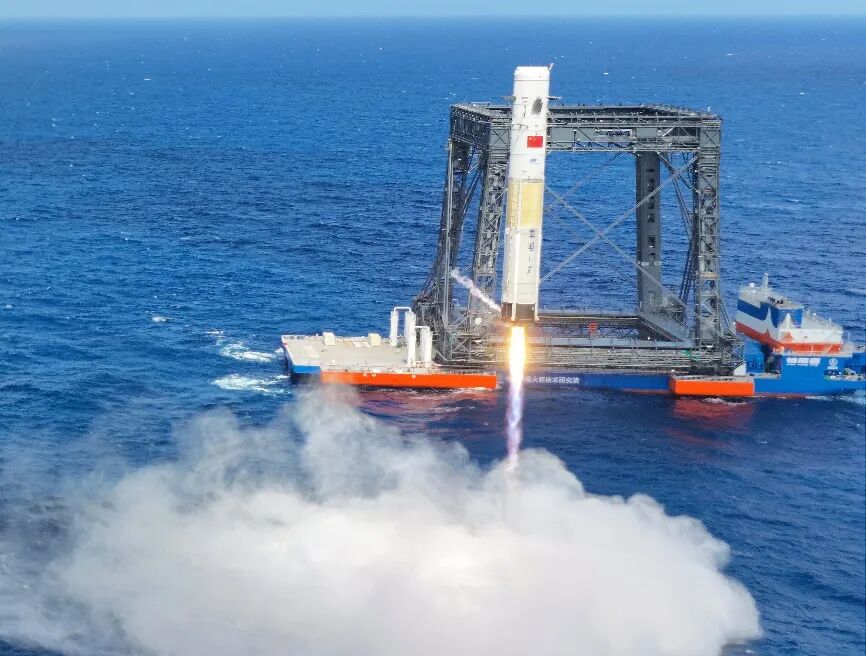
Prototype rocket splashing down near the recovery vessel during test flight | Xinhua News Agency
Therefore, it is more accurate to say that the Long March 10B did not just "succeed on its maiden flight"—it brought a performance that had been rehearsed countless times onto the official stage, only adding the very final action: landing in the net.
What Does This Mean for the Future?
The primary beneficiary of this success is China's crewed lunar landing program.

China plans to achieve a crewed lunar landing by 2030 | CMS
The Long March 10B is not a standalone rocket. It forms part of the broader Long March 10 family, a series of launch vehicles specifically tasked with sending Chinese astronauts to the moon before 2030.
As the first member of its family to reach space, the key technologies validated by the Long March 10B today—such as multiple engine reignition and return flight control—will become shared assets for the entire series, accumulating critical technical and engineering experience for the subsequent development of other Long March 10 variants.
The other major beneficiary is the rapidly expanding satellite internet constellation under construction.
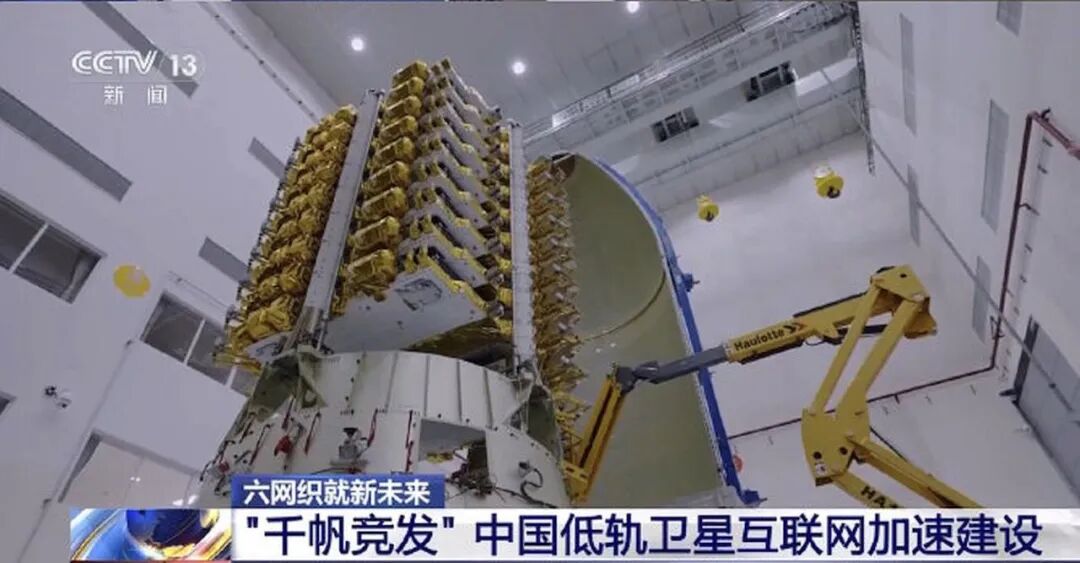
China's low-orbit satellite internet is being accelerated in construction | CCTV News
China's low-orbit constellations such as Guowang and Qianfan are on the verge of entering large-scale deployment. These constellations are planned to consist of tens of thousands of satellites, and launching all of them into orbit relies on exactly the two key advantages mentioned earlier: low cost and high frequency.
The Long March 10B, in its recoverable configuration, has a low-Earth-orbit payload capacity of no less than 16 tons. Once it achieves stable operational reuse in the future, launch costs will be further reduced, perfectly matching the high-volume launch demands of constellation deployment.
The first stage of the Zhuque-3 Y2 rocket during static fire testing, which will launch and conduct recovery tests in the near future | LandSpace
Moreover, the Long March 10B is just the vanguard.
Multiple other reusable rockets are already on China's development roadmap, and flight recovery tests for models like the Zhuque-3 will be conducted in succession. It is easy to imagine that the cycle of a rocket landing, being refurbished, and launching again will gradually become a routine part of China's space operations.
What was caught in that giant net today is the first return of a new rocket. From now on, returning will become the norm, and so will new departures.
This article is from the WeChat public account "Guokr" (ID: Guokr42), written by Baige Zheng