Open-source developers can finally monetize their work, but what they are selling is no longer just code.
In June 2026, Cloudflare announced the acquisition of VoidZero.
VoidZero is a company founded by Evan You in 2024, whose core assets are Vite, Vitest, Rolldown, and Oxc — tools he built himself that collectively form one of the most influential modern JavaScript toolchains today. In its official statement, Cloudflare pledged that the VoidZero team will continue leading these projects, all tools will remain open source under the MIT license, and stay vendor-agnostic.
For the open source world, this is no ordinary acquisition — it is a signal that top-tier open source creators have finally secured a fair valuation, and the party writing the check is still a platform provider.
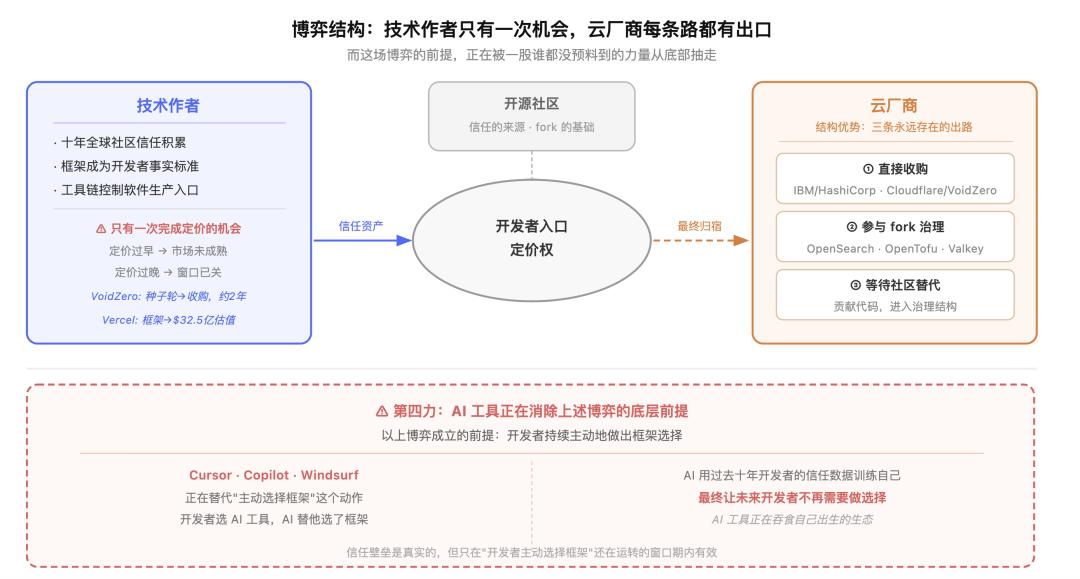
This is neither "programmers defeating cloud vendors" nor "cloud vendors winning again." It is a game being re-priced by AI programming tools, platform entry wars, and capital — and the most critical variable in this game is being pulled out from under everyone by an unexpected force.
Why This Is the Window of Opportunity
The open source movement has existed for decades, and it is nothing new for programmers to be "leveraged" by cloud vendors. Why has the intensity of this game suddenly escalated after 2023, leading to a wave of acquisitions and financing outcomes in 2025 and 2026?
Three conditions have matured simultaneously: AI has raised the upper limit of delivery capacity for individuals and small teams by an order of magnitude, allowing framework authors for the first time to maintain complex production-grade toolchains without relying on large corporate organizational structures; cloud computing has driven distribution costs close to zero, while making cloud vendors' business models sufficiently transparent, turning "who is profiting from my open source work" into a quantifiable question; venture capital has spent nearly a decade truly understanding developer-led growth — the tool choices of developers permeate upward through an entire organization's procurement decisions, something no traffic-driven To C model can buy.
It is not that open source authors have suddenly awakened, but that the market has for the first time provided a reasonable pricing mechanism for technical influence, and open source creators are responding to this mechanism. This is a window of opportunity, not the final state.
I. Open Source Creators Can Finally Price Their Work
VoidZero's path is the clearest example of this window: it secured $4.6 million in seed funding from Accel, with the core justification being Evan You's global influence built around Vite, Vue, and the modern JavaScript toolchain; less than two years later, Cloudflare completed the acquisition. The entire journey from technical influence to commercial entity to platform integration proceeded faster than anyone expected.
VoidZero is not a replicable startup template. Its premise is the decade-long standard-setting influence Evan You has accumulated in the global frontend community with two generations of products: Vue and Vite. The vast majority of open source authors lack this bargaining chip, so it is not that they have not established a company, but that they have not yet reached a stage where platforms can assign a value to their work.
Vercel represents a more mature version. With a $3.25 billion valuation in its 2024 Series E round, it proved a complete commercial closed loop: Next.js as the framework entry point, Vercel as the deployment platform, and v0 as the AI interface generation tool. The three layers — framework, cloud service, and AI tool — stack together, each deepening lock-in for enterprise customers.
In the large model era, this path has been further compressed. Several founders of Mistral AI left DeepMind and Meta, launched their startup in 2023, and completed a €1.7 billion Series C round in 2025 with a post-money valuation of €11.7 billion. Hugging Face's moat is not the performance of any single model, but the network effect connecting researchers, developers, and enterprise demands, with a publicly disclosed financing valuation of approximately $4.5 billion. Research papers increasingly resemble product launches, open source projects increasingly function as customer acquisition channels, and the gap between technical judgment and commercialization is narrower than ever in history.
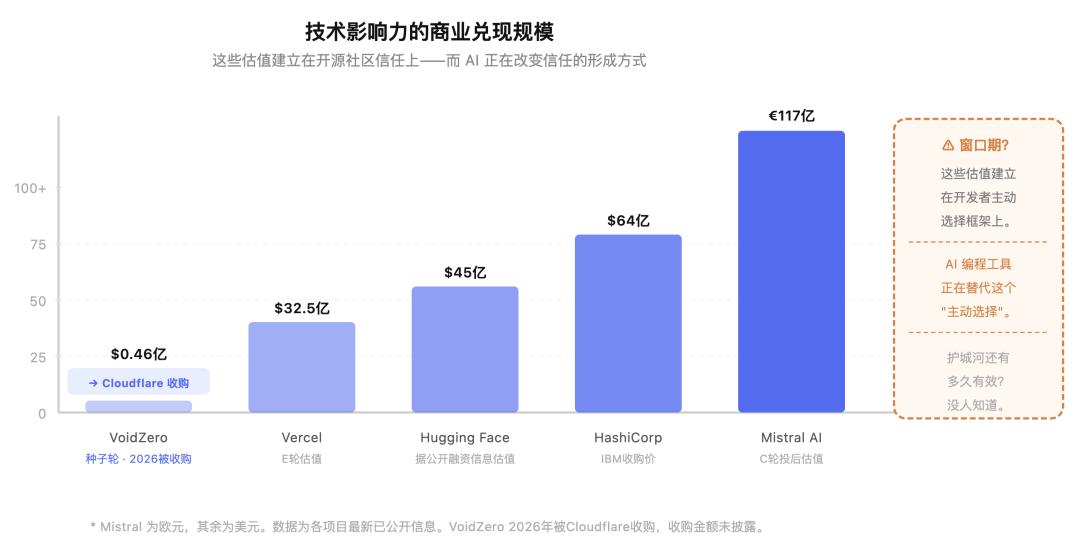
Open source influence is being revalued by capital, and the speed of this pricing is accelerating.
The problem is that when open source creators can finally put a price tag on their trust assets, the validity period of those assets also begins to shorten.
II. Why Cloud Vendors Always Have a Backup Plan
Developer tools control the entry points of the entire software production chain. Whoever controls the toolchain controls developers' workflows; whoever controls the workflow has the opportunity to turn framework influence into cloud bills. This logic underpins Vercel's business model and is also why Cloudflare acquired VoidZero — it is not just buying a toolchain, but integrating the most influential entry point in the JavaScript ecosystem into its platform territory.
Why did AWS or other larger cloud vendors fail to lock in these entry points earlier?
Because the essence of an entry point is not technical capability, but trust. Developers trust Vite not because of its benchmarks, but because of how Evan You responded to issues over the past decade, his attitude toward handling community controversies, and his fulfillment of roadmap promises — the judgment accumulated through these actions is something that large corporate KPI systems are inherently bad at producing.
Therefore, cloud vendors facing an established open source ecosystem have only a few paths: acquisition (IBM buying HashiCorp, Cloudflare buying VoidZero); participating in open source foundation governance to turn themselves into rule-makers; or waiting for the community to fork out a more vendor-friendly alternative. None of these paths end badly for cloud vendors.
But the conclusion of a "trust barrier" has an implicit premise: developers must continuously and actively make framework choices. Only when "which framework to use" is a conscious decision does developers' trust in Vite or Next.js have commercial value. Remove this premise, and all previous analyses begin to unravel.
III. The License War Is Platform Redistribution, Not a Community Victory
Beyond the entry point wars, there is an ongoing long-term license game that reveals the deeper power structure of this game.
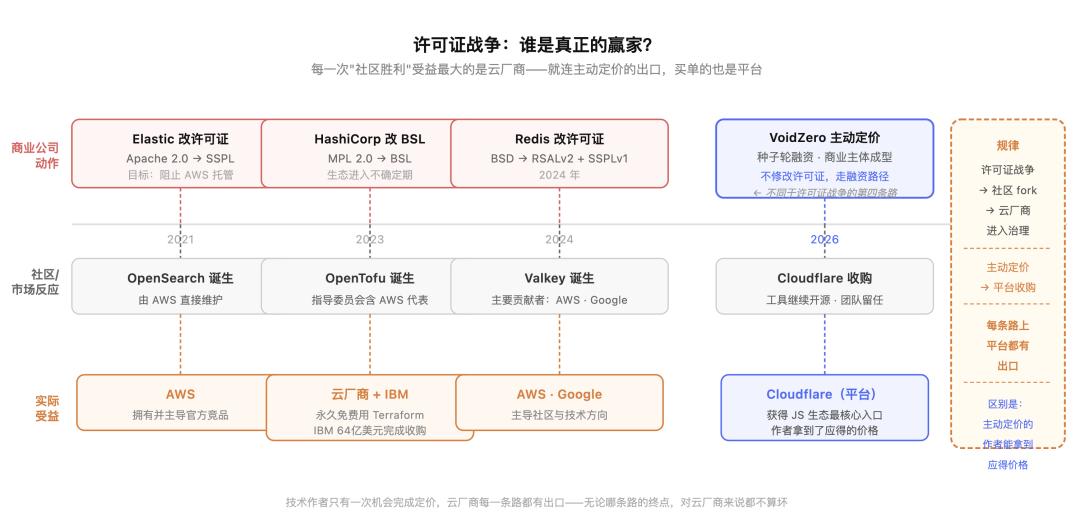
The standard narrative goes: commercial company changes license → community forks → open source spirit prevails. In 2021, Elastic changed its license, and AWS immediately launched OpenSearch; in 2023, HashiCorp moved Terraform from MPL 2.0 to BSL, and the community forked OpenTofu; in 2024, Redis changed its license, and Valkey emerged.
But looking at the governance structures of these forks, the conclusion becomes more complex. Core members of OpenTofu's steering committee include AWS representatives; OpenSearch is directly maintained by AWS; major contributors to Valkey come from AWS and Google. Every "community pushback" structurally provides cloud vendors with an alternative that will never have its license terms tightened.
HashiCorp's outcome illustrates a more universal pattern. After the 2023 license adjustment, the Terraform ecosystem entered a period of uncertainty, with community division and enterprise customers adopting a wait-and-see attitude. IBM completed its $6.4 billion acquisition of HashiCorp in February 2025, in a sense providing HashiCorp with an enterprise-level exit — but this also demonstrates that when an open source commercial company cannot independently resolve ecosystem fragmentation and its game with cloud vendors, being absorbed by a larger platform often becomes a realistic option.
Structural asymmetry persists here: technical authors only get one chance to complete their pricing, while cloud vendors have an exit for every path.
IV. AI Is Attacking the Premise of the Trust Barrier
The trust barrier of open source creators is built on one premise: developers will still actively choose frameworks.
Cursor, Copilot, and Windsurf are not changing the competitiveness of individual frameworks, but the very mechanism of "developers actively choosing frameworks" itself. When an engineer writes code in Cursor, they may not truly "choose" Next.js — they chose Cursor, and Cursor chose Next.js for them. Framework selection is shifting from a conscious decision by developers to the default configuration of AI tools.
This makes the argument for trust barriers face a timeliness problem: it holds true, but only within the window where the "developers actively choose frameworks" mechanism is still operating. Stack Overflow's 2025 survey shows that 84% of respondents are using or planning to use AI tools, and 51% of professional developers use AI tools daily. The right to choose frameworks is slowly but surely shifting from "individual developer preference" to "AI tool default path."
There is a thought-provoking paradox here: the default configurations of AI were initially trained on whom? Precisely on those outstanding developers who actively made framework choices in the past. These AI tools are consuming the ecosystem that gave birth to them. They train themselves on the "trust data" accumulated from developers' active choices over the past decade, with the ultimate goal of eliminating the need for future developers to make choices at all.
Against this backdrop, Cloudflare's acquisition of VoidZero takes on richer meaning. Cloudflare is not just buying a toolchain — it is integrating trust assets at the framework layer into its edge computing and developer platform territory while those assets still hold value. Vercel building v0 follows the same logic: before the "developers actively choose" mechanism becomes obsolete, proactively move the entry point from the framework layer to the AI tool layer.
The people who know best how thick the trust barrier is and how long it will last are the very creators who built it. They are also the first to start moving upstream.
V. Why China Lacks a Mature Pathway
Evan You was born in China, but VoidZero completed its financing and acquisition within the U.S. ecosystem. This is not a matter of capability, but of access pathways.
This path has an unavoidable prerequisite: first establish standard-setting influence in the global developer community. Evan You's achievements today fundamentally rest on Vue and Vite becoming de facto standards among millions of frontend developers worldwide, giving him global-scale user dependency as bargaining power during financing and acquisition negotiations — not just regional market share.
Building this kind of global influence requires long-term, low-return community investment: continuously maintaining projects without salaries or institutional backing, responding to cross-timezone community needs, and fostering a sense of "one of us" among developers worldwide. This is an investment with multi-year return cycles and no intermediate cash flow.
Chinese engineers are not unaware of this, but they face a systematically unfriendly incentive structure: technical professionals in China more easily obtain position premiums, project bonuses, rank promotions, and internal enterprise influence — rather than global community standards, open source reputation, developer trust, and capitalizable exits. The short-term return gap between these two paths is so large that when all rational engineers choose the former, the collective outcome is a lack of independent technical brands that can establish standard-setting influence in the global developer community.
To be more precise: China lacks an intermediate market that can convert five years of global community credibility into company valuation. Without this conversion pathway, rational engineers will not make such investments; without these investments, the pathway will never emerge. This is a self-reinforcing structure.
Worse still, as AI tools continue to move developer entry points further upstream, latecomers will have even less time to "slowly accumulate trust in the global community."
Epilogue: Racing Against the Closing Window
Cloudflare's acquisition of VoidZero can be interpreted in two ways.
One version says: open source creators finally got the price they deserve, and technical influence has been capitalized.
The other says: the ultimate destination of top-tier open source influence is still absorption by a larger platform — Cloudflare has promised to keep the tools open source and vendor-agnostic, but VoidZero is already part of the Cloudflare ecosystem. The entry point war has entered its next chapter.
Both versions are true.
The real conclusion is: the window for open source creators is not "permanent pricing power," but to complete valuation quickly before platform integration, AI upstream migration, and default path solidification. VoidZero's seed round, Vercel's Series E, Mistral's Series C — behind these valuations is not just pricing for technical influence, but also a bet on the time window.
They are not betting that "this asset will hold value forever," but that "it has value now, and those who move fast enough can cash out before it depreciates."
This is why everyone is racing against time.
This article is from the WeChat public account "Singularity Outside", author: wiwi, republished with authorization from 36Kr.