36Kr Exclusive | NVIDIA's World's First Haptic Simulation Partner Secures Hundreds of Millions in New Funding, With H1 Orders Quadrupling Last Year's Full-Year Figure
Image source / Enterprise
This article contains approximately 3100 words, with an estimated reading time of 7 minutes
Author | Xue Ou
Editor | Silai Yuan
Hard Krypton learned that Beijing Tashan Technology Co., Ltd. (hereinafter referred to as "Tashan Technology") has recently completed its Series B financing, with the amount reaching several hundred million yuan. Investors in this round include industrial stakeholders such as Joyson Electronics, Taiping Innovation, AUX, Pengling Group, Lavender Hill Capital Partners (LHCP), and Hongshan Capital, while existing shareholders Dow Tech and Binfu Capital participated in follow-on investments. The raised funds will be primarily allocated to the iteration of tactile sensors and chips, the implementation of scenario-based solutions, and the construction of the tactile training platform.
Founded in 2017 and headquartered in Beijing, this company is a developer dedicated to artificial intelligence tactile perception technology and full-stack application solutions. Its core team consists of R&D personnel from institutions including Tsinghua University and the University of Manchester; its chief scientist is Steve Furber, co-inventor of the ARM architecture and Fellow of both the Royal Society and Royal Academy of Engineering of the UK; the company's founder, Tengzhan Sun, graduated from the Department of Automation at Tsinghua University and is the inventor of planar and curved capacitive technologies.
In 2019, the company jointly established the world's first AI tactile perception laboratory with the University of Manchester. After years of intensive efforts, Tashan Technology has built a full-stack technical system covering "chips - sensors - algorithm models - scenario applications".
The critical role of tactile perception in the robotics industry is rapidly gaining widespread recognition. According to the company's observations, the penetration rate of tactile sensors in dexterous hands has risen from just over 20% to more than 60% in 2025, and this figure continues to grow month by month.
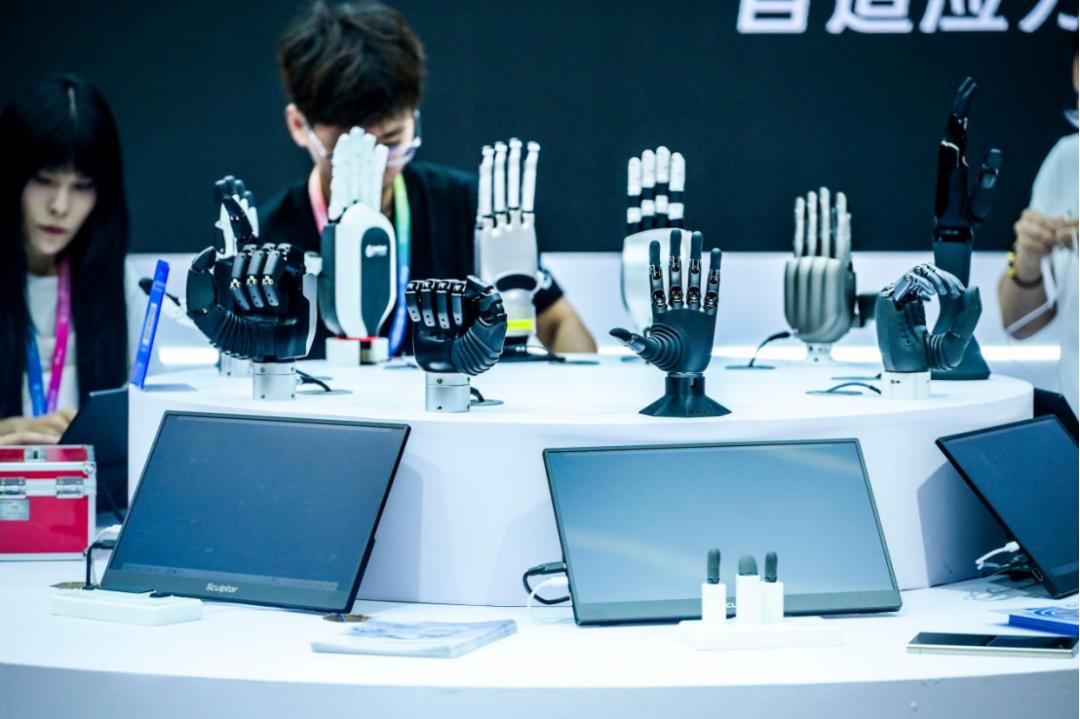
Dexterous hand equipped with Tashan tactile sensors (Image source / Enterprise)
The core driving forces behind the market growth come from multiple dimensions: First, as embodied intelligence evolves from "seeing" to "perceiving", tactile sensing, as a critical perception dimension for robots to interact with the physical world, is growing in importance. Second, the industry is experiencing an explosion in demand for robotic data, where tactile data support is indispensable for both simulation and real-world robot training.
At present, Tashan Technology has established a complete product matrix covering chips, sensors, algorithm platforms, and simulation systems.
On the chip level, the company has independently developed the world's first digital-analog hybrid AI tactile chip. Based on a spiking neural network architecture, it supports low-latency, low-power edge-side processing of multi-dimensional tactile signals. The brand-new next-generation large chip has achieved successful tape-out, with an official release scheduled for Q3 this year.
On the sensor level, core products include the TS-F fingertip tactile sensor and the TS-E manipulator tactile sensor. The TS-F integrates proximity sensing, 3D force detection, temperature difference perception, and texture recognition functions, with a force measurement resolution of 0.01N, enabling it to identify over 30 types of materials even in a non-contact state. The TS-E is widely compatible with various robot grippers. This year, the measurement frequency of the sensors has been increased by 3 to 4 times compared to last year, and a multimodal sensor with temperature perception capability will be launched in the future.
In terms of data collection and algorithm platforms, the company has introduced the TS-V visual-tactile fusion training platform and the TS-VT data collection version, significantly lowering the data threshold for tactile algorithm training. In March and May this year, the Beijing Shijingshan Digital Training Factory and the Hubei Qianjiang Data Collection Center were successively completed, focusing on three key directions: tactile perception, heterogeneous systems, and autonomous unmanned data collection.
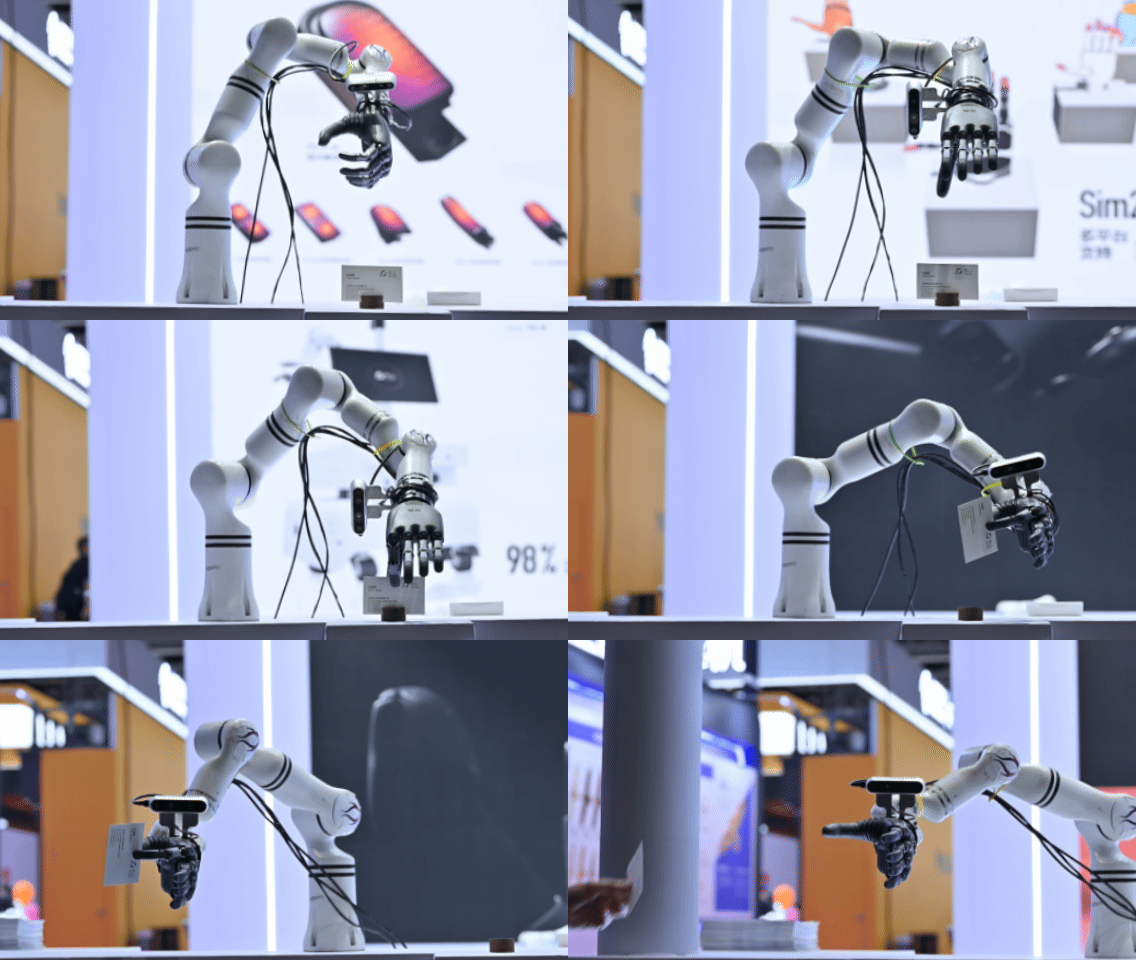
TS-VT visual-tactile fusion training platform showcased at China Mobile Partner Conference (Image source / Enterprise)
On the simulation level, Tashan Technology is the world's first tactile simulation partner for NVIDIA Isaac Sim, and its self-developed tactile simulation system has been open-sourced on MuJoCo and the NVIDIA platform.
In addition, the company recently launched a data collection glove that supports synchronous multimodal data acquisition; it has also partnered with CloudGeni Technology to launch the TS-R tactile perception service robot, serving as a typical demonstration of tactile technology implementation in service scenarios.
In terms of business performance, according to the company, the pending orders for tactile sensors as of the end of May have reached 4 times the full-year revenue of 2025. The company's total revenue by the end of May has already exceeded the full-year revenue of 2025.
From the perspective of business structure, the robotics business has seen particularly outstanding growth. It is expected that the robotics business in 2026 will be 3 to 4 times larger than the automotive business, contributing approximately two-thirds of the annual revenue.
Currently, the company has established in-depth commercial partnerships with more than 180 customers across the global robotics industry chain, including complete machine manufacturers such as Xindong Era, Galaxy Universal, and Independent Variable, as well as leading dexterous hand enterprises such as InTime Robotics, BrainCo, and Dexterous Intelligence. Tashan Technology accounts for over 80% of shipments in the segmented field of tactile sensors for humanoid robots.
The following is an edited excerpt from the conversation between Hard Krypton and Yihui Fu, Vice President of Marketing and Ecosystem at Tashan Technology:
Hard Krypton: The penetration rate of tactile perception in the industry is increasing rapidly. What is the reason behind this?
Yihui Fu: Last year, our 80% market share was calculated based on the global shipment volume of dexterous hands, but at that time the penetration rate of tactile sensing in dexterous hands was only just over 20%. Starting from Q4 last year, almost all customers who approached us reported a penetration rate exceeding 60%, and this figure keeps increasing every month.
A widespread industry consensus is taking shape rapidly — people are realizing that without tactile sensing, robots cannot close the operation loop in the physical world. This year, model developers have also begun large-scale procurement of sensors for data collection, further driving up market demand.
Hard Krypton: We noticed that the company has recently launched data collection centers in Beijing and Qianjiang. How do you position your role in the industry chain moving forward?
Yihui Fu: Our positioning remains to be the "tactile infrastructure" for all downstream customers. Currently, 80% of tactile sensors on the market are manufactured by Tashan. The industry is increasingly recognizing that tactile technology requires its own dedicated algorithms and models. Therefore, as a tactile infrastructure builder, we aim to accelerate the R&D of specialized tactile algorithm models and further validate application scenarios to support the development of the entire industry.
In March and May this year, we successively completed two data collection factories in Shijingshan, Beijing, and Qianjiang, Hubei, to adapt to heterogeneous bodies and data collection solutions of various forms. We also collaborated with Richard Sutton, the "Father of Reinforcement Learning" and Turing Award winner, to build the "Robot Kindergarten", exploring a new paradigm that allows robots to learn through autonomous trial and error via tactile perception in the real physical environment.
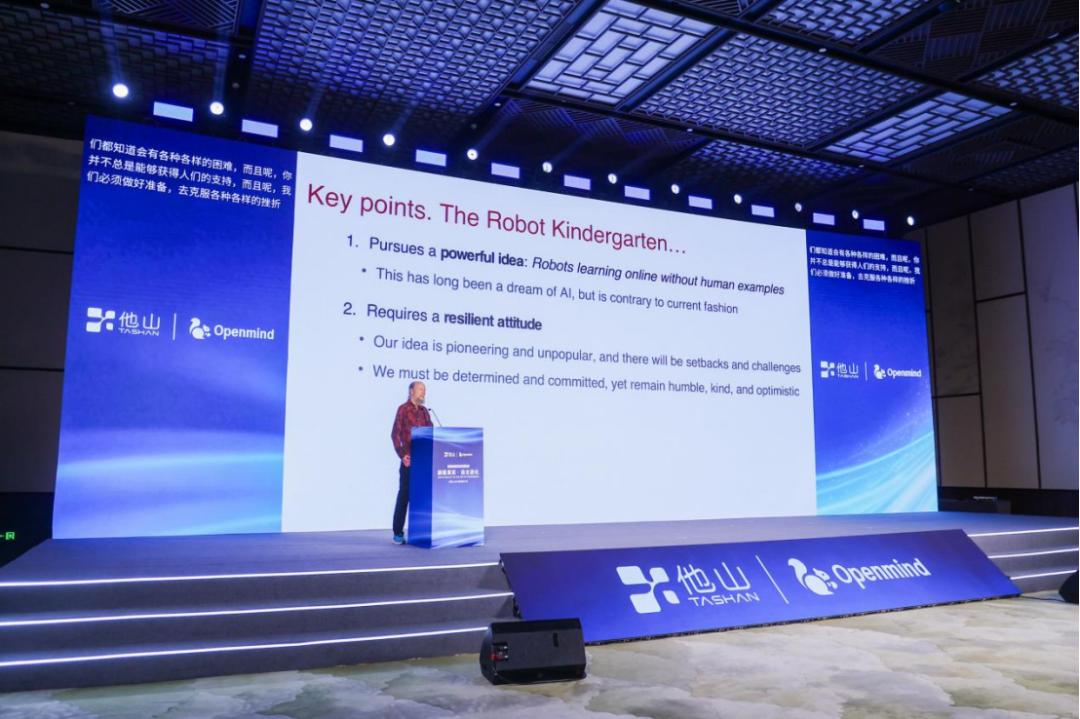
Turing Award winner Richard Sutton introducing the "Robot Kindergarten" co-built with Tashan Technology (Image source / Enterprise)
Hard Krypton: What is your view on the industry's explosive growth point in the next one to two years?
Yihui Fu: From the perspective of hardware penetration rate, tactile sensors are evolving from an "optional accessory" to a "standard configuration". Starting from Q4 this year, tactile-based algorithm models and applications will be successively launched, and 2027 will be a major breakout year. Our revenue from sensors this year has already doubled compared to last year, and pending orders are 4 times the full-year figure of last year. This industry is only just getting started.
Investor Perspectives:
Joyson Electronics: Tactile sensors are the core technology for the "last centimeter" of interaction between robots and the physical world, and also a key bottleneck currently restricting embodied intelligence from achieving precise dexterous operations. It is evolving from an "optional component" to an essential foundational technology for precise operations and human-robot collaboration. Tashan Technology is a leading player in the AI tactile perception sector both in China and globally. Leveraging its full-stack independent R&D capabilities covering "chips - sensors - algorithm models - scenario applications", the company is filling the critical "tactile" gap for the embodied intelligence industry.
AUX: With the rapid evolution of multimodal large models, the economic value of physical AI is on the eve of accelerated explosive growth. Unlike the vision-dominated "obstacle avoidance" logic of autonomous driving, embodied intelligence requires deep interaction with the physical world through tactile sensing. Tactile perception is not only a critical cornerstone for achieving precise operations but also a core restrictive factor for industrial evolution. As a benchmark enterprise in the industry with full-stack independent R&D capabilities for underlying chips, algorithm models, and sensors, Tashan Technology has built a deep technical moat through vertical integration. The company not only solves the common multi-dimensional perception bottleneck of the industry with high-performance tactile solutions and takes the lead in achieving commercial mass production, but also demonstrates extremely wide commercial implementation scope: in addition to occupying a key position in cutting-edge hot fields such as embodied intelligence and AI toys, it also has a solid implementation foundation in mature industries including automotive electronics and smart home appliances. This layout that combines the explosive power of cutting-edge technology and cross-industry anti-cyclical attributes makes Tashan Technology a rare high-value technology enterprise in this sector.
Joyson Electronics has long-term layout in the embodied intelligence industry through "independent R&D + investment", driven by the two wheels of "core components + industrial scenarios". This investment aligns with the company's strategy of deploying core links in the embodied intelligence industry chain. We hope to establish and deepen business collaboration with Tashan Technology in the field of tactile sensors through this investment, and jointly promote the development of the embodied intelligence industry.
Pengling Group: High-precision tactile perception is the underlying key for dexterous hands to break through operation bottlenecks, achieve safe human-robot interaction, and complete adaptive grasping of complex objects. It is the core starting point for embodied intelligence to achieve general implementation and complete fine operations. Tactile data is also the core increment that complements the multimodal training data of embodied intelligence and improves model generalization capabilities. Tashan Technology has built a unique full-stack independent R&D barrier in the industry, and is one of the very few tactile solution providers in China that simultaneously masters underlying dedicated sensing chips, large tactile algorithm models, and flexible sensing array hardware. Its exclusive distributed collaborative perception architecture can perfectly adapt to complex grasping and precise operation scenarios of dexterous hands, and its products have obtained bulk order recognition from leading dexterous hand manufacturers in the industry. Both the commercial implementation progress and product delivery scale of the company are in the global first tier.
Taiping Innovation: Tashan Technology has forward-looking and holistic strategic thinking in the field of tactile perception. Beyond the tactile sensing modules themselves, the company explores the construction of simulation and real-world tactile data systems, extends upstream to brain-inspired sensing chips, and expands downstream to explore key application scenarios. On the scenario side, in addition to embodied intelligence, the company's products are also widely used in multiple fields including automotive electronics and consumer home appliances. Furthermore, with the continuous deepening of population aging in China, elderly care technology has become an inevitable trend. Tactile sensing is one of the core perceptual barriers for embodied intelligence to break through into elderly care scenarios, helping to build a safety line for the elderly and other family members. We hope that Tashan, together with many partner companies across the industry chain, will use the warmth of technology to safeguard the health of the elderly population.