GPT-5.6 full rollout, Codex officially integrated into ChatGPT
On July 9 US time, the highly anticipated GPT-5.6 series was finally fully released to all users.
Alongside it, ChatGPT Work was launched. To put it simply: OpenAI has integrated Codex directly into ChatGPT.
This is not just adding a separate entry point as before, but a full integration — Codex is now a core part of ChatGPT, and even its app icon has been updated to the ChatGPT logo (the original icon can still be retained if preferred).

13 days ago, in the documentation for the limited preview of GPT-5.6 Sol, OpenAI only showcased key evaluations in coding, biology, cybersecurity and other fields, stating that an expanded set of evaluation results would be released when the model was more widely available. Those full results have now been published alongside the full model rollout.

Even before the official full evaluation report was released, a wave of "community-driven testing" had already begun.
Many users who gained early access have shared their real-world usage experiences on social platforms. Compared to cold, standardized benchmarks, these firsthand feedbacks are more like leaked practical observations from real-world scenarios.
Let me tell you in the most straightforward, simplest, and most direct way possible...
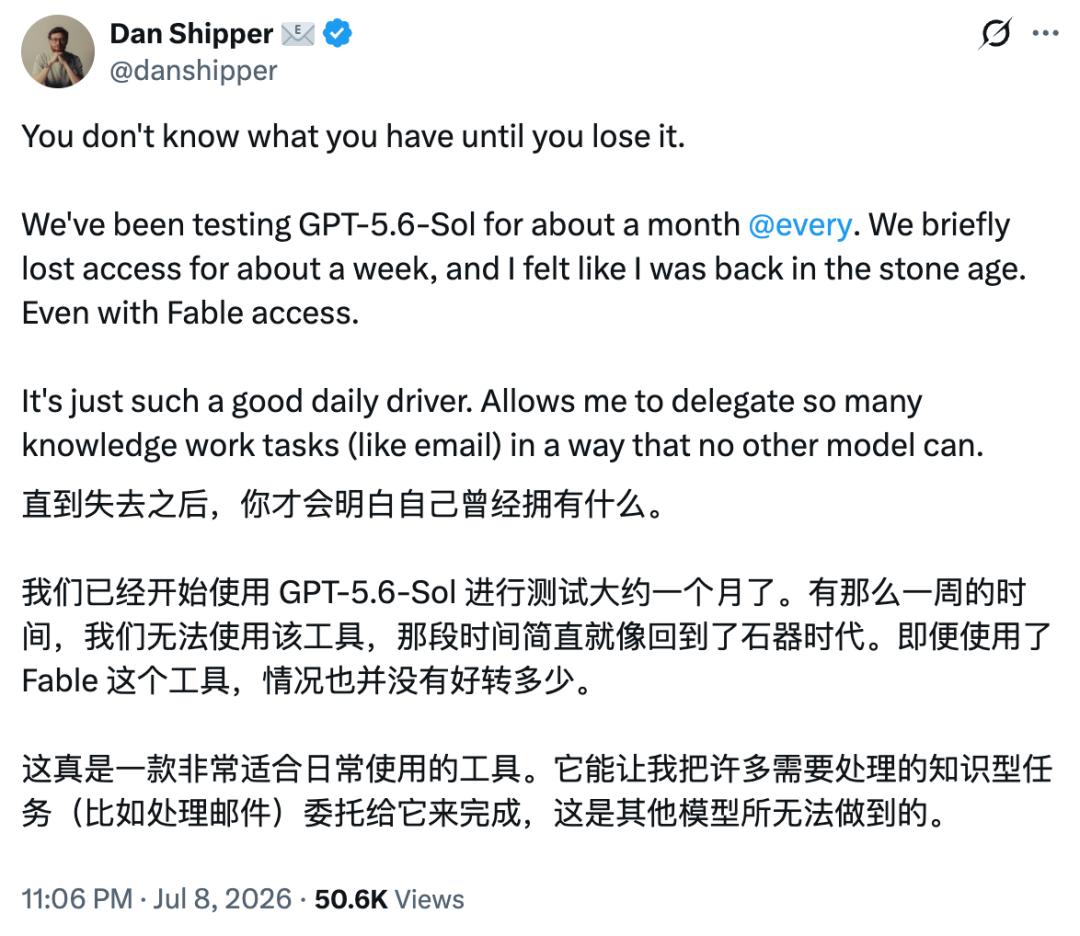
GPT-5.6 Sol cannot outperform Fable5 on tackling extremely difficult, cutting-edge problems, but it offers far better cost-effectiveness and is much more suitable for daily office work.
It is relatively affordable, and extremely fast — this is a huge advantage.
01
Key Highlights: Low cost, high speed, excellent cost-performance
In the official OpenAI release documentation, the opening statement is very clear: the goal of GPT-5.6 is to "deliver more intelligence per token, stronger performance per dollar, and on-demand access to higher capabilities for the most challenging tasks".
First, let's re-emphasize the pricing of the GPT-5.6 series.
The GPT-5.6 family has three variants: Sol, Terra, and Luna. According to the API pricing released by OpenAI, billed per 1 million tokens: Sol costs $5 for input and $30 for output; Terra costs $2.5 for input and $15 for output; Luna costs $1 for input and $6 for output.
Understanding this pricing is extremely important, as it makes users more forgiving of minor performance shortcomings. Many people compare GPT-5.6 Sol to Claude Fable 5, but in terms of unit API pricing, GPT-5.6 Sol is significantly cheaper: its input price is half that of Fable 5, and its output price is 40% lower.
Additionally, OpenAI mentioned that GPT-5.6 supports more predictable prompt caching, with a 90% discount on cached reads, which will substantially reduce the actual cost of long-context tasks.
Apart from pricing, another notable feature is speed — the official documentation specifically states that Sol can generate up to 750 tokens per second.
Roughly translated for Chinese users, this is equivalent to 500 to 700 Chinese characters per second.
This drastically cuts down the model's thinking and generation time, delivering an almost instant response experience for regular chat interactions.

We previously mentioned key evaluations in coding, biology, and cybersecurity inour earlier article. This latest set of evaluations is more comprehensive, but does not differ significantly in core testing themes.
For example, in the Agents’ Last Exam assessment, which tests long-duration professional workflows, GPT-5.6 Sol scored 53.6 points, 13.1 points higher than Fable 5; even when running at medium reasoning intensity, it outperforms Fable 5 at roughly a quarter of the estimated cost.
OpenAI also claims that Terra and Luna can outperform Fable 5 at approximately 1/16 of its cost.
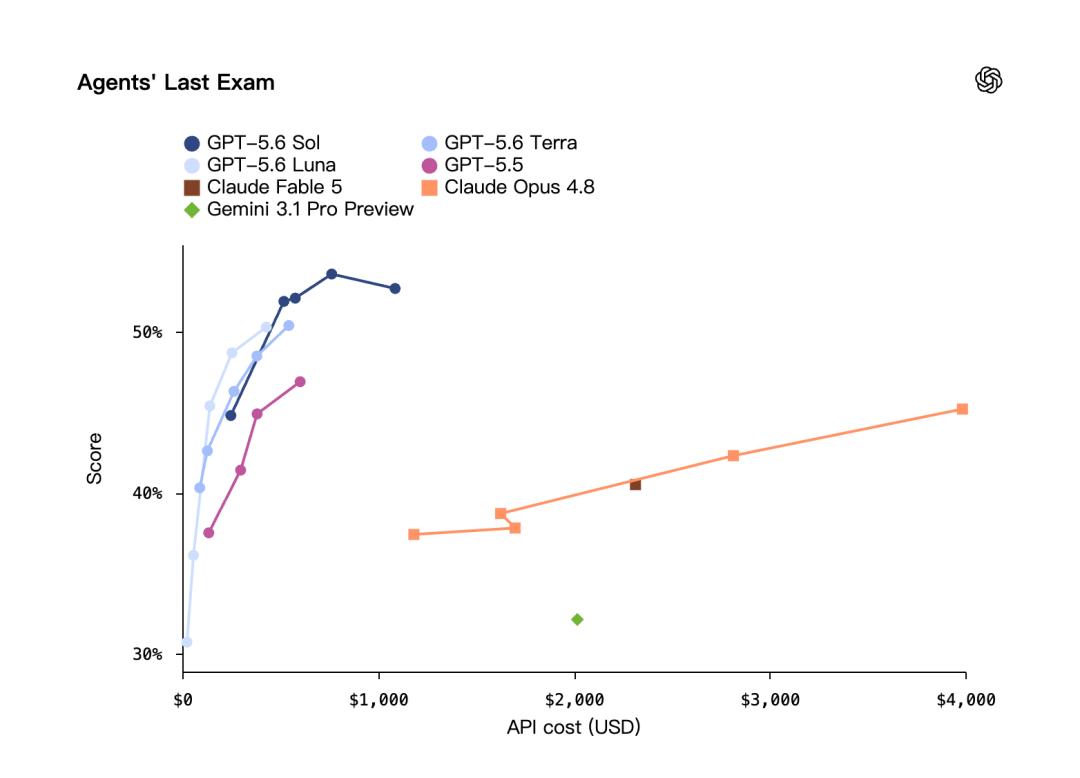
While official benchmarks do not represent the final conclusion, they clearly highlight OpenAI's core narrative for this release:
The competition is no longer just about who is more powerful, but about who can complete more tasks at a lower cost.
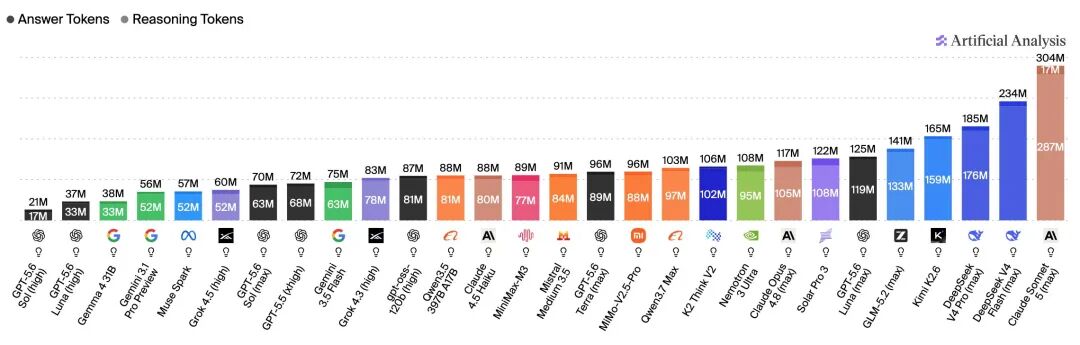
Beyond official documentation, in the Artificial Analysis comprehensive evaluation suite, GPT-5.6 consumes significantly fewer tokens to complete tasks — especially its reasoning token usage is remarkably low. In terms of output per unit token and running speed, its efficiency is exceptionally high.
Compared to impersonal benchmarks, the live demo event is far more noteworthy — at 1 a.m., OpenAI hosted a live stream to introduce all the details of this update.
During the live session, ChatGPT Work and GPT-5.6 were presented as equally important, with ChatGPT Work even receiving greater emphasis. Sam Altman directly described it as a "really big deal".
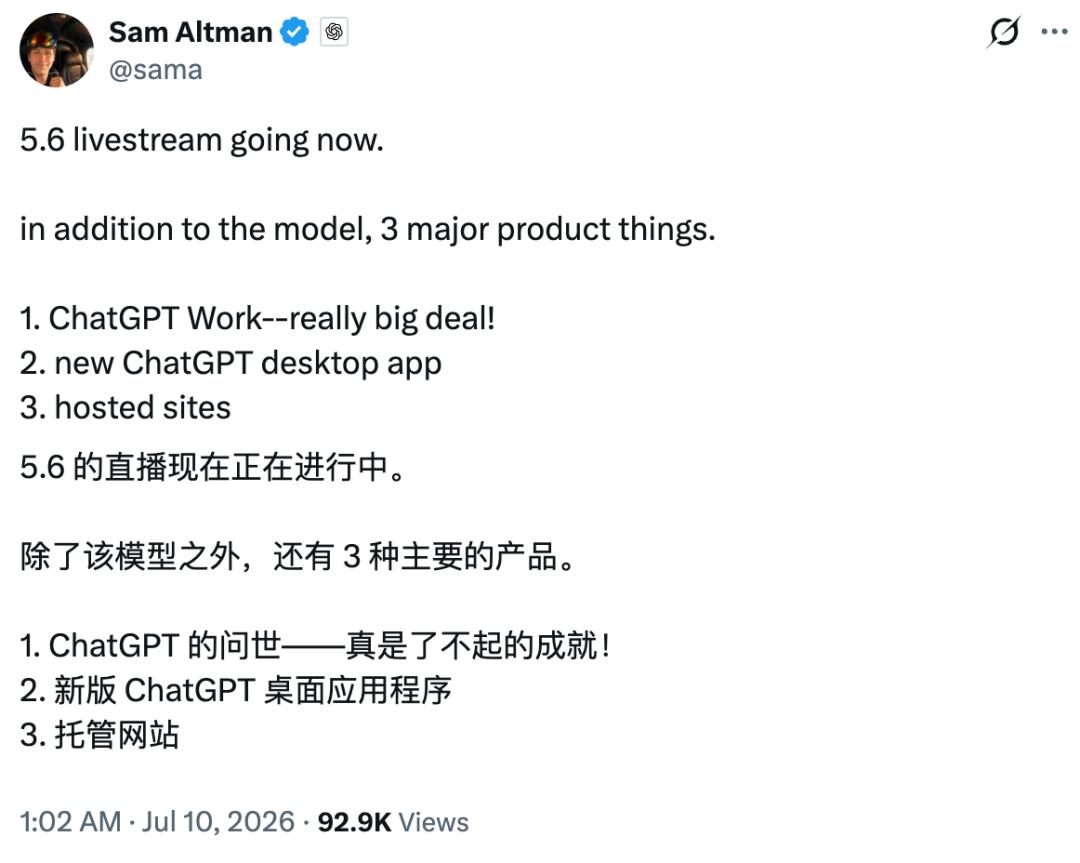
From the live demonstration, in a sense, GPT-5.6 is more like a dedicated model base built to support ChatGPT Work.
And ChatGPT Work itself, essentially, is Codex embedded into ChatGPT.
Doesn't this interface shown in the live stream look very familiar?
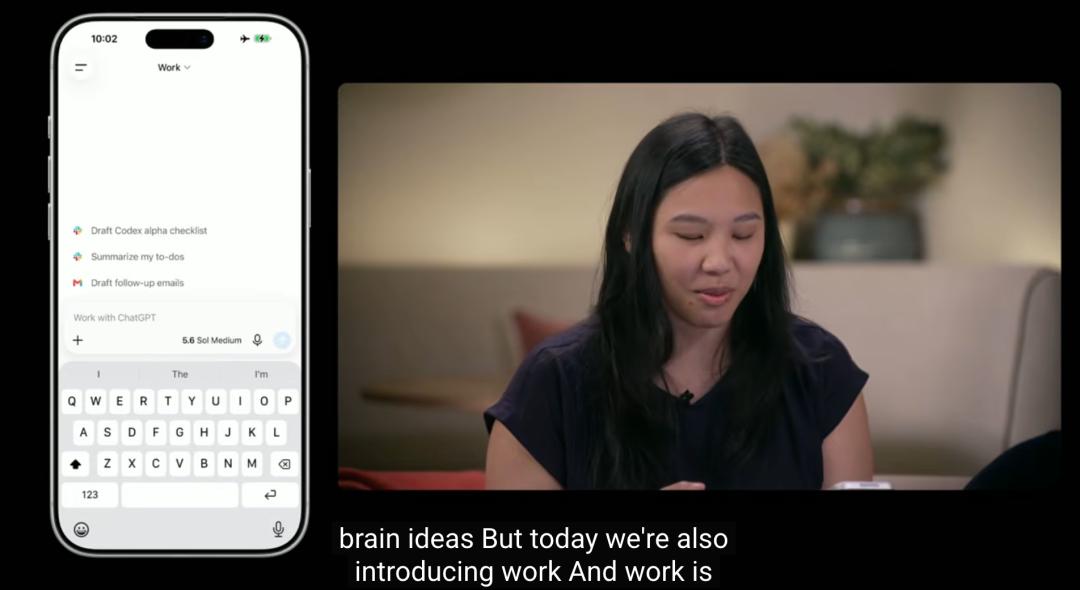
When introducing ChatGPT Work, OpenAI explicitly states: ChatGPT Work is an Agent within ChatGPT that can take actions across apps and files, work alongside a single project for hours if needed, and turn a stated goal into a finished deliverable.
Interestingly, OpenAI did not simply rename Codex to ChatGPT Work — OpenAI announced that starting today, the Codex app will be merged into the new ChatGPT desktop app. Codex remains a powerful coding Agent for developers and technical professionals, but it now appears alongside Chat and Work within the same desktop application.
OpenAI had previously positioned Codex as a "productivity tool for everyone", noting that Codex helps workers across different professions automate daily tasks, speed up output, and reduce bottlenecks in knowledge work. Now, during this full integration, OpenAI has split Codex's capabilities into two distinct components.
The Codex entry point still exists, continuing to serve developers and technical staff, handling engineering tasks such as coding, repository management, PR reviews, diff processing, code reviews, and multi-repository projects.
But the more valuable core capabilities behind Codex — accepting tasks, reading context, invoking tools, executing workflows step by step, and delivering final results — have been abstracted and integrated into ChatGPT Work.
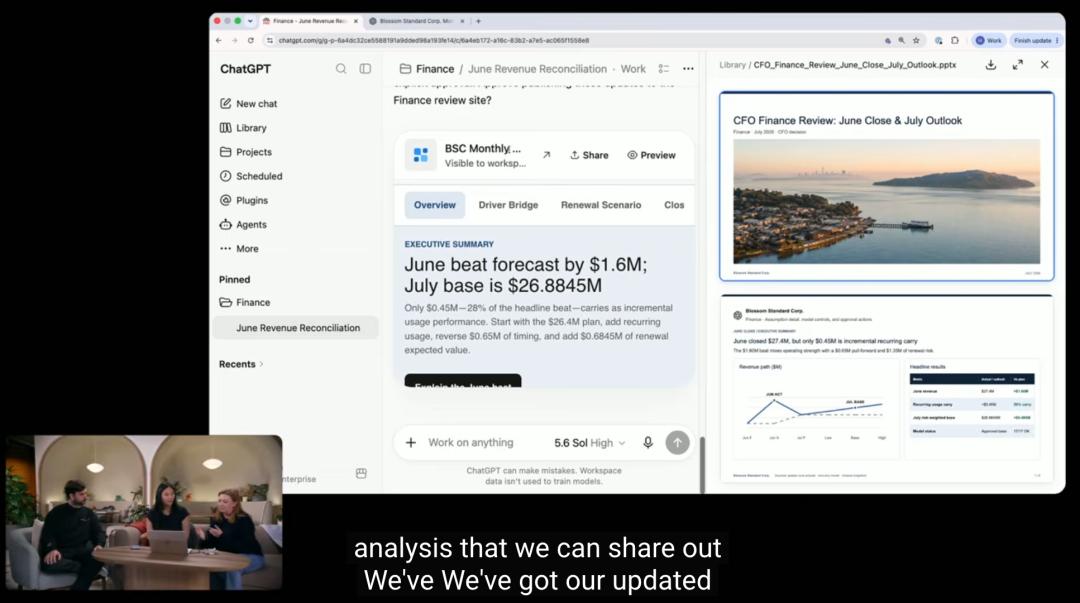
In other words, ChatGPT now has three dedicated entry points: Chat for conversations, Codex for coding tasks, and Work for general office productivity tasks.
To put it briefly, this represents another step toward a universal super entry point for AI productivity.
02
Real-World Experience: Optimized for Daily Tasks
Many users with early access to GPT-5.6 have shared their hands-on experiences.
Overall, GPT-5.6 Sol's strengths do not lie in tackling extreme, cutting-edge challenges (many users note that its peak performance still lags behind Fable 5), but it has earned user trust for daily work scenarios: users are comfortable keeping it running all day long, delegating a large number of routine tasks, detailed checks, context-based judgments, and intermediate processing steps to it.
One user described Sol as a charming, efficient, talented, and enviable colleague; while Fable is more like a slightly quirky genius who performs exceptionally well on problems he is obsessed with, but is not very suitable for regular day-to-day collaboration.
In his experience, Fable is still best suited for tasks with extremely clear objectives, such as targeted debugging, security issue resolution, and performance optimization. These tasks have well-defined reward functions that allow the model to continuously push toward a precise target.
But when it comes to more common daily work, Sol's advantages shine through: it is more intuitive to use, more cooperative, and far better suited for long-duration collaborative sessions.
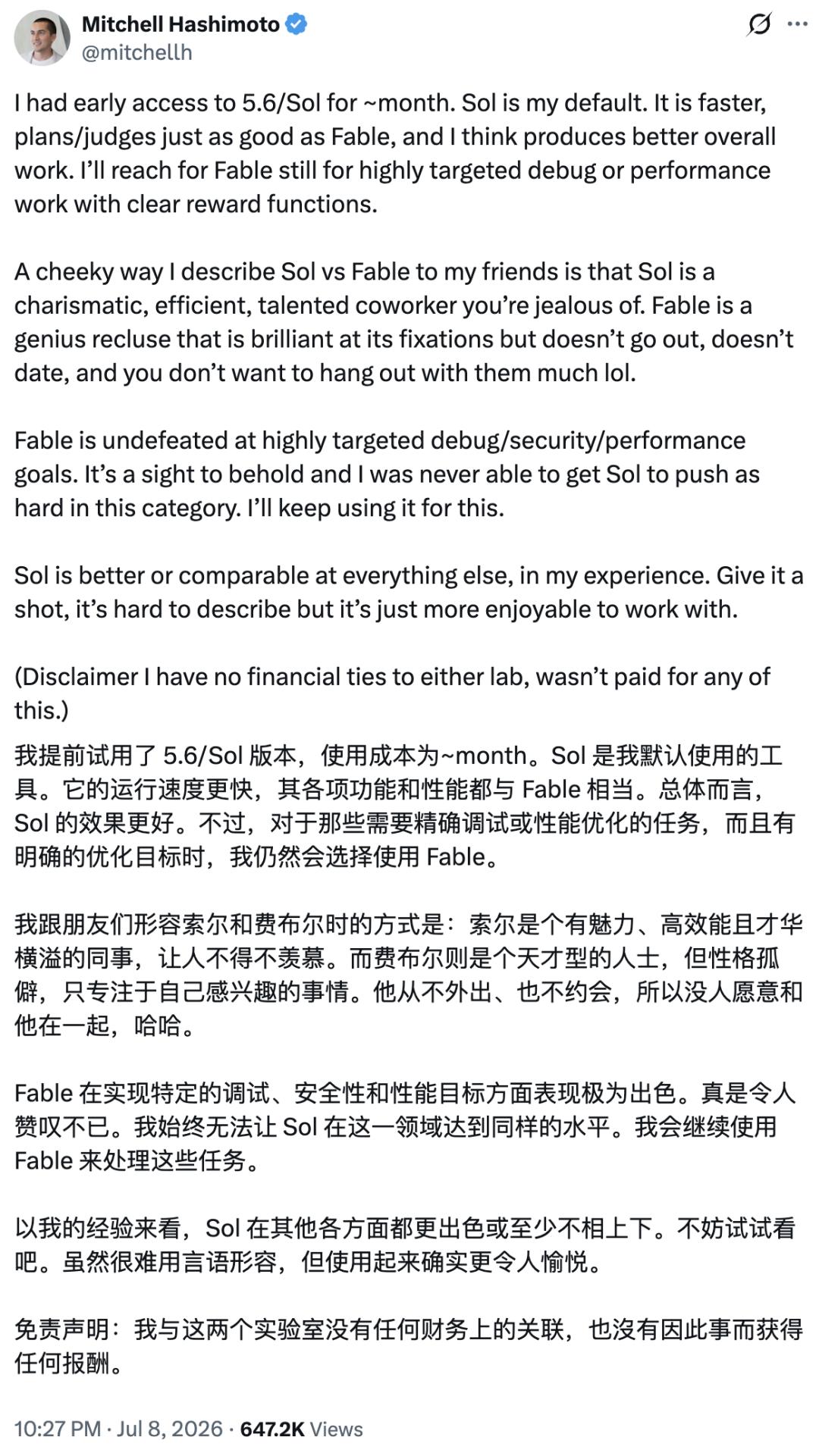
Therefore, a better workflow might be to let Fable devise strategies and solutions, and then use Sol to execute them.
Another user's feedback focused on behavioral changes at the team level. He mentioned that his team was initially conservative about using AI models, but GPT-5.6 has had a huge impact: their team's total token consumption is now 5 times what it used to be.
He also agrees that GPT-5.6 is not as "smart" as Fable 5, but it is far more reliable for daily use.
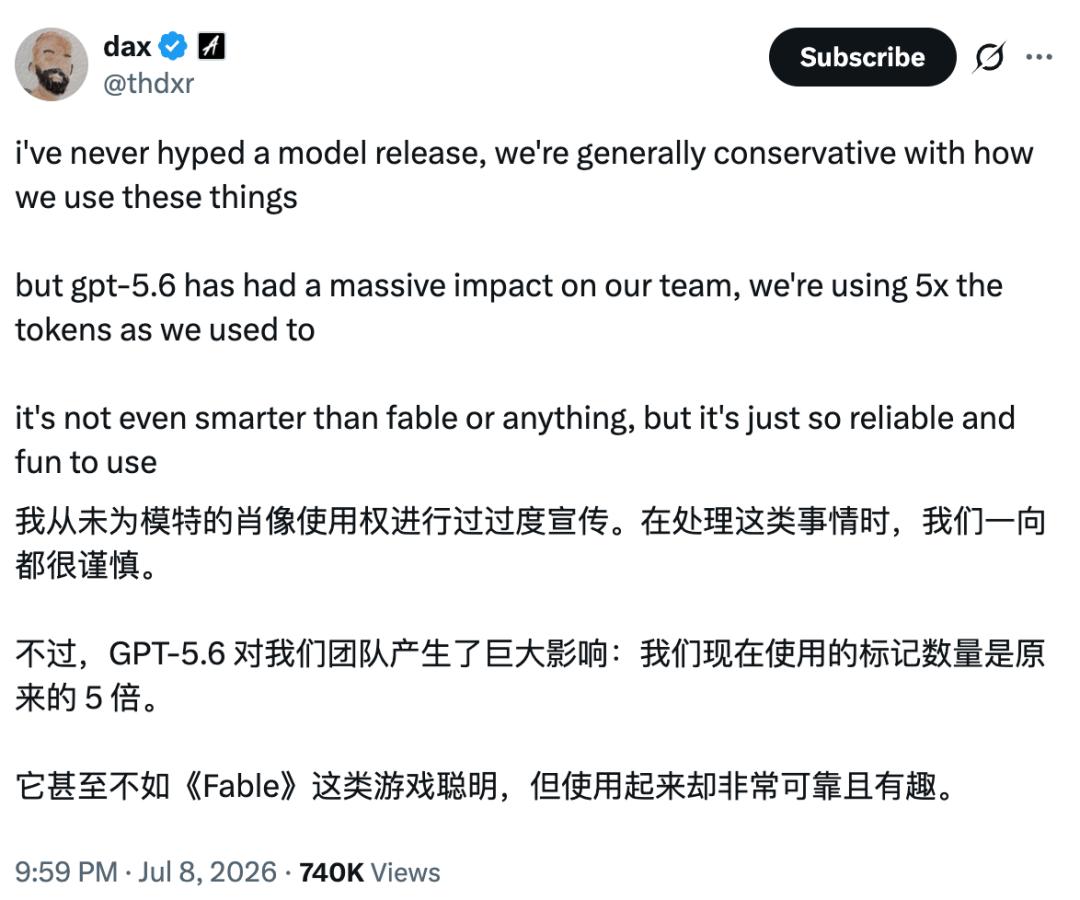
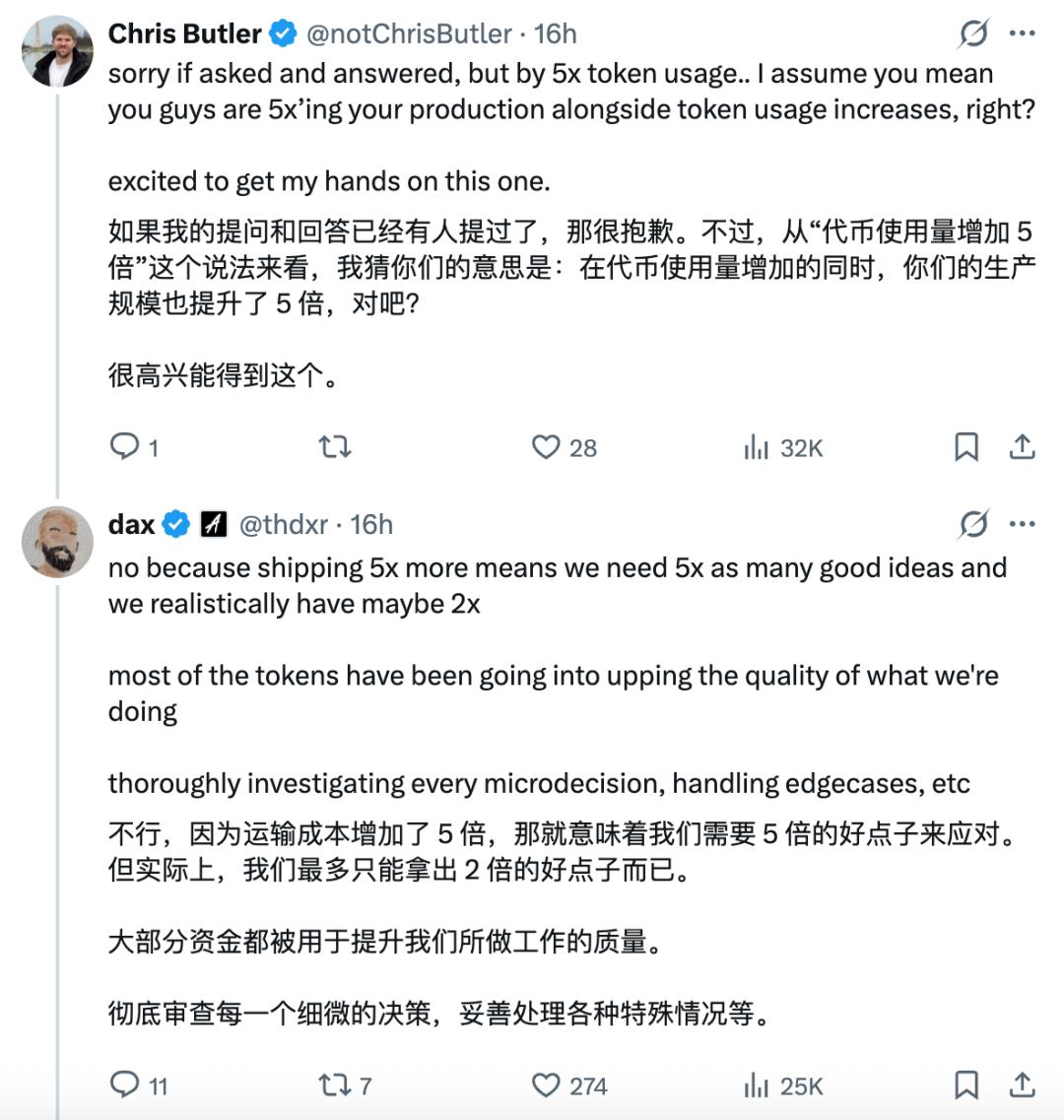
When he said "token consumption is 5 times higher than before", I initially thought he was complaining that GPT-5.6 burns through tokens too quickly, but the comment section clarified that was not the case.
The higher consumption comes simply from the fact that the team uses the model far more often — the key change is that they are now willing to turn to it for more tasks.
That said, 5x token consumption does not equate to 5x productivity gains. The user noted that his team does not have 5 times more high-value ideas to drive productivity.
Most of the extra tokens are not used to generate more output, but to improve the quality of existing work: such as repeatedly checking every small decision, handling various edge cases, and adding extra polish to easily overlooked details.
But at the very least, his team is now comfortable delegating more detailed work to the model for joint refinement.
In terms of coding capabilities, user Tim Neutkens shared very specific feedback — he is the technical lead of Vercel's Next.js and one of its co-authors. Next.js is a large, influential open-source framework, and one of the most mainstream modern frontend development frameworks.