Overnight, GPT-5.6 arrived, Codex was gone, and Claude was thrown into a panic.
Even though we've heard the story of Sam Altman slumping into his chair countless times, we still can't help feeling a flicker of anticipation every time ChatGPT rolls out a new model.
We didn't have to wait long — just now, the GPT-5.6 series has officially launched, releasing three models at once: the flagship Sol, the balanced Terra, and the cost-effective Luna, whose names are derived from the Latin words for sun, Earth/Land, and Moon respectively.

On pricing, Sol costs $5 per million input tokens and $30 per million output tokens; Terra halves that directly to $2.5 and $15; Luna is the cheapest at just $1 and $6.
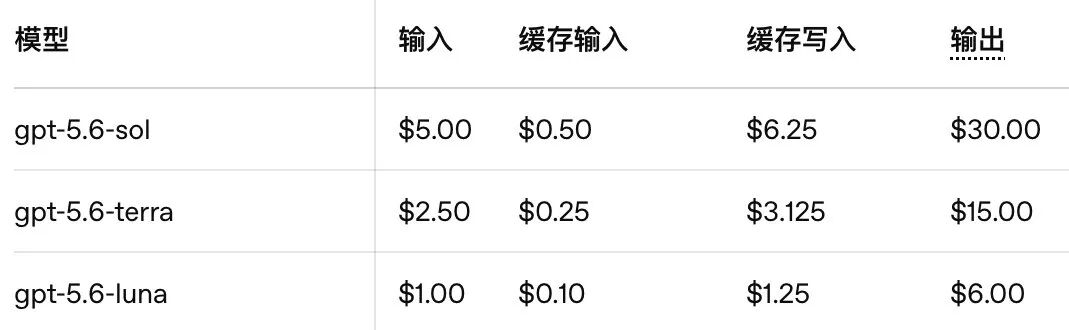
API Pricing 🔗 https://developers.openai.com/api/docs/pricing
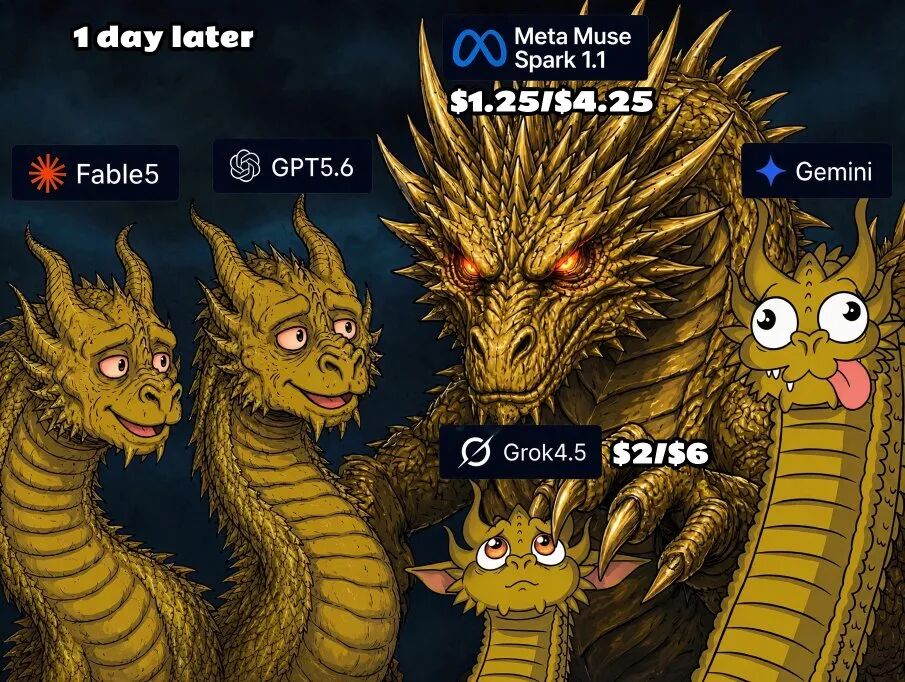
Unlike the rocky rollout of Fable 5, all three models will be fully available starting today, rolling out across ChatGPT, Codex, and the API within 24 hours.

Under this mounting pressure, even Anthropic has stepped up and voluntarily reset Claude's usage quotas.
That's not even the biggest update. The standalone Codex app is being discontinued today, but it's not gone. The full capabilities of Codex have been integrated into ChatGPT, creating a new AI super app. GPT-5.6 is the core engine powering this new entry point.

At the GPT-5.6 Launch Event, Claude Became the Hidden Star
Open the official GPT-5.6 blog, and you'll notice something: Claude is mentioned so many times that it feels like free advertising for a rival. By comparison, the underperforming one ends up looking awkward.
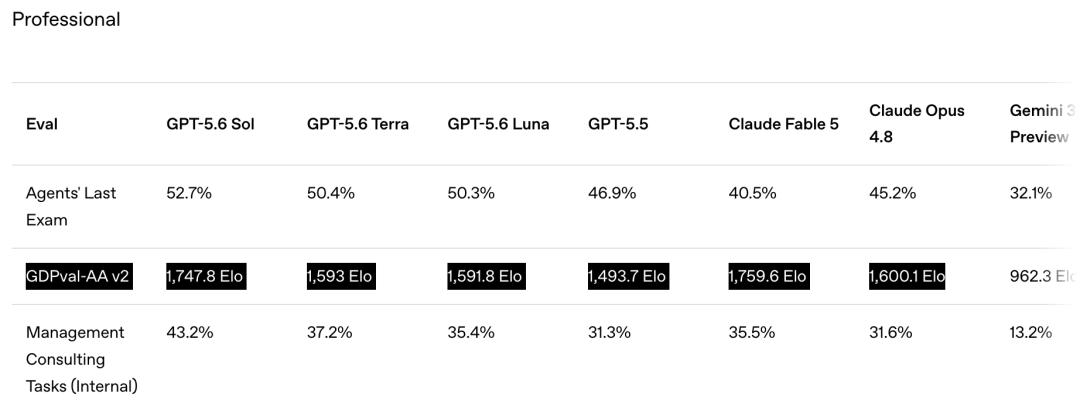
The most intense showdown came in Agents' Last Exam, a long-horizon agent workflow benchmark spanning 55 industries. GPT-5.6 Sol scored a new record of 53.6 points, 13.1 points higher than Claude Fable 5 (Adaptive Reasoning).
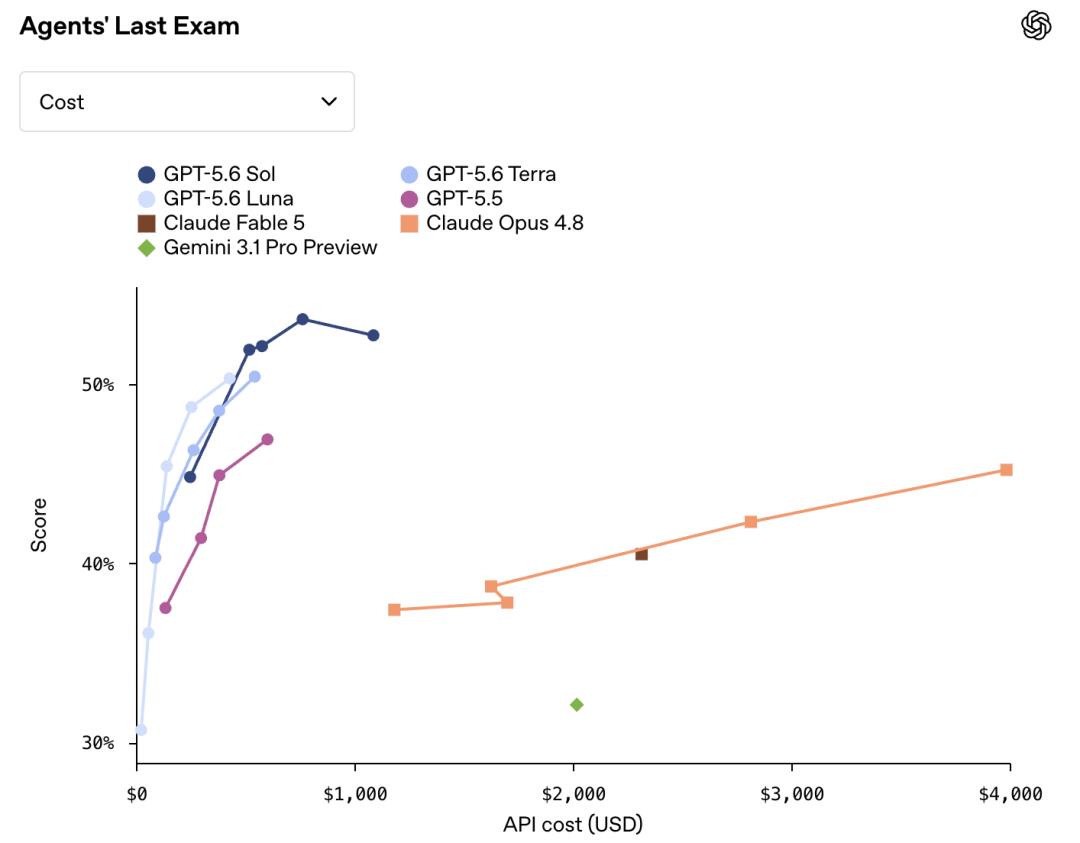
Not stopping there, OpenAI added: Even with medium-level reasoning enabled, it outperforms Fable 5 by 11.4 points, at roughly a quarter of the cost. The smaller Terra and Luna also surpass Fable 5, with their cost coming in at about one-sixteenth.
On the broader Artificial Intelligence Index, Sol at full reasoning mode is just 1 point behind Fable 5, but completes tasks 61% faster at roughly half the cost.
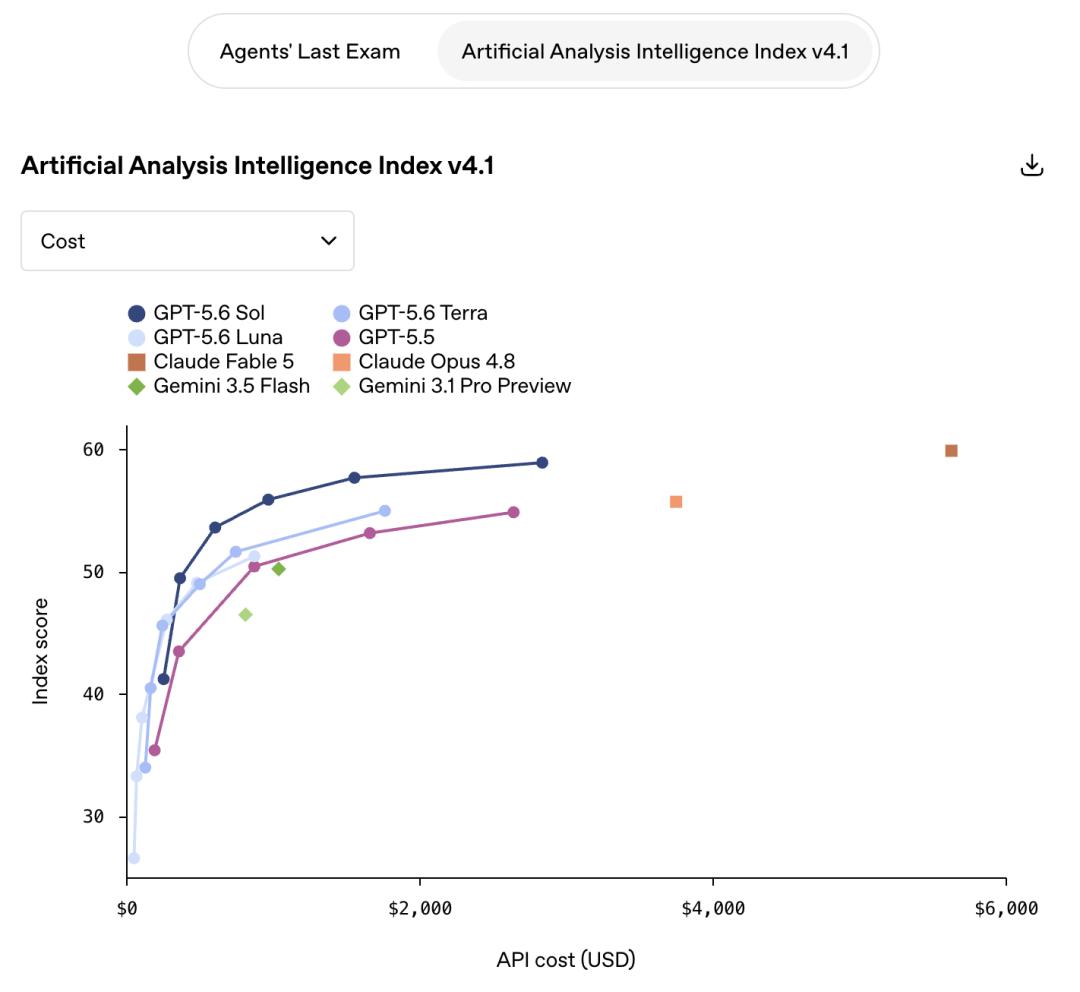
It's clear that the core narrative of this launch boils down to one word: cost-effectiveness. Get more work done for the same price, or complete the same work at a lower cost.
Sam Altman himself quickly chimed in on X, saying OpenAI has heard enterprise clients' concerns about AI costs, and 5.6 Sol has made a major leap forward in "cost per task" — the same goes for Terra and Luna.

To reinforce this value proposition, the billing rules have also been adjusted: Writing to prompt cache is charged at 1.25x the regular input rate, while reading from cache only costs 10% of the regular price; developers can also manually set cache breakpoints, with cached content retained for at least 30 minutes, making billing far more predictable.
Of course, the fine print might not always translate perfectly to real-world usage.
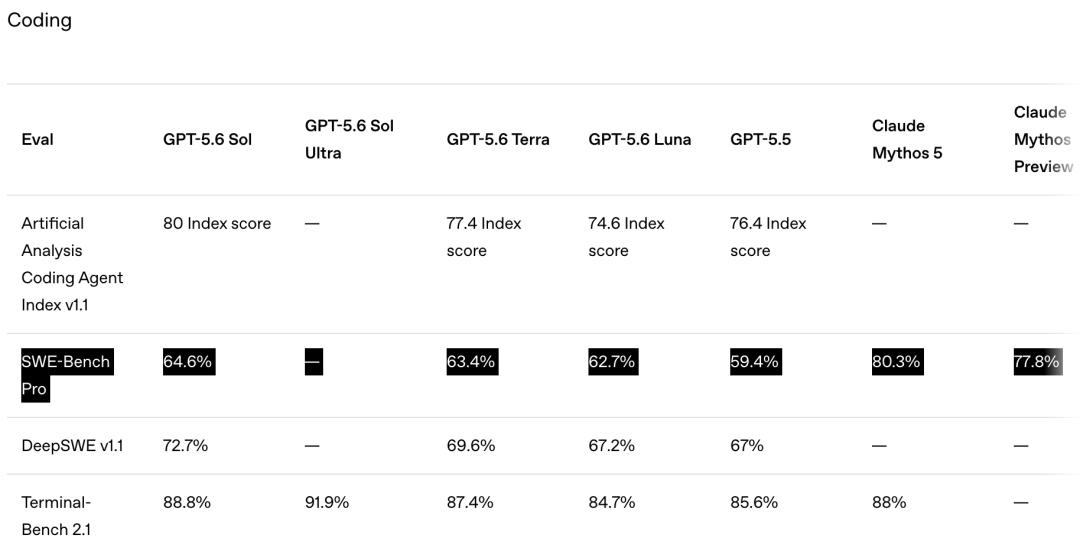
Coding is the main battlefield. Sol scored 80 points on the Artificial Analysis Coding Agent Index, setting a new record, 2.8 points higher than Fable 5, with less than half the output tokens, less than half the runtime, and roughly a third lower cost. It also set new best scores on Terminal-Bench 2.1 and DeepSWE.
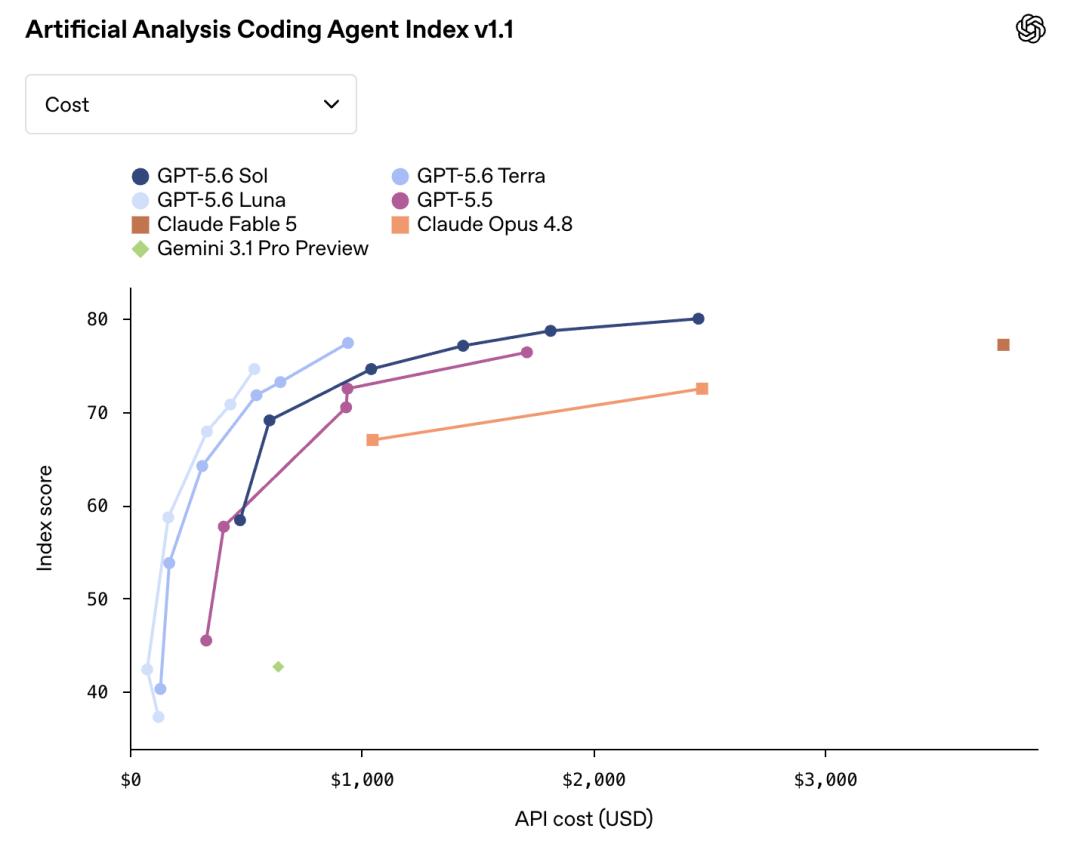
Terra and Luna are equally competitive: Terra slightly outperforms Fable 5 on this index, while Luna surpasses Opus 4.8. Both models take roughly one-third the runtime of their competitors, at around a quarter of the cost.
Early adopters are already singing their praises. The co-founder of Lovable noted that the new models reduce the number of steps users need to build apps by roughly 25%, cut tool calls by 35% to 48%, and reduce stuck tasks by 15%.
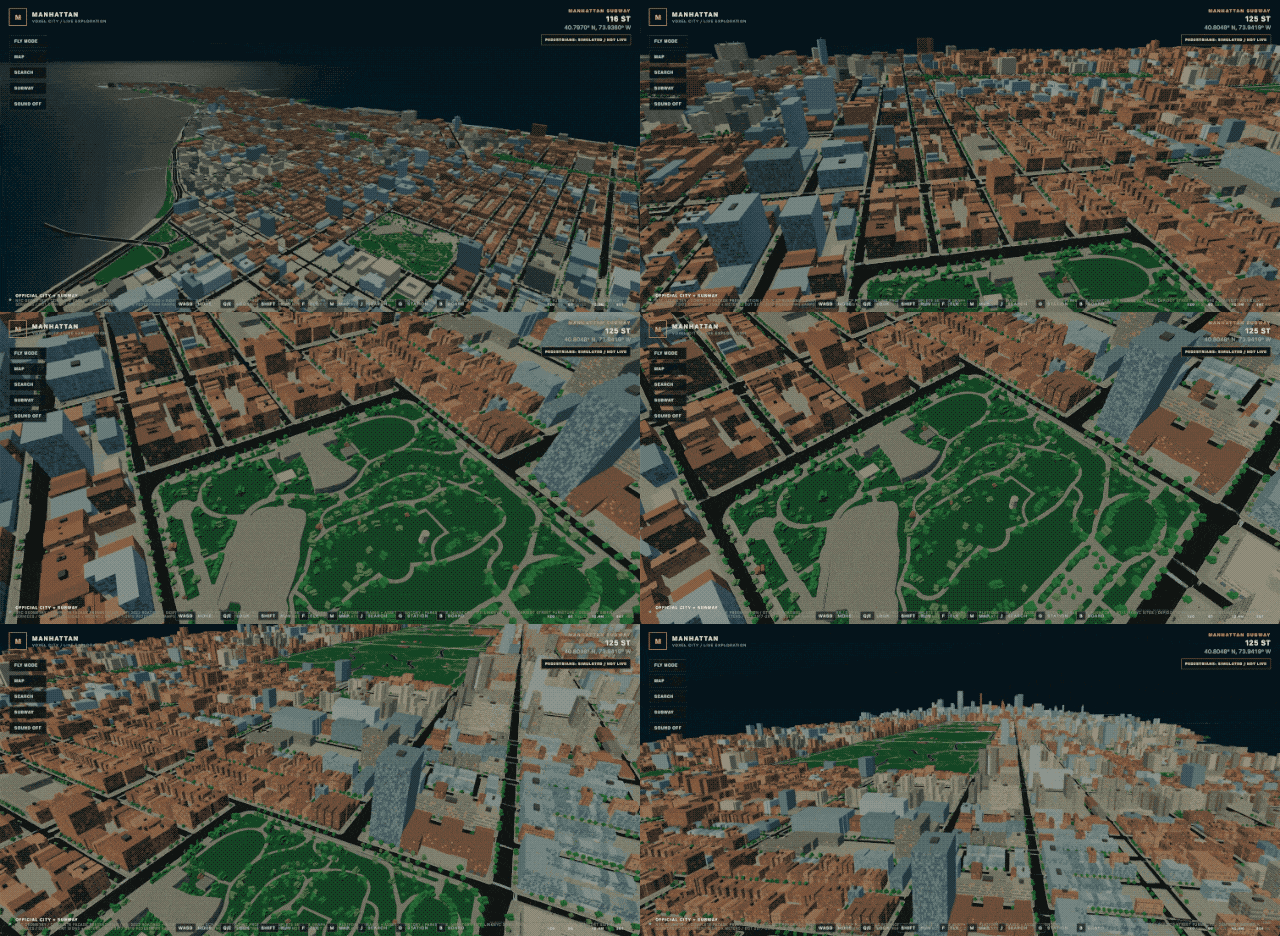
The online community has already gone wild. Developer Matt Shumer shared a voxel version of Manhattan generated entirely by Sol in one go, with stunning precision — the model ran autonomously for nearly a week to complete it.
Building an entire Minecraft world from scratch is no challenge either.
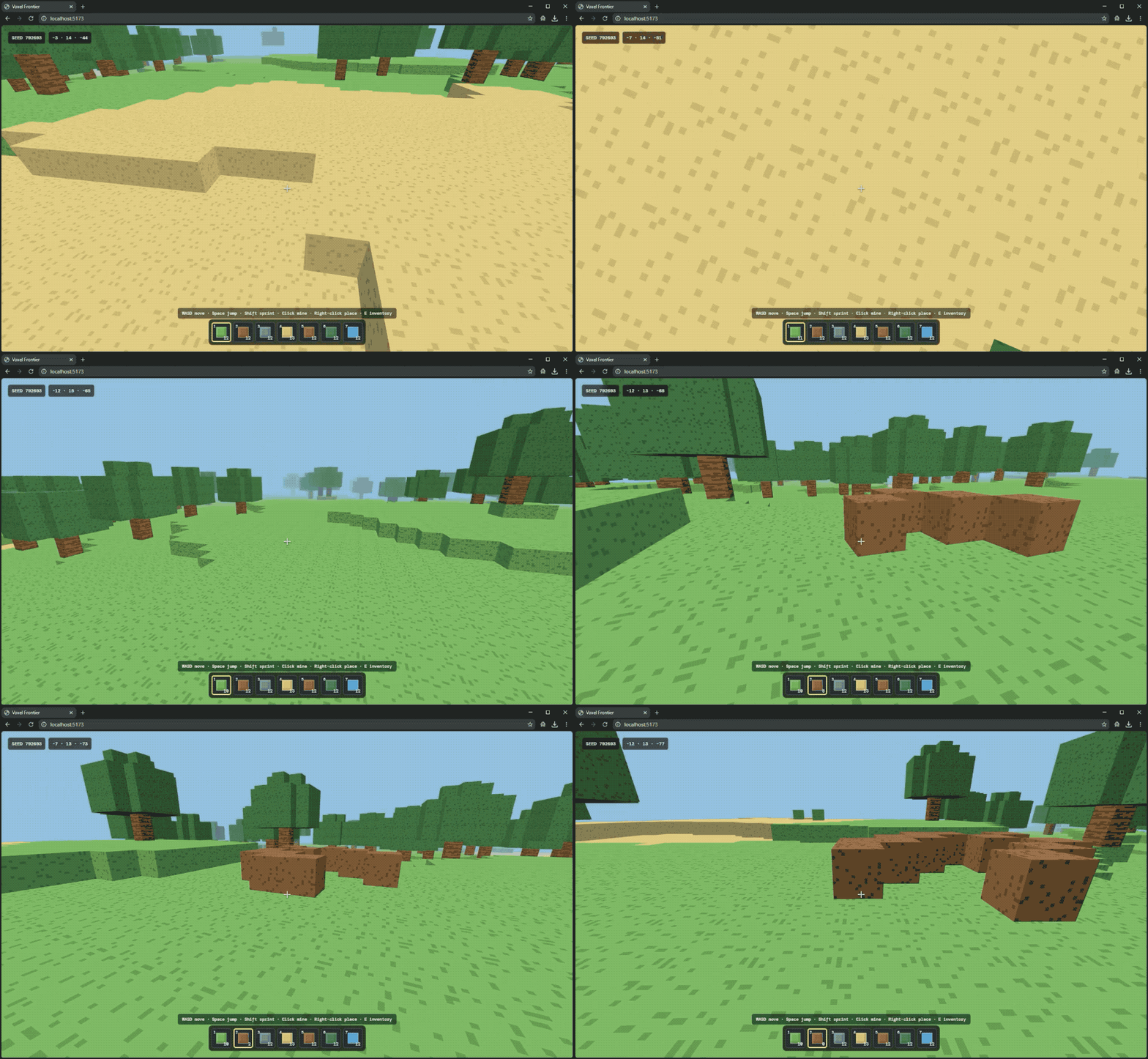
https://x.com/preferredev_/status/2075282363458982299
Beyond coding, OpenAI has repeatedly emphasized two other key capabilities: design taste and computer operation.
The company states that GPT-5.6 delivers a "leap forward" in design judgment — give it a broad direction, and it can create aesthetic, user-friendly interfaces.
More importantly, it uses its enhanced computer operation capabilities to inspect its own rendered outputs, identify visual and functional issues, and finalize the work before delivery. Older models would finish writing code and move on; this one self-audits its own work.
Improvements in knowledge work scenarios are equally obvious.
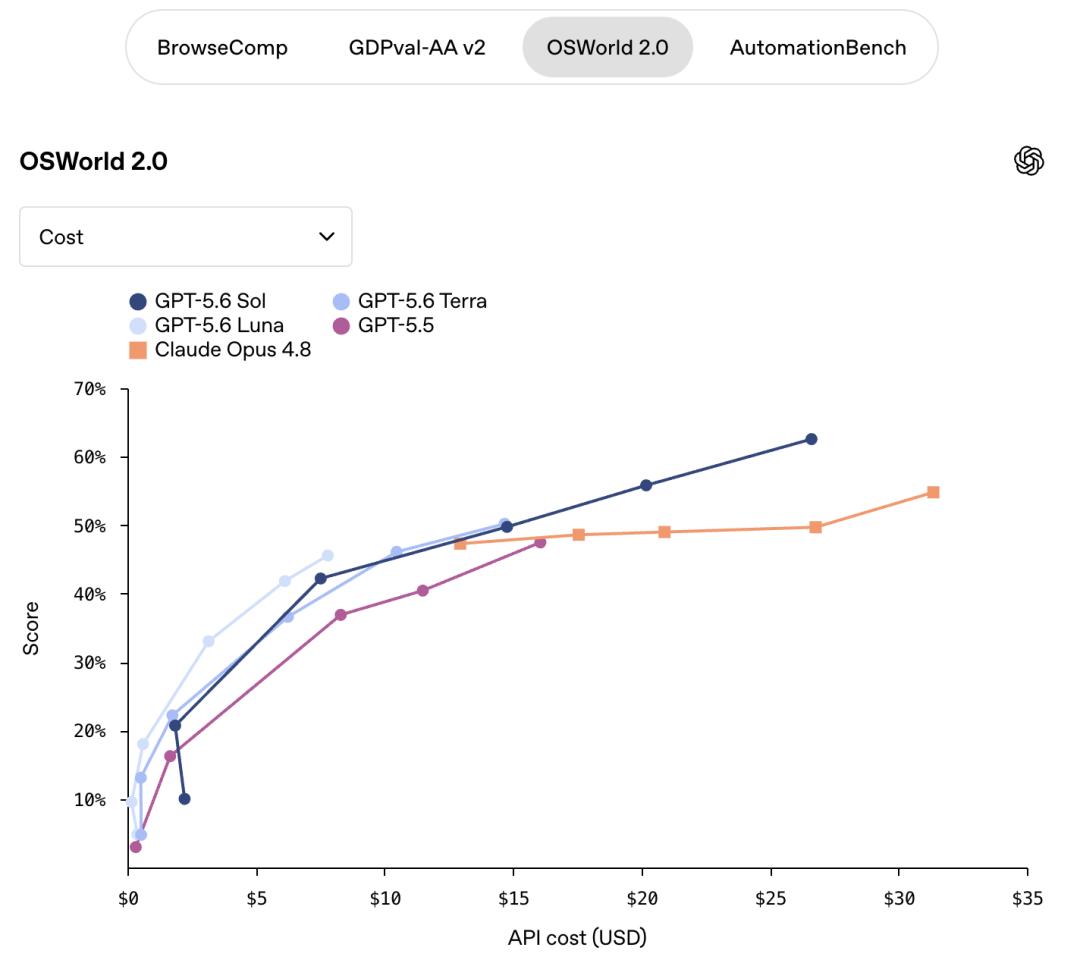
On the BrowseComp web browsing benchmark, Sol hit a new record of 92.2%; on the OSWorld 2.0 computer operation benchmark, it scored 62.6%, surpassing Opus 4.8 while cutting output tokens by 85%.
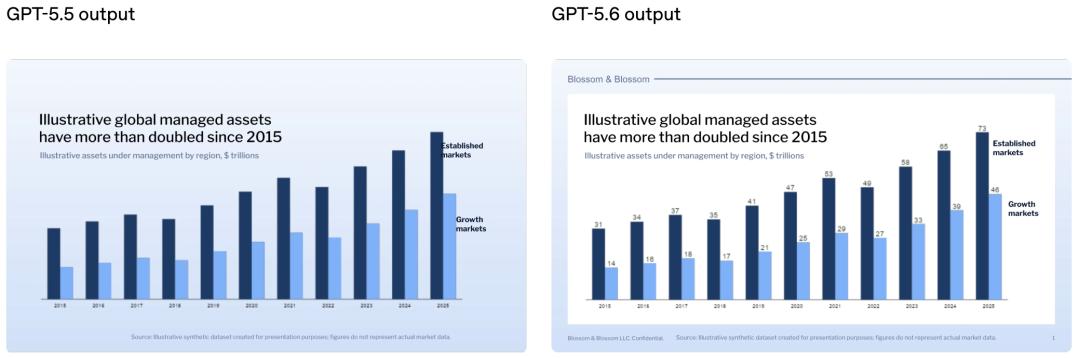
For essential office tasks like building presentations, OpenAI shared a side-by-side example: when asked to update data based on a reference file, GPT-5.5 lost key master slide elements, while GPT-5.6 could infer the full design system and apply it seamlessly to new content.
The same applies to documents and spreadsheets, with higher accuracy for formulas and financial models.
But there's more to unpack. At the bottom of the blog's benchmark table, a few numbers stand out:
On SWE-Bench Pro, Sol scores 64.6%, while Claude Fable 5 hits 80%, and Anthropic's higher-tier Mythos 5 reaches 80.3%. Claude still holds the lead in this category.
For the hardest Tier 4 math problems in FrontierMath, Sol scores 65.9% — even lower than its predecessor GPT-5.5's 72.5%, while Fable 5 scores 87.8%.
On the GDPval-AA professional work benchmark, Sol's 1747.8 Elo rating is still slightly below Fable 5's 1759.6.
There's a subtle dig in the GeneBench Pro biology benchmark: OpenAI explicitly noted in the figure caption that Claude Fable 5 wasn't listed because it "declined to answer most questions in this benchmark that involve advanced biology topics." A single footnote that makes their jab crystal clear.
Notably, GPT-5.6 introduces a new feature: ultra mode.
Put simply, it leverages the power of multiple agents working together.

Ultra mode defaults to running four agents in parallel, and can scale up to 16 total, using more tokens to deliver stronger results faster. Across the BrowseComp, SEC-Bench Pro, and Terminal-Bench 2.1 benchmarks, adding more agents shifts the "score vs. runtime" curve favorably.
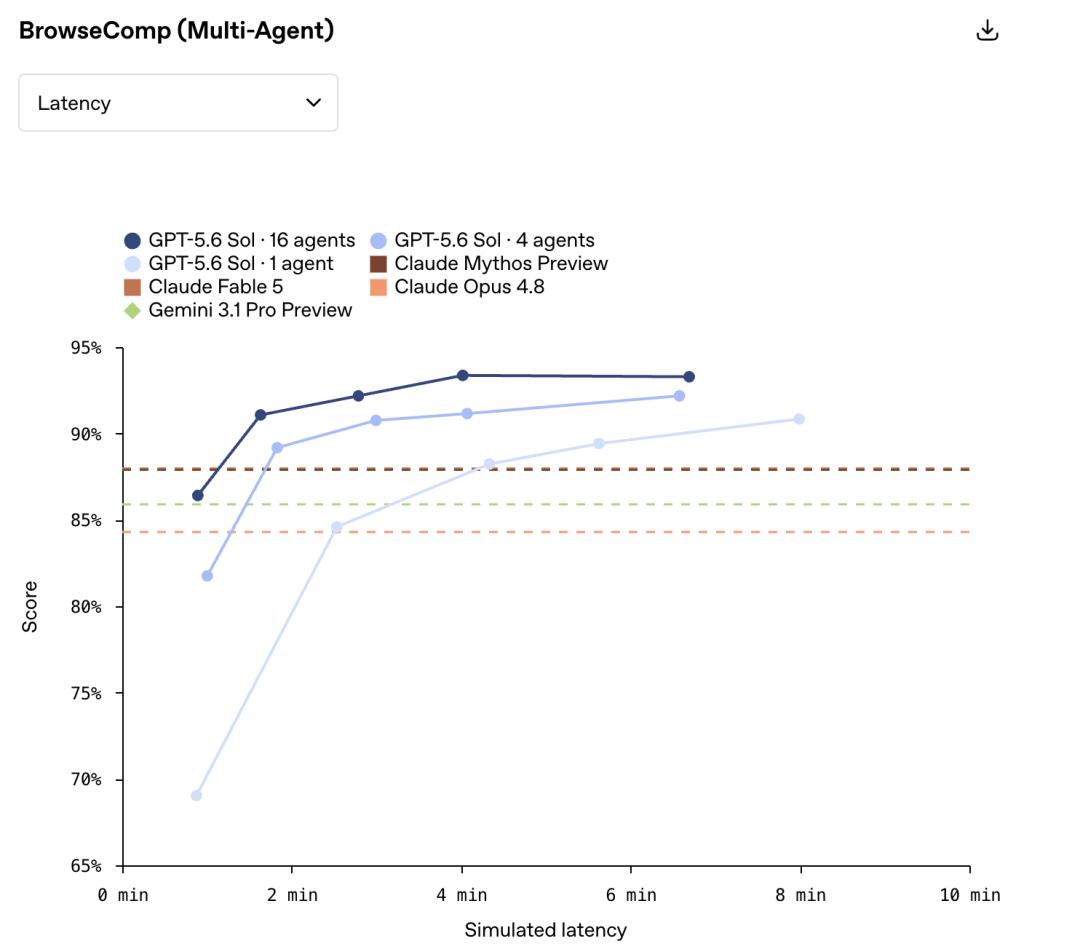
Researchers explained during the event that these agents can split up work just like an experienced, coordinated team.
Apart from ultra, there's also a max mode, which gives the model even more thinking time than xhigh to reason, verify results, and explore alternative approaches. On the API side, Programmatic Tool Calling