When Chinese air conditioners are sold out in Europe, the EU is wielding the tariff stick against small parcels worth 3 euros
Let me share a "hot joke": The other day, the European Union tried to convene a meeting of experts to discuss how to cope with extreme high temperatures. Due to the sweltering heat and the lack of air conditioning in the venue, the meeting was forced to be canceled.
This is no made-up story. A high-temperature seminar at the London Climate Action Week ended up being called off in exactly this way. Extreme heat, the very problem they aimed to solve, defeated them first, painting an awkward portrait of Europe in 2026.
It's not that Europe is unwilling to install air conditioners, but its cumbersome regulations have tied its own hands. Drilling holes in old buildings requires a vote from the entire building, installation costs exceed the price of the unit itself, and any refrigerant charge over 2 kilograms demands professional inspection. Installing an air conditioner can drag on for one or two months. Then Midea's PortaSplit entered the market: no drilling required, fully movable, ready to use in 10 minutes, with technical parameters precisely aligned with environmental protection standards. It completely broke through the European market, with shipments exceeding 200,000 units in the first half of the year.
But on the very same day, July 1, the EU canceled the duty-free policy for parcels under 150 euros, imposing a 3-euro tariff on each category of goods. On one hand, consumers are eager to buy Chinese products; on the other hand, the EU is wielding the tariff stick to block their entry. Behind this contradiction lies a structural transformation in China's cross-border e-commerce sector.
1
One Air Conditioner's Breakthrough Battle in Europe
Midea's PortaSplit rose to popularity not through low prices, but through precise market positioning.
The air conditioning dilemma in the European market is essentially rooted in institutional barriers. Traditional split-system air conditioners require drilling through exterior walls to install outdoor units, but Europe has a large number of old buildings with strict historical preservation rules. Apartment installations need property management approval, and rental tenants have no right to modify their living spaces. Exorbitant installation costs and lengthy approval processes have turned air conditioners into luxury goods.
The paradox is that Europeans are not unwilling to live more comfortably; they are trapped by regulations they themselves created. For example, noise levels must not exceed 35 decibels, refrigerant cannot exceed 2 kilograms, and no drilling is allowed on building facades. While these rules were originally intended to protect the environment and historic architecture, they left European consumers helpless in 48.2°C heat. They clearly have the money to buy air conditioners, but cannot install them due to a tangled web of red tape. This "self-imposed limitation" has precisely created a massive market gap for Chinese enterprises.
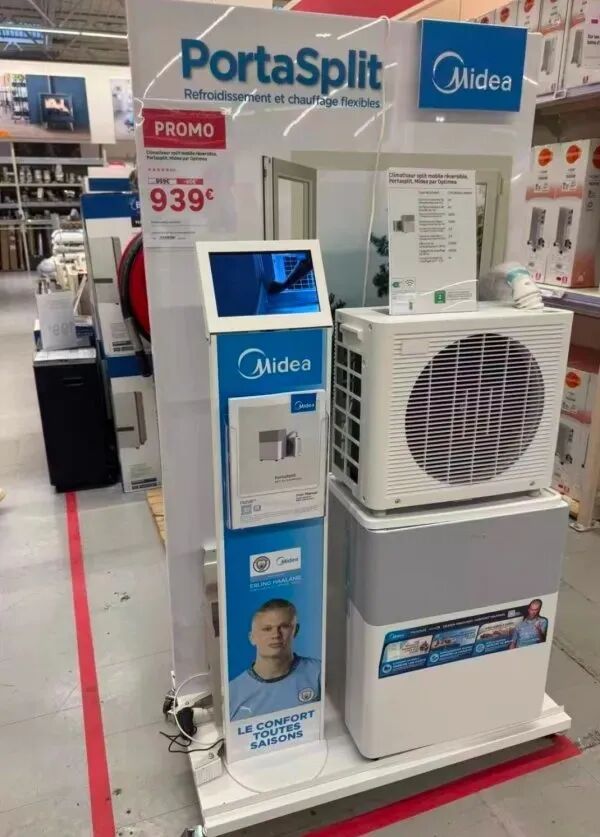
Midea's solution eliminates drilling, formal installation, and approval processes entirely. The PortaSplit is classified as a "movable portable appliance": the outdoor unit can be placed on a balcony or windowsill, while the indoor unit is freely movable, and the whole setup takes just 10 minutes. Even more brilliant is its parameter design: France mandates professional inspection for systems with over 2 kilograms of refrigerant, so this unit uses exactly 1.99 kilograms; Germany restricts nighttime noise to 35 decibels, and its silent mode hits exactly 35 decibels; Switzerland bans products with energy efficiency ratings below 6, and it achieves a rating of 6.1.
Some netizens summed it up: every design detail of this air conditioner hits Europe's soft spots perfectly.
This strategy reveals a deeper logic: the high barriers Europe erected through regulations have ironically become breakthrough points for Chinese enterprises. Unwilling to break their own rules, we navigate around them; reluctant to relax their standards, we design products that precisely meet them. Midea is not challenging Europe's regulatory system, but adapting to and leveraging it through thoughtful product design. When European consumers finally find a usable air conditioner in the sweltering heat, they won't care if it's "Made in China" or "Made in Europe"—they just want cool air.
However, Midea's path represents a "brand-capital driven approach" that cannot be easily replicated by most small and medium-sized sellers. Three years of R&D investment, establishing local teams, and partnering with overseas design institutions are barriers that only top players can overcome. Ordinary sellers face a completely different reality in the European market.
Song Zhe (a pseudonym) is a seller who has operated on Amazon, Temu, and Shein for the European market. Over the past two years, the pitfalls he encountered could fill a "Survival Guide for Europe". In 2023, his store was suspended for several months due to listing variant violations. His first Plan of Action (POA) submission was rejected, and after repeatedly working with service providers, he finally got reinstated at a cost of 6,000 yuan. When operating on the German site, his listings were suspended for lacking WEEE registration. He hired a service provider who turned out to be a scam—nearly a year passed without progress, and they refused to refund his money, forcing him to find a new agent. Earlier this year, products were taken down for missing DOC documents and EU Representative requirements, forcing him to remove inventory ranked at BSR 5000, which remains unresolved after three months. A top-selling BSR product was hit with an appearance infringement complaint from a competitor, even though the designs were clearly different. Amazon delisted the product across all five European sites, rejected appeals, and demanded he contact the complainant directly to withdraw the claim—who refused all negotiations. He later discovered many other sellers in his industry had been targeted by the same person, forcing everyone to relist their products under new links.
Song Zhe calculated the costs: EU and UK trademarks together cost 12,000 to 15,000 yuan, VAT registration 20,000 to 25,000 yuan, EU and UK Representative services 2,500 to 3,000 yuan, WEEE registration 7,000 to 8,000 yuan, Packaging Law compliance 1,200 yuan, and other fees 2,000 yuan—totaling 45,000 to 54,000 yuan. This is just the "entry fee", not including the additional 3-euro tariff per order. Song Zhe says the European market now "brings new challenges every single day": Italian security deposits, German tax audits, Spanish VAT number delays, problems keep piling up. "They say entrepreneurship won't be smooth sailing, but this level of constant torment is unbearable. I actually miss the days when I was an employee—back then, my boss was the one who should have been worrying about all this."
Zhang Miao (a pseudonym) has an even more direct take. He sees Europe's heatwave this year as an opportunity, but is full of concerns. Fans and cooling products will definitely sell well in Europe, but by the time he finds manufacturers, stocks up, and ships the goods, two months will pass—and the heatwave might already be over. The high temperatures themselves are also slowing down his operations: his French VAT application has been pending for nearly two months, and the agency says the heat has reduced work efficiency across the board. Other sellers in his industry report that Packaging Law and VAT processing times have slowed dramatically.
These cases reveal a reality: opportunities and barriers coexist in the European market. Midea leverages its brand strength and R&D investment to capture the high-end market, while ordinary sellers face a complex landscape of surging compliance costs, frequent policy changes, and uneven quality among service providers. The low-cost bulk shipping model is becoming unsustainable, while localized innovation to solve real problems opens up broader paths. PortaSplit took three years from concept to launch, proving that localization is not a last-minute fix but a capability requiring long-term investment. Sellers who only want to "copy domestic bestsellers and sell them overseas" are being eliminated, while brands willing to redesign products specifically for European consumers are capturing market share.
2
Who is the 3-Euro Tariff Targeting?
Why did the EU cancel the duty exemption for low-value parcels?
The official stated reason is "fair competition". Data from the European Commission shows that in 2024, the EU imported 4.6 billion items valued under 150 euros, nearly 5 times more than in 2022, and 91% of these came from China. This massive volume of parcels has overwhelmed customs authorities and put tremendous pressure on local retailers.
But the deeper logic lies in the EU's instinctive rejection of a fundamentally new business model.
For decades, European companies were accustomed to the traditional supply chain: products manufactured in China, branded as European, distributed through European channels, and sold to European consumers at European price points. In this system, brand premiums, distribution markups, and patent fees stacked up, keeping most profits within Europe. Cross-border e-commerce completely eliminates all these intermediate links, allowing European consumers to buy Chinese products of equal quality at far lower prices.
Oliver Richterberg, Head of Foreign Trade at the German Engineering Federation, accidentally let the cat out of the bag: "Chinese suppliers can produce products of comparable quality to European ones, but at 30% to 50% lower prices. I admit choosing Chinese products is a rational decision, but it hurts our interests, so we cannot accept this 'unfairness'."
This reveals a key contradiction: the EU's definition of "unfairness" is not based on whether Chinese products are dumped at below-market prices, but on the very fact that "choosing Chinese products is a rational decision". This mindset is essentially cognitive dissonance: European consumers want Chinese products, European governments know they are high-quality and affordable, but they refuse to accept the reality that "European manufacturing is losing competitiveness". Instead, they frame the problem as "unfair competition" and use tariffs to mask their own industrial decline.
An even deeper tension is that the EU is torn between two conflicting anxieties. On one hand, it is highly dependent on Chinese manufacturing—whether air conditioners or small consumer goods, the efficiency and cost advantages of China's supply chain are irreplaceable locally. On the other hand, it fears this dependence: deindustrialization, job losses, and losing control over key economic sectors. So while enjoying the low inflation and high living standards brought by Chinese products, it builds walls of tariffs and regulations, trying to find a balance between "cannot live without" and "do not want to rely on". But this balance is inherently contradictory: tariffs cannot suppress demand, they only make products more expensive, and European consumers themselves end up footing the 3-euro bill.
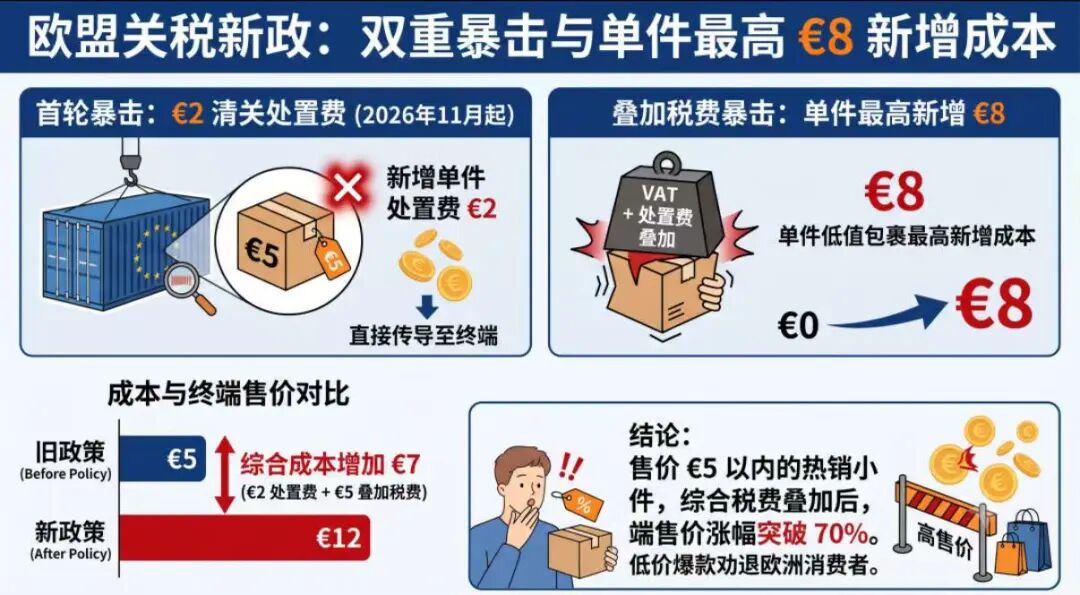
Returning to this new policy, how far-reaching are its impacts? A phone case selling for 9.9 euros in Europe generates a profit of roughly 1 to 2 euros after deducting procurement, logistics, and platform commission costs. Now, with a 3-euro tariff imposed per product category, a single phone case classified as its own category would result in direct losses. Industry insiders widely agree that the profit model of low-cost direct mail is being completely destroyed. The fixed 3-euro tariff alone will add tens of billions of euros in extra costs to China's cross-border e-commerce sector.
Worse still, this is just the beginning. Starting November 2026, an additional 2-euro customs clearance handling fee will be introduced. After July 2028, the transition period ends, and all parcels will be fully taxed under standard tariff rules. At the same time, EU customs reform will shift compliance responsibilities from consumers and carriers to platforms and sellers, who will be designated as official importers. Violators face fines up to 6% of their annual turnover. For German site sellers, annual compliance costs per store have already risen by approximately 12,000 euros.
Song Zhe's experience confirms this. His estimated 45,000 to 54,000 yuan in compliance costs only covers basic registration and certification fees, not the new per-order tariffs. Even more frustrating, compliance requirements vary across EU member states, creating endless daily challenges: German tax audits, Italian security deposits, Spanish VAT delays. One seller summed it up: the trouble with the European market isn't that any single task is impossibly difficult—it's that there are so many scattered requirements that problems can erupt at any moment.
3
Tariffs Cannot Stop Demand, But They Change the Game
Can a 3-euro tariff stop European consumers' demand for Chinese products? The answer is almost certainly no.
In 2022, the EU received 1.3 billion low-value parcels; by 2025, that figure had surged to 5.9 billion. Billions of orders placed every year represent a tangible vote of confidence from European consumers with their wallets. Cheap products don't always sell, but products that sell well are never just cheap. European consumers keep reordering because the products meet or even exceed their expectations.
However, we need to distinguish two types of demand: one is "price-driven demand", where consumers buy solely because something is cheap; the other is "value-driven demand", where consumers buy because the product itself solves their problems. The 3-euro tariff is fatal for the former, but has a far milder impact on the latter. This means sellers must rethink their market positioning and find new competitive anchors as price advantages erode.
The most immediate change brought by the new policy is the complete rewriting of cross-border parcel logistics. The old model of shipping directly from China to Europe duty-free via small parcels is being cut off by new regulations. The core advantage of direct mail was its "lightweight"—no need for overseas inventory, no upfront capital investment, no complex local tax compliance. But the 3-euro tariff, combined with upcoming clearance fees and shifted compliance responsibilities, has instantly turned this "light model" heavy. A phone case selling for 9.9 euros with 1-2 euros profit now loses money immediately after adding the 3-euro tariff. Sellers relying on massive SKU volumes and thin margins no longer face "lower profits"—they face losing money on every single sale.
One European netizen put it bluntly when commenting on the new EU policy: "Their (the EU government's) goal is to make us buy more from European shops and companies that already source their products from China. It sounds like they hate being cut out as middlemen." This statement captures a critical reality: consumers realize that removing middlemen makes Chinese products cheaper, and they refuse to pay for unnecessary markup profits. Once this mindset takes root, no policy can easily reverse it.
More fundamental changes are happening at the logistics level. Shein has shifted over half its European orders to local warehouses, AliExpress now fulfills over 50% of its European orders from local warehouses in Spain, France, and Poland, and Temu plans to achieve 80% coverage of European overseas warehouses by the end of 2026. This collective shift across platforms proves that local warehousing is no longer an "option" but a "necessity". Shipments originating within the EU are unaffected by the new policy, giving early movers who invested in overseas warehouses a structural competitive edge.
However, localized fulfillment is not just about shipping goods and storing them in warehouses. Sellers need to stock inventory in advance, bear inventory risks, handle local tax compliance, and integrate with local logistics networks. In the old direct mail model, processes were clear: product selection, listing, order generation, and shipping. Now, operating local warehouses requires calculating inventory turnover rates, stock cycles, storage costs, and exchange rate fluctuations. The new policy is forcing sellers to evolve from a "lightweight model" to a "heavyweight model", transforming them from operators who only understand product selection and advertising to comprehensive managers who master supply chains, inventory management, and local compliance.
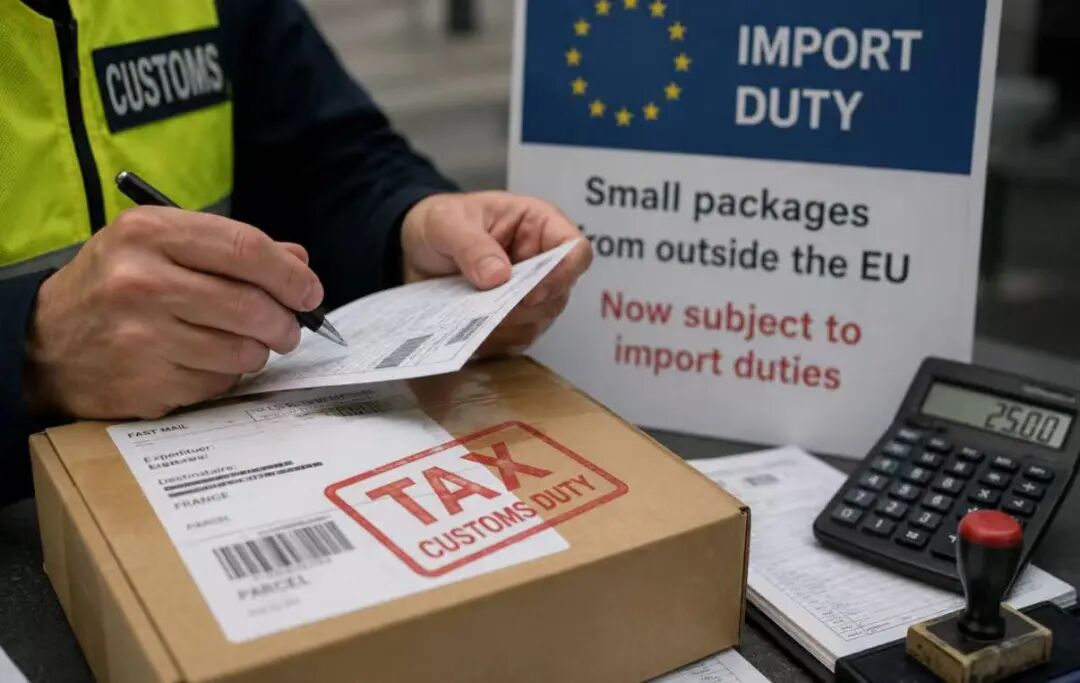
Song Zhe's experience offers another insight: compliance costs in the European market are becoming invisible entry barriers. The 45,000-yuan entry threshold significantly raises the trial-and-error costs for small and medium sellers. A single misstep can cost them not just tens of thousands of yuan, but their entire store and inventory. One seller admitted: "The trouble with the European market isn't that any single thing is too hard—it's that there are so many scattered issues that problems can blow up at any time."
With direct mail shrinking and local warehouses becoming mainstream, the competitive landscape has also shifted. Where success once depended on sharp product selection and efficient ad spending, it now relies on deep supply chain integration and localized capabilities. Sellers who can