Unpaid manuscript fees and internal corruption? What happened to Shanhai Xingchen, a top player in the short drama industry?
The Feishu group is still accepting script submissions, while the Xiaohongshu group is continuously flooded by screenwriters whose remuneration has been in arrears. These two groups with vastly different atmospheres together form the surreal drama currently unfolding at Shanhai Xingchen.
On one hand, screenwriters are chasing overdue payments by holding contracts and tax reporting documents; on the other hand, the platform released a performance report boasting that it secured 106 scripts in just seven days. While its partner Feilu Novel issued a statement that Shanhai Xingchen failed to pay the guaranteed fees and demanded it immediately stop all adaptation activities, Shanhai Xingchen immediately retaliated by claiming Feilu had breached the contract first.
All these contradictions ultimately point to the same question: after a short drama platform established only three years ago completed its "three-leap" transformation from live-action short dramas to AI-generated dramas, and then to overseas AI dramas, can its internal management system covering finance, legal affairs and other departments keep up with the breakneck speed of business expansion?
The Remuneration Controversy Continues to Escalate
On July 2, Xiaohongshu content creator "Xiamu Zhenliu" posted that he had filed a real-name report on Shanhai Xingchen's tax irregularities. As a contracted screenwriter for the company, the creator has three scripts totaling 90,000 yuan in guaranteed remuneration that are overdue for payment.
According to his disclosure, there are two reporting clues: first, when Shanhai Xingchen paid labor remuneration to external screenwriters, it failed to fulfill the statutory obligation of withholding and remitting individual income tax; second, cross-verified by multiple screenwriters, Shanhai Xingchen is suspected of irregularly listing costs without actually paying remuneration, and has abnormal input VAT deductions, with some projects having deducted thousands of yuan in VAT before final payment was made.
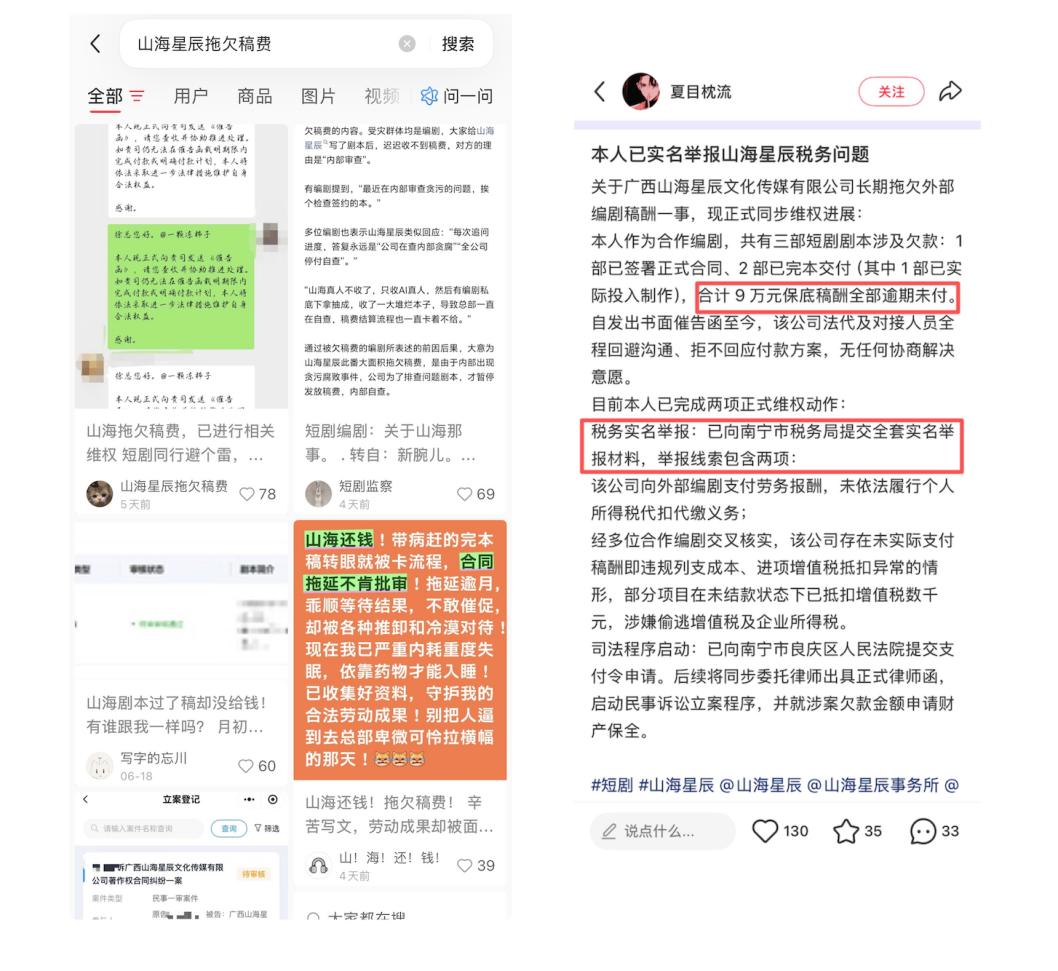
Based on accounts from multiple screenwriters on social media platforms, to expand its team, Shanhai Xingchen recruited dozens of chief editors and deputy chief editors externally. Some chief editors exploited their authority to take kickbacks through scripts from young screenwriters, siphoning off advance payments while the resulting low-quality scripts could not be produced. This prompted the company's senior management to order a full investigation of all contracted scripts, which inadvertently led to innocent screenwriters also having their remuneration delayed.
36Kr joined a remuneration discussion group for Shanhai Xingchen on Xiaohongshu, which now has more than 400 members and over 10,000 cumulative messages. Most conversations in the group focus on when contracts will be signed, how long remuneration has been delayed, and the evasive rhetoric used by Shanhai Xingchen's liaising staff.
In recent days, many posts claiming to have received remuneration have appeared on Xiaohongshu, but group members suspect they are "damage control posts" from Shanhai Xingchen due to their obvious new accounts and identical phrasing. This further inflamed tensions in the group, with some screenwriters even considering offline rights protection actions at the company's headquarters. Shanhai Xingchen staff stated that remuneration will be issued "in batches", but screenwriters remain unconvinced, believing that "more noise brings faster payment" is the unspoken rule, and those who make the biggest fuss will get their money first.
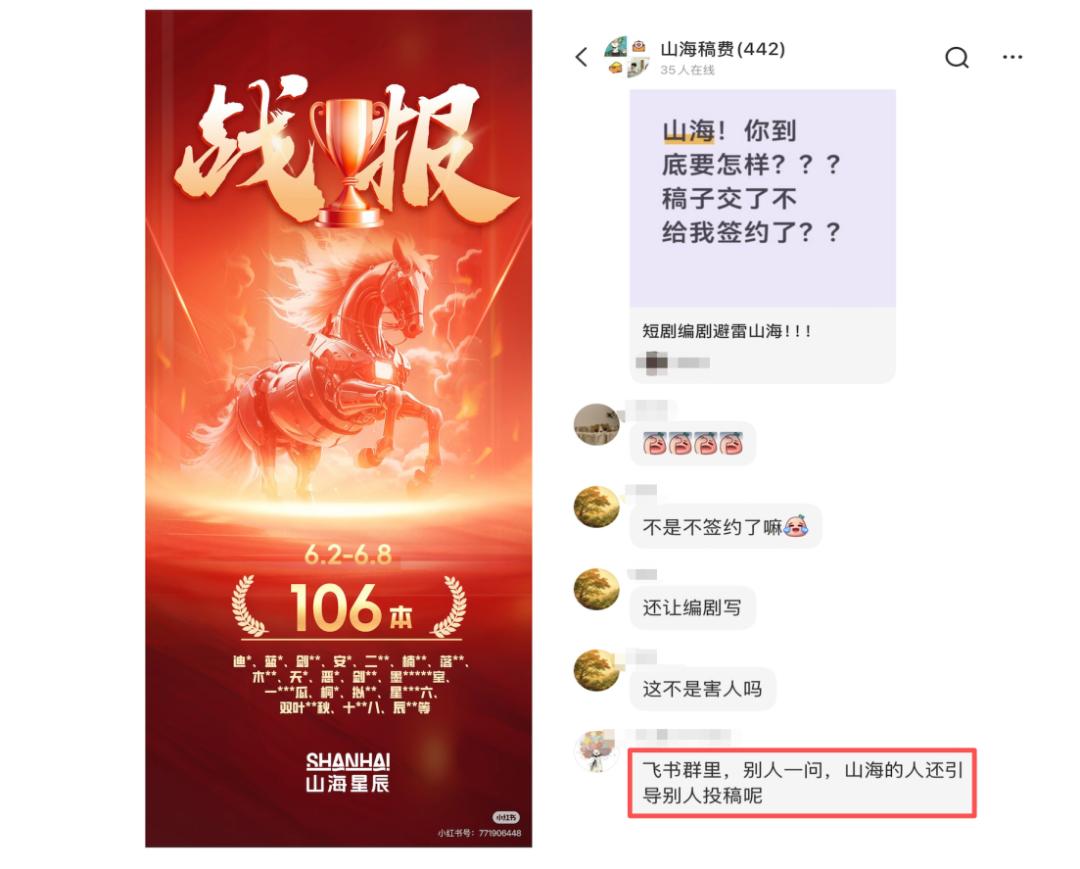
While internal turmoil rages, external public relations remain calm. A content creator claiming to be in charge of copyright business at Shanhai Xingchen posted a performance report on Xiaohongshu, stating that the company had signed 106 scripts in just seven days from June 2 to June 8. Members of the aforementioned group also mentioned that staff in Shanhai Xingchen's Feishu group are still guiding new screenwriters to submit their work.
Previously, insiders revealed that the chief editors and the young screenwriters they "mentored" all came from a "Feilu background". Feilu Novel is known for its fast-paced, high-thrill imaginative stories, where screenwriter teams often prioritize viral potential and short-term traffic. When this mindset was brought into Shanhai Xingchen, which lacked internal controls, chief editors' script approval power quickly degenerated into a tool for rent-seeking. For Shanhai Xingchen, this talent recruitment move risked "inviting wolves into the house".
Shanhai Xingchen and Feilu Publicly Fall Out
The partnership between Shanhai Xingchen and Feilu Novel in the male-focused fiction genre has a deep shared history.
Zhou Peijin, founder of Shanhai Xingchen, earned his first fortune writing online novels during college and became a contracted writer for Feilu Novel. In 2021, a novel he co-created with his later business partner Li Hongjian became an instant hit upon release, reportedly earning hundreds of thousands of yuan in monthly remuneration. Zhou was also awarded the title of "2021 Outstanding Writer" by Feilu Novel, and the word "Shanhai" in the company's name was his pen name back then.
Zhou Peijin's connection with Feilu Novel goes far beyond that. In 2017, he established an online fiction studio, completing his transformation from a fiction writer to a content supplier for online platforms. His writer team, which gradually expanded to over 100 people, became his core resource when he entered the short drama industry in 2023.
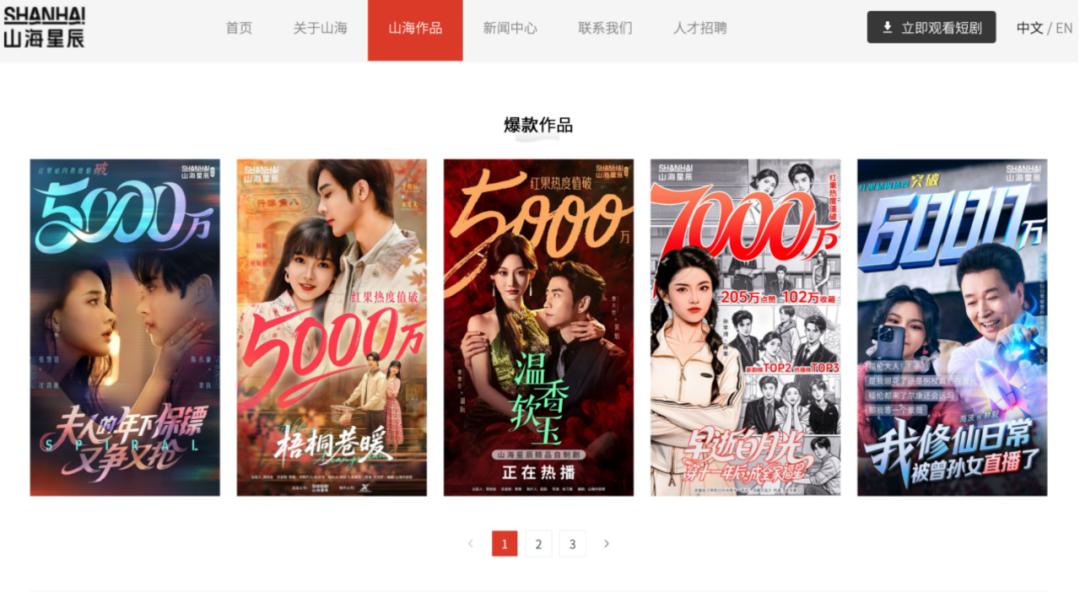
In June 2025, when the two parties reached an exclusive strategic partnership granting Shanhai Xingchen adaptation rights to Feilu's works, the public widely viewed the collaboration as a strong alliance combining "Feilu's IP library and Shanhai's video production capabilities".
Therefore, the public falling out between the two parties at the end of May this year, less than a year after their partnership began, caught everyone by surprise.
On May 29, Beijing Chuangyue Technology Co., Ltd., the operating company of Feilu Novel, issued a statement titled "Shanhai Xingchen Must Immediately Stop Adapting Feilu's Works", pointing out that Shanhai Xingchen had hired screenwriters to adapt Feilu's works without permission, and failed to pay the remaining guaranteed licensing fees from their previous cooperation.
In response, Feilu demanded that Shanhai Xingchen immediately cease all adaptation activities; Shanhai Xingchen does not hold adaptation rights for AI-generated realistic short dramas, and must not develop, produce or distribute such dramas based on Feilu's licensed works in any form.
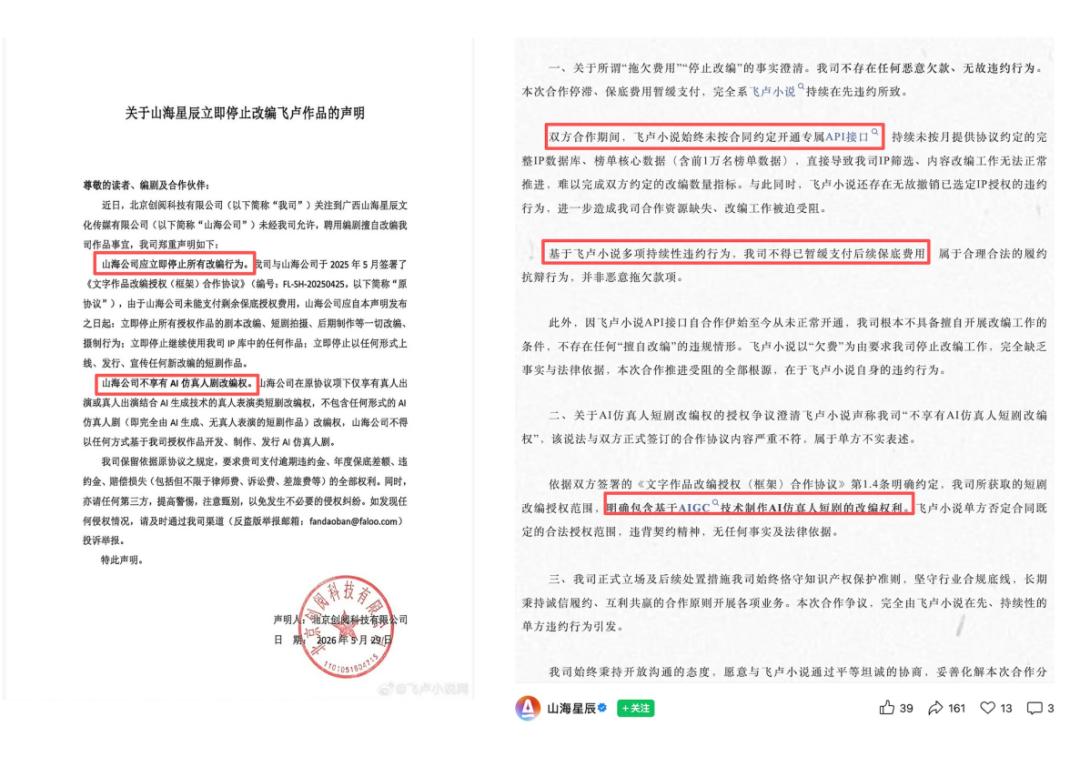
On May 30, Shanhai Xingchen responded that Feilu Novel failed to open the exclusive API interface as stipulated in the contract, which prevented it from normally advancing IP screening and content adaptation work; the suspension of guaranteed fee payments was a legitimate defense in performance of the contract. Regarding the adaptation rights for AI-generated realistic short dramas, Shanhai Xingchen stated that Clause 1.4 of their cooperation agreement clearly includes the right to produce AI-generated realistic short dramas based on AIGC technology, making Feilu Novel the party in unilateral breach of contract.
This is not just a dispute over a specific contract clause, but a battle over the lucrative market of "IP-based AI short drama development". Behind it lies the huge profits brought by the iterative upgrade of AI video generation tools and the explosive growth of the AI short drama market.
A Short Drama Platform Riding the AI Trend
The rise of Shanhai Xingchen can be seen as a typical story of a "trend chaser". By precisely seizing strategic windows, it expanded from domestic short dramas to overseas short dramas, from live-action dramas to AI-generated realistic dramas, and from platform globalization to content globalization; it completed the "three-leap" transformation in just three years, growing from an initial team of 30 people to over 1,000 employees.
Before the remuneration controversy broke out, every transformation step taken by Zhou Peijin was interpreted as a bold and forward-looking move.
In 2023, while launching its first short drama "Aoshi Shenzun", Zhou Peijin maxed out his consumer credit lines to fund promotion, never considering the possibility of losses. The drama's success reinforced his determination to fully enter the short drama industry; at that time, the company's online fiction business was already generating stable profits, but only half of its 30 employees were willing to follow Zhou Peijin through the transformation. He later summarized: "The window of opportunity in any industry is fleeting. Platform subsidies and traffic dividends are temporary, so we must quickly secure our position."
In the paid short drama era, Zhou Peijin poached talent with high salaries and personally trained his team on promotion operations. He claimed that "only our own team can work in unison, ensuring a 99% chance of avoiding pitfalls." After the short drama market shifted to a free model, Shanhai Xingchen recruited externally and arranged internal transfers to form a core screenwriter team of 30 to 50 people, and reached partnerships with over a dozen fiction platforms including Feilu, Tomato and Qimao to expand its IP library.
By 2026, Shanhai Xingchen began to lay out its AI transformation strategy.
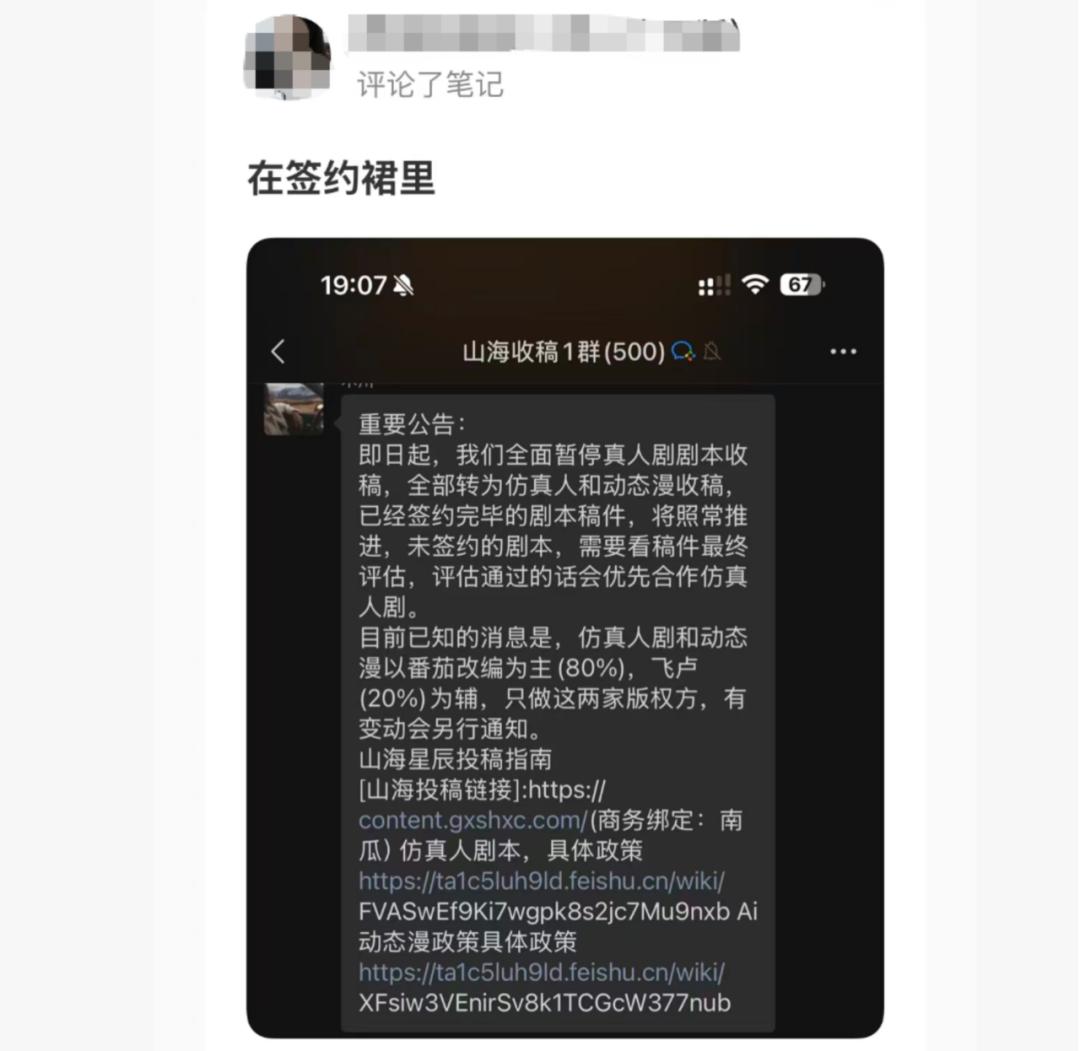
In early March, a message from Shanhai Xingchen's script submission group circulated on Xiaohongshu, stating that the company would fully suspend the acceptance of live-action drama scripts, shifting entirely to realistic AI and animation script submissions. At the same time, 80% of adapted scripts would be based on Tomato IPs, with the remaining 20% using Feilu IPs, sparking widespread discussion among screenwriters.
In April, Shanhai Xingchen announced a strategic partnership with Miwu Culture to produce 1,000 AI dramas; it expanded its AI short drama team, introduced talent-attracting policies such as "chief editors can earn up to 30% revenue share, and senior editors up to 20%", and announced that top-ranked Feilu writers Nanshan and Nanfeng had joined the company. Its self-developed all-in-one AI content creation platform NOVA AI achieved daily promotion spending of tens of millions of yuan on ByteDance's marketing platform, and NOVA AI was positioned by Shanhai Xingchen as a model for reshaping the industry ecosystem.
Everything at Shanhai Xingchen was accelerating forward, but reality shows that when the governance system cannot keep pace with development speed, past "progressiveness" becomes synonymous with "recklessness".
Shanhai Xingchen is not the only short drama platform that neglected internal controls. Since last year, similar negative public opinions have emerged at Jiuzhou Culture and Hongguo.
In May 2025, three people including Liu Jinlong, the former CEO of Jiuzhou Culture's overseas short drama platform ShortMax, were arrested for corruption and fraud, including falsifying costs and embezzling company revenue.
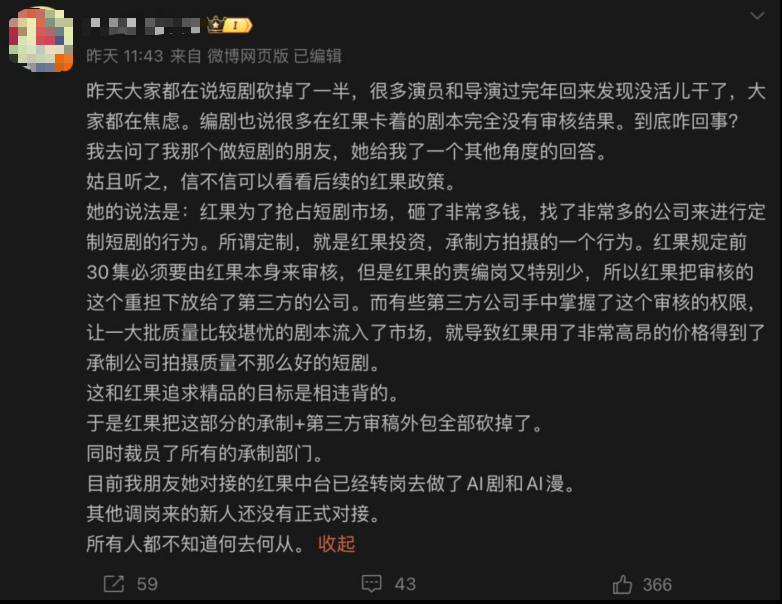
In March 2026, the trending search term "Hongguo has suspended many projects" went viral. It was reported that Hongguo lost over 90% on its 2025 live-action short drama projects, so the platform would suspend live-action drama production and fully shift to AI short dramas. In addition, insiders revealed on Weibo that Hongguo outsourced its script review positions to a third party, leading to a flood of low-quality scripts entering the market. To maintain its premium content positioning, the platform laid off outsourced review staff and production teams, and imposed strict checks on AI-generated scripts, which ultimately caused production halts and made script approval extremely difficult.
The internal control issues at Jiuzhou Culture, Hongguo and Shanhai Xingchen are not isolated corporate cases. The concentrated outbreak of problems such as power rent-seeking, related-party transactions and contract disputes essentially stems from short drama platforms neglecting management while aggressively expanding their business territories.
No matter how industry trends shift or how large a platform grows, only by establishing strict screening mechanisms for core positions, abiding by the non-negotiable bottom line of contract performance, and synchronously iterating expansion strategies with governance capabilities can platforms secure their "safety belt" during rapid business growth.
Back at the center of the controversy, Shanhai Xingchen can pay off overdue remuneration in installments, but rebuilding lost business trust will be far more difficult. Only when governance outpaces expansion and rules override personal connections can the surreal drama at Shanhai Xingchen finally come to an end.
This article originates from the WeChat public account "Gudu Online Film and Television" (ID: guduowlj), authored by the Gudu Editorial Team, and is published by 36Kr with authorization.