powerful, Tsinghua AI Dream Team
In China's AI industry, Tsinghua University is a name impossible to overlook.
Yang Zhilin, founder of Moonshot AI; Tang Jie, founder of Zhipu AI; Wang Chuan, founder of Baichuan Intelligence; Liu Zhiyuan, co-founder of Wall Intelligence... they are either Tsinghua professors or former students of the university.
In another AI track, the field of embodied intelligence, a similar scene unfolds: Chen Jianyu, founder of Starbot; Zhao Mingguo, co-founder of Accelerated Evolution; Gao Jiyang, founder of Nebula Robotics; Wang He, founder of Galaxy Universal... all of them are Tsinghua professors and alumni.
What is even more thought-provoking is the relationships between these individuals.
Yang Zhilin's introductory mentor was Tang Jie, while Liu Zhiyuan's advisor is Professor Sun Maosong of Tsinghua University. Sun Maosong's Department of Computer Science and Technology at Tsinghua counts Zhang Bo, the founding figure of China's artificial intelligence field, among its faculty.
This is not an alumni directory, but a family tree spanning four generations along a single lineage — the story of Chinese artificial intelligence is the story of this very lineage.
01
In the minds of most people, China's AI only became popular in recent years, as if nothing significant happened before that.
But that is not the case at all.
In 1978, Professor Zhang Bo from the Department of Automatic Control at Tsinghua University transferred to the Department of Computer Science, and set a research direction for himself: artificial intelligence and intelligent control.
Shortly after, he launched a new course titled *Introduction to Artificial Intelligence*, and even compiled and printed the teaching materials page by page by combining overseas references.
During his academic visits abroad, Zhang Bo gradually realized that the development of artificial intelligence must rely on mathematical tools to improve algorithm efficiency. So he sought collaboration with Professor Zhang Ling from the Department of Mathematics at Anhui University. The two communicated across the ocean via letters, using the thinnest paper and writing the smallest characters, all to save on postage costs.
In 1984, Zhang Bo and Zhang Ling collaborated to publish a paper in a top international journal in the field of artificial intelligence — this was the first academic paper published by a Chinese scholar in the AI domain. Later, he became the first Chinese scientist to present a paper at the International Joint Conference on Artificial Intelligence.
For many years afterward, AI experienced more than one downturn. In the 1980s, the expert system bubble burst, global AI funding plummeted, and research entered a "winter"; from the 1990s to the early 2000s, neural networks were questioned, and AI was repeatedly dismissed as unpromising. In every winter, some people left the field, some switched tracks, and some believed this path could not lead anywhere.
But Zhang Bo always stayed at Tsinghua, mentoring students and conducting research. He grew from a professor to an academician, staying firmly rooted in the AI field without moving an inch.
In 2015, nearly 80-year-old Zhang Bo proposed the theoretical framework of "Third-Generation Artificial Intelligence" — advocating to combine data-driven deep learning with knowledge-driven symbolic reasoning, to solve the fundamental problems of AI systems being unexplainable, unsafe, and unreliable.
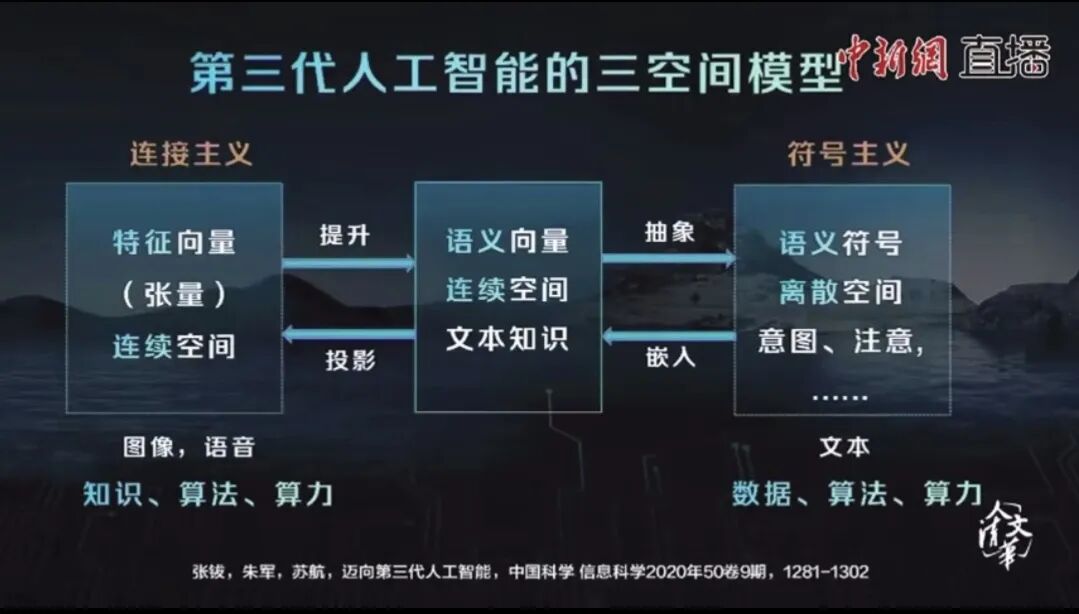
This framework has profoundly influenced many of today's large language models, and is a core principle in AI theory.
02
Zhang Bo planted the root of China's AI, but for this root to grow into a large tree, successors are needed to continue nurturing it.
Professor Sun Maosong from the Department of Computer Science at Tsinghua is exactly that person who watered the tree.
As a senior professor at Tsinghua, Sun Maosong has worked in the computer field for 46 years. If Zhang Bo is the founder of Tsinghua's AI ecosystem, Sun Maosong is the generation that connects the past to the future. The Chinese word segmentation system CSegTag he led the research on is the infrastructure of natural language processing, which is indispensable for all later researchers working on Chinese NLP.
But Sun Maosong's contributions also include his outstanding students he mentored.
For example, Tang Jie, who started his PhD at Tsinghua in 2002, rejected offers from large companies after graduation and stayed on campus to focus on research. He developed an academic search engine called AMiner — using AI to mine relationships in academic networks, tracking who collaborated with whom, who influenced whom, and which research directions were gaining momentum.
This project, seemingly a small tool, possesses the key capabilities of large language models — data mining and knowledge graph.
In 2019, Tang Jie founded Zhipu AI, with a clear goal: to build China's own large language model, benchmarked against OpenAI.
Another example is Liu Zhiyuan, who enrolled in his undergraduate program in 2002. He originally had no decent research experience, no competition awards, and his academic performance was not outstanding, but Sun Maosong recognized his dedicated research spirit and recruited Liu Zhiyuan to his graduate program.
Liu Zhiyuan took a different path from Tang Jie — Tang Jie focused on cloud-based large language models, competing on parameters and computing power; while Liu Zhiyuan's Wall Intelligence develops edge-side large language models, competing on efficiency and real-world deployment.
This tree can continue to branch out and flourish.
While Tang Jie was teaching at Tsinghua, he mentored a student named Yang Zhilin. From how to identify important research problems, find perspectives to solve them, conduct experiments, write papers, to give presentations — Tang Jie personally taught Yang Zhilin all the foundational skills for scientific research.
Later, Yang Zhilin went to Carnegie Mellon University to pursue his PhD, studying under leading AI experts from Apple and Google. After that, he returned to China to found Moonshot AI, and developed the Kimi chatbot.
From Zhang Bo to Sun Maosong, then to Tang Jie and Liu Zhiyuan, and on to Yang Zhilin. From 1978 to 2026, four generations spanning 48 years. Every generation has stood at the frontier of AI, and every generation has pushed the field one step forward.
03
The Tsinghua AI ecosystem has grown into a towering tree, thanks to not only the continuous passing of the torch, but also three key advantages.
First, professors personally engage in entrepreneurship.
Tang Jie founding Zhipu AI is not a case of "professors leaving their positions to start businesses". Instead, as a Tsinghua professor, he directly incubated the company with his academic research achievements. The foundation of the GLM model is the research accumulation he built at Tsinghua; Zhipu AI's core team is the original team from the AMiner project.
The same is true for Liu Zhiyuan and Wall Intelligence. He is still an associate professor in the Department of Computer Science at Tsinghua, while co-founding Wall Intelligence, balancing his academic identity and entrepreneurial role.
In the field of embodied intelligence, Zhao Mingguo, founder of Accelerated Evolution, is a professor in the Department of Automation, who began researching bipedal robots as early as 2000.
Chen Jianyu, founder of Starbot, remains an assistant professor at the Institute for Interdisciplinary Information Sciences. His company was incubated within the institute, making it the only embodied intelligence enterprise in which Tsinghua University holds shares. Achievements from the lab can be directly transformed into the company's products.
This is not very common in China's science and innovation landscape.
In most fields, there is a "valley of death" separating academia and industry — professors conduct research and publish papers; students graduate and join companies; companies take ideas from papers and slowly develop products. The gap between them can take several years or even more than a decade.
In the field of artificial intelligence, Tsinghua has directly filled in this valley. Professors do not need to leave their positions, research achievements do not need to be formally transferred, and doctoral students can directly join projects. Papers can be published today, and the corresponding model can be launched tomorrow — there is almost no time lag between the academic frontier and commercial deployment.
This is one of the reasons why Tsinghua-affiliated AI enterprises develop so rapidly — Zhipu AI was founded in 2019 and now has a market value of 900 billion Hong Kong dollars, while Moonshot AI reached a valuation of 30 billion US dollars in just three years.
This is not only driven by capital, but also because the distance from laboratory technology to products has been compressed to the extreme.
Second, a top-tier talent echelon.
In 2005, Turing Award winner Yao Qizhi returned from Princeton University and founded the Tsinghua School of Computer Science Experimental Class, commonly known as the "Yao Class".
The positioning of the Yao Class is straightforward: to cultivate top-notch talents with competitiveness equal to or even higher than undergraduates from MIT and Princeton. In 2019, Yao Qizhi established the "AI Class" — the artificial intelligence experimental class, dedicated to cultivating leading talents in the AI field. In 2022, the Yao Class, AI Class, and Quantum Information Class under the Institute for Interdisciplinary Information Sciences merged, offering three tracks: computer science, artificial intelligence, and quantum information.
Over 20 years of the Yao Class, 7 years of the AI Class, the Institute for Interdisciplinary Information Sciences has nurtured more than 750 undergraduates and 237 doctoral students.
This number may not seem large, but the talent quality is extremely high. Students from the Yao Class were top performers in provincial informatics competitions before enrollment, and received world-class research-oriented training after enrollment, making them the most elite seeds of China's AI field.
Third, a seamless transformation mechanism.
In December 2020, the Tsinghua University Institute for Intelligent Industry Research (AIR) was established, with Zhang Yaqin, former Microsoft executive and foreign academician of the Chinese Academy of Engineering, serving as its dean.
Zhang Yaqin, who has witnessed the cutting edge of the industry, did not return to Tsinghua just to teach — he came to build bridges.
The positioning of AIR is clear: to empower industrial upgrading with artificial intelligence technology. It is not a traditional laboratory, nor an incubator, but a "revolving door" between the two — university professors can conduct industry-level research here, enterprises can access cutting-edge academic technologies here, and doctoral students can work on both their papers and product development at the same time.
Some people ask online: why can Tsinghua gather so many top talents in the artificial intelligence track?
There are many respondents, but several reasons are impossible to ignore.
The first is academic inheritance. Since Zhang Bo set the AI research direction in 1978, the academic heritage of generations has never been broken. Zhang Bo established the theoretical framework, Sun Maosong built NLP infrastructure, and Tang Jie developed knowledge graphs — every generation has stayed at the research frontier, and the core direction has never been lost.
The second is technical accumulation. CSegTag, AMiner, GLM — decades of accumulated technical foundation allowed Tsinghua to avoid starting from scratch when the large language model boom arrived. While others were still figuring out the right direction, Tsinghua researchers were already moving forward on that path.
The third is industrial integration. Professors can engage in both academic research and commercial activities at the same time, laboratories can incubate enterprises, and Tsinghua can hold shares in these companies. AIR has institutionalized this industry-university-research mechanism, compressing the distance from laboratory technology to products to the shortest possible length.
These three reasons allow Tsinghua's AI lineage to continue unbroken, constantly expanding its reach.
The AI field has experienced countless reshuffles. The expert system bubble burst, neural networks were dismissed as unpromising, deep learning rose unexpectedly, and large language models disrupted everything — in every paradigm shift, some were eliminated, some fell behind, and some had to start all over again.
When the industrial chain breaks, people have to reorient themselves, rebuild accumulation, and restart from zero. Many fields in China are in this situation — after a decade of catching up, the direction changes and all previous efforts are wasted.
But Tsinghua's artificial intelligence field has no such regret. There are always people staying in the game. As long as people are there, the position is retained; as long as the position is there, accumulation continues.
This is why China's AI can compete on the same stage as OpenAI — not only because computing power has caught up, and not just because capital has poured in, but because for over 40 years, there have always been people refusing to leave the table, and new people constantly joining in. This Tsinghua AI table has never been empty for 48 years.
This article is from WeChat Official Account "Huashang Taolue" (ID: hstl8888), author: Huashang Taolue, published with authorization from 36Kr.