What is Liang Wenfeng's view on talent behind the conflict between Huawei's "Genius Young Man" and DeepSeek?
Li Bojie, a graduate of the University of Science and Technology of China's Young Class and one of Huawei's first batch of "Genius Youths" with countless impressive credentials, hit a wall during his interview at DeepSeek.
Li Bojie posted online that after passing the written test, the process was put on hold for half a month, and the interview was only arranged after repeated follow-ups. During the interview, the DeepSeek interviewer suspected Li Bojie of copying code. Feeling offended, Li Bojie terminated the interview on the spot.
Putting aside the debate over who was right or wrong in this incident, public attention has once again been drawn to DeepSeek's talent recruitment practices.
Since its financing stage, talent has always been a core keyword for DeepSeek. However, the dramatic conflict of Li Bojie's case has attracted more public scrutiny on the company's talent issues.
With the explosive popularity of DeepSeek-v3 and R1, many of DeepSeek's core members have been poached. Just recently, the DeepSeek-V4 technical report included a list of nearly 300 R&D authors at the end.
Ten people on the list were marked as "Left the Company". Most companies usually downplay former employees when publishing papers, but DeepSeek explicitly marked their departures.
These departed employees cover four core technical tracks of DeepSeek: foundational models, inference, multimodality, and OCR.
Fortunately, while some top talents have left DeepSeek, new outstanding talents have also joined. For example, Cui Tianyi, a fellow alumnus of Liang Wenfeng, joined DeepSeek and launched a widespread talent recruitment drive, bringing in a large number of skilled professionals for the company.
DeepSeek plans to double its talent pool. So how exactly will they recruit? What kind of talents are they looking for? Let's break this down step by step.
Immediately Launching Massive Recruitment After Securing 50 Billion Funding
Nine days after the funding arrived, late at night on June 25, DeepSeek simultaneously released a recruitment announcement across multiple platforms including WeChat Official Accounts and Xiaohongshu.
The announcement stated: "Humanity is currently on the eve of AGI. Join DeepSeek, experience the development of AGI firsthand, sit in the front row of the era, and witness the birth of a new epoch. As technology evolves, we are striving to expand the scale of all departments by at least double."
According to data from relevant recruitment platforms, DeepSeek currently has 121 open positions. This recruitment scale is notably large even when compared to industry giants like Tencent and ByteDance.
This recruitment covers 33 positions across 7 categories, with work locations in Beijing and Hangzhou, and all positions accept interns. The roles range from underlying supercomputing cluster R&D, high-performance operators/compilers, large model training/inference frameworks, high-performance distributed storage, all the way to server-side development engineers, pre-training data engineers, and AI search algorithm/architecture engineers.
Moving up the model stack, the key recruitment focus this time lies in the Agent Harness team, as well as frontend/client-side development engineers.
Apart from these highly AI-related positions, there are even data product managers specialized in professional fields such as law, medicine, and minority languages. Even functional departments including HR, legal affairs, finance, and administration are set to expand.
There is also a special position called "Cross-Disciplinary AI Technical Talent", targeted at candidates who "possess extraordinary abilities and aspire to participate in creating and building AGI". There are no restrictions on academic backgrounds, and bonus points include "thinking outside the box", "reaching ultimate excellence in a certain field", and "having entrepreneurial experience".
This indicates that DeepSeek has evolved from a small laboratory into a formal AI company.
However, the flip side of large-scale recruitment is that DeepSeek is facing talent outflow.
From the second half of 2025 to the first half of 2026, at least 5 core R&D members of DeepSeek have confirmed their departures.
Gu Daya, a core researcher of DeepSeek-R1, joined ByteDance's Seed team; Wang Bingxuan, the core author of the first-generation large model, joined Tencent's Hunyuan team; Luo Fuli, an early DeepSeek member, was personally poached by Xiaomi founder Lei Jun with an annual salary in the tens of millions, to serve as the head of Xiaomi's MiMo large model. In addition, Wei Haoran, Ruan Chong and others have also left the company one after another.
Talent outflow is only part of the issue. To compete for top talents, large tech corporations rely on their abundant capital to offer sky-high salaries to these young professionals.
For example, ByteDance's "Top Seed" program has seen its graduate recruitment salary rise from around 1.5 million RMB in 2024 to 3 million to 5 million RMB in 2025, with some core positions in 2026 exceeding 6 million RMB. Tencent has its "Qingyun Plan", and Alibaba has its "Alibaba Star", both of which have adopted slogans like "Uncapped Compensation" and "No Upper Limit" in their recruitment promotions.
Clearly, this is not favorable for DeepSeek.
Additionally, in DeepSeek's systematic organizational expansion drive, the most notable highlight is not any specific position, but a person - Cui Tianyi.
Cui Tianyi is the head of DeepSeek's Harness team. The Harness team was newly established in March this year, focusing on R&D for code agent products, following a simple formula: "Model + Harness = Agent".
In reality, the scope of Harness is very broad. When building Agent products, all supporting work outside the model itself falls under the Harness category. This team aims to compete with Anthropic's agent programming tool Claude Code, by developing "DeepSeek Code Harness".
So how does Cui Tianyi recruit talents for this team?
He frequently posts recruitment information on X (formerly Twitter), expanding the open positions from 2 categories to 3: researchers, R&D engineers, and product managers, with the researcher position being newly established for the first time.
Even more so, whenever Cui Tianyi sees someone posting opinions related to Agent or Harness on X, he will leave a comment under that post, asking if the person is interested in submitting a resume.
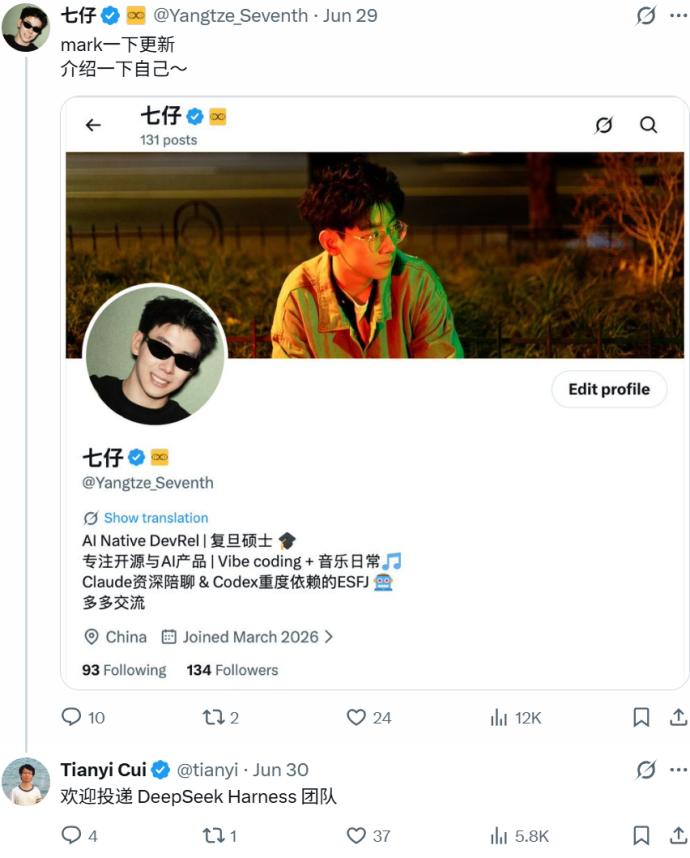
Cui Tianyi stated that "the department is still severely understaffed, and I am conducting interviews every day", adding that he is "posting recruitment notices everywhere like small ads". He also mentioned that after over a month of continuous recruitment, the team still hasn't filled all positions.
Cui Tianyi's recruitment strategy has several notable features.
First, no nationality restrictions, only requiring the ability to work in Chinese.
Second, no rigid requirements for work experience. Taking the Agent Harness R&D Engineer position as an example, the top priority is "excellent technical skills and broad technical vision", rather than a set number of years of experience.
Third, the newly established researcher position requires candidates to have at least 2 years of research experience, have published papers in top computer science conferences, and be capable of independently completing the full research process from problem definition to prototype verification. The job description specifically emphasizes the dual standards of "research taste" and "engineering implementation ability".
As Business Evolves, Recruitment Requirements Change
To understand why DeepSeek is launching large-scale recruitment at this moment, we cannot only look at how much funding it has raised, but also examine the ongoing changes in its business.
The release of the V4 series models, the launch of the image recognition mode, the establishment of the Agent Harness team, and the introduction of peak-valley pricing for APIs - these changes are worth mentioning, but what truly deserves in-depth analysis is how they have reshaped DeepSeek's talent needs.
A headhunter who served DeepSeek in mid-2025 once said: "Over the past year, DeepSeek's recruitment standards have undergone subtle changes. Last year, the requirements were relatively broad, as long as candidates had outstanding resumes. But this year, many positions explicitly require in-depth expertise in a specific niche direction."
How specialized are these requirements exactly? Let's break down DeepSeek's recruitment announcement in detail.
Take the deep learning researcher position for example. Last year, when DeepSeek recruited researchers, the requirements were relatively general - having experience working on large models and publishing papers would suffice. But this year, the researcher positions have been split into at least four specialized tracks: LLM pre-training, alignment, code/math reasoning, and multimodality.
The reason is not hard to guess: the increasing technical complexity is driving the division of labor.
In the past, models were simpler, so a single researcher could follow the entire development process of a model from start to finish.
But now, pre-training (Base Model) → post-training (SFT/RLHF/GRPO) → alignment (safety + usefulness) → specialized capabilities (reasoning/code/multimodality) - each stage has completely different methodologies, evaluation systems, and data pipelines. No single person can possibly master all of these domains.
The V4-Pro has a total of 1.6 trillion parameters, yet its inference computing power consumption is only 27% of its predecessor V3.2, and KV Cache usage is reduced to 10%. This level of efficiency is not achieved by simply adding more GPUs, but through optimized training strategies and data ratios. Recruiting specialized talents is necessary to continue advancing this path.
As for R1, its core breakthrough is abandoning human demonstrations, and relying entirely on the reinforcement learning loop of "solving problems - receiving rewards - solving problems again" to let the model develop its own reasoning chains. However, R1 only marks the starting point for designing reward models on this path, so talents specialized in alignment are needed to further advance this direction.
There is no need to elaborate further on code/math capabilities, as they are currently the top priority across the entire industry and the foundation for all Agents. In fact, Gu Daya, who recently left DeepSeek, was conducting research in this exact field.
On June 18, DeepSeek launched its image recognition feature, marking its first public announcement of native image understanding capabilities. Next, the V4.1 is planned to integrate the ViT-22B image encoder.
Therefore, recruiting talents specialized in multimodality is also a necessary step.
Looking at the Agent Harness team, as mentioned earlier, its product is positioned to compete with Anthropic's Claude Code.
As previously noted, the team emphasizes both research taste and engineering implementation. "Research taste" refers to not just chasing benchmark scores, but focusing on solving real-world bottlenecks.
The team prioritizes solving problems that "users encounter every day but the academic community has not seriously studied", such as context loss in long tasks, high failure rates in tool calling, and error accumulation in multi-step reasoning.
This is why the position requires candidates to be familiar with context management, long-term memory architectures, multi-Agent collaboration, and tool calling orchestration.
"Engineering implementation ability" is relatively straightforward to understand: candidates cannot only publish papers, but must also be able to turn research results into deployable products.
However, this "wanting both" requirement directly filters out a large number of candidates with purely academic backgrounds.
The most notable position in this recruitment drive is the aforementioned "Cross-Disciplinary AI Technical Talent". This is essentially a talent pool position, specifically designed to recruit people with non-traditional academic backgrounds but exceptional natural talents.
There are no restrictions on academic backgrounds. After joining the company, candidates will be matched to the most suitable research or engineering team based on their interests and abilities.
There are only four mandatory requirements: genuine long-term passion for AI with practical actions and proven results (not just empty talk); strong hands-on skills and learning ability, independent thinking rather than following trends; basic programming skills; and a good educational background.
For example, talents who study how the human brain learns and remembers can provide inspiration for improving model architectures and training methods.
Last but not least, DeepSeek has begun recruiting a large number of traditional software engineering roles. In the June 25 recruitment announcement, positions such as server-side development engineers, frontend/client-side development engineers, and test engineers are clearly listed, without using vague concepts like "AI Full-Stack Engineer".
Because to deliver a usable product, proper frontend and backend engineers are needed to build the user interface, and test engineers are required to ensure the system runs without bugs.
Currently, AI programming cannot fully replace professional engineers in commercial product development. To stably deliver a commercial-grade product, human engineers are still indispensable. DeepSeek has frequently experienced server outages, which requires engineers to optimize the system - handling high-concurrency services, ensuring stable operation of distributed systems, and refining the frontend user experience.
Liang Wenfeng Serves as Both CEO and CTO
Liang Wenfeng is different from other CEOs. He has deep technical expertise and actively participates in DeepSeek's research work.
On September 17, 2025, DeepSeek-R1's paper became the first large language model paper in the world to undergo independent peer review and appear on the cover of the main issue of *Nature*, with Liang Wenfeng as the corresponding author.
The magazine made a rare editorial comment: "In an AI industry flooded with unsubstantiated claims, DeepSeek has taken a commendable step toward transparency and reproducibility."

Apart from that, Liang Wenfeng actively participates in the team's research work.
In 2025, Yuan Jingyang, a PhD student from the School of Computer Science at Peking University, interned at DeepSeek. As the first author, he published the paper *Native Sparse Attention* (NSA), which won the ACL 2025 Best Paper Award.
Although researchers from Peking University and the University of Washington jointly participated in this paper, Liang Wenfeng himself was the corresponding author.
Liang Wenfeng has his own unique philosophy on talent recruitment. In a 2023 interview, he stated: "One of our recruitment principles is to prioritize ability over experience. Our core technical positions are mainly filled by new graduates or people with only 1-2 years of work experience."
"Experienced people will directly tell you 'this is how it should be done', but inexperienced people will repeatedly explore and find solutions that fit the actual current situation."
A new graduate who interviewed at DeepSeek mentioned that the interview process exceeded 6 rounds, including on-site coding, system design, and paper reproduction. Multiple new graduates who participated in interviews stated that the interviewers asked extremely detailed questions - not just discussing broad directions, but digging into specific experimental details. The interviewers would keep asking follow-up questions about the candidate's mentioned papers until the candidate could no longer answer, to verify whether the candidate had truly conducted the research work.
Large tech companies typically have 4 rounds of interviews: 1 round of algorithm written test, 3 rounds of interviews (technical interview → system/research interview → final interview). Even if researcher positions add 1-2 additional cross-interviews, interviews exceeding 6 rounds are extremely rare.
The interview process for DeepSeek and ByteDance's large model positions are completely different. ByteDance's recruitment starts immediately with coding challenges, no discussion of papers, with extremely high requirements for speed and code cleanliness.
Only after passing the coding and algorithm thresholds will they discuss model-related topics, such as the underlying principles of transformers, training and inference details, distributed training, etc. Finally, they will evaluate the candidate's business and engineering implementation capabilities.
ByteDance's recruitment preference is that top conference papers are a bonus, not a mandatory requirement. The ability to write, run, and deploy working code is more important. The company particularly values system optimization and engineering architecture capabilities, after all, ByteDance has one of the largest large model training and inference scales in China.
Tencent's recruitment positions are even more specialized than DeepSeek's. For example, large model algorithm positions are split into: post-training (SFT/RLHF/GRPO), fine-tuning & RAG, Agent scheduling and task planning, Tool Use / Function Calling, Long Context modeling, Memory systems, and Agentic RL.
Tencent also highly values practical deployment experience - whether candidates have tuned models and improved performance metrics in real business scenarios, these are all mandatory requirements.
Liang Wenfeng's role is very reminiscent of