Valuation Soars to 82 Billion, the World's Largest Unicorn in Life Sciences Changes Hands
The story of a new king dethroning the old one plays out every day, and this time it is OpenEvidence's turn to take the crown.
According to the Global Unicorn Index 2026 recently released by the Hurun Research Institute, OpenEvidence — an AI research platform focused on delivering decision support to clinicians — has claimed a corporate valuation of 820 billion RMB (approximately 120 billion USD), surpassing anti-aging pharmaceutical firm Biosplice Therapeutics in one move and becoming the highest-valued unicorn in the global life sciences sector.
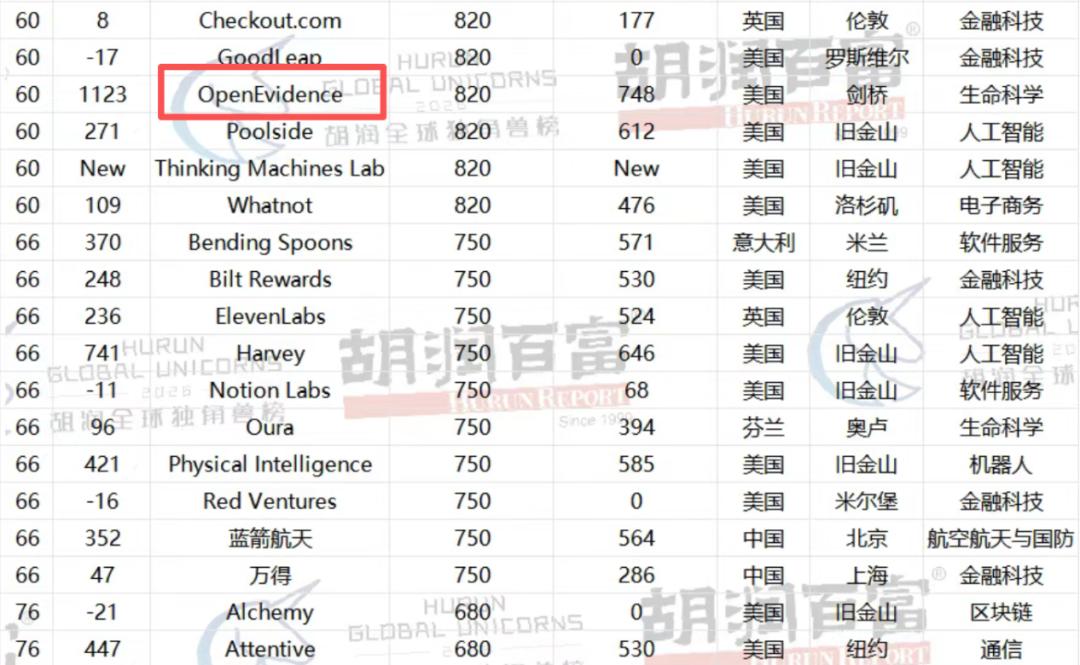
Image source: Hurun Report
The valuation surge has been remarkably abrupt. OpenEvidence's $120 billion valuation stems from its Series D funding round completed this January, while just three months prior, its valuation stood at only $60 billion. For a cutting-edge medical startup founded merely four years ago, this pace is more than enough to draw widespread attention.
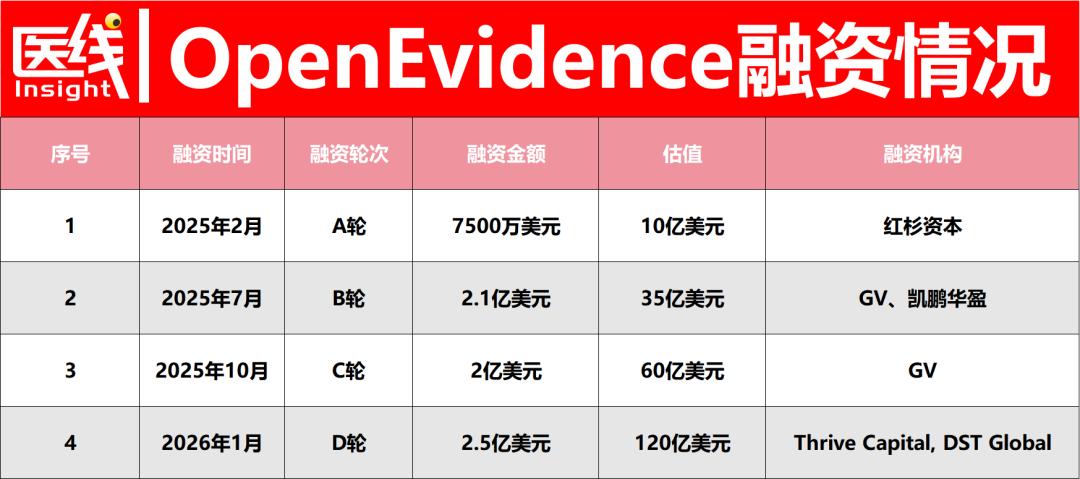
Data source: Crunchbase
Beyond its standout performance in the primary market, OpenEvidence now boasts over 40% coverage among physicians in the United States, ranking it as one of the fastest-growing AI medical platforms by user count across the country.
Public records show OpenEvidence currently serves more than 757,000 verified physician users. Between July and November 2025, its average monthly clinical consultation volume rose from 10 million to 16.5 million, with steadily growing user engagement and retention.
So how exactly did OpenEvidence pull off all this?
01
Its Sky-High Valuation
What Sustains It?
At its core, OpenEvidence delivers one single function: helping physicians look up information.
But never underestimate this capability. It resolves the efficiency paradox in clinical knowledge retrieval — where resources are "findable but unfinishable to read, or finishable to read but unusable" — freeing physicians from the quagmire of information overload and building a high-value attention hub at the critical moments when they make clinical decisions.
It is well known that the explosive growth of medical knowledge is overwhelming clinicians. In a 2011 paper, Dr. Peter Densen, a professor at the Carver College of Medicine at the University of Iowa, noted that the doubling cycle of medical knowledge had shrunk from roughly 50 years in 1950 to about 3.5 years by 2010, and predicted it would compress to as little as 73 days by 2020.
For frontline physicians racing against the clock, keeping up with every piece of cutting-edge literature is an almost impossible mission.
Meanwhile, traditional tools suffer from delayed updates and clunky interactions; general-purpose large language models, while convenient, face the fatal risk of "hallucinations" in rigorous medical scenarios.
OpenEvidence precisely targeted this pain point.
Specifically, it avoided the parameter arms race of general large models and instead took a more "methodical" yet far more reliable path: training its vertical specialized model on millions of peer-reviewed authoritative medical publications, and requiring precise original citations for every output conclusion, achieving essentially "zero hallucinations".
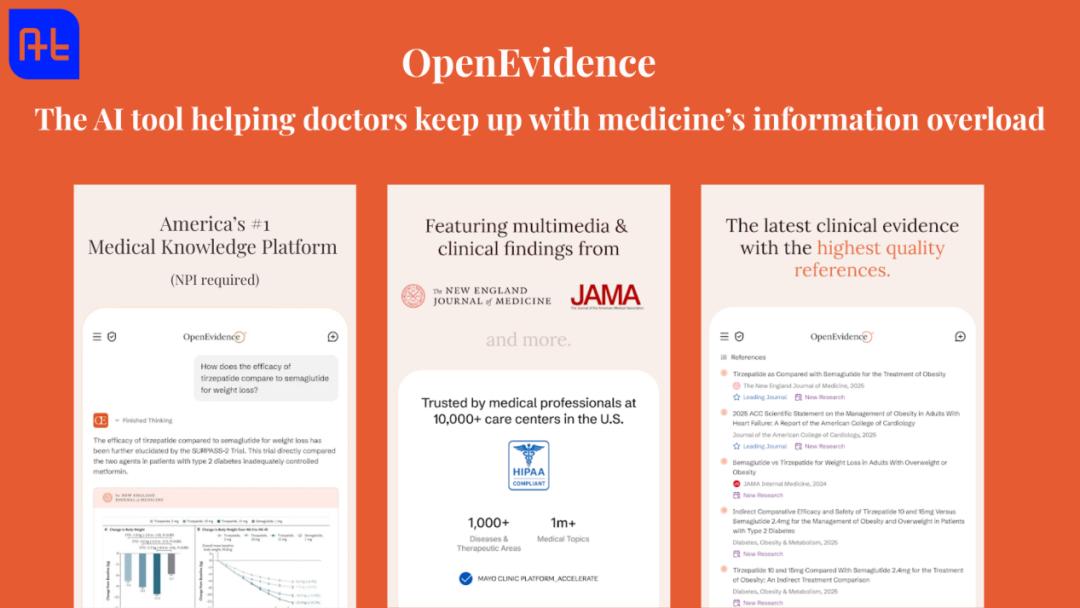
Image source: OpenEvidence official website
To build content moats, OpenEvidence has not only secured exclusive content licensing with top journals and databases such as the New England Journal of Medicine (NEJM), JAMA, Wiley, and Cochrane, but also established deep partnerships with leading global specialty medical associations including the American College of Cardiology (ACC), the National Comprehensive Cancer Network (NCCN), and the American Diabetes Association (ADA).
Data backs this up: in a large-scale independent evaluation published in Nature Medicine in 2026, OpenEvidence achieved 89.6% accuracy on 500 U.S. Medical Licensing Examination (MedQA) questions, matching the performance of clinical decision support benchmark UpToDate (88.4%).
More critically, in multiple targeted tests for citation authenticity, OpenEvidence's fabricated citation rate was 0%, while the citation hallucination rate of general large models in the same period generally ranged between 20% and 85%.
This is exactly why it has earned the deep trust of U.S. clinicians, reaching over 40% of practicing physicians nationwide in a short time while maintaining extremely high usage frequency — with nearly 30 million monthly consultations and interactions.
Typically, after building such a massive and highly engaged user base, OpenEvidence could have adopted a standard business model of charging subscription fees to physicians or hospitals. Instead, it blazed a unique trail: offering free access to physicians, and selling precisely targeted ad slots directly to pharmaceutical and medical device manufacturers.
This may seem like "choosing the hard path over the easy one", but its strength lies in forming a closed service loop of "acquiring users via free tools — monetizing traffic in precise scenarios". Leveraging the nation's largest real-world clinical decision data stream, it accurately identifies physicians' actual medication preferences, prescribing habits, and unmet needs during diagnosis and treatment, delivering a far more efficient, compliant, and higher-ROI precision marketing channel for pharma and device companies than traditional in-person visits by medical representatives.
According to reports, on the commercial front, OpenEvidence's ad business already generates $50 million in annual revenue, with projected 2026 revenue set to exceed $100 million.
Clearly, its business logic has gained broad market recognition, and the platform is rapidly entering a phase of large-scale expansion.
Therefore, OpenEvidence's closed service loop — which uses clinical trust as a moat, translates its "zero-hallucination" technical edge into high-retention user assets, and realizes monetization through targeted scenarios — is the underlying rationale why capital markets are willing to support its lofty valuation.
02
The "OpenEvidence" Model
Can It Thrive in China?
In fact, OpenEvidence's distinctive business model is not entirely without a foothold in China, but fully replicating it would require crossing several formidable, deep-seated chasms.
The first chasm lies in the systemic differences between Chinese and U.S. healthcare systems.
In China, clinicians' decision-making logic relies not only on clinical guidelines, but also heavily on practical experience from higher-tier hospitals and in-hospital training systems, where AI tools primarily serve as an "auxiliary" function. This fundamentally differs from the U.S. system, where physicians hold full, independent clinical decision-making authority.
Thus, to build an equally high-value clinical decision-based hub in China, OpenEvidence's "zero-hallucination" technical advantage is merely an entry ticket. What matters far more is whether it can successfully integrate into Chinese physicians' unique "in-hospital workflows", and even achieve deep interoperability with electronic medical record systems — which places extremely high demands on localized product adaptation.
Across the entire AI healthcare industry, "integrating with electronic medical record systems" is also the key priority OpenEvidence is currently pursuing, which further confirms the critical need for AI to embed into in-hospital workflows.
Entering 2026, OpenEvidence has moved beyond standalone web portals or mobile apps to launch "DeepConsult", a multi-step reasoning agent purpose-built for physicians. It has since been fully embedded into the Epic electronic medical record systems of Sutter Health, Mount Sinai, and Cedars-Sinai.
In real-world deployment at Cedars-Sinai, the system can even directly access patients' real-time historical surgical records, complications, medication histories, and allergy profiles to deliver deeply personalized, evidence-based matching.
This demonstrates that, whether in China or the U.S., AI medical solutions will hit a deployment ceiling without underlying system-level integration.
The second chasm is the mismatch between payers and decision-making authority.
In China's healthcare system, procurement decision-making power rests primarily with hospital administrators or health authorities, while physicians mostly act as end users with no direct product purchasing authority or budget control — a system structure fundamentally different from the U.S. framework OpenEvidence operates within.
Furthermore, under the current domestic push for healthcare regulatory compliance, OpenEvidence's model of "precision ad targeting" based on clinical decision scenarios could easily cross the policy red line of "disguised benefit transfer" in China, creating unnecessary exposure to regulatory penalties.
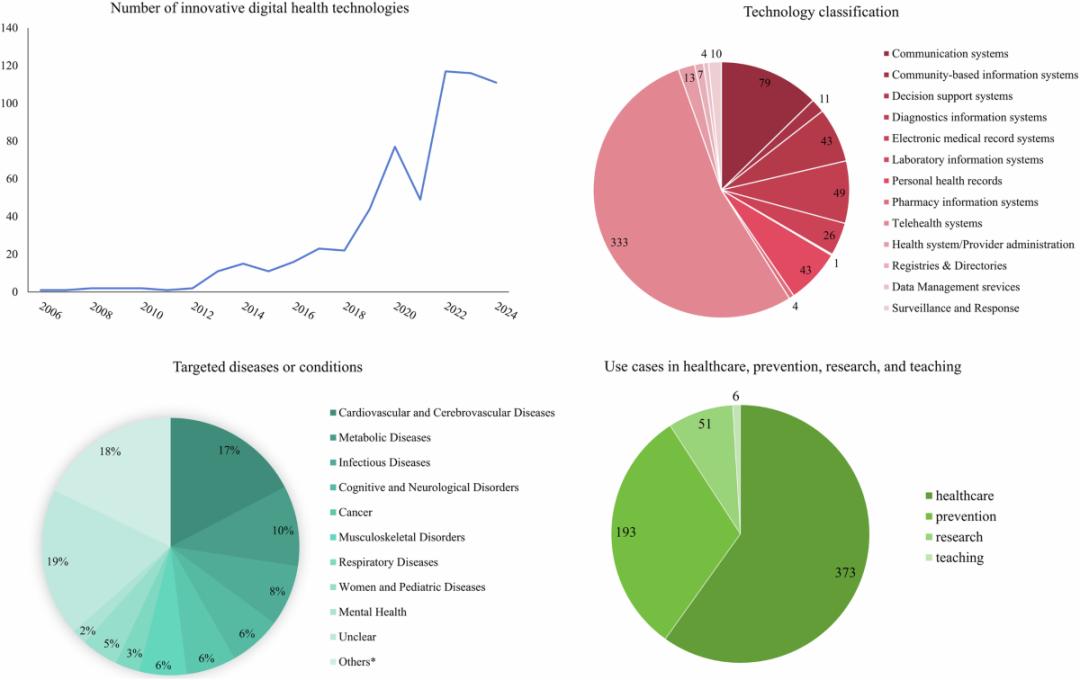
China's Digital Health Governance Data Chart. Image source: Nature Partner Journal
The third chasm is the difficulty of building data moats.
Another major moat for OpenEvidence is its access to the U.S.'s largest real-world clinical decision data stream, which allows it to precisely identify physicians' medication preferences, prescribing habits, and unmet needs.
But in China, the ownership, circulation, and utilization of healthcare data are subject to strict regulatory oversight, and the problem of data silos in hospital information systems is particularly acute — 85% of pharma companies remain trapped in data silos, and only 12% have achieved full-channel data interoperability.
This means OpenEvidence's core "data flywheel" effect would face major hurdles operating in China.
The final chasm is the mismatch between user habits and willingness to pay.
"Free-to-use" models are already ubiquitous in China's healthcare sector, with countless competing platforms and software offerings. This makes it far harder to build a massive user base and high user loyalty via the "free" approach as OpenEvidence did in the U.S.
On the willingness-to-pay front, while China's pharmaceutical digital marketing market is growing rapidly — with an estimated size of 1.486 trillion RMB in 2026 and a projected 4.776 trillion RMB by 2030 — the track is already extremely crowded, making differentiation an enormous challenge.
So does this mean the "OpenEvidence" model has no viable path in China? The answer is no.
For one, while the exact OpenEvidence model cannot be directly copied, it delivers valuable insights to China's AI healthcare peers: the core of the business lies in a product philosophy rooted in clinical trust, evidence-based certainty as a moat, and physician workflows as the entry point — with "free access + advertising" being just one monetization method for this framework.
Thus in China, this path is more likely to evolve into a new paradigm of "evidence-based agents + multi-agent collaboration". As many platforms are already exploring, tools will upgrade from simply answering questions to evidence-based collaboration systems that can handle complex tasks, visualize reasoning processes, and ensure full end-to-end traceability.
On the commercial front, the Chinese version of "OpenEvidence" will likely move beyond the single model of "selling ad slots to pharma companies", and instead adopt a diversified hybrid model: "free basic features + premium decision support subscriptions + compliant digital marketing for pharma + real-world evidence (RWE) research services". Within compliance boundaries, this framework translates physician attention value into measurable, traceable, and auditable marketing ROI for pharmaceutical partners.
Quite tellingly, this "diversified combined strategy" is exactly the commercial evolution path OpenEvidence is currently pursuing. With deep integration into EHR systems, OpenEvidence is rolling out enterprise-level subscription models to charge seat licensing fees to large healthcare institutions — a move projected to increase ARPU per customer by 5 to 10 times.
Meanwhile, OpenEvidence recently announced a strategic partnership with Veeva Systems, the global leader in life sciences cloud platforms, to co-develop the "Open Vista" platform, formally expanding its business into high-value B2B domains such as clinical trial patient matching and drug discovery intelligence.
It is clear that evolving from frontline physician decision support to empowering the underlying life sciences infrastructure is the ultimate path to closing the full AI healthcare commercial loop.
Overall, China is home to the world's largest physician population and richest clinical data resources, and the demand for AI-powered clinical decision support will only be more urgent than in the U.S.
But in this market, technology alone cannot determine success or failure; the decisive competitive edge will belong to the first player that finds the narrow path between "evidence-based credibility" and "commercial sustainability" — a path that aligns with the realities of China's healthcare system and navigates through evolving regulatory cycles.
03
AI Healthcare Is Booming
But Grounded Execution Remains Essential
Undoubtedly, AI healthcare is currently at an unprecedented inflection point.
OpenEvidence's meteoric rise, the frenzy of capital investment, and sustained policy tailwinds are all pushing this sector into the global spotlight.
Yet beneath the hype, we need to take a measured view: as the fanfare of proof-of-concept demonstrations fades away, whether a company can establish deep roots in real clinical scenarios will be the make-or-break factor for survival.
Currently, the universal challenges facing AI healthcare are concrete and granular — from breaking down data silos to embedding into physician workflows; from building credibility for evidence-based outputs to developing a commercially viable business model within regulatory boundaries. There are no shortcuts to these problems, and "storytelling" alone will not solve them. Companies must stay focused and methodically tackle these hard challenges one by one.
And OpenEvidence's story tells us that beyond technical moats, what matters more is building clinical trust; beyond business model innovation, the underlying driver is deep understanding of, and adaptation to, the realities of the healthcare system.
Thus, for Chinese AI healthcare enterprises, this market boasts the world's largest physician base and richest clinical data resources, with far more urgent demand and broader room for growth than many imagine.
But opportunities never favor speculators — the player that first strikes a balance between "evidence-based credibility" and "commercial sustainability", and builds a true value loop that respects the unique characteristics of China's healthcare system, will be poised to become the next industry paradigm-defining leader.
The second half of the AI healthcare race has only just begun. By staying focused and tackling the difficult yet meaningful work, the greatest breakthroughs in China's AI healthcare space will belong to the enterprises willing to slow down, dig deep, and deliver real value.
This article originates from WeChat Official Account "Medline Insight", authored by Ke Lan, and is republished with authorization from 36Kr.