Trump's annual income is 2.2 billion U.S. dollars, two-thirds of which comes from cryptocurrency, and he places an average of 87 stock transactions per day.
How much does the President of the United States earn in a year?
Before Trump, this figure was usually $400,000, which is the statutory basic annual salary for the president; there was also an additional $50,000 annual allowance, a $100,000 tax-free travel subsidy, and a $19,000 entertainment expense stipend. Perks tied to the office also include the presidential limousine, Marine One helicopters, Air Force One aircraft, and free residence in the White House.
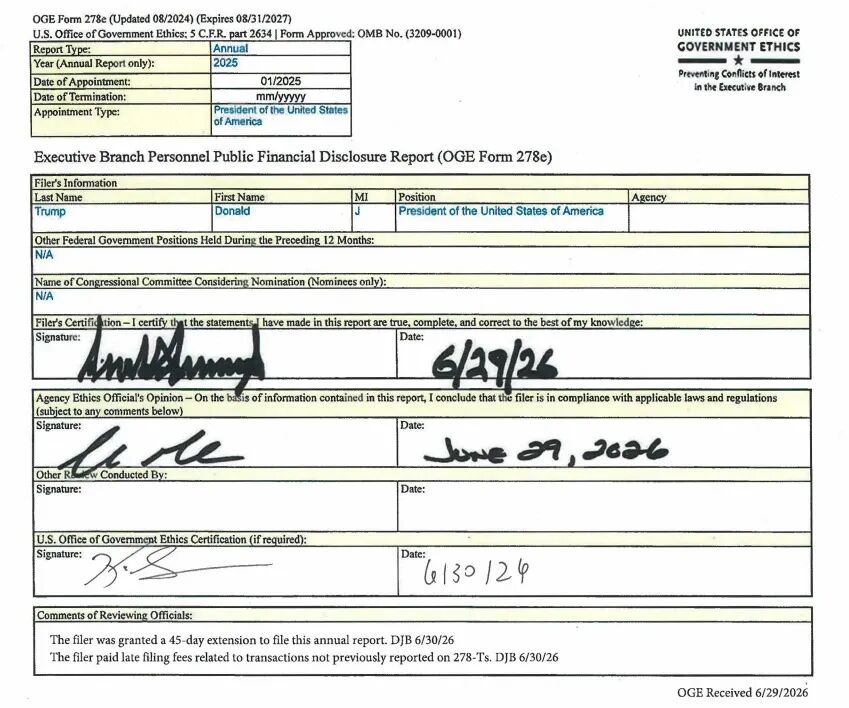
But "usual" has never been a word that describes Trump — recently, according to Trump's annual financial disclosure documents released by the U.S. Office of Government Ethics, Trump's personal income in 2025 exceeded $2.2 billion, setting the record for the highest annual income in any U.S. presidential term.
This 927-page document clearly outlines the business empire centered on Trump as the core of power.
Trump's "Power-to-Profit Playbook":
Earning $1.4 Billion from Cryptocurrencies, with BTC and ETH Holdings Worth Over $100 Million
For Trump, who has served two terms as U.S. president, the $400,000 basic salary has long been beneath his notice, and he has twice rejected the presidential paycheck.
Instead, leveraging his "brand image" and "family business," he has expanded his territory in the business world, carving out new wealth paths far beyond his original real estate sector.
Trump's "Income Curve": Personal Wealth Multiplied 2.8 Times in 2 Years, Cryptocurrencies as a Cash Cow
According to data from the Forbes Billionaires List, in 2024, Trump's personal net worth stood at $2.3 billion; at that time, his annual income was around $600 million, and he was also burdened with massive debts — one was a $500 million fine owed to the State of New York for fraud, and the other was $88 million owed to E. Jean Carroll, the plaintiff in the sexual assault case, over the sexual abuse allegations and defamation charges.
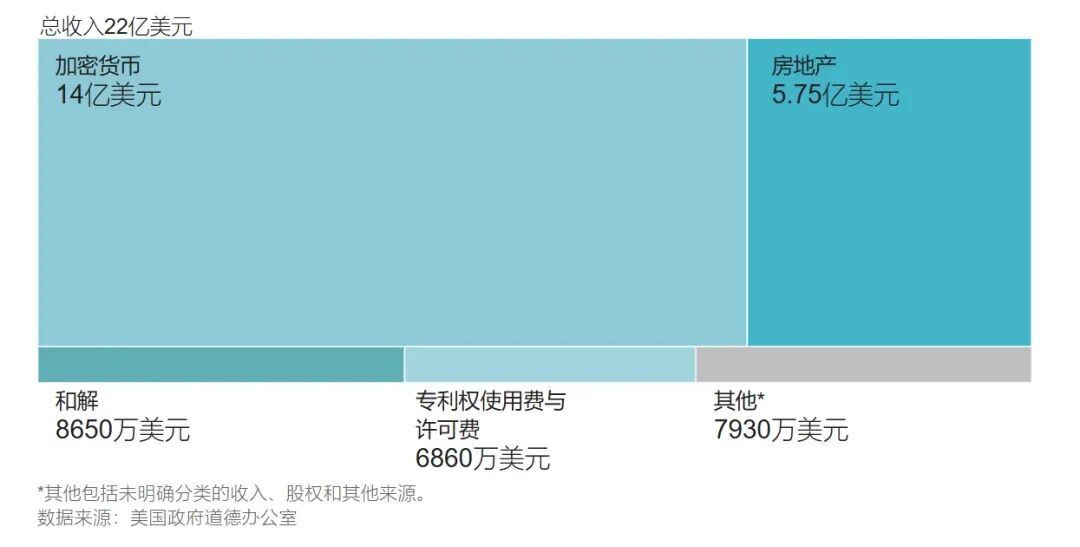
According to 2026 data, Trump currently has a personal net worth of $6.5 billion. In 2025, his personal annual income reached $2.2 billion, of which the "new family business" of cryptocurrencies generated $1.4 billion, accounting for about 64%; the "traditional family trade" of real estate brought in $575 million, accounting for roughly 26%; the remaining 10% of income mainly came from lawsuit settlements ($86.5 million), brand licensing fees ($68.6 million), and other income such as stock investments ($79.3 million).
Odaily will take a deep dive into the Trump family's "crypto wealth-building secrets" and the "Trump-style industrial chain."
Trump's "Crypto Breakdown": I Don't Know About It, and I Didn't Recuse Myself
In a recent media interview, "Mr. Great President" claimed to be unaware of his "crypto earnings," stating in his own words: "I've always been making money, I'm a businessman, and a very good one. I've made money, quite a substantial amount... I let other people handle that money. I haven't even talked to them — I don't even know who they are... My son Eric (Trump's second son) is in charge of that stuff. I don't discuss those kinds of things with him... It's not illegal not to know about those things... There's no law that requires you to recuse yourself from every decision that might relate to you when you're running the country. That's simply not practical."
For some reason, this kind of Versailles-style brag of "Huh? I made more money again?" coming out of Trump's mouth doesn't surprise anyone at all.
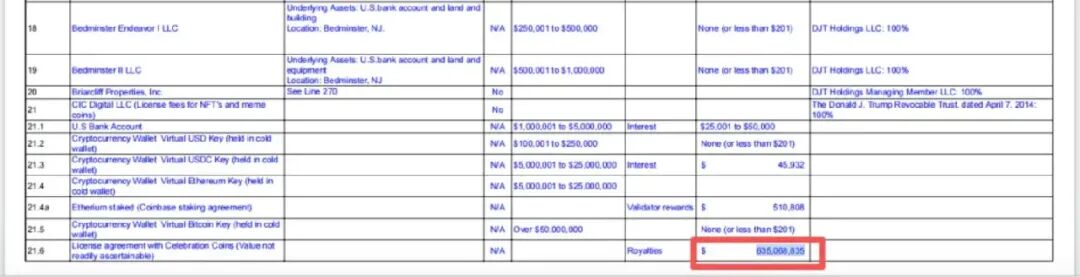
According to the latest personal financial filing documents, Trump's personal assets include BTC and ETH worth over $100 million, as well as a small number of altcoins such as LINK, AAVE, ENA, MOVE, and ONDO; Trump also earned nearly $800 million from World Liberty Financial, a crypto project he co-founded with his son (including $527 million in token sales revenue and $263 million in equity transfer income, covering equity stakes in stablecoin firm Stablecoin Holdco LLC and WLFI); he gained around $635 million from selling the TRUMP meme coin, and over $80 million from a legal settlement with a media company.
Reuters previously estimated that since Trump returned to the presidency in January 2025, the Trump family's crypto businesses have generated at least $2.3 billion in profits from investors.
Where does the revenue in the crypto world come from?
Take the "presidential meme coin" as an example: TRUMP has caused around 1 million people to suffer investment losses.
Behind every great victory lie countless casualties. In the dog-eat-dog crypto market, every dollar of Trump's income comes from the blood-soaked chips surrendered by retail investors and institutions.
Trump's "Personal American Dream": I Am the Stock God
Apart from crypto businesses, stock market gains are also a prominent part of Trump's wealth narrative.
According to the financial documents, Trump reported over 22,000 stock trades in 2025, averaging as many as 87 trades per day, making him a bona fide "high-frequency trader." Just as Trump claimed earlier, the White House explained that "all these trades are executed by a professional investment team in Trump's trust account, not directly by Trump himself."
But a closer look at Trump's stock holdings is rather intriguing.
In terms of specific assets, Trump's 8 stock accounts hold more than 4,000 stocks, mainly concentrated in U.S. tech giants such as Alphabet (Google), Apple, Broadcom, Meta, Microsoft, NVIDIA, Tesla, and Amazon, with holding values ranging from $5 million to $25 million. In addition, index products such as the S&P 500 ETF and tech sector ETF are also on the list.
In terms of trading operations, Trump's stock investments are far from a "value investing style" and more resemble that of a "swing trader." Over the past year, Trump's stock account bought and sold Microsoft shares 84 times; for Google, the number reached 97 times. The strangest thing is that on August 18 last year, Trump's stock account almost bought all 8 of the aforementioned tech stocks in one go, plus popular assets spanning multiple sectors including payment, technology, investment banking, insurance, and healthcare, such as Visa, Mastercard, JPMorgan Chase, UnitedHealth, and Eli Lilly.
In terms of long-held assets, Trump's account bought gold ETFs and silver ETFs 5 times in one year and never sold any of them; U.S. Treasuries and a Vanguard fund tracking dividend growth are also included.
Let's think carefully: what was happening in the "off-market world" when these on-exchange trades took place?
Over the past year, Trump's account has repeatedly conducted intensive trading around the release of major U.S. policies: last April, Trump announced "Liberation Day" tariffs on global trade partners, which triggered a "global tariff war," with U.S.-China tariffs even surging to over 100%. At that time, Trump's account executed hundreds of stock trades for several consecutive days; a few days later, Trump staged his first "TACO episode," first claiming that "now is a good time to buy," then announcing a pause in tariff hikes, and U.S. stocks rebounded sharply immediately after; from late August to October last year, Trump's account once bought at least $82 million in corporate bonds and municipal bonds covering multiple industries, many of which clearly benefited from U.S. policy adjustments.
Just yesterday, the U.S. launched another strike against Iran, causing crude oil prices to rise and U.S. stocks to fall. A suspected insider address built a position betting "long crude oil, short Nasdaq" with a position size as high as $21 million, and floating profits exceeding $500,000, which makes people have to wonder about the connection behind it.
All signs indicate that behind the "TACO" narrative lies rampant insider trading and under-the-table collusion.
The "TACO" Conspiracy Theory: Insider Trading and Token Compliance Formalities
For a long time, the conflict between Trump's business transactions and U.S. national interests has been the focus of public attention and the core of controversy. Many Democratic senators previously raised objections, demanding that relevant departments take action and launch investigations, but limited by Trump's presidential status, most disputes were eventually dropped or put on hold temporarily.
But looking back now, many of Trump's anomalous behaviors are likely nothing more than profit-seeking moves.
In January 2025, a few days before Trump officially took office, an investment firm associated with the UAE government acquired a 49% stake in WLFI for $500 million; shortly after, despite strong opposition from some U.S. national security officials, the Trump administration still reached an AI-related computer chip export agreement with the UAE.
In addition, his family business, the Trump Organization, also earned millions to tens of millions of dollars from real estate projects in countries including Saudi Arabia, Qatar, Romania, and Vietnam, all of which later received policy or political concessions from the U.S. in areas such as trade, military, and technology.
This also brings up the "real estate business" that laid the foundation for the Trump family's wealth, and the branded resort empire built leveraging Trump's massive celebrity prestige.
Brand Value: The Presidential Trump Nameplate
Looking through Trump's personal financial reports, a striking section lists numerous companies starting with "DT Marks" — DT Marks Dubai, DT Marks Doha, DT Marks Abu Dhabi, DT Marks Hyderabad, DT Marks Gurgaon... At first glance, it seems that real estate businesses all over the world are tied to the Trump family.
In reality, these are nothing but "shell companies" — most of them have no actual assets at all, and their "valuation" is impossible to measure. Their only value is to "carry the TRUMP name and enjoy the Trump brand premium." In other words, through the "family name licensing" model, leveraging 20 "DT Marks" series companies, Trump raked in nearly $60 million in 2025 alone, with DT Marks Dubai generating $10.36 million and DT Marks Abu Dhabi generating $9.24 million.
Unlike Obama, who made money after leaving office by selling memoirs, giving global speeches, and posing for photos with entrepreneurs, Trump has long maximized the business value of both the "presidential title" and the "Trump" family name.
The Mutual Embrace of the Politico-Business Era and the Businessman President
For 250 years, compared to the political power represented by the title "President of the United States," the money-making ability of presidents has never drawn widespread public attention.
When Biden left the presidency, his net worth was around $10 million; Obama's personal net worth was only nearly $70 million by the end of 2025; the Obamas' total income in 2013 was just $481,100, and because "book sales were poor," their income was nearly $130,000 less than in 2012, yet they still had to pay a personal income tax rate as high as 20.4%.
From Washington to Trump, the presidential salary has only been raised 5 times — respectively: $25,000 during President Washington's term (it is said he donated the entire sum to the nation); in 1873, President Ulysses S. Grant's annual salary rose to $50,000; 36 years later, President William Howard Taft's annual income reached $75,000; in 1949, President Harry S. Truman's annual salary exceeded $100,000; 20 years later, President Richard Nixon's annual salary finally rose to $200,000; in 1999, at President Clinton's request, the U.S. presidential salary was raised to $400,000, but because U.S. law stipulates that "salary increases can only take effect after the next president takes office," George W. Bush eventually became "the first U.S. president to receive a $400,000 annual salary."
Now, just in the first year of his second term, Trump has single-handedly pushed his annual income to the billions of dollars level. Obviously, this is not achieved by relying on a fixed salary. Is it the advancement of the times? The management of national fortunes? The monetization of power? It is a combination of all three. This is what Trump sees and seizes that none of his predecessors did: he saw through the essence of the rules of the world, and then made full use of them for his own benefit.
This article is from the WeChat public account "Odaily" (ID: o-daily), author: Wenser, editor: Hao Fangzhou, published with authorization from 36Kr.