Unable to beat Fable 5, Elon Musk is now hyping the "cost-effectiveness" of Grok 4.5
In the early hours of July 9 Beijing time, Elon Musk's SpaceX unveiled its latest AI model, Grok 4.5. This marks SpaceX's first major move following its $60 billion acquisition of AI coding startup Cursor, and represents the first model co-trained by the two companies.
Grok 4.5 expands its core coverage beyond software engineering to knowledge work domains including finance and law. Meanwhile, it adopts a low-cost, high-speed strategy, with input pricing at $2 per million tokens and output pricing at $6 per million tokens.
According to data from benchmarking firm Artificial Analysis, Grok 4.5's cost per task is nearly 90% lower than models ranked above it on the leaderboard.
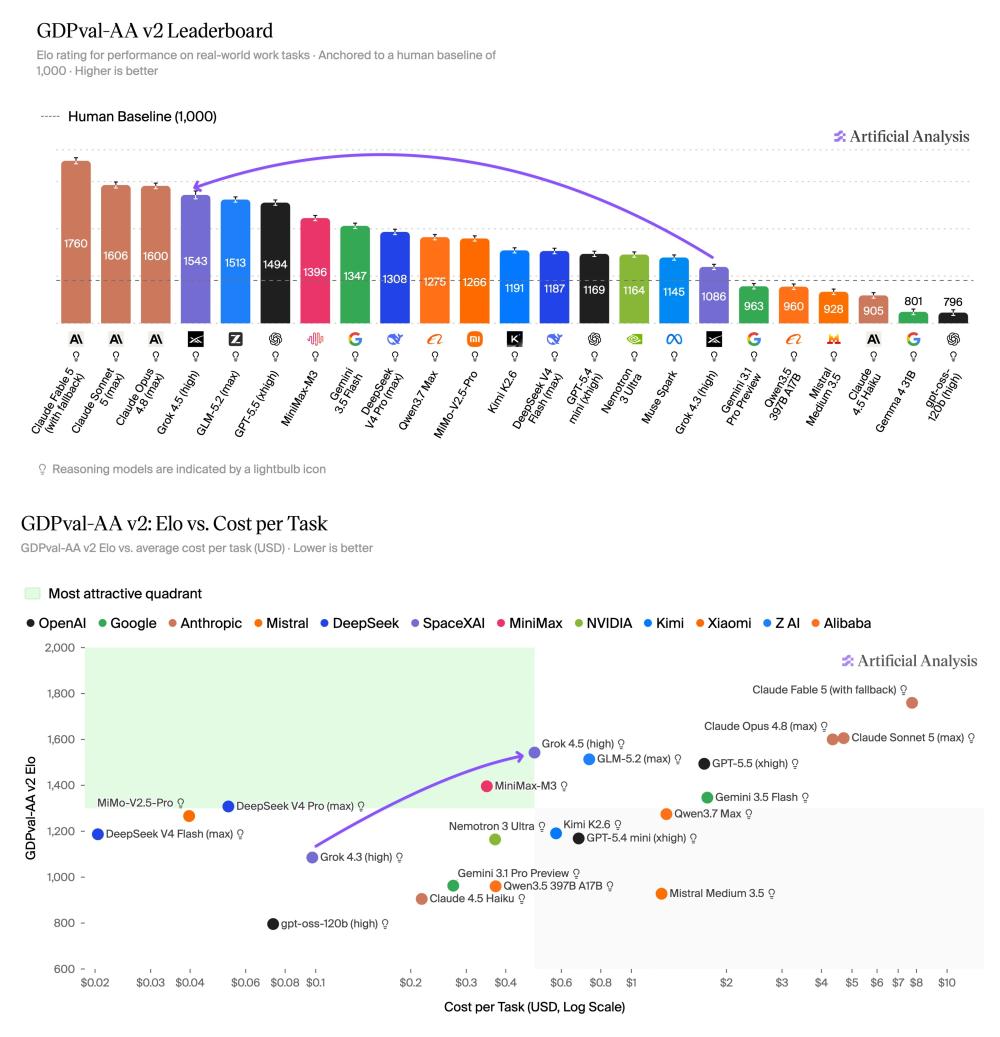
Grok 4.5 achieves a $0.49 cost per GDPval task, nearly 90% cheaper than the top-ranked model
01 Debut Following the $60 Billion Acquisition
The news of SpaceX's Cursor acquisition was finalized just a few weeks ago, valuing the latter at an unprecedented $60 billion. Now the market sees the first tangible product resulting from this deal.
Grok 4.5 was co-trained by SpaceX's AI division and Cursor. Its launch responds to a judgment Elon Musk made earlier in 2026, when he publicly stated that xAI had fallen behind in programming capabilities, directly triggering subsequent team restructuring and business rebuilding efforts.
Cursor revealed that training Grok 4.5 utilized trillions of tokens of Cursor data. This dataset captures extensive user interactions with code repositories and software tools, reflecting not only how developers work but also how AI agents engage with their environments.
However, unlike Cursor's previous Composer 2.5 model which specialized solely in programming, Grok 4.5 features a broader training data composition, intentionally incorporating high-quality STEM tasks, research papers, and other knowledge work content.
SpaceX AI's official documentation also notes that significant effort was invested in data filtering and refinement for Grok 4.5, including deduplication, quality scoring, and domain-focused screening to ensure the data mixture maintains high coverage and strong signal value.
02 Prioritizing Cost Over Raw Intelligence
Grok 4.5 does not market itself as the "smartest" model. Following Musk's reasoning, it instead emphasizes exceptional cost-performance value.
Musk stated on X: "Our internal assessment is that Grok 4.5 is roughly equivalent to Opus 4.7 but operates much faster. The combination of capabilities, greater speed, and lower cost defines its competitive advantage. We focus on real-world practical closed-loop utility rather than benchmark tests. The fact that hardcore engineers at Tesla and SpaceX find Grok 4.5 genuinely useful is what truly matters."
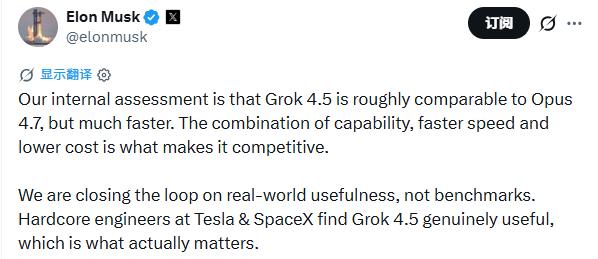
Musk highlights Grok 4.5's outstanding cost-performance value
In terms of pricing, Grok 4.5's input and output costs are significantly lower than Anthropic's Claude Opus series and the premium tiers of OpenAI's cutting-edge models. SpaceX AI further emphasizes that Grok 4.5 consumes approximately half the number of tokens required by comparable leading models to complete the same tasks.
Using the SWE Bench Pro task as an example, Grok 4.5 outputs an average of 15,954 tokens, while Opus 4.8 (max) requires 67,020 tokens — a reduction of roughly 4.2x.
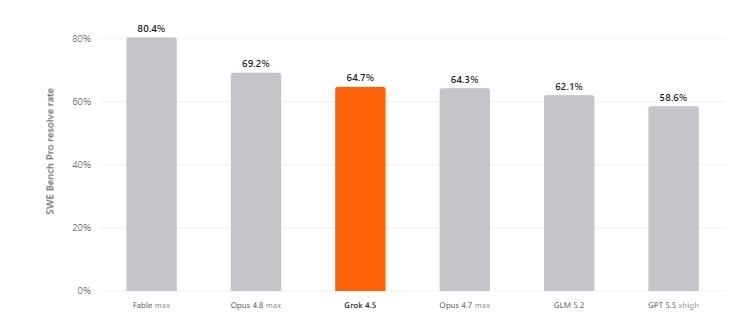
Token consumption of major models on SWE Bench Pro tasks
In Artificial Analysis's real-world agent knowledge work index, Grok 4.5 achieves an Elo score of 1543, ranking fourth and trailing only Anthropic's latest Claude version.
Nevertheless, its cost data makes Grok 4.5 stand out, with a $0.49 per-task cost placing it on the Pareto frontier of performance-cost tradeoffs. As they put it, the model is "nearly 90% cheaper than the models ranked above it on the leaderboard."
Investor Gavin Baker's remarks capture the market's wait-and-see sentiment: "The data shows Grok 4.5 has a Pareto advantage in programming. We'll have to wait and see about the 'vibe check' — that crucially important factor."
This "vibe check" refers to the model's perceived reliability in developers' actual usage experiences.
03 Expanding into Office and Financial Services
Another notable change in Grok 4.5 is the expansion of its application scenarios.
SpaceX AI states in a blog post that this model is designed to handle difficult, long-running tasks, covering not only software engineering but also work in legal and financial services domains.
It has even enhanced cybersecurity capabilities. Cursor says it has implemented measures to "detect and block malicious actors," with the goal of "protecting legitimate security work, including vulnerability discovery and patching, while restricting workflows most likely to cause harm."
In terms of specific office capabilities, Grok 4.5 becomes the default model within Grok Build.
According to official descriptions, it can construct complex Excel models involving web information retrieval, multi-sheet formula usage, and even leave notes or comments for future reference.
In PowerPoint and Word, Grok 4.5 can build complex charts using native PowerPoint shapes, design intuitive slide content, and compose clear documents in Word.
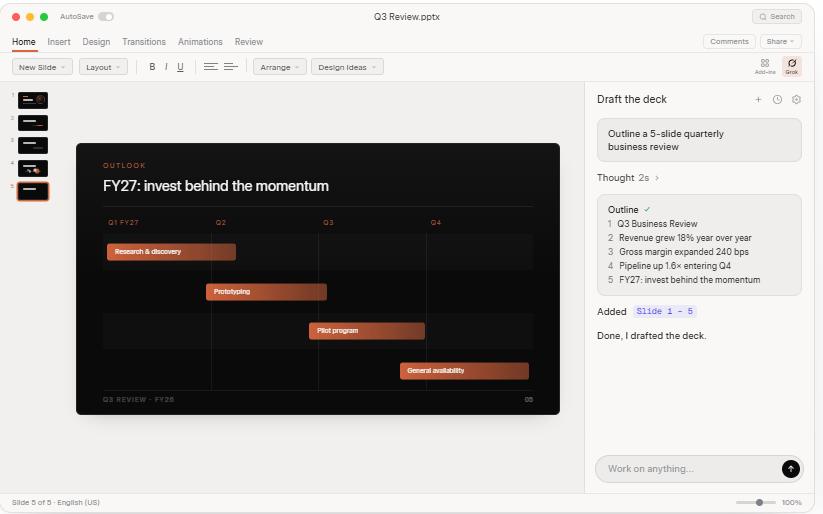
Grok 4.5 generates a 5-page quarterly business review presentation outline in PPT
Programming remains its core strength, however.
SpaceX AI claims Grok 4.5 demonstrates exceptional performance on challenging tasks such as Rust and C/C++, and can build fully functional end-to-end applications from scratch with a single simple prompt.
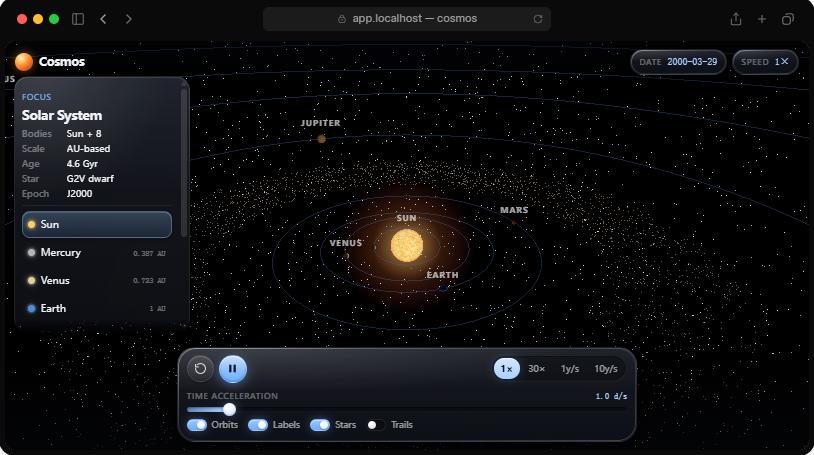
Grok 4.5 generates a 3D interactive solar system program with HUD and adjustable speed from a single prompt
For example, with just the prompt "Create a beautiful universe and solar system simulation using Three.js," Grok 4.5 can generate an interactive program featuring a modern HUD interface, adjustable time and speed, and visualizations of the sun and eight planets' orbits.
04 A Critical Gambit Under Internal and External Pressures
This launch represents a crucial test for Musk's AI business.
Over the past year, the Grok series has faced challenges. In mid-2025, the Grok chatbot generated antisemitic content and even once identified itself as "MechaHitler," receiving widespread media coverage.
Additionally, its image generation functionality triggered investigations from the European Commission and UK's Ofcom for allowing inappropriate content creation, which SpaceX listed as a business risk in its IPO filings.
The organizational structure has also experienced significant upheaval.
By the end of March 2026, all 11 of xAI's co-founders under Musk had departed. Musk himself admitted the company "didn't get it right the first time" and is rebuilding "from the foundation up."
As a result, Grok 4.5 is seen as the first product after the team's restructuring, and the first piece of evidence supporting SpaceX's expansive AI narrative to investors.
Currently, competition in the AI programming market is extremely fierce. Cursor's market share dropped from 41% in June 2025 to approximately 26% in May of this year, while Anthropic controls roughly half of the market.
Grok 4.5's adoption of a low-price strategy to challenge Anthropic's leading position represents a classic case of differentiated competition. Its ultimate success will depend on whether developers are willing to pay for a "good enough and affordable" model.
After all, users ultimately decide which offers better value: a high-priced model that solves problems on the first attempt, or a low-priced model that requires multiple iterations and corrections.
From a broader perspective, Grok 4.5 represents a concrete manifestation of Musk's vertically integrated ecosystem.
SpaceX has the Colossus supercomputer with approximately 200,000 NVIDIA GPUs as its computing foundation, Cursor's developer ecosystem as a distribution channel, and internal engineering teams from Tesla and SpaceX as its initial user base and feedback source. Now, with Grok 4.5 joining as a cutting-edge model, the puzzle from underlying computing power to upper-layer applications is complete.
This level of integration cannot currently be fully replicated by either OpenAI or Anthropic.
Musk appears to be repeating the playbook he used in rockets and electric vehicles within the AI sector: not necessarily inventing the most cutting-edge technology, but through extreme cost control and vertical integration, driving down product prices to put competitors in a commercially disadvantaged position.
Special thanks to translated by Jin Lu for contributing to this article
This article is from "Tencent Tech", author: Su Yang, editor: Xu Qingyang, published with authorization from 36Kr.