GPT-6 is coming, OpenAI completely abandons the old 4T base model
OpenAI Fast-Tracks GPT-6, Ditching the Old 4T Base Entirely? Meanwhile, GPT-5.6 Gets Full Clearance, Launching This Thursday! The Sol, Terra, and Luna Models Are Fully Unlocked, Covering Coding, Scientific Research, and Daily Tasks. Early Testers Are Already Raving About the Sol Model for "Never Giving Up", and Now the Entire Developer Community Is Gearing Up.
Just moments ago, the news spread like wildfire across the industry.
The release timeline for GPT-6 has been drastically moved up, with a surprise launch possible as early as this month!
If the leaks are accurate, the GPT-5.x series will conclude with GPT-5.6, marking its final iteration.
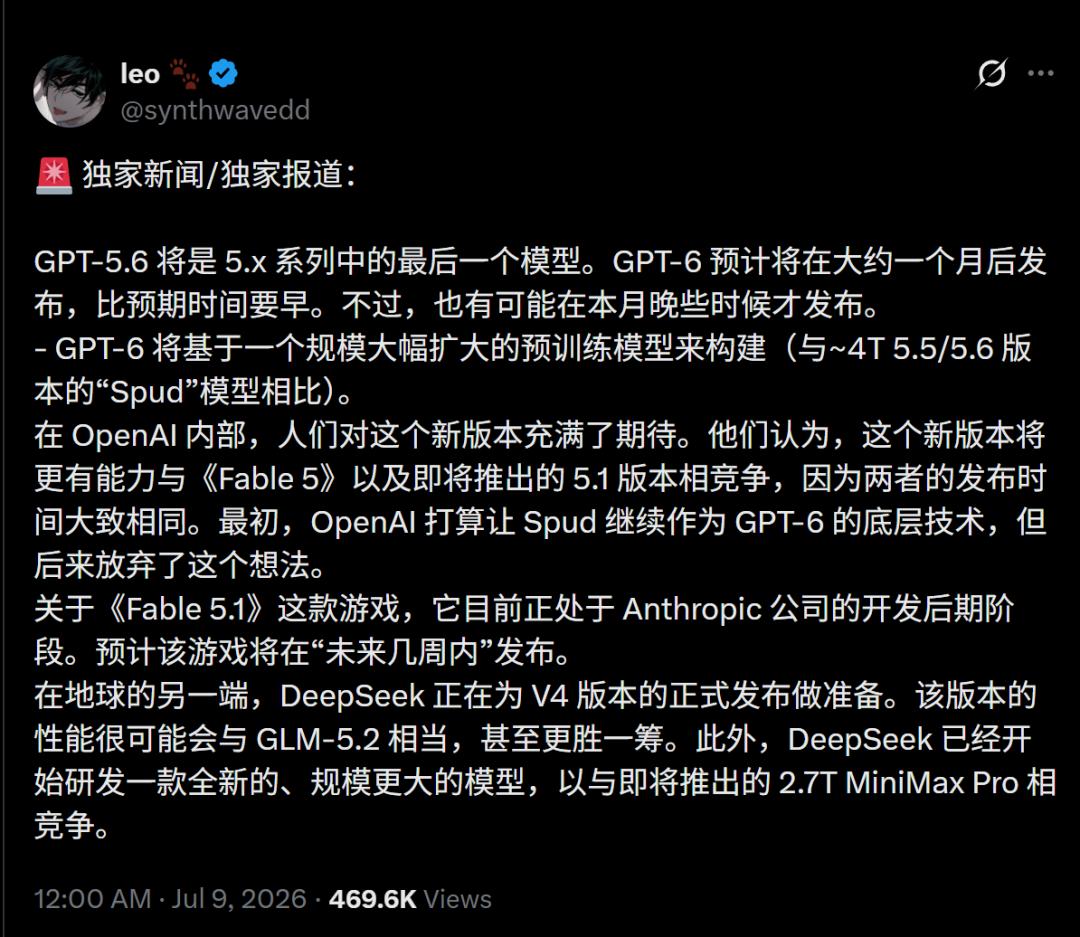
According to sources, OpenAI has made a bold decision: to completely abandon the previous "Spud" legacy base with around 4T parameters, and bet entirely on a much larger new pre-training foundation.
Their goal is clear: with this new base, they will directly go head-to-head against Anthropic's upcoming Fable 5.1, set to launch in a few weeks.
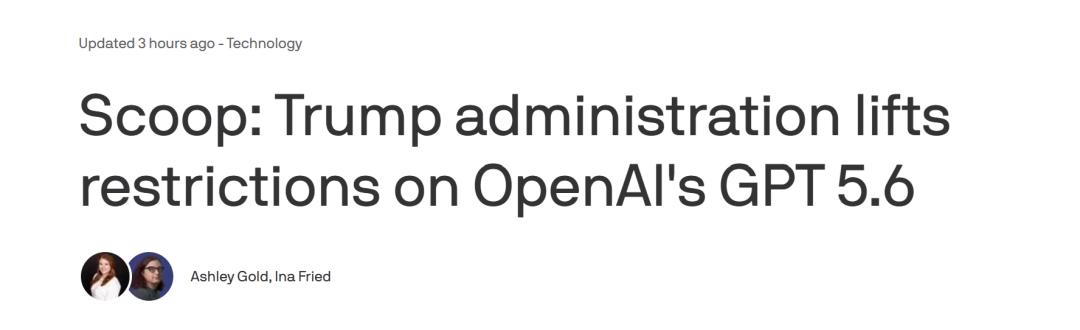
And yesterday afternoon, breaking news arrived: GPT-5.6 has been fully cleared for release! It's coming this Thursday!
Yesterday at noon, Axios broke the exclusive story: regulators have officially lifted the access restrictions on OpenAI's GPT-5.6.
Shortly after, OpenAI officially announced on X that their flagship model GPT-5.6 Sol, alongside Terra and Luna, will be publicly released globally to all users this Thursday (July 9th)!
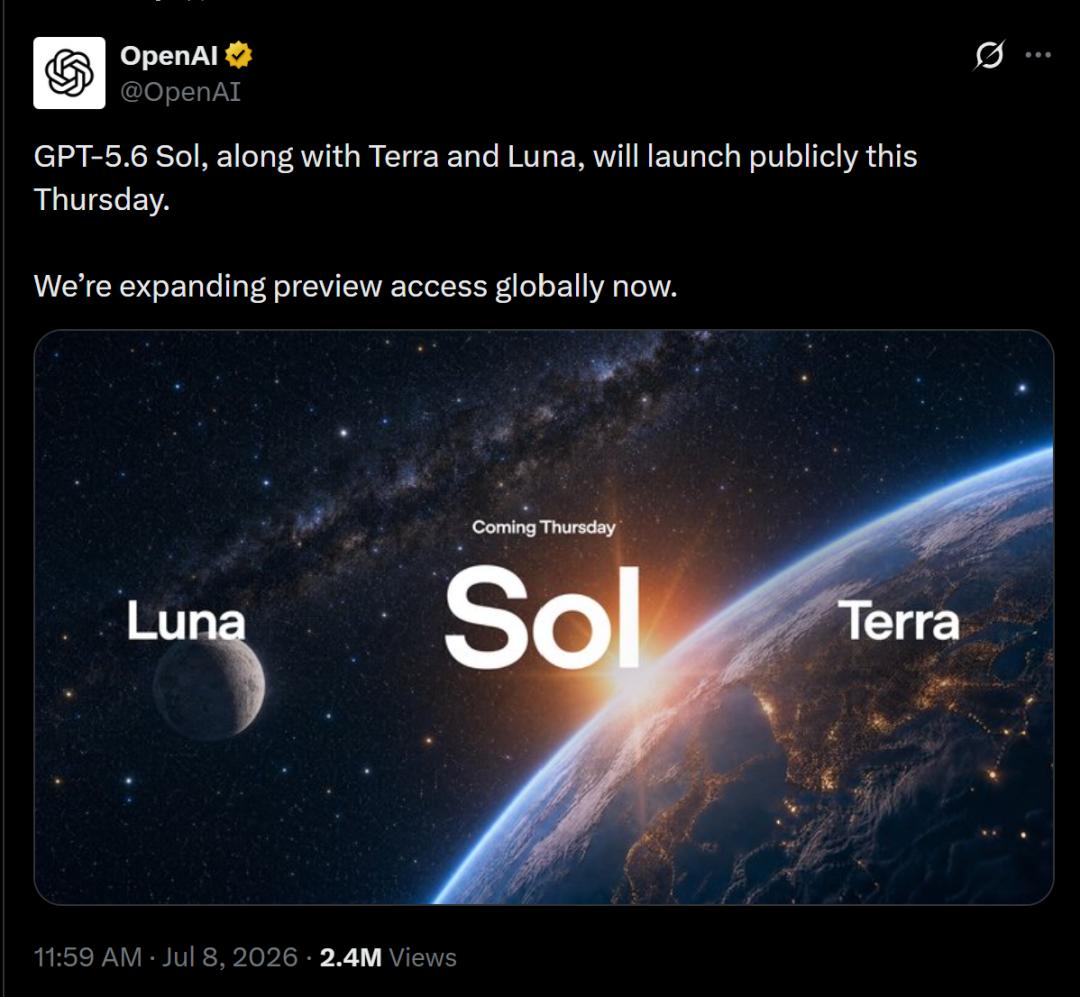
This highly anticipated "game-changing" model has finally been cleared after a month of limited preview exclusive to government and enterprise users.
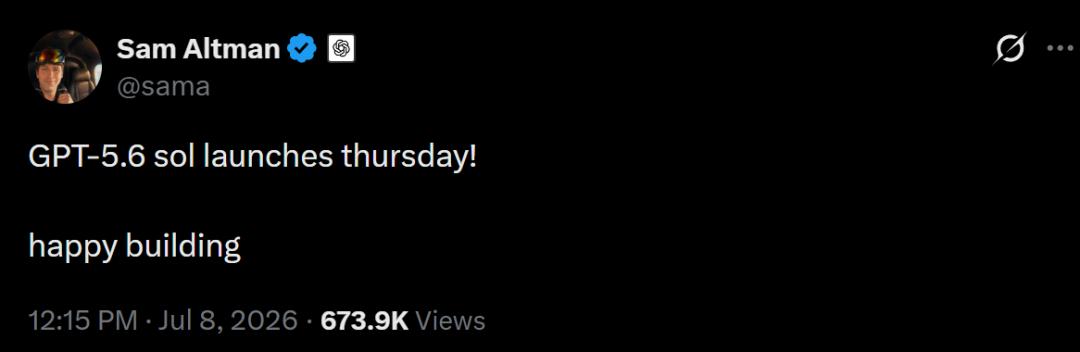
Sam Altman sent a message to developers: Happy Building!
Pressure, Negotiations, and the Late-Night Clearance
Back on June 26th, OpenAI quietly launched a limited preview of GPT-5.6, accessible only to a small group of users.
The "AI Standards and Innovation Center" under the US Department of Commerce had set up a presence at OpenAI, even requiring OpenAI's technical experts to stay on-site to undergo "safety reviews".
Under the latest US AI executive order, the release of frontier AI models requires real-time, case-by-case regulatory negotiations.
So why did regulators suddenly give the green light now?
Industry insiders reveal that OpenAI's specialists in Washington went through countless real-world attack stress tests and vulnerability fixes, ultimately proving that GPT-5.6 is the most robust and secure system OpenAI has ever built.
In today's announcement, OpenAI made a pointed statement: "We have collaborated with regulators, but these short-term restrictions were designed to pave the way for broader availability. We never intended for government pre-access to become a permanent norm — technology must not be monopolized."
Now that the uncertainty is resolved and regulators have approved the release, the long-waiting global developer community is bursting with excitement.
"Three Models Launching Together": Just How Powerful Are Sol, Terra, and Luna?
These three new models have clearly defined, distinct roles.
GPT-5.6 Sol: The Ultimate Flagship
Sol is built for top-tier frontier capabilities, specializing in complex coding, cutting-edge scientific research, and cybersecurity tasks.
Its most defining feature is extreme, unrelenting reasoning.
Many say the performance leap from previous models to GPT-5.6 is comparable to the massive jump from GPT-4 to o1.


Early tester Max Weinbach excitedly shared: "The most incredible thing about this model is that it never gives up! If you put it into extreme reasoning mode, it will stubbornly grind away until it fully solves the problem, no matter what."

Others note that GPT-5.6 is extremely persistent: even without using the /goal command, it can keep running and working for an entire day.

GPT-5.6 Terra: The Cost-Performance Champion, GPT-5.5 Killer
Its performance is nearly identical to the previous flagship GPT-5.5, but its operating costs are cut in half!
This model is purpose-built for everyday, high-volume workloads. Its arrival means GPT-5.5 is now effectively obsolete.
GPT-5.6 Luna: Blazing Fast, Unbelievably Cheap
Luna focuses on extreme speed and ultra-low cost, making it the ideal choice for high-frequency agent calls.
Even more impressive is the seamless integration with hardware ecosystems: sources say GPT-5.6 Sol will run natively on the Cerebras inference platform, delivering a staggering 750 tokens per second processing speed!
For demanding use cases like software development, biomedical research, and cybersecurity operations, this experience is a massive step up from previous models.
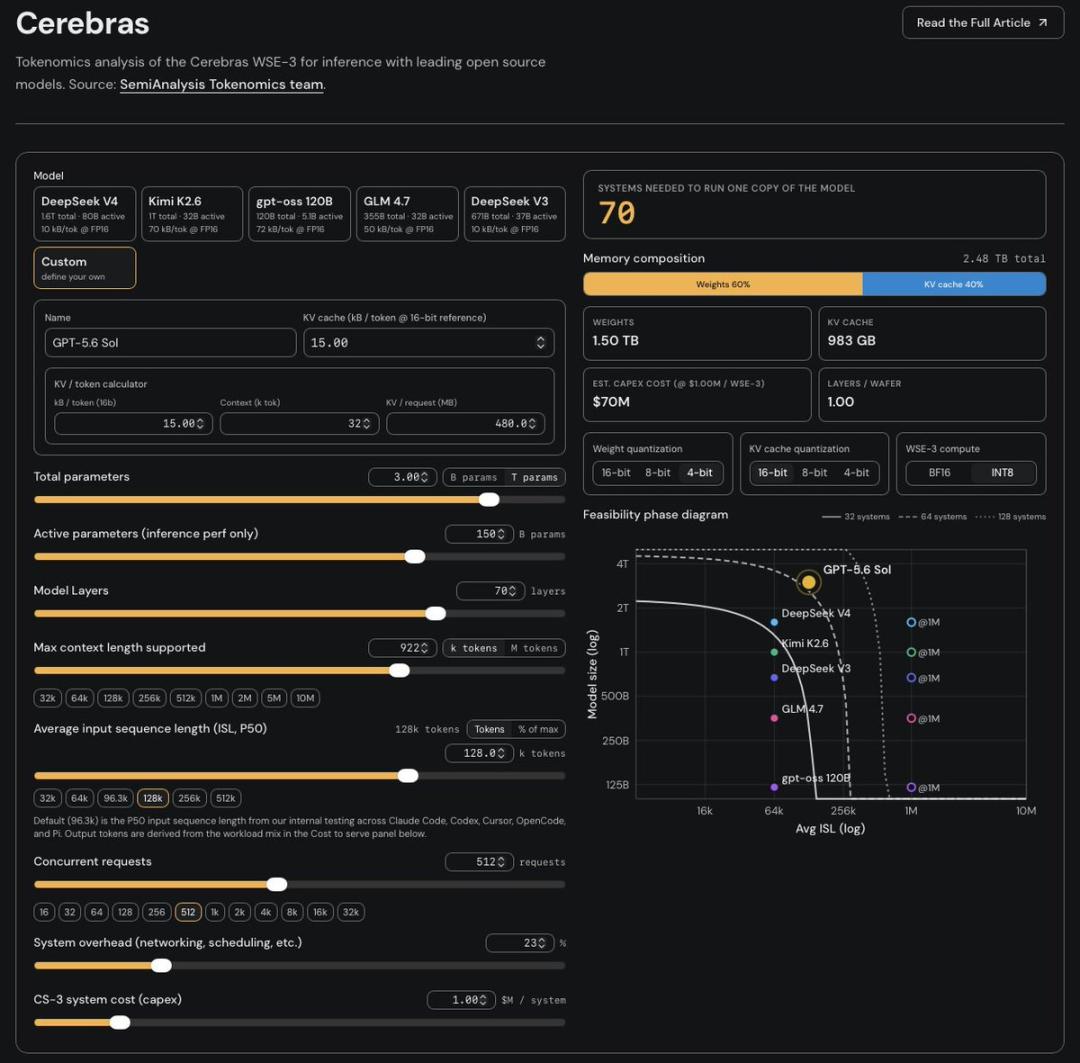
It's no wonder an early testing developer commented: "When I lost access to version 5.6, I felt like I was going crazy."
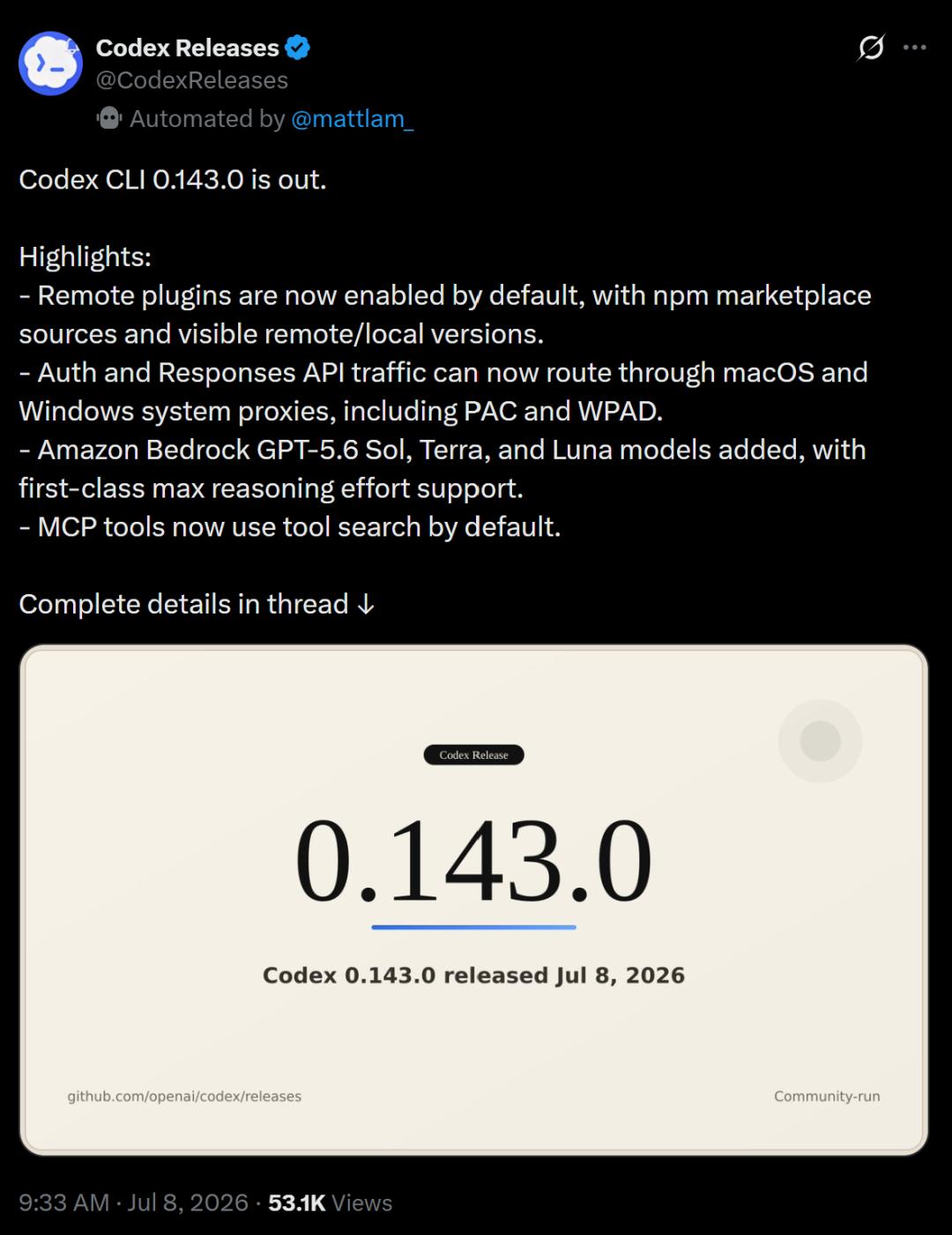
Earlier today, the Codex CLI 0.143.0 update log was accidentally leaked: Amazon Bedrock has quietly added the three GPT-5.6 models, with support for maximum inference intensity.
Based on the configuration details, these models are almost certainly optimized for the highest-tier access plan.
The First Wave of Power Users Share Their Impressions
Now, users on X who got early access to test the models are starting to share their reviews.
Prominent developer Theo posted a series of X posts, full of high praise.
GPT-5.6 fixes every single frustration I had with GPT-5.5. It's so persistent that even without giving it a /goal command, it can keep working productively for an entire day! Its ability to understand and coordinate sub-agents is incredible. It's made me use my computer a hundred times more often — when the beta ended and I lost access to 5.6, I honestly felt like I was going through withdrawal.


Pietro Schirano, CEO of Magicpathai, also shared his positive feedback.
Without exaggeration, this is the best model I have ever used. It's fast, extremely creative, and they finally fixed all the frontend design issues! I haven't manually reviewed my own written code for two full months now.

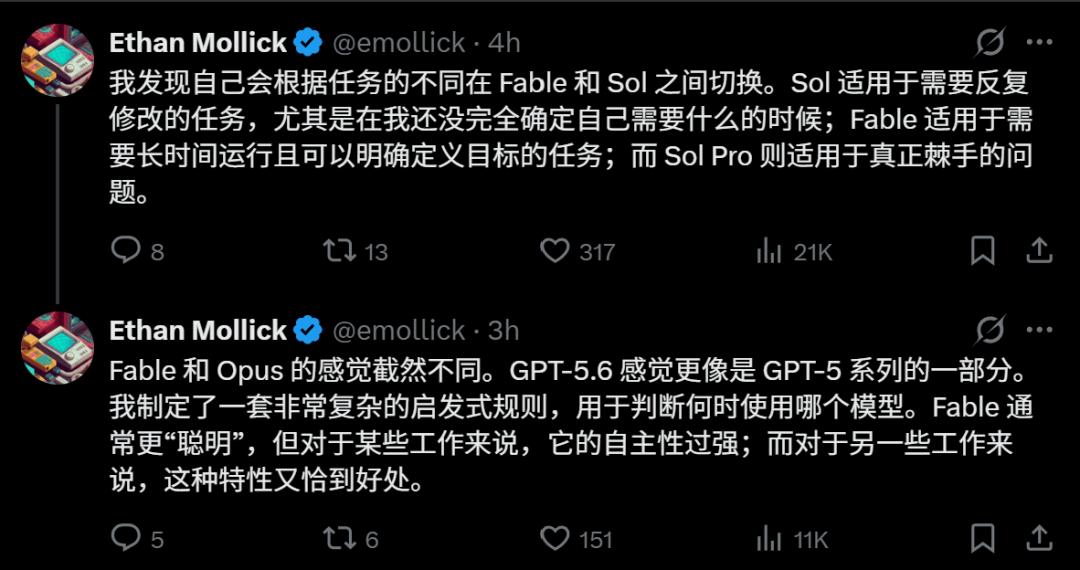
Wharton School professor Ethan Mollick compared Sol directly to Anthropic's Fable model.
Sol's capabilities are similar to Fable, but the user experience feels completely different. Fable likes to work independently at its own pace to finish tasks on its own; Sol is extremely fast and prefers to work alongside you with constant, high-frequency interaction. When I'm not yet sure exactly what I need, I use Sol to bounce ideas back and forth. When I have a clearly defined long-term task, I use Fable to run it end-to-end. For the most difficult, high-stakes problems, I turn to Sol Pro.

AI entrepreneur Matt Shumer offered a slightly different, more critical take, stating openly:
Sol is a great model, but for the vast majority of tasks I tested, Fable still performs better, and has much stronger native agent capabilities.

LMArena Director's Verdict: The Wise Owl vs. The Tenacious Rottweiler
As a prominent figure in the AI community, LMArena leader Peter Gostev published the most in-depth, technical side-by-side comparison available online right now.
He used a vivid, memorable analogy: Fable 5 is like a "wise owl", while GPT-5.6-Sol is a "Rottweiler" — it will clamp down on the problem and never let go until it is completely solved.
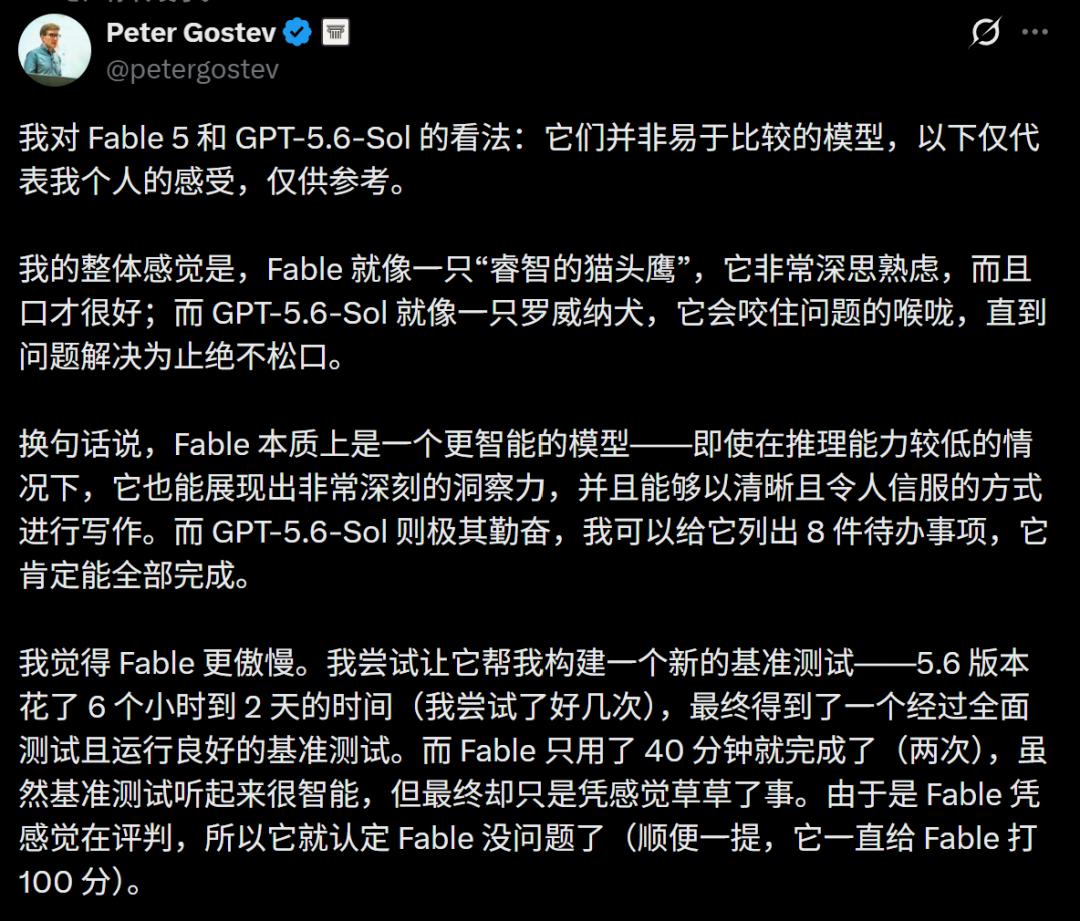
According to Gostev, the two