OpenAI's new voice model has annoyed users first
In the early morning livestream last night, OpenAI unveiled its next-generation voice model GPT-Live, announcing that it will power ChatGPT Voice moving forward.
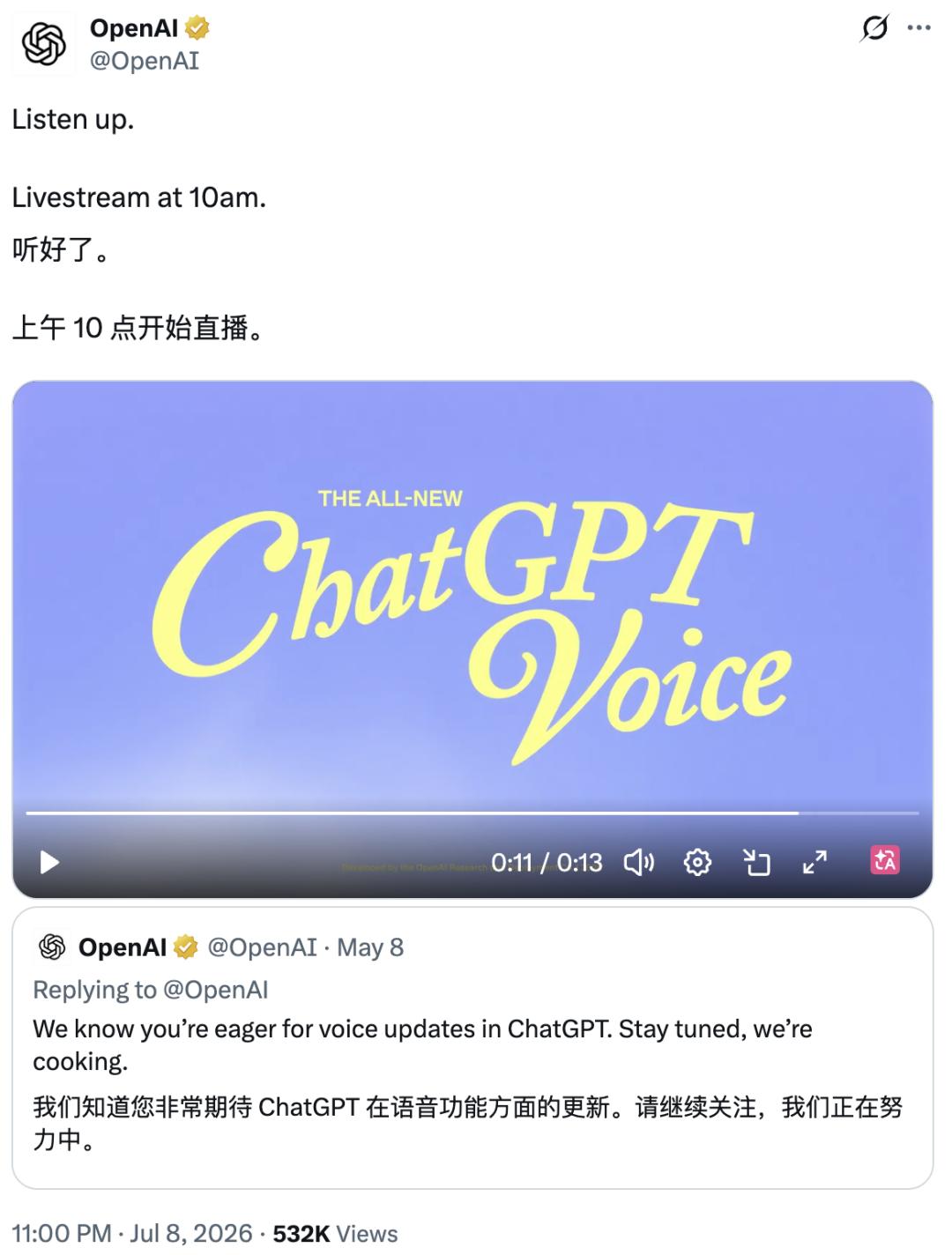
The last generational update to ChatGPT Voice was the Advanced Voice feature showcased alongside the GPT-4o launch in May 2024; it began rolling out to a limited group of Plus subscribers that July. Two full years have passed since then, leading to the release of GPT-Live.
This time, OpenAI has brought full-duplex architecture to ChatGPT Voice.
Previous AI voice assistants largely operated like fast-response walkie-talkies: the user finished speaking, then the model replied. While users could interrupt mid-response, the system typically had to re-evaluate context and rebuild its answer from scratch.
These systems felt conversational, but far from natural, lacking the fluidity of real human interaction.
GPT-Live is designed specifically to close that subtle experiential gap.
The feature is officially launching on ChatGPT today, though... initial reactions seem far from glowing?


01
A Long-Awaited Upgrade for ChatGPT Voice
In real-world conversations, outside of formal debates, people rarely take rigid, perfectly timed turns speaking. We pause, hesitate, correct ourselves mid-sentence, and interject with "Wait, that's not what I meant" while the other person is still talking.
Sometimes a quick "Uh-huh" or "I see" matters more than a full, lengthy response; sometimes the best reaction is simply staying silent to let the other person continue their thought.
Traditional AI voice assistants have always struggled most with these tiny, nuanced interaction details.
Whether it's ChatGPT, Gemini, or the widely used Doubao, all these systems feel stiff and robotic when it comes to natural, casual chatting.
They can answer questions, read text aloud, and stop responding when interrupted, but they nearly all rely on a core premise: first confirming the user has finished speaking before deciding to generate a reply. When that confirmation fails, the entire conversation feels awkward and disjointed.
A one-second pause from the user might be misread as the end of their question, triggering an overly eager response; if the user changes their mind halfway through a sentence, the model might keep rambling based on the original partial thought; even unrelated background speech can be misinterpreted as user input.
GPT-Live aims to resolve these small, unglamorous issues that directly define the overall user experience, even if they don't qualify as headline-making "major features."
To understand the current GPT-Live, we first need to look at how OpenAI's previous voice systems operated.
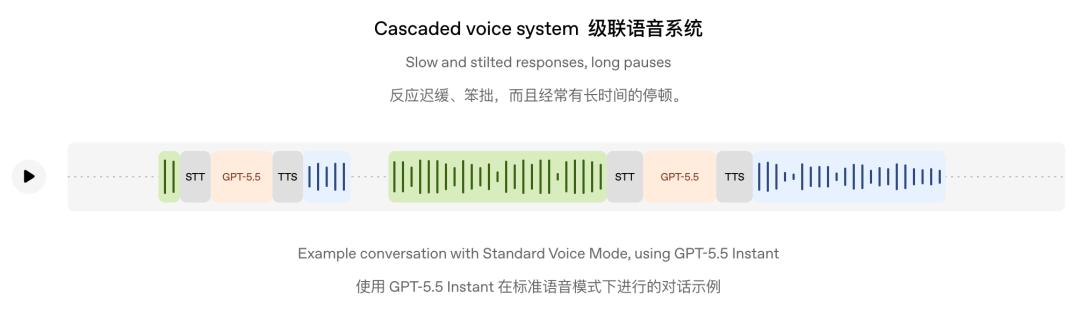
The original ChatGPT Voice used a cascaded voice system architecture.
In simple terms, it wasn't a single model handling audio end-to-end: multiple models worked in sequence, transcribing the user's speech to text first, then passing that text to the large language model to generate a response, before finally converting that text response back to synthesized speech.
This approach was easy to implement and quickly integrated large language model capabilities into voice interactions, but it had obvious flaws: massive amounts of contextual audio information were lost at the very first speech-to-text step.
When generating responses, the model only received cleaned, processed text rather than the full context of the live conversation. The user's tone, pauses, and emotional shifts never made it to the downstream language model. Combined with the layered latency from multiple chained models, the voice assistant easily fell into the rigid pattern of "listen, think, speak".
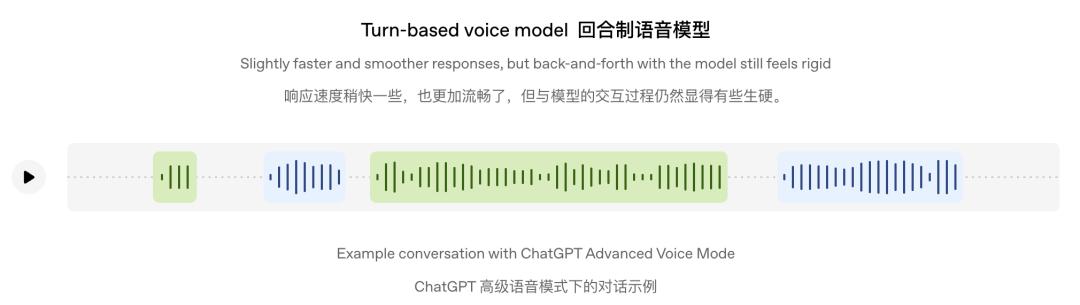
After GPT-4o launched, OpenAI introduced Advanced Voice, which used a native audio model to directly process and generate sound.
This was a clear improvement over cascaded systems: the model no longer needed to convert all speech to text before generating audio responses, preserving far more fine-grained audio details, reducing latency, and enabling more natural user interruptions.
But Advanced Voice still never fully broke free from turn-based conversation patterns.
When introducing GPT-Live, OpenAI referred to the previous Advanced Voice as a turn-based voice model. While it was more natural than traditional voice assistants, it still required confirming the user had finished speaking before starting to generate a reply.
This mechanism works perfectly for text chat, where pressing send explicitly signals the model that the current input is complete. But voice chat has no such send button: the model has to judge for itself when it's appropriate to respond.
A one-second user pause could mean they've finished their thought, or simply that they're still formulating their words; a drawn-out syllable could signal they're organizing their idea, or building emotion; background speech from another person could be misclassified as new user input.
This ambiguous boundary is the hardest challenge for turn-based voice models to resolve.
GPT-Live solves this problem through two key architectural improvements.
The first upgrade is advancing voice conversations from rigid turn-taking to full-duplex operation.
It can continuously listen, evaluate context, and generate speech simultaneously, rather than only entering response mode after the user stops talking.
In other words, the model participates in an ongoing, live conversation, rather than only answering a fully completed, closed-ended question.
According to official documentation, GPT-Live makes multiple interaction decisions every second: whether to keep speaking, keep listening, pause, interrupt the user, or trigger a tool call. This enables far more natural dynamic interaction, better temporal awareness, and even real-time translation capabilities.
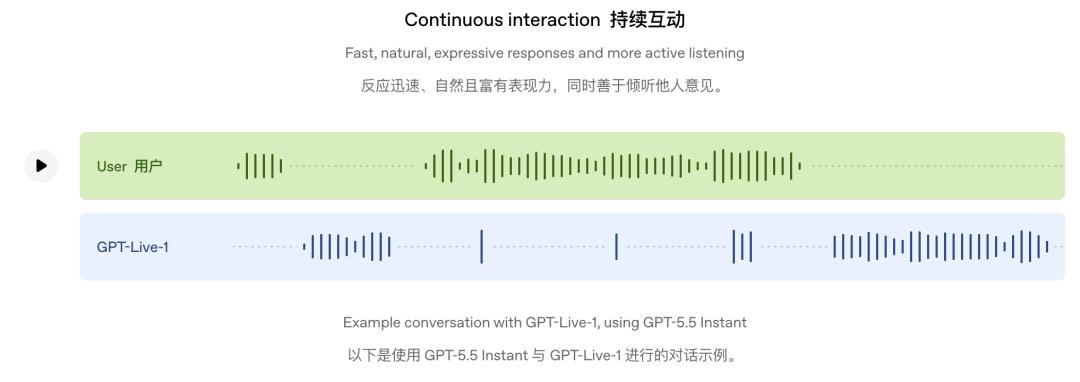
As seen in demonstrations, GPT-Live delivers small, emotionally aligned backchannel responses while the user is still speaking, just like the casual "mm-hmm" interjections you'd hear during a phone call with a friend.
In fairness, GPT-Live is not the first voice model to experiment with full-duplex architecture. Previous systems including Kyutai's Moshi, NVIDIA's PersonaPlex, and multiple academic research models have already explored simultaneous listening and speaking, handling pauses, interruptions, and short backchannel feedback. Google's Gemini Live, while not explicitly emphasizing full-duplex, also supports real-time voice conversations and native audio processing, aligning closely with this design direction.
What makes GPT-Live distinct is that it brings this "listen and speak at the same time" capability to ChatGPT, the mainstream consumer entry point for AI, while seamlessly integrating with OpenAI's broader model ecosystem.
This leads directly to the second key improvement: clear division of labor between the voice interaction layer and backend intelligent processing.
GPT-Live is not merely a "more talkative model" — it functions as ChatGPT's dedicated real-time voice interaction layer, responsible for listening, speaking, waiting, interrupting, judging the right moment to respond, and maintaining natural conversational rhythm.
When encountering questions that require search, complex reasoning, or multi-step tasks, it can offload that heavy processing work to more powerful backend models.
The voice model no longer needs to carry full intelligent processing burden for every single utterance. Simple queries get near-instant responses, while complex tasks can trigger higher-intensity reasoning; the interaction layer preserves conversational fluidity, and backend models handle the deep thinking and task execution.
This architecture is not entirely novel, but that does not make it any less effective.
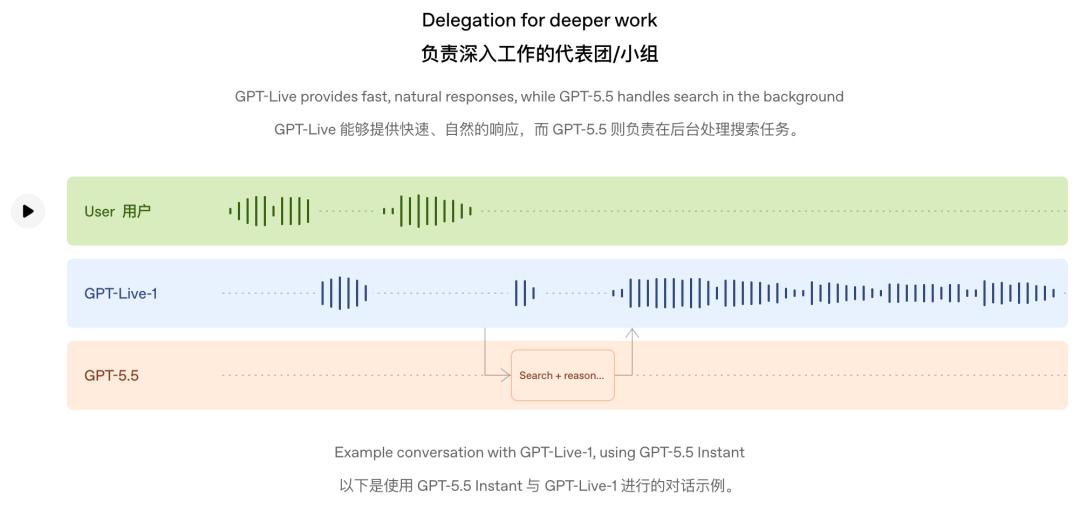
It is best understood as OpenAI delivering a long-overdue upgrade to ChatGPT Voice: combining industry-proven real-time voice interaction capabilities with full-duplex architecture, and rolling that integrated experience out directly to the massive ChatGPT user base.
02
Performance Benchmarks and Public Reception
It is too early to draw definitive, fully conclusive judgments about GPT-Live's real-world performance.
With every new model release, OpenAI excels at defining custom evaluation frameworks tailored to highlight its new capabilities: emphasizing reasoning performance when launching reasoning-focused models, and coding benchmarks when releasing code-specialized models.
This time around, it has published its own set of evaluation results covering interrupt handling, wait time management, short backchannel feedback, background noise robustness, and speech comprehension capabilities.
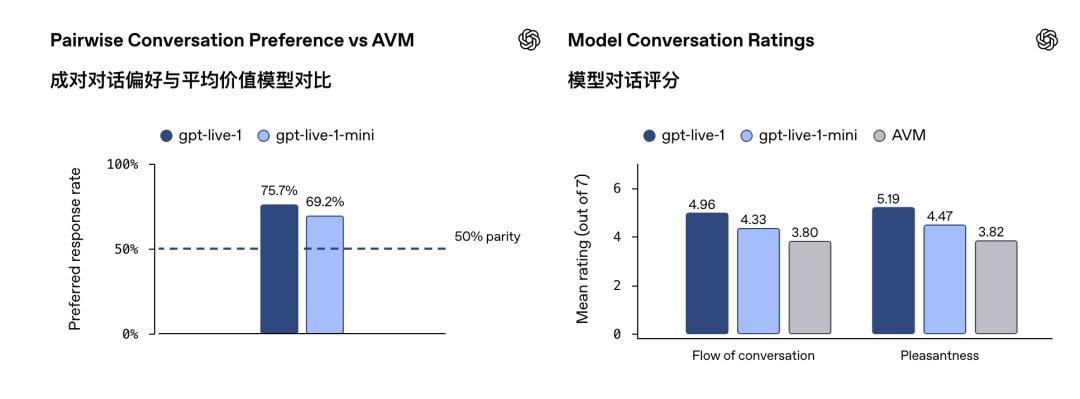
Using this newly designed evaluation framework, testers showed a clear preference for GPT-Live-1 and GPT-Live-1 mini during 5-10 minute matched voice conversations.
Beyond that, several additional benchmark rankings are worth reviewing.
OpenAI states that GPT-Live-1 outperforms the Advanced Voice Mode on GPQA, BrowseComp, and an internal τ³-Voice Telecom benchmark, which respectively measure scientific reasoning, web search proficiency, and multi-turn telecom customer service task performance.

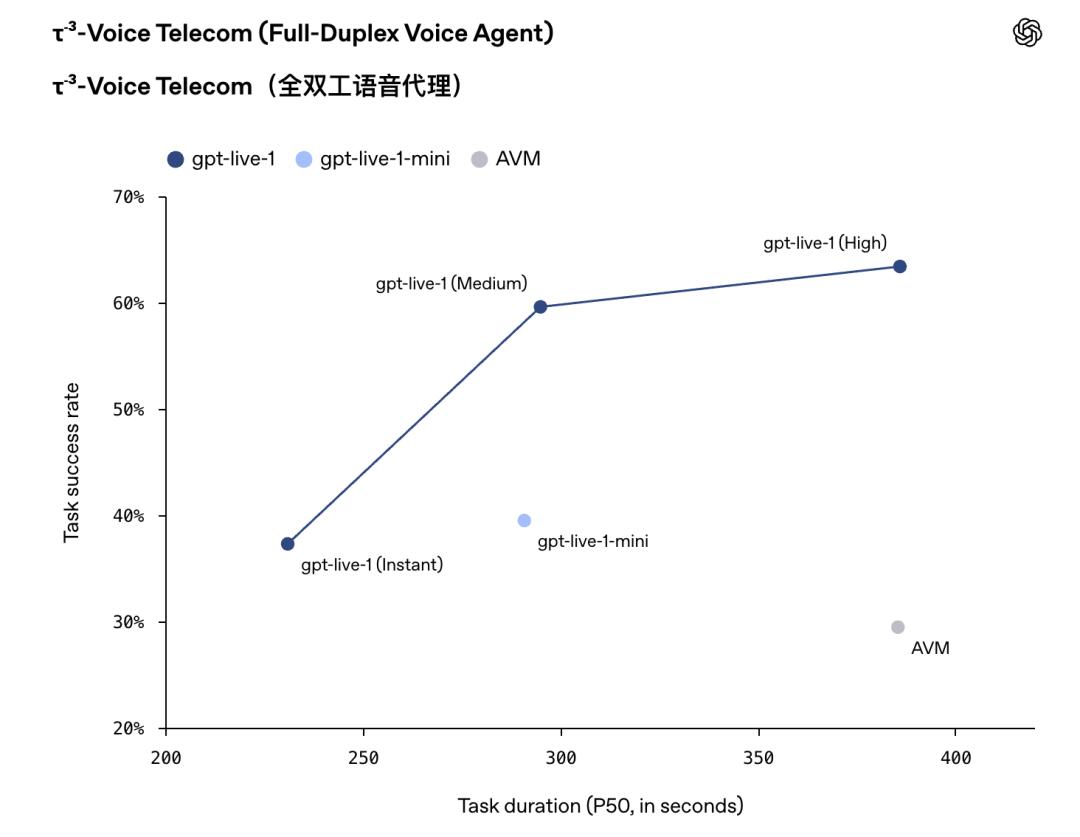
However, these results cannot be simply interpreted as "the GPT-Live voice model itself has grown significantly smarter". That's because GPT-Live offloads search, reasoning, and complex tasks to the underlying GPT-5.5 model.
In other words, the official evaluations primarily demonstrate that the new ChatGPT Voice system performs better, rather than proving that the voice interaction layer alone has achieved a revolutionary leap in capability.
Also, as many users have noticed, OpenAI only published vertical comparisons against its own older models, with no mention of cross-industry horizontal benchmarks against competing products.
There is no public data showing exactly where GPT-Live stands relative to the broader AI voice assistant ecosystem.
Public user feedback has been sharply divided.
One segment of users believes this update carries enormous potential, and if integrated effectively into coding workflows, could transform how many people work.
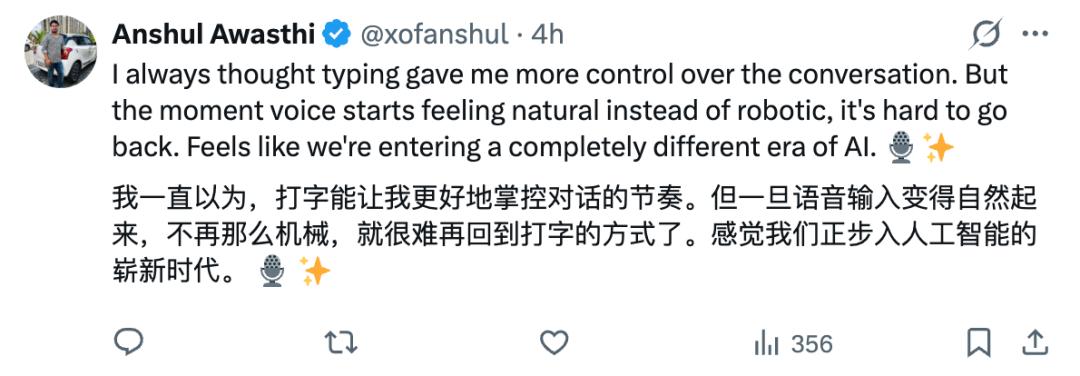



But many other users find GPT-Live's constant, frequent backchannel responses annoying and intrusive.
