Dialogue with CAO Xudong of Momenta: To achieve lunar autonomous driving, we must first develop a mass-producible "rocket"
Compiled by | Fan Shuqi
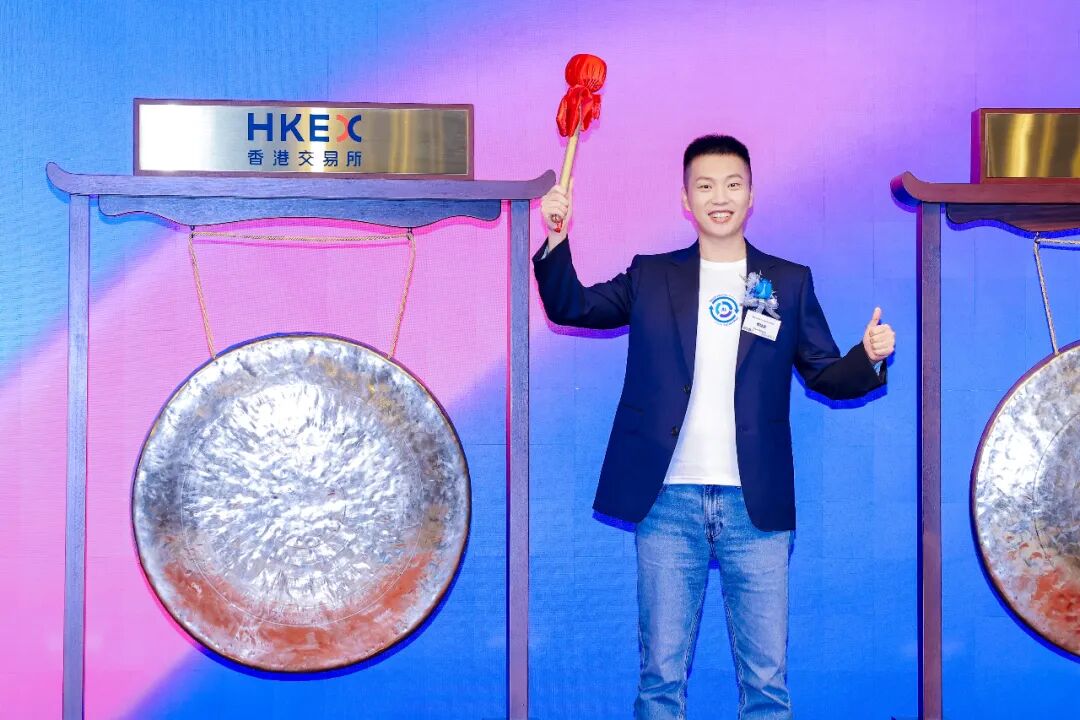
On July 8, autonomous driving company Momenta officially listed on the Main Board of the Hong Kong Stock Exchange under the stock code "6880". After the opening, Momenta's share price rose by more than 6% at one point, pushing its market value beyond HK$70 billion.
Calculated at the issue price of HK$295.6 per share, assuming the full exercise of the "green shoe" (over-allotment option), Momenta's global offering totals approximately 22.93 million shares, raising total proceeds of roughly HK$6.8 billion.
This undoubtedly delivered an exhilarating hammer blow amid the dull price war in the automotive industry.
Over the past decade and more, the automotive industry has gone through several rounds of reshuffling, not only producing leading new vehicle manufacturers such as NIO, Li Auto and Xpeng Motors that stand at the forefront of the car-building camp today, but also spawning breakout leaders across the industrial chain including CATL, Hesai Technology, and now Momenta.
Their underlying stories are highly similar: in a frenzied market environment, they identified and firmly implemented their own strategic will. Momenta's experience is a particularly typical example. Back when it was founded in 2016, the industry was ignited by autonomous driving technology, and capital flooded rapidly into Level 4 self-driving projects.
But Cao Xudong, who had deep roots in computer vision at Microsoft and SenseTime, early anchored the technical path of data-driven development and data closed-loop. He sought a business model where data and R&D systems could continuously reinforce each other, so at the very start of his entrepreneurship in 2016, he set the strategy of walking on "two legs" — L2 mass production and L4 autonomous driving.
Using the L4 leg to make cutting-edge technological breakthroughs that trickle down to the L2 mass production business, then leveraging the data flywheel generated by the L2 business to feed back the L4 autonomous driving operation.
"To achieve scalable L4, you definitely need a data flywheel and massive amounts of data. Without these two things, it is impossible to 'land on the moon'."
Prior to Momenta's listing, Feng Dagang, CEO of 36Kr, and Yang Xuan, Senior Content Director of 36Kr, interviewed Cao Xudong, Founder of Momenta, where he described the company's early strategic intentions in this way.
Making a choice is easy, but putting it into practice is often fraught with hardship and setbacks. 36Kr learned that from 2016 to 2022, Momenta explored almost all L2 mass production businesses that could be deployed on a large scale, successively trying aftermarket all-in-one devices and carrying out a large number of nearly-free POC (proof of concept) projects for automakers.
Even Cao Xudong himself experienced the gap between technical ideals and commercial implementation. He told 36Kr that when he first entered the automotive industry, he thought it was just like the internet, where it only took a few months from product initiation to launch, or at most one or two years if slow. But from breaking into Mercedes-Benz's supply chain to delivering products for vehicle installation, Momenta spent 8 years.
Fortunately, long-term tempering and preparation also allowed Momenta to be among the first to break into the door of mass-produced assisted driving algorithms for automakers. Today, it stands firmly in the leading camp of autonomous driving companies.
On the eve of its listing, Momenta announced that its cumulative vehicle installation volume had exceeded 1 million units. As its scale grows, its performance has increased linearly. Momenta's prospectus shows that from 2023 to 2025, the company's revenue surged from 743 million yuan to 2.413 billion yuan, with a gross margin reaching 71.6%. With the emergence of scale effects, its net loss also narrowed continuously from 1.093 billion yuan to 303 million yuan.
"Many people start with grand goals, saying they want to land on the moon. Then they think Mount Everest is the closest place to the moon, so they go climb Everest. But what you need to do to land on the moon is build a rocket. In our view, what we are doing in L2 mass production is essentially building a rocket," Cao Xudong told 36Kr.
Today, Momenta has once again made a new technical prediction, choosing the world model and reinforcement learning. This technical system has already been applied to the company's latest R7 world model.
Cao Xudong is quite confident in the R7 world model, claiming that the product "can go toe-to-toe with Tesla's FSD V14". Regarding the company's Robotaxi business, Cao Xudong also has a relatively robust plan: his goal is to "operate 10,000 Robotaxis by 2028, half in China and half overseas".
Momenta's longer-term strategic layout focuses on robotics. Cao Xudong plans to launch the robotics business in 2027. On one hand, by then "the construction of Momenta's Robot flywheel will be relatively complete". On the other hand, the company's "spillover capabilities will be just right for robotics development".
Admittedly, many autonomous driving companies in the industry, including automakers, have dabbled in cross-border robotics earlier than Momenta, but Cao Xudong does not feel that the company has missed the best time to enter the market.
This is not only because robotics and autonomous driving can achieve high reuse in areas such as data infrastructure, training infrastructure, data flywheels, and large model architectures. Most of Cao Xudong's confidence comes from the technical foundation, organizational system, and market scale that Momenta has forged through long-term cultivation in the automotive industry.
The following is an edited transcript of the dialogue between Feng Dagang (CEO of 36Kr), Yang Xuan (Head of Original Content at 36Kr), and Cao Xudong (Founder of Momenta):
On Listing: Going Public for Brand and Trust
36Kr: Why did Momenta decide to go public?
Cao Xudong: That's a very good question. The company chose to list at this point in time, largely for the sake of brand building and trust enhancement.
Actually, our company has quite substantial cash reserves, and our losses are narrowing rapidly. We will break even next year and achieve scalable profitability the year after. So from a cash flow perspective, whether we go public or not doesn't make much difference to us.
Although we are a To B company, we attach great importance to the C-end brand and the trust of C-end users in us. And listing will definitely amplify our brand to a large extent, thereby helping us win the trust of users, clients, and the capital market.
36Kr: Isn't this a bit like Intel? It makes users think that as long as a computer uses an Intel CPU, it must be very good. Similarly, if a car uses Momenta's assisted driving, it must also be very good?
Cao Xudong: That's definitely an object we learn from and draw inspiration from.
Now many of our clients will do co-marketing with us when their products are launched. For example, Mercedes-Benz, BMW, Audi, Toyota, Honda, Nissan, and Chinese automakers such as SAIC and Chery are all doing co-marketing with us. With a better brand and higher user trust, we can also help our clients sell cars better.
36Kr: How do you want the capital market to define Momenta? Is it an intelligent driving company, or an AI company? And what do you yourself think Momenta is?
Cao Xudong: I think people in the capital market are very smart. They won't define us in the way I wish they would.
In my view, our philosophy is "Better AI, Better Life". So in the long run, we are definitely an AI company that covers autonomous driving as one of our business areas.
From current urban assisted driving to future Level 4 autonomous driving, no matter for passenger cars, Robotaxis or Robotrucks, the core essence is AI. This AI core, when mapped to the physical world, is the World Model.
36Kr: Today many people are talking about the concept of "pure-blooded AI". For example, companies that sell tokens are considered pure-blooded AI, while other AI-related companies may not be defined as such. Do you think this external definition is unfair?
Cao Xudong: Different people have different views. I once read a saying: in the short term it's a voting machine, but in the long term it's a weighing machine. I think ultimately we have to focus on being the weighing machine.
When making decisions, our company is never capital-oriented, but more value-oriented. We figure out how to create value for users and what actions match our value orientation, then we take the corresponding approach.
Let me give you an example. When our company first proposed the idea of "one flywheel, two legs" — to mass-produce L2 and develop fully autonomous driving, the entire industry couldn't understand it at all. Everyone else in the industry was working on Robotaxis.
But we told a story that was inconsistent with the most mainstream direction in the industry, or the direction that received the highest valuation from the capital market. Why did we make such a choice? Because in our view, it was the right path — the only path that could eventually lead to scalable L4, so we chose it.
On the World Model: The World Model is a Necessary Condition for Achieving Autonomous Driving
36Kr: I heard that you yourself are actively working on the front line to keep up with the latest technological developments. Today's AI technologies and new concepts are emerging in endlessly. For instance, everyone is talking about the world model, but I feel everyone is defining it differently. How does Momenta define the world model, and how do you ensure that your world model truly understands the physical world?
Cao Xudong: Our world model mainly consists of three parts: first, World Model Prediction, second, World Model Simulation, and third, World Model Reinforcement Learning.
Let me start with World Model Pretraining. Our benchmark for this is GPT. The reason GPT is so powerful lies in its pre-training. Pre-training uses next-token prediction to train on all data from the entire internet or the whole digital world, compressing the common sense of the digital world into the model.
Correspondingly, World Model Pretraining works by predicting the future. For example, if I throw this pen up, it will fall down — this is essentially predicting the rules of the physical world. With massive amounts of such data, we can make these predictions, compressing the laws of the entire physical world into the model. In this way, the model acquires physical common sense.
36Kr: So the world model is very important for autonomous driving.
Cao Xudong: Yes, absolutely. It's not just autonomous driving — you can see that robotics is the same.
In the second half of last year, we had already verified the effectiveness of the world model in autonomous driving, and we are putting it into mass production this year.
During my visit to Silicon Valley in the first half of this year, I observed that many companies are shifting from VLA to the world model. This is because after large-scale pre-training using the world model, the success rate can be greatly improved. I have a number here that may not be accurate, but for reference: the success rate increased from 50% to 90%, which is a very substantial improvement. This has caused a huge stir in the industry.
36Kr: Earlier, everyone was working on end-to-end systems. What's the difference between that and the world model we're talking about now?
Cao Xudong: There's no conflict at all. End-to-end is everything. ResNet is end-to-end, Transformer is end-to-end, GPT is end-to-end, reinforcement learning is end-to-end, and the world model is also end-to-end. Nowadays, essentially every model is end-to-end.
36Kr: So what's the progress reflected in the world model that everyone is talking about now, compared to the end-to-end systems that were frequently discussed in the industry a few years ago?
Cao Xudong: Without the world model, if you only have an end-to-end system, the autonomous driving task becomes a slightly abnormal task, because its input dimension is extremely high. Without compression, its input tokens could number in the millions or even more.
But the output may only be the trajectory of autonomous driving, which could be just 10 or dozens of tokens.
That means going from a very high-dimensional input to a very low-dimensional output. This easily leads to overfitting, or causal confusion — the model will learn some very strange mapping relationships.
But if you have a World Model, the World Model first learns physical common sense. It's like a person who has gone all the way from primary school to university. At that point, when you discuss a university-level physics problem with him, it's very easy — you can explain it clearly in just a few words.
If that person has never attended primary or secondary school, and you try to discuss a physics problem with him, he might argue with you — for example, insisting that the Earth is the center of the universe.
36Kr: So do you think the world model is the ultimate answer to autonomous driving?
Cao Xudong: I think it's definitely a necessary condition, but not necessarily the ultimate answer, because technology is still evolving rapidly.
For another example, is reinforcement learning a necessary condition? I think it is. Is end-to-end a necessary condition? Definitely yes. Although people don't talk about end-to-end as frequently these days, in reality, reinforcement learning and end-to-end are the foundation — the world model and reinforcement learning are both built on top of end-to-end.
36Kr: So has reinforcement learning become extremely important again under the framework of the world model? When using reinforcement learning methods to train the world model, are there any potential problems that could arise, for example, with its reward function?
Cao Xudong: Yes, there are. This is very important, especially for safety — the improvement is extremely significant, at least 5-10 times better.
But there are indeed some challenges, because reinforcement learning is prone to "reward hacking" — just like employees might hack a company's KPIs, the model is also very likely to slack off. So the reward for reinforcement learning needs to be well designed. On one hand, we must ensure safety; on the other hand, we need to consider whether certain behaviors are anthropomorphic, so we also have some rewards that guide the model to behave like a human.
36Kr: Has Momenta seen reinforcement learning significantly improve the performance of autonomous driving?
Cao Xudong: The improvement in safety is particularly significant. For example, after we added reinforcement learning to our R6 system, safety was at least 5-10 times better than before the feature was deployed.
On Prioritizing Mass-Produced Assisted Driving: Massive Data is Required to Achieve Scalable L4
36Kr: You mentioned earlier the concept of "one flywheel, two legs" — developing L2 and L4 simultaneously. That reminds me of