SpaceX: Space Computing Power, Elon Musk's New Fantasy, or a Real Future?
Dolphin Research pointed out in SpaceX: AI Burning Money Nonstop, Is "Space Computing Power Hegemony" the Ultimate Killer Move? that space data centers are not only the core pillar of SpaceX's grand narrative, but also hold the largest "option value" in its future valuation.
To realize this vision, SpaceX has drawn up a seemingly crazy "space computing power deployment timeline":
1. 2028, the first batch of computing satellites enter orbit: The first orbital AI satellite fleet "AI1" is scheduled to launch large-scale commercial networking in 2028. These satellites boast a wingspan of 70 meters, with an average power consumption of 120kW (peak 150kW), acting like floating power stations suspended in outer space.
Dual-engine synergy of "Starship + In-house Chip Fab": Between 2028 and 2031, SpaceX will launch two game-changing infrastructure projects: first, ultra-high-frequency heavy-lift launches via Starship (V3 variant delivering 100 tons to orbit per launch, with long-term targets of 10,000 annual vehicle production and 10,000 annual launches); second, its Texas-based Terafab chip fabrication plant (adopting 2nm process, with long-term targets of 1TW annual computing power output, ~800GW of which dedicated exclusively to space deployment).
2. Post-2030, transporting 1 million tons of computing hardware to space annually: With both launch capacity and on-orbit computing power scaled up, SpaceX plans to achieve an annual delivery of 1 million tons of computing hardware to orbit by 2030-2031. Calculated at 100kW per ton of hardware, this corresponds to an annual new space computing power deployment capacity of 100GW, with its ultimate target directly hitting 1TW (1,000GW).
For reference, the total accumulated deployed AI computing power of all major global cloud service providers (CSPs) on Earth currently only stands at 30-50GW. This means SpaceX's annual "space computing power increment" alone is equivalent to building two to three times the total global cloud computing capacity entirely in space. If this plan is implemented, it will completely break the energy and land growth bottlenecks that plague ground-based computing infrastructure.
Facing such a disruptive industry landscape, this Dolphin Research analysis focuses on two core questions:
1) From ground-based operations to "space computing power hegemony": Is this merely a dazzling sci-fi fantasy, or a true "dimensionality reduction strike" against traditional tech giants?
2) Confronting such an unprecedented large-scale commercial closed loop, how exactly should we value this super unicorn SpaceX?
Below is the full analysis
1. The Core Question: Vacuum Heat Dissipation - Can It Be Done? Not Quite Yet
Ground-based AI data centers already present major engineering challenges. In the vacuum of space, where convective heat transfer does not exist and heat can only be dissipated via thermal radiation emitting infrared energy into deep space, the heat dissipation efficiency under the same temperature difference is merely 1% of that of ground air convection.
Heat dissipation stands as the top technical barrier for space computing power, with priority even higher than deployment cost and space radiation. In a vacuum, "how to expel excess heat" is the fundamental physical prerequisite for all computing operations.
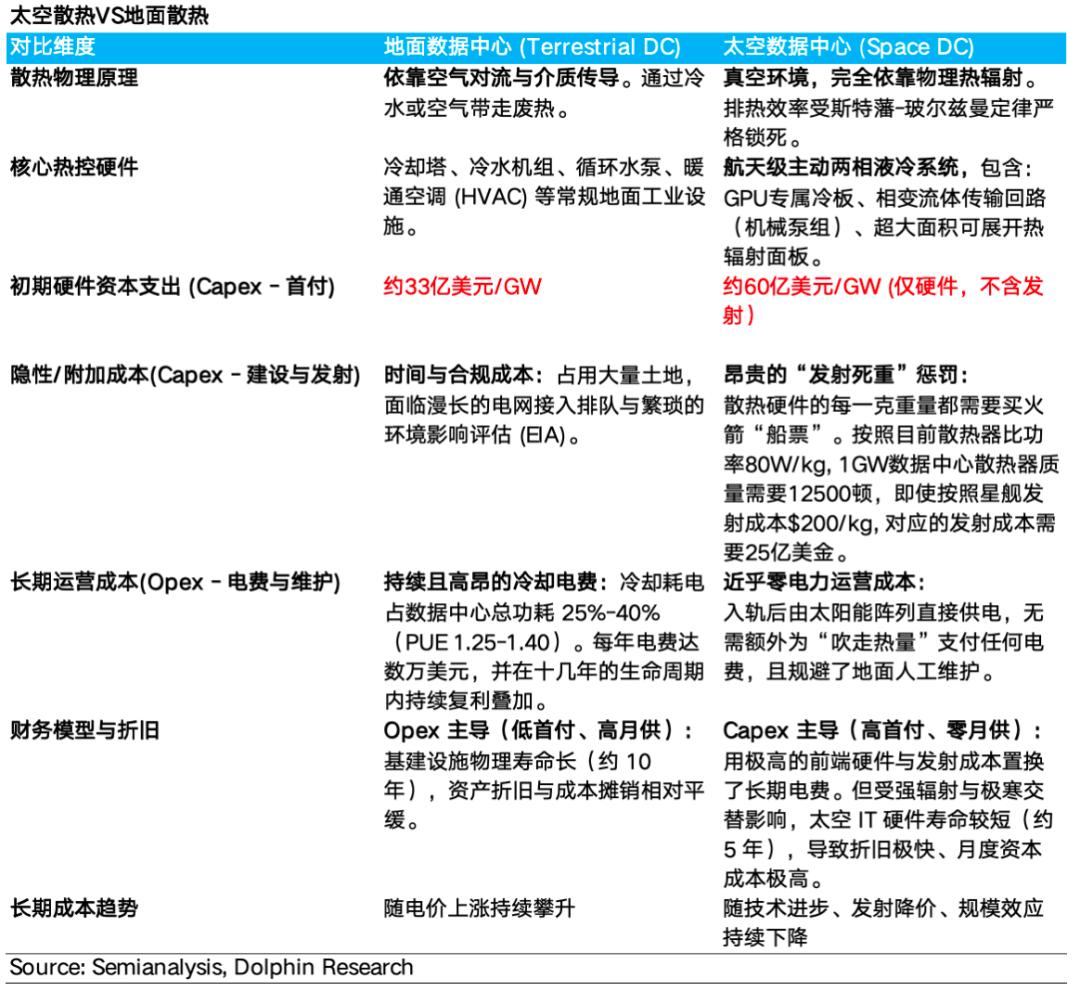
Currently, SpaceX faces several major dilemmas:
a. Hard physical area constraint: Based on fundamental physics, thermal radiation power increases with higher operating temperature, larger heat dissipation area, and higher surface emissivity. At a typical cabinet operating temperature of 70°C, the maximum theoretical radiative heat rejection limit is only 880 W/m². A 1.5MW data center would require 2,100 m² of radiator panels (roughly one-third the size of a football field), far exceeding the volume capacity of any rocket fairing.
b. Heat dissipation arrays as sitting ducks for space debris? Due to their enormous surface area, even a 1mm micro-debris fragment traveling at orbital velocity can penetrate the thin-walled radiator structure.
Additionally, LEO satellites experience extreme 250°C temperature swings (from +120°C to -160°C) every 90 minutes as they pass between sunlight and Earth's shadow. This violent thermal shock easily causes chip packaging cracking or pipeline fatigue leaks. With no possibility of manual on-orbit repair, a single penetration leak will completely disable the heat dissipation system and result in total satellite loss.
c. Prohibitive cost: The International Space Station uses customized aerospace-grade systems, with heat dissipation costs reaching $4.5-6.6 million per kW. Even under mass production cost reduction scenarios, pure heat dissipation hardware would still cost $6 billion per GW, nearly double the cost of ground data centers ($3.3 billion per GW).
d. Launch cost inversion: Under current Falcon 9 pricing, the launch cost to send this "deadweight heat dissipation hardware" to orbit hits $23 billion per GW (nearly 4 times the hardware cost). Even with future Starship launch costs dropping to $200/kg, the total launch price in 2026 (at 80W/kg specific power) would still be $2.5 billion per GW; this figure is only projected to fall below $1 billion per GW after 2032 following thermal control system iterations (targeting 195W/kg specific power).

To resolve these contradictions, space data centers must find a balanced solution across "efficiency, weight, and reliability":
a. Trading operational lifetime for reduced area (raising temperature tolerance thresholds): Leveraging the physical principle that radiation efficiency scales with the fourth power of absolute temperature, chips can be allowed to operate at full load at 85-100°C. Every 20°C temperature increase reduces the required heat dissipation area by 15%-25%. The tradeoff is reduced reliability and accelerated component degradation (long-term operation of GPUs and HBM above 85°C will accelerate hardware failure modes).
b. Trading extra power consumption for space (active liquid cooling decoupling): Adopt a heat transfer path of "cold plate → active pump → coolant → external radiator". While adding 2%-4% extra power consumption and introducing pump failure risks, this completely eliminates the geometric constraint that chips must be directly mounted to radiators.
c. Trading extra weight for lower cost (material downgrade + foldable deployment): Abandon expensive aerospace-grade materials in favor of ordinary 6061-T6 aluminum alloy with good thermal conductivity but higher density, following the logic of "using cheap deadweight to reduce manufacturing costs". The radiators are folded like an accordion during launch, then fully expanded once in orbit.
d. Trading redundancy for risk resistance (independent modular honeycomb piping): Reuse proven Starlink engineering experience, adopting integrated chassis with radiation fins, and designing liquid cooling pipelines as independent modular honeycomb networks. In case of debris impact, a single pipeline leak can be instantly physically isolated, effectively preventing single-point failures from causing total system loss.
From a technical perspective, the active liquid cooling + deployable radiator architecture is theoretically feasible, but it remains in the engineering validation phase and has not been tested at large-scale deployment.
2. Space Radiation - Will It Destroy Chips? Manageable
In semiconductor physics, the core metric determining whether a transistor is vulnerable to radiation effects is "Critical Charge" - the minimum amount of energy required to trigger a state flip (0→1) in the transistor.
As chip processes have evolved from 28nm to 3nm and below, transistor dimensions have shrunk dramatically, operating voltages have dropped significantly, and critical charge levels have decreased exponentially.
High-energy particles in space easily cause Single Event Upsets (SEUs, data corruption) and Single Event Latchups (SELs, short-circuit burnout). However, traditional radiation-hardened aerospace chips with large process nodes lack sufficient computing power to support AI workloads.
SpaceX's solution is to accept localized errors while ensuring system-level resilience:
a. Orbit advantage: Deploy systems in 500-1000km LEO/SSO orbits, using Earth's magnetic field to deflect most high-energy particles and reduce radiation flux at the source.
b. Heterogeneous architecture separation: Use 3nm GPUs for main computation (the "brain"), while 65/28nm radiation-hardened FPGAs/MCUs handle monitoring tasks (the "cerebellum"), detecting abnormal currents in real time and cutting power/restarting GPUs within milliseconds to prevent permanent burnout.
c. Targeted graded shielding: Abandon the full cabinet heavy metal wrapping approach, instead applying an ultra-thin "low-Z polymer + high-Z tantalum/tungsten" coating only above the GPU and PMIC core components to suppress secondary radiation, balancing thermal conductivity and lightweight design.
d. Natural AI tolerance + hierarchical fault tolerance: Large Language Models are probabilistic systems, where isolated SEU events are acceptable in most inference scenarios. HBM memory is equipped with ECC automatic error correction, and core control nodes deploy Triple Modular Redundancy (TMR) majority voting to completely filter out single-point hard errors.
Google research tested extreme LEO radiation conditions using a 67MeV proton beam experiment, empirically disproving the traditional assumption that "space operations must use expensive custom radiation-hardened chips":
HBM Memory (3x radiation tolerance, imperceptible error correction): Only isolated errors appeared after absorbing 2 krad of radiation (nearly 3 times the 5-year expected dose for ultra-low orbit satellites), all of which were automatically corrected by ECC with zero service disruption.
Core Computing Chips (20x radiation tolerance, zero physical damage): No permanent damage occurred even after exposure to 15 krad of radiation (20 times the expected dose), with AI training and inference operations remaining fully stable throughout the test.
This test empirically validated that the "advanced COTS process chips + software-level fault tolerance (ECC/watchdog reset)" technical path can withstand extreme radiation environments.
3. Latency: A Legitimate Challenge
The interior of a space data center remains a standard "NVIDIA server farm", but external interconnection becomes a massive wireless network woven together by "space lasers (high-speed inter-satellite links)" and "microwave/hybrid optical-terrestrial links (satellite-to-ground backhaul)":
a. Intra-Cluster Interconnection (Inside satellite vs Inside ground cabinet): Identical
GPUs on the same motherboard still use NVLink/NVSwitch interconnection, and different compute nodes are still connected via standard Ethernet or InfiniBand to form local clusters.
b. Node-to-Node Interconnection (Between satellites vs Between ground data centers): Transition from "wired" to "wireless"
Ground: Data centers or server racks must be connected via physical fiber optic cables buried underground or strung overhead.
Space: Fully wireless. Different satellites use Optical Inter-Satellite Links (ISL), using invisible laser beams to achieve ultra-high-speed data transmission.
c. Backhaul Links (Between space and ground vs Ground fiber backbone): Tradeoff between stability and speed
This represents the most significant difference between space and terrestrial networks. Ground data centers connect directly to extremely stable, ultra-high-bandwidth fiber optic backbones; but space computing power must transmit data through the thick atmosphere to reach Earth users, facing unavoidable physical compromises:
Stability-First (Ka-band Microwave): The current mainstream solution. Transmit data via radio waves at relatively modest speeds (~17Gbps), but it is extremely robust, immune to rain and cloud cover, and maintains 24/7 uninterrupted connectivity.
Speed-First (Optical Ground Links): The future upgrade path. Offering 100x higher bandwidth ideal for massive AI data transfer, but extremely sensitive to atmospheric conditions - connectivity drops immediately in rain, fog, or cloud cover, requiring massive global deployment of redundant ground stations that are completely dependent on favorable weather.
Current challenges facing space data centers include:
a. Data Latency: A single Low Earth Orbit (LEO) computing satellite orbits Earth 15 times per day, with only 5-7 minutes of visibility over any specific ground station. Connection quality is only good when the satellite happens to pass directly overhead the nearest ground station to the user, a window that lasts just 5-7 minutes per day.
Once the satellite moves out of range, data must be relayed across multiple satellites in a "telephone game" style multi-hop transmission, driving one-way latency straight up to 30-80ms (compared to <1ms over terrestrial fiber).
b. Satellite-to-Ground Backhaul: Switching from radio frequency links to optical ground links further exacerbates these issues. Optical satellite-to-ground links are highly vulnerable to weather disruptions, building a global network of ground stations is prohibitively expensive, and communication between distributed ground stations and end users introduces additional latency.
For SpaceX, viable solutions include:
b. Promote "Sensor-Compute Converged" Edge Processing: Satellites can process captured imagery directly on adjacent computing satellites, where AI extracts actionable results in 1 second on-orbit, compressing 10GB of raw full-resolution imagery down to a tiny few-kilobyte "text message" of conclusions (e.g. "Anomalous target detected at coordinates X") for downlink to Earth. This reduces total downlink data volume by over 90%.
With drastically reduced data volumes, even if optical links are blocked by weather, operations can switch to weather-immune microwave backup links (Ka/V bands) to achieve sub-second all-weather downlink. However, this approach will impose limitations on multi-round, multi-modal interactive AI use cases.
Communication latency is fundamentally constrained by the speed of light and orbital mechanics, and cannot be eliminated through any technical improvements. Therefore, space data centers must abandon millisecond-latency real-time use cases (autonomous driving, high-frequency trading), and precisely position space computing power for high-latency-tolerant asynchronous workloads: AI training (days/weeks cycle), meteorological and climate simulation (tolerable to multi-second delays), and on-orbit space processing (debris collision warning, astrophysical modeling, etc.).
Operations & Maintenance: The inability to perform convenient manual on-orbit intervention is the core operational challenge for space data centers. At this stage, redundant design (e.g. pre-deploying 20% excess GPU capacity to handle unfixable permanent hardware failures, and reserving margin for radiation-induced computing power availability degradation - targeting 95% compute uptime) and software-level fault tolerance mechanisms (ECC error correction, watchdog resets, etc.) are used to replace on-site maintenance, which increases overall deployment and operational costs.
On-orbit robotic maintenance remains in experimental phases. It is expected that after 2032, as on-orbit robotics technology matures, partial on-orbit repair and component replacement will become feasible, extending the operational lifespan of space data centers.
4. Cost Economics: Is It Economically Viable?
The above analysis primarily examines technical feasibility. Next, we focus on economic viability. Compared to ground data centers, space data centers have access to effectively unlimited solar energy.
However, this energy is not completely free. Dramatic differences in sunlight exposure across different orbits directly impact power generation capacity and energy storage costs:
Low Earth Orbit (LEO): Orbiting Earth ~15 times per day, LEO satellites are exposed to sunlight for only ~60% of their orbital period, with low average effective solar irradiance. Frequent passes through Earth's shadow require large-capacity energy storage batteries, significantly increasing system complexity and hardware costs.
