How does the startup team from Northwestern Polytechnical University with a valuation of over 1 billion successfully take root in industrial scenarios?
While many robot manufacturers are still searching for viable landing scenarios to achieve breakthroughs from 0 to 1, this entrepreneurial team founded by alumni of Northwestern Polytechnical University has already developed the fourth-generation embodied intelligent industrial robots.
Recently, Sixth Mirror Technology completed its B1 round of financing of tens of millions of yuan, with investments from Kunlun Trust and Xi'an High-Tech Investment. The company's valuation has exceeded 1 billion yuan, and it has simultaneously launched the B+ round of financing. While most AI enterprises are still confused about "how to implement technology in real scenarios", this AI company originating from Northwestern Polytechnical University has long taken deep root in the two major scenarios of industrial quality inspection and work safety.
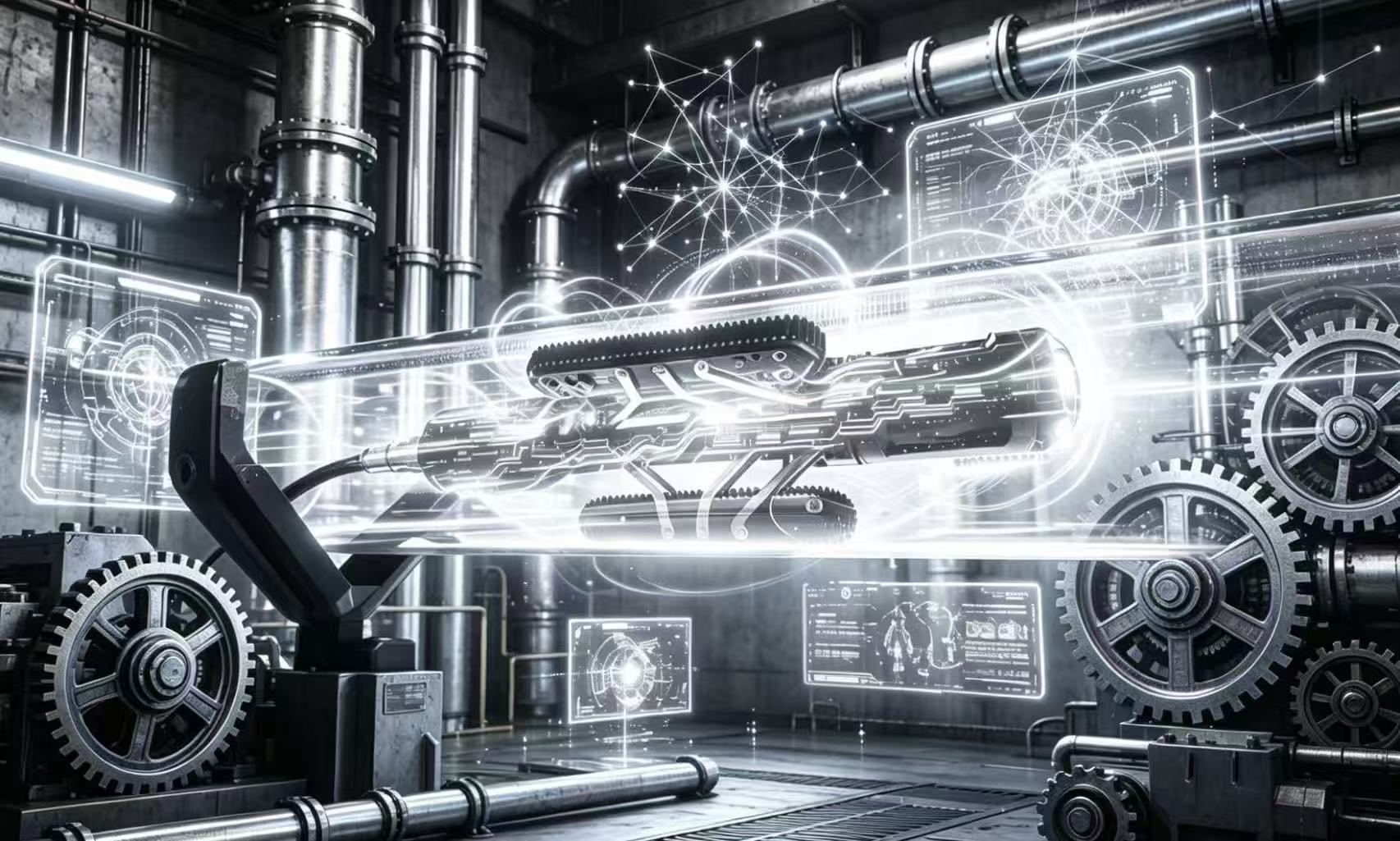
What Sixth Mirror does is essentially industrial AI — empowering the transformation and upgrading of traditional manufacturing with artificial intelligence. And industrial AI is precisely standing at the dual favorable outlets of policy and industry. From the national "14th Five-Year Plan" Intelligent Manufacturing Development Plan to the Intelligent Inspection Equipment Industry Development Action Plan, from the proposal of "new quality productive forces" to the intensive introduction of special "AI + Manufacturing" action plans across various regions, the policy side is paving a fast track for the landing of industrial AI.
Three Major Mountains Facing Industrial AI
The industrial AI track has never been an easy path.
Completely different from the "massive data and standard scenarios" of traditional consumer internet, the integration of AI and industrial production faces three natural barriers:
The first barrier is the extremely scarce small-sample data barrier. First, make an important distinction: not all industrial scenarios need to "learn what a defect is". For products such as PCB boards and mirror steel strips with high feature consistency, AI only needs to learn "what is qualified", and can detect anomalies by comparing differences.
However, in high-end industrial production, under normal production conditions, the yield rate is extremely high, and defective samples are inherently scarce. To make AI learn to identify "what is a defect", it is necessary to obtain enough "defective samples" first — which is a paradox in itself. Traditional deep learning relies on massive data drive, while in industrial scenarios, data acquisition is difficult and costly, making model training very challenging.
The second barrier is the highly exclusive industry knowledge barrier. Different from the relatively standardized production processes and quality inspection standards of 3C and lithium battery industries, fields such as metallurgy, chemical industry and energy all have highly exclusive and non-universal technological processes, equipment mechanisms, defect features and quality evaluation systems. There is no general detection algorithm and model logic for scenarios, nor standardized solutions that can be reused across industries. The algorithm model deeply developed for steel metallurgy quality inspection cannot adapt to the inner wall corrosion and crack detection of petroleum pipelines; the technical system adapted for plate defect identification will completely fail when migrated to pipe and pressure vessel scenarios.
Such high-end industrial AI detection is by no means a simple algorithm technology R&D. It must be deeply bound to the core industry know-how. The accumulation of exclusive industry knowledge, scenario experience and defect judgment logic requires long-term deep cultivation on site, which cannot be quickly replicated or implemented, forming an extremely high industry access barrier.
The third barrier is the full-link closed-loop barrier from perception to execution. At present, most industrial AI enterprises are only good at front-end visual algorithms. In general scenarios such as 3C and lithium batteries, they only need to complete defect perception and labeling to achieve implementation, without participating in subsequent disposal. However, high-end industrial scenarios require full-link closed loop: not only accurate perception, identification and judgment, but also linkage of on-site equipment, production processes and operation and maintenance systems to complete intelligent disposal, state correction, data review and model iteration.
Such scenarios are highly closed and professional, with complex equipment linkage, extremely low production fault tolerance rate and strict operation and maintenance specifications. Most enterprises lack on-site industrial operation and system linkage experience, can only achieve basic perception, cannot undertake subsequent judgment, disposal and review, and completely break the value closed loop of "perception-judgment-disposal-review-iteration". Because the full-link technology is difficult, the adaptation cost is high, and the verification cycle is long, the implementation of products from 0 to 1 is often calculated in years, which is far longer than that of general detection scenarios.
Entering the Market in 2019 and Winning "National Team" Clients
As early as 2019, Sixth Mirror Technology has already started to deploy embodied intelligent scenarios. PetroChina, HBIS, TISCO, Xinxing Ductile Iron Pipes, Shaanxi Coal... These "national team" players in China's industrial system are clients that Sixth Mirror has gradually served since 2019. Today, Sixth Mirror's product matrix has covered a variety of scenarios in the industrial field. This press conference mainly introduces two major landing scenarios of embodied intelligent robots.
Released Scenario Products: AI + Quality and Safety in Invisible Industrial Spaces
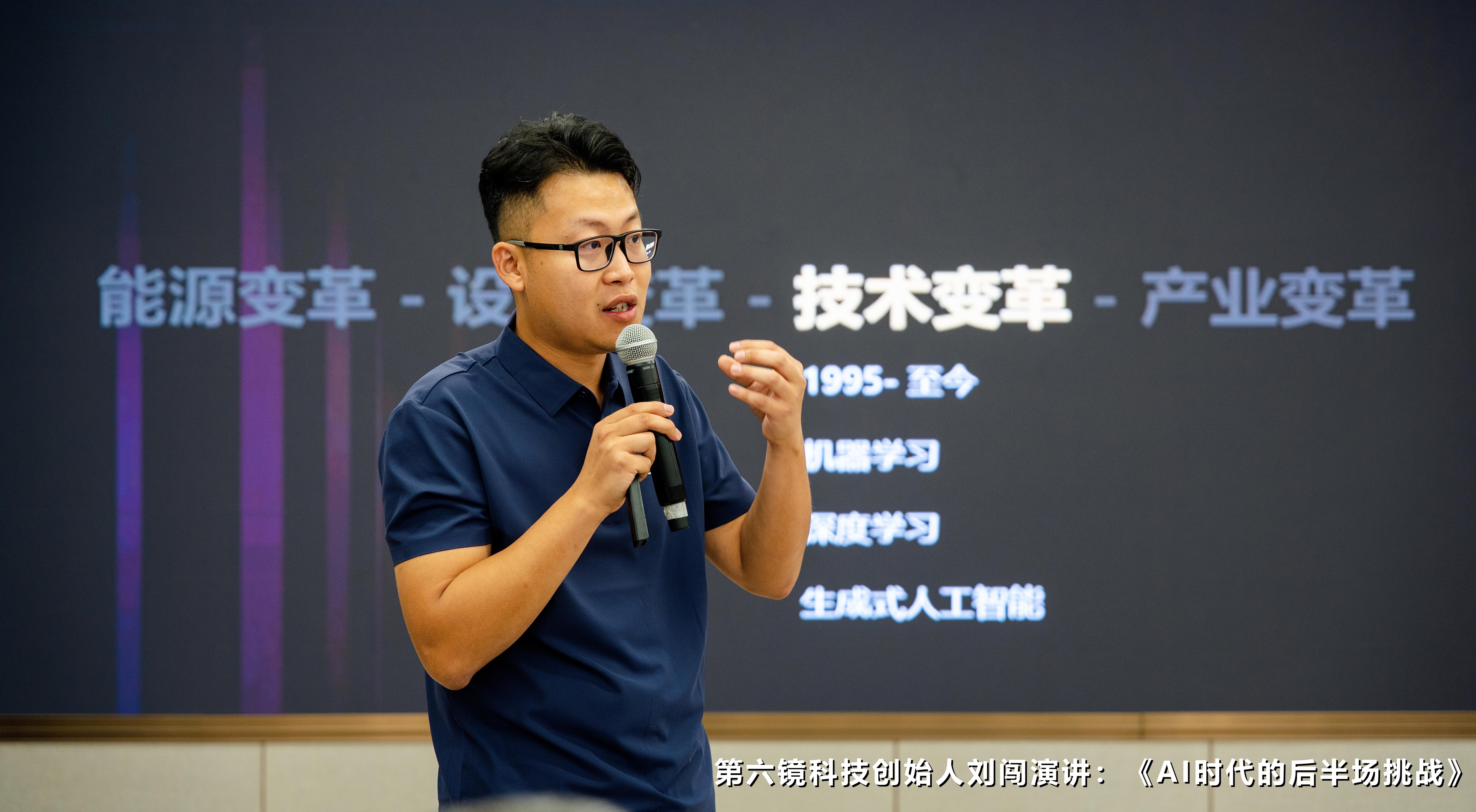
At the press conference, Liu Chuang, founder of Sixth Mirror Technology, demonstrated the three-layer technical architecture of Sixth Mirror industrial robots: the bottom layer is AI tools, the middle layer is the "eyes and brain" that combines software and hardware such as computing power and 2D+3D visual recognition system, and the top layer is the embodied execution layer close to user applications, which fully reflects Sixth Mirror's full-stack strength in the high-end industrial field.
Scenario 1: Prismind L Pipeline Visual Quality Inspection Robot.
Oil and gas pipelines, chemical transmission pipelines, municipal water supply and drainage systems... These pipelines are often hidden in dark, narrow, high-risk unstructured extreme environments. Traditional detection methods either cannot reach them at all, or are costly and inefficient. The core advantage of Sixth Mirror's Prismind L pipeline robot can be summarized in four points: clear vision, stable movement, accurate judgment and full control.
Clear vision — go deep into dark, narrow, high-risk unstructured extreme environments, break through the detection limits of human vision and conventional means, and convert the invisible state inside the pipeline into perceptible, diagnosable and decision-supporting data assets.
Stable movement — can move stably inside complex and unstructured pipelines, adapt to hidden spaces such as small and medium-diameter pipelines.
Accurate judgment — equipped with a vertically customized large model specially developed for industrial quality inspection scenarios, it has "expert-level" industrial knowledge to make accurate judgments on detection data.
Full control — form a full-link closed loop from perception, identification, judgment, disposal to review, and precipitate into iterable, migratable and scalable industrial embodied intelligence capabilities.
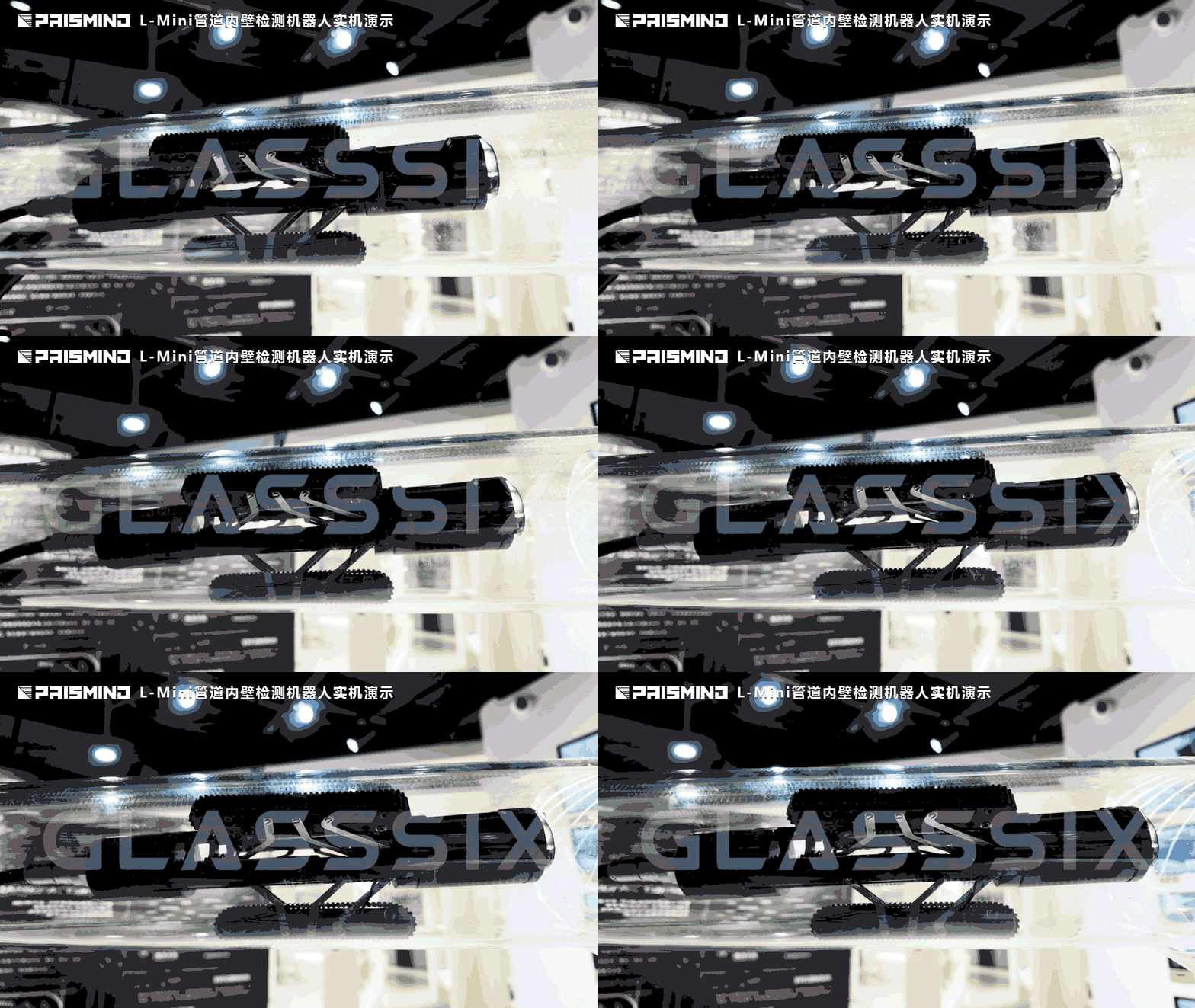
For industries such as oil and gas and chemical industry, Prismind L solves the persistent problems of traditional detection modes such as "low coverage, delayed response and high cost" — transforming the pipeline from a "black box" that cannot be directly observed into a visualized and digitalized transparent state, realizing the paradigm revolution from "post-maintenance" to "predictive maintenance". For front-line detection and operation and maintenance personnel, it replaces manual work in dark, narrow and high-risk environments, greatly reducing safety risks. For enterprise decision-makers, detection data is no longer a "one-time consumable", but a core asset that can be iterated and reused.
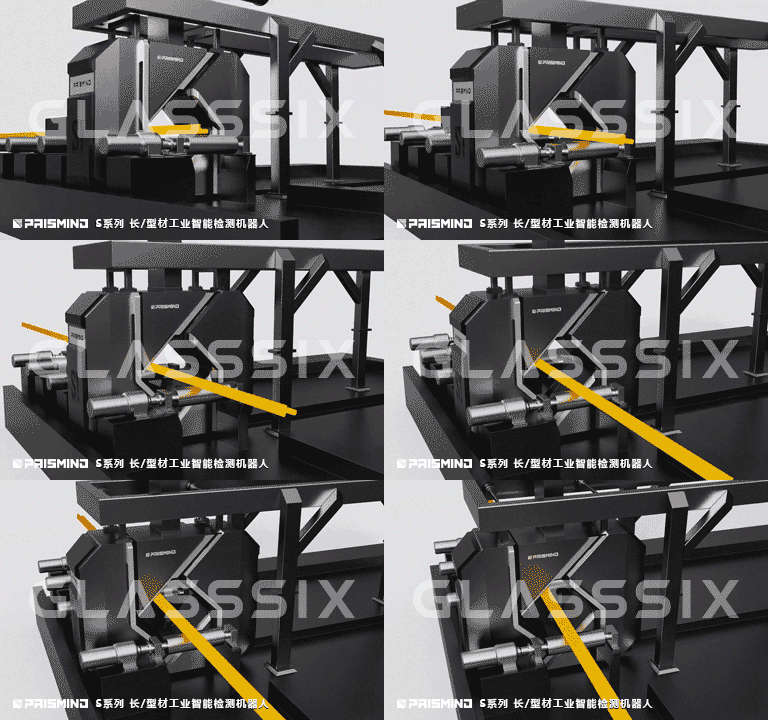
Prior to this, Sixth Mirror has launched the Prismind series of quality inspection robots for steel of different shapes such as profiles, plates and wires. The release of Prismind L marks that Sixth Mirror's industrial quality inspection product line has completed the coverage of all categories of products in the metallurgical industry — various application scenarios such as profiles, plates, pipes and wires.
Scenario 2: "Eyes and Brain" Embodied Intelligent System for Work Safety.
If the pipeline robot solves the "quality" problem, then the work safety solution solves the "life and death" problem.
In high-risk industries such as metallurgy, energy and mining, work safety is never a slogan — it is related to human life. Traditional work safety monitoring relies on cameras + manual supervision. But the reality is that the massive video streams generated by tens of thousands of cameras cannot be fully checked by manpower; and a single algorithm model frequently produces false alarms and missed alarms under extreme working conditions such as dense dust, low light occlusion and high temperature radiation.
A single algorithm is easy to develop, but the SOP covering the whole process of complex industries is extremely difficult.
Why is it so difficult? Because the SOP (Standard Operating Procedure) for work safety is not just a simple recognition of safety helmets and reflective vests, but involves different specific industrial production steps. For example, how to replace the flange safely is by no means a simple disassembly and assembly, but a high-risk and complex operation that needs to go through links such as work permit approval, energy isolation and lockout-tagout, medium emptying and replacement, and installation of blind plates. During installation, it is necessary to rely on a torque wrench to fasten diagonally in steps to accurately control the compression amount of the gasket. After the operation, strict pressure test and leak detection are required to verify the sealing performance. Any omission may lead to leakage or even catastrophic accidents. The precipitation of SOP for such complex industrial processes requires a lot of professional knowledge and practical experience, which is exactly the difficulty of implementing complex algorithms.
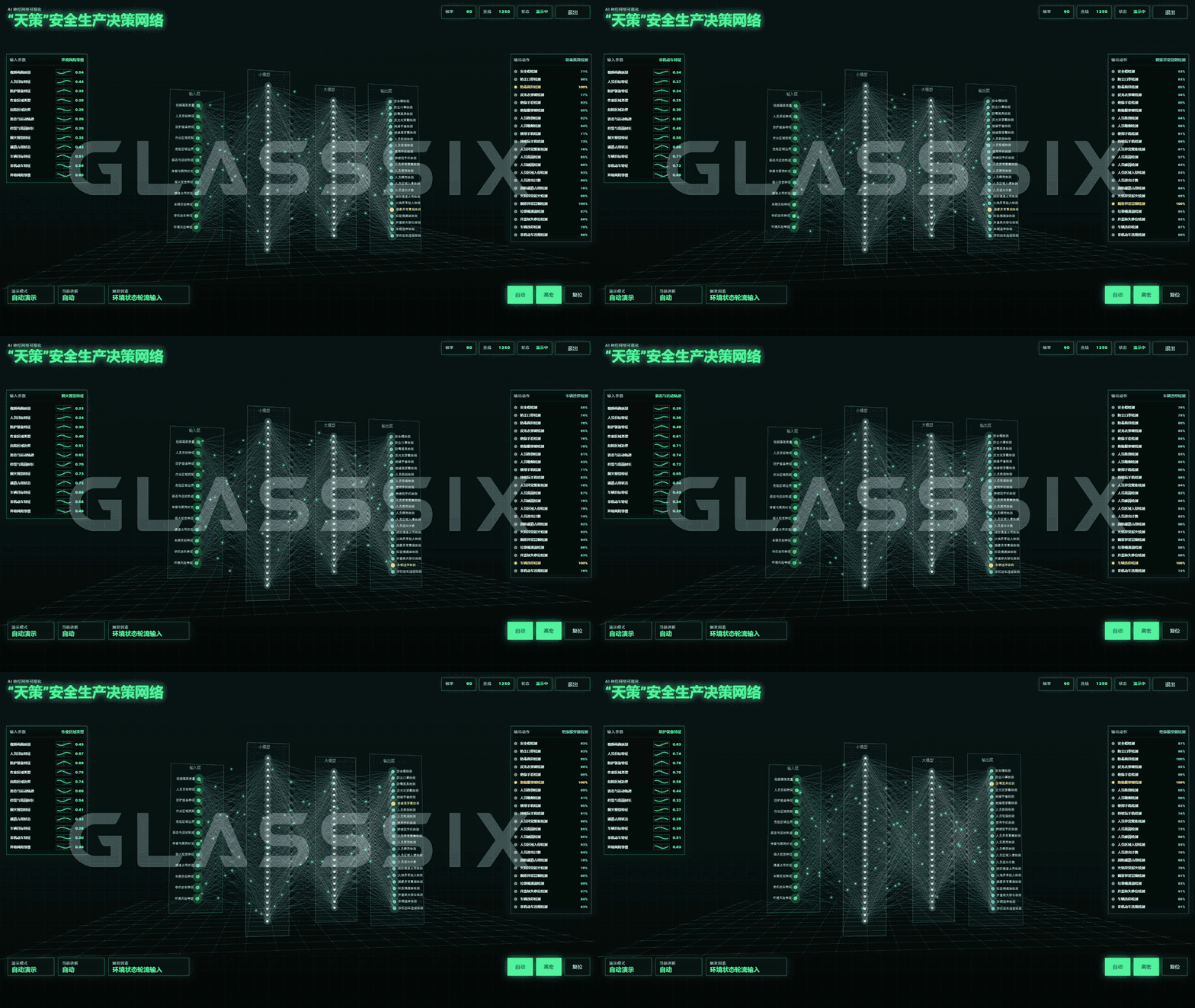
This set of solutions from Sixth Mirror is a full-link intelligent safety management system built around the "Tiance" work safety VL large model and the "Xiyi" AI safety decision-making brain.
At the perception layer, it integrates multiple cameras, sensors and robots to monitor environmental anomalies in real time and identify violations. At the management and control layer, it supports full-process monitoring of high-risk operations and compliance inspection of work permits. At the emergency layer, it provides knowledge Q&A and disposal recommendations. At the report layer, it automatically generates reports and supports one-click export. At the decision-making layer, it can summarize the situation of multiple factories to assist senior management in real-time decision-making. The value of this solution covers everyone from front-line staff to senior management: front-line personnel get real-time alarms to avoid risks; safety management personnel reduce their burden and realize automatic closed loop and compliance; senior management realizes real-time decision-making. More importantly, it provides SaaS lightweight services to reduce the decision-making burden of small and medium-sized enterprises, allowing them to obtain AI capabilities at a low cost through subscription. Through six steps of preset template, data access, model fine-tuning, edge deployment, business configuration and operation optimization, the capabilities can be migrated, combined and replicated on a large scale. The full-process closed loop from perception to disposal and review — this is exactly the core capability of Sixth Mirror's embodied intelligence.
"Slow from 0 to 1, Fast from 1 to 10": The Ten-Year Deep Cultivation Logic of an Industrial AI Company
"Industrial AI is the future development direction of artificial intelligence." Liu Chuang, founder of Sixth Mirror, said in the interview. In 2014, Liu Chuang, who was a junior at Northwestern Polytechnical University, founded Sixth Mirror with two classmates. From campus entrepreneurship to a valuation of over 1 billion yuan today, they have taken 12 years on this road. Different from the "extensiveness" pursued by consumer-grade AI, industrial AI pursues "depth" — dig deep enough and thoroughly enough in one scenario before expanding horizontally. This is exactly the development logic of Sixth Mirror: cultivate deeply in different industrial fields, and then extract reusable industry methods.
"The speed of industrial scenarios from 0 to 1 is very slow, but the improvement from 1 to 10 can be very fast. Because once you truly understand the pain points of an industry, accumulate enough on-site data, and polish a reusable standardized product, the marginal cost of horizontal replication will drop sharply." Sixth Mirror has now served more than 500 industry clients and created 726 AI-enabled scenarios. From steel to chemical industry, from energy to mining, from domestic to overseas — this flywheel of "1 to 10" is accelerating.
Standing on the Shoulders of China's Manufacturing Industry, Let Industrial AI Move to the Global Stage
Not only in the domestic market, the feedback from overseas markets is also equally exciting. Sixth Mirror's products have gradually gone overseas and established cooperation with clients in the United Arab Emirates, Russia and other countries.
In March 2026, Sixth Mirror joined hands with SICK, the global giant in industrial sensing and vision technology from Germany, to participate in the Vision China Shanghai Exhibition. Liu Chuang recalled: "In the communication with overseas clients, a foreign partner made such an evaluation of our products: 'The products of your company make me feel that I have arrived in the future.'"
This is not an exaggeration. In the global industrial AI competition, relying on the vigorous development of China's manufacturing industry as well as the vast industrial market and clients, Chinese enterprises have been at the forefront of the world in their development level. Sixth Mirror's industrial embodied intelligence is exactly developed on the shoulders of China's manufacturing industry — there is an astonishing steel output, particularly prominent chemical production capacity, and a huge network of energy infrastructure. In the future, China's manufacturing industry will gradually move to the center of the global stage, and industrial AI enterprises will also go further because of this.
From an entrepreneurial laboratory in Northwestern Polytechnical University to a leading industrial AI enterprise with a valuation of over 1 billion yuan, the story of Sixth Mirror is, in a sense, a microcosm of China's hard technology entrepreneurship: do not chase hot trends, only solve problems; do not hype concepts, only focus on implementation. The future of China's manufacturing industry precisely requires more such "real capabilities".