Space Computing Power — Sending Chips Next to the Sun
Introduction:
As AI enters the large model era, competition for computing power has gradually evolved from chip rivalry into a contest over energy, land, and electricity. While terrestrial data centers keep pushing against the physical limits of power grids, heat dissipation, and resource supply, a new type of infrastructure has begun to emerge on the industrial horizon — space-based computing power.
This is not simply about moving data centers into space, but an attempt to redefine next-generation computing infrastructure: leveraging continuous solar power in orbit, natural cryogenic heat dissipation, and global coverage to provide a new computing foundation for the AGI era.
In this issue of Future Prelude, we attempt to answer questions including why space-based computing power is emerging, how its industrial value will be distributed, and what the current state of the industry looks like, along with related industrial observations.
Future Industry Insights for This Issue | Space-Based Computing Power

Let's start with core viewpoints:
Xie Siwei, Investment Vice President at BV Baidu Ventures: We are standing at the intersection of the AGI era and the Space 2.0 era, while terrestrial AI computing power is clearly facing multiple physical bottlenecks — power grids cannot expand fast enough, electricity supply cannot keep up, and heat cannot be dissipated efficiently. Therefore, space may be the most straightforward path to circumvent these challenges. We believe the value distribution across the space-based computing power industry chain is far from finalized: payloads have the thickest barriers, networking holds the strongest sovereign control, and operations boast the highest ceiling. It is too early to conclude which party will eventually become the chain leader. We look forward to early-stage companies closing the computing power loop in orbit and securing a ticket to the next-generation infrastructure.
01. A Future Market Worth $28.5 Trillion
SpaceX recently went public, raising $75 billion and reaching a market capitalization of $2.1 trillion, making it the largest IPO in human history.
SpaceX's 280-page prospectus drew most attention to its relatively mature Starlink and rocket businesses, but we believe the most noteworthy part is its estimation of Total Addressable Market (TAM) — $28.5 trillion, over 90% of which comes from the AI sector. This estimate is built on a major premise: Earth is highly unlikely to rapidly expand its power generation and computing capacities.
In 2025, global data centers consumed 485 terawatt-hours of electricity, equivalent to the total annual power consumption of Japan. By 2030, this figure is projected to double to 950 terawatt-hours. The power consumption of AI servers is growing at roughly 6 times the rate of global total electricity consumption. The total load of pending grid-connected data center projects in the United States has reached 241 gigawatts, with over 170 gigawatts of power applications backlogged in Texas alone, requiring a 3-8 year waiting period. Transformer lead times have extended from 12-16 weeks before the pandemic to 128-144 weeks.
Although computing power is still expanding exponentially, the power grid is clearly struggling to keep up.
Musk's solution to this problem is both simple and bold: move data centers into space — the Starmind project.
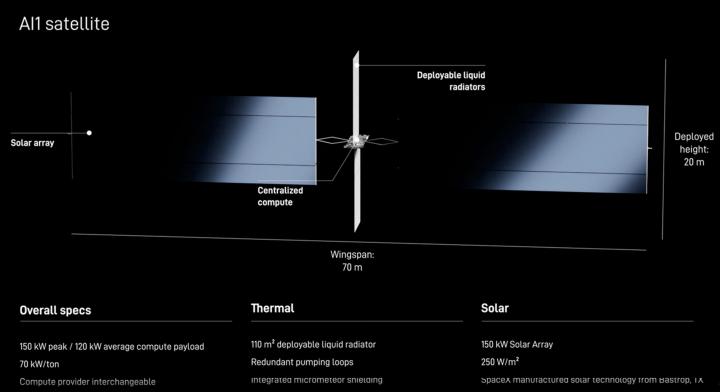
On June 8, 2026, SpaceX publicly revealed the design details of its AI1 computing satellite for the first time — a 70-meter wingspan, 150-kilowatt solar array, 110-square-meter deployable liquid-cooled radiator, with single-satellite computing power equivalent to one NVIDIA GB300 terrestrial AI cabinet. Musk's timeline targets an annual deployment rate of 1 gigawatt of space-based AI computing power by the end of 2027, equal to the daily electricity load of residents in a standard urban area with a million people.
This is not so much a new narrative for a rocket company as a computing power company using rockets to solve its most fatal bottleneck.
Summary: The ceiling of computing power may not lie in chips, but in electricity. The first to bypass this barrier will be more likely to secure a ticket to next-generation AI infrastructure.
02. The Dilemma of Terrestrial Computing Power
To understand the logic of space-based computing power, we must first sort out the full picture of terrestrial computing power.
Let's look at the United States first. The four major tech giants will see their combined capital expenditure exceed $725 billion in 2026 — roughly $200 billion from Amazon, $180-190 billion from Google, $190 billion from Microsoft, and $125-145 billion from Meta. This figure represents a 77% increase over 2025 and is still rising. Google even resorted to an equity financing tool unused for over two decades, raising $84.7 billion in one go to invest entirely in AI infrastructure. From 2020 to the first half of 2026, the U.S. has accumulated approximately $3.27 trillion in AI infrastructure investment, 76% of which comes from corporate self-funding.
Where did this money go? To buying GPUs, building data centers, and constructing chip factories — but the core bottleneck is actually electricity. A 40-megawatt AI data center faces roughly $140 million in electricity costs over its 10-year operational lifecycle, accounting for 84% of total costs, and this is calculated at an industrial electricity price of $0.04 per kilowatt-hour. Securing new power connections in core hubs typically requires a 5-7 year wait. Goldman Sachs predicts data center power demand will surge 165% by 2030, with 43% of global data centers located in high water-stress regions; a 40-megawatt data center consumes around 1.7 million tons of water over 10 years.
Now turn to China. Data from the National Development and Reform Commission shows that computing network investment exceeded 400 billion RMB in 2026, and cumulative investment during the 15th Five-Year Plan period is projected to surpass 2 trillion RMB. In the first half of 2026, 412 new intelligent computing center projects were launched nationwide, with total investment of 892.6 billion RMB, a year-on-year increase of 68.5%. ByteDance has started construction on a 1GW AI computing cluster in Ulanqab, with total investment of 70 billion RMB, supported by 2 GW of wind and solar power stations for direct green power supply. By the end of March 2026, China's intelligent computing power scale had reached 1882 EFLOPS.
Unlike the U.S., China's computing power development is strongly government-guided — 15% of funding comes from government guidance, 35% from state-owned enterprise leadership, and 40% from private capital. According to statistics on public project data, China's cumulative AI infrastructure investment is roughly 1/5 of the U.S. level. Restricted by high-end GPU export controls, China relies more on domestically developed Ascend and Cambrian solutions. The "East Data, West Computing" initiative uses real-time pricing based on carbon emission factors per unit of electricity, making cheaper power available in western regions but introducing 15 milliseconds of additional network latency. All local computing parks are required to mandatorily support energy storage and distributed photovoltaics, and newly built intelligent computing centers must maintain a PUE below 1.3.
Adding these three sets of figures together, the conclusion becomes clear: The expansion speed of terrestrial computing power is being constrained by the physical world.
NVIDIA's H100 chip consumes 700 watts per unit, and the next-generation Blackwell architecture will push a single cabinet's power consumption to 240 kilowatts, potentially hitting 1.5 megawatts by 2028. Chips continue to double in performance following Moore's Law momentum, but the three fundamental foundations — electricity, heat dissipation, and land — are already struggling to support this growth.
Summary: The U.S. is spending heavily to compete for electricity, while China is using policy to allocate power resources. But regardless of the path chosen, terrestrial computing power is approaching its physical ceiling.
03. Why Space?
The underlying logic of space-based computing power is that space naturally solves the three most expensive problems on Earth.
Energy Arbitrage. Terrestrial solar power is limited by weather and day-night cycles, with an annual equivalent utilization time of roughly 1200-1800 hours. But in the dawn-dusk orbit — the orbit that always flies along the Earth's terminator — the sun never sets, delivering 6000~8000 hours of annual equivalent utilization. The theoretical energy cost of orbital solar power can be as low as $0.002 per kilowatt-hour, 95% lower than terrestrial industrial electricity prices. SpaceX has even built its own solar production line in Bastrop, Texas, to vertically integrate photovoltaics and rockets.
Cooling Arbitrage. In the vacuum of space, radiating heat into deep space at -270°C is an almost passive process that barely requires energy-consuming equipment. SpaceX's AI1 satellite uses a 110-square-meter deployable liquid-cooled radiator, achieving a two-sided radiative cooling capacity of roughly 1400 watts per square meter. The cooling process uses no water and consumes almost no electricity.
Sovereignty and Space. Free from geographical restrictions, space can provide "sovereign cloud" services with physical and jurisdictional isolation. For governments, financial institutions, and cross-border enterprises, this is value that cannot be easily replicated on Earth.
Based on optimistic projections from U.S. space computing startup Starcloud, we can roughly work out a full cost calculation. Taking a 40-megawatt cluster operating for 10 years as an example:
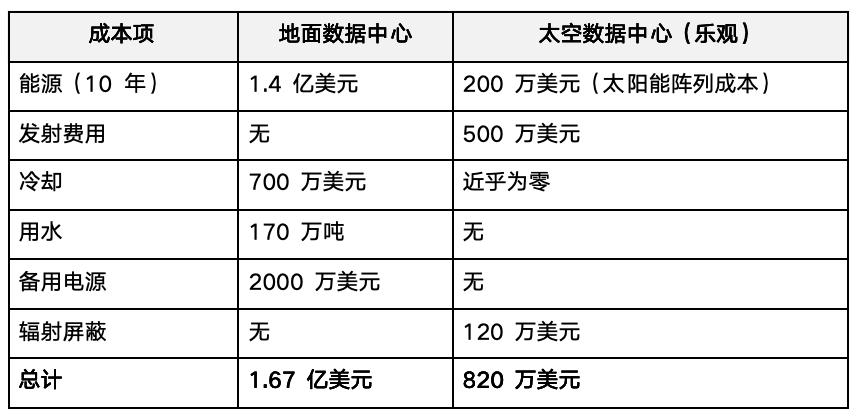
There is a 20-fold cost difference between the two solutions. This is why Musk stated that "in 4-5 years, running AI systems in orbit will most likely be more cost-effective than on Earth."
Of course, using a relatively conservative estimate, SemiAnalysis calculated with a 2026 B300 cluster and found that the total cost of space deployment is still roughly 3 times that of terrestrial deployment. Whether the math works out largely depends on whether launch costs can drop below $100-200 per kilogram.
Summary: The essence of space-based computing power is to trade launch costs for energy and cooling costs. The cheaper rockets become, the more economically viable this model becomes.
04. Industrial Chain Mapping: Who Can Generate the Highest Value?
If space-based computing power forms a complete industry chain, the value distribution will most likely not be uniform.
Let's look at this industrial mapping diagram between terrestrial and space-based computing power:
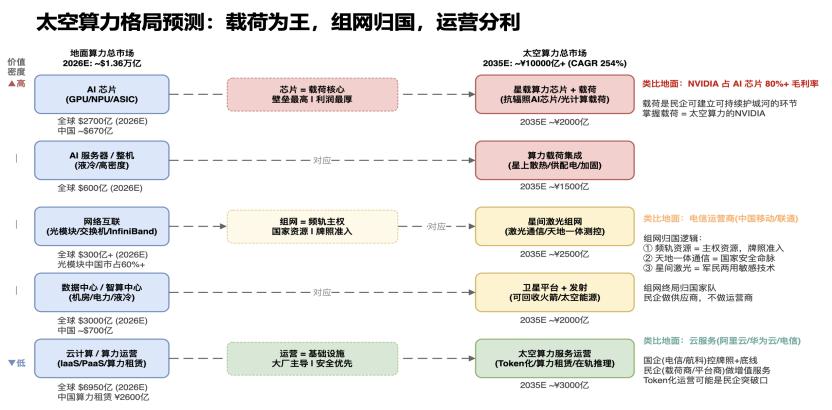
The left side represents the total terrestrial computing power market (estimated at ~$1.36 trillion in 2026), with value density decreasing roughly from top to bottom: AI chips, AI servers, network interconnection, data centers, and cloud computing.
The right side shows the corresponding space-based computing power market (projected at over 1 trillion RMB by 2035, with a CAGR of 254%), which will likely replicate the same value gradient.
The transitional logic in the middle is critical:
Chips — Core Payload, with the highest barriers and thickest profit margins. Terrestrial AI chips (GPU/NPU/ASIC) map to spaceborne computing chips and payloads in space — radiation-hardened AI chips, optical computing payloads, and computing payload integration (on-satellite cooling, power supply and distribution, hardening). These two segments are projected to reach a market size of 350 billion RMB by 2035, potentially becoming the most technologically dense part of the space-based computing power industry chain.
Networking — Frequency and Orbit Sovereignty, a national resource with license access requirements. Inter-satellite laser networking and integrated space-terrestrial TT&C will correspond to a roughly 250-billion market by 2035, naturally belonging to state-backed teams and chain-leading enterprises.
Operations — Infrastructure, dominated by large players with security as the priority. The integrated space-terrestrial platform and space-based computing operations will correspond to a roughly 600-billion market by 2035, realizing returns latest but boasting the highest ceiling.
In this value chain, the payload segment is currently where private enterprises are most likely to build a sustainable moat. The reason is that payloads determine "how much and how fast a satellite can compute," acting as the performance bottleneck of the entire space computing system. Mastering payloads is equivalent to occupying a position in the space computing industry chain similar to NVIDIA's position in terrestrial AI chips — NVIDIA holds over 80% of the AI chip market share and gross margin, with the core logic that whoever controls the supply bottleneck of computing power gains pricing power.
Companies capable of developing payloads that successfully validate their business model will have the opportunity to become chain leaders in the space computing era: docking with chip suppliers upstream, connecting to satellite platforms and constellation operators downstream, holding core technologies themselves, defining industry standards, and capturing the most lucrative profits.
Summary: Payloads are the "chips" of space computing, and mastering payloads means controlling the throat of the industry chain. Emulating NVIDIA to become a chain leader is the most promising narrative in this track.
05. The "Power Plant" in Space
If space-based computing power is fully realized, what does it correspond to on Earth?
It may not be a computer room, nor a data center — perhaps it is a power plant.
In human industrial history, every infrastructure revolution roughly follows the same logic: scarcity first emerges, then someone moves production capacity to places with fewer constraints, and finally that location becomes the new center. Thermal power plants are built near coal mines because transporting electricity is more efficient than transporting coal; data centers are built near power hubs because moving computing power is more efficient than moving data.
Space-based computing power is essentially a continuation of this logic — launching chips into space is roughly cheaper than transmitting power down to Earth.
Once launch costs drop below