Just now, the world's first ultra-high-frame world model was born, with 0 NVIDIA content and a surge of 50 frames
The world model has finally entered the real-time era. While the industry is still struggling to achieve 5FPS or 10FPS, a Chinese team has directly pushed the real-time interactive world model to 50FPS. More importantly, they did not use NVIDIA GPUs.
Moxin Technology, a company focused on 4D world model R&D and industrialization, has partnered with the team led by Academician Pan Yunhe from Zhejiang University to release MoWorld — the world's first Flash World Model, and also the first real-time interactive world model fully built on domestic NPU chips.
From training and distillation to deployment, the entire process has achieved a closed loop based on domestic computing power; the inference cost is 70% lower than that of GPU solutions of the same scale.
The inflection point for the industrialization of world models may come earlier than anyone expected.
The real-time challenge that stymied the entire industry
Has been broken through by a Chinese team
If you have tried today's mainstream world models, you most likely share a common feeling:
- You can watch it, but you can't interact with it.
- Robots require real-time decision-making.
- Games demand real-time feedback.
- Digital worlds need real-time simulation and deduction.
Past research has shown that once the frame rate drops below 30FPS, all sense of immersion is completely lost.
This is why for a long time, world models have remained confined to laboratories, and have struggled to make their way into real industrial scenarios.
Real-time performance was once the ultimate barrier standing in the way of the commercialization of world models.
Today, this formidable barrier has been conquered in one fell swoop by a Chinese team.
50FPS!
For the first time ever, a world model has truly entered the real-time era
The technical report has been released. The model weights and code will be open-sourced in the near future, and public services will be provided based on domestic NPU super nodes.
Technical Report: https://moxin-tech.github.io/moworld/
Moxin Technology first proposed the concept of the Flash World Model. MoWorld is the industry's first "Flash World Model" that achieves inference speeds exceeding 50FPS, and it is also the first low-cost real-time interactive world model fully built on domestic NPUs.
MoWorld is the first to realize a complete closed loop covering training, distillation, and real-time inference deployment on a full-stack domestic computing platform. At the same time, under typical inference configurations, its cost is 70% lower than that of GPU solutions of the same scale.
While everyone else is piling on GPUs
They chose a different, difficult yet correct path
From the very beginning, MoWorld was not built around GPUs. Instead, it opted for a more challenging, rarely explored path — a full-stack domestic NPU architecture.
This does not mean simply porting an existing model to a domestic chip for inference. Instead, every stage from data processing, training, and distillation to inference deployment has been redesigned around the characteristics of domestic NPUs.
First, there is the data challenge.
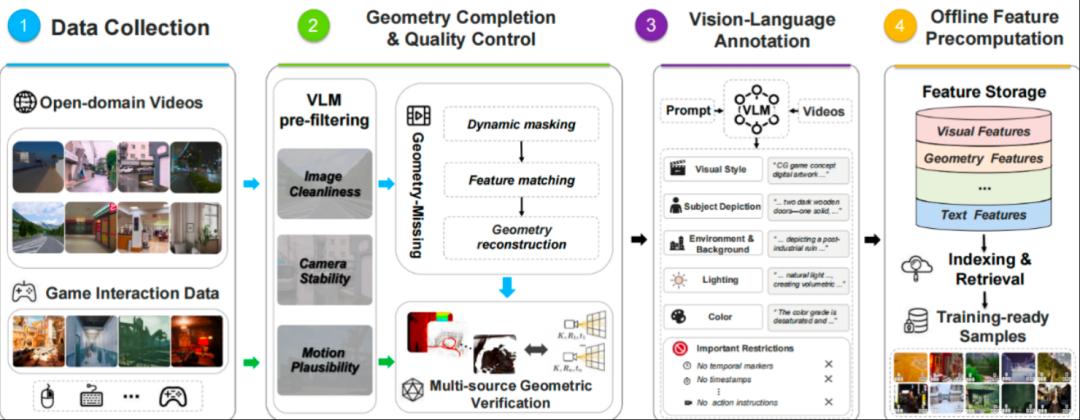
Compared to video generation models, world models require not only video and text data, but also additional information such as camera trajectories. Public internet videos are far from sufficient to meet the training demands.
To address this, MoWorld has established a complete data production and governance system, which has been upgraded into a dedicated data engine serving world model development.
Leveraging the Moxin team's years of technical expertise in 3D/4D modeling, the data pipeline behind MoWorld features fully self-collected and fully 3D-annotated datasets. It not only annotates camera information, but also the geometric dimensions and spatial structures of objects, laying a solid data foundation for MoWorld.
Even more daunting challenges lie in the training and inference phases.
Tailored to the hardware features of domestic NPUs, MoWorld has redesigned its training system, introducing technologies such as ultra-dense attention parallelism and long-sequence token parallelism. These innovations significantly alleviate the video memory pressure caused by ultra-long video training, enabling the world model to achieve long-sequence training and inference capabilities of 2000 frames for the first time.
During the inference phase, the team continued to implement a series of system-level optimizations for domestic NPUs, including pipeline execution, hierarchical sequence parallelism, and dynamic mixed-precision quantization.
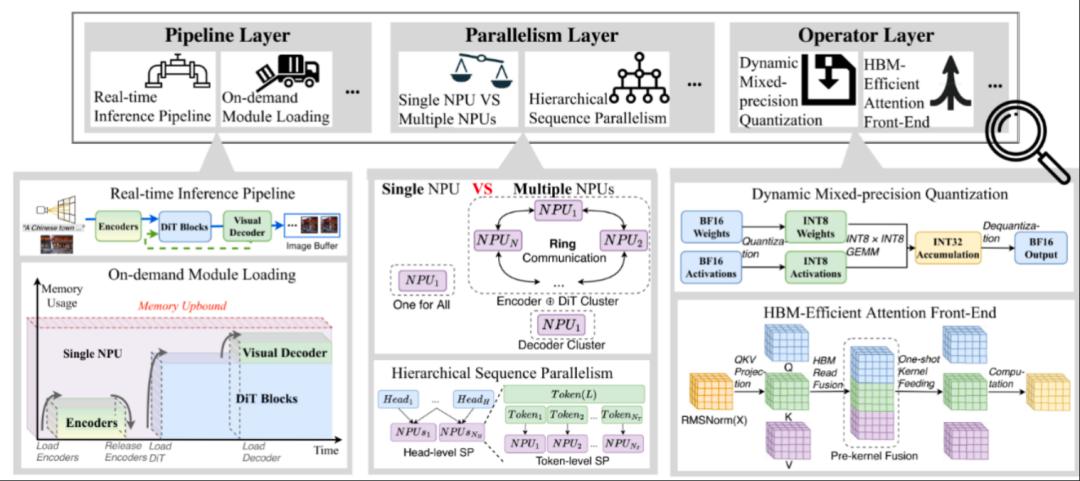
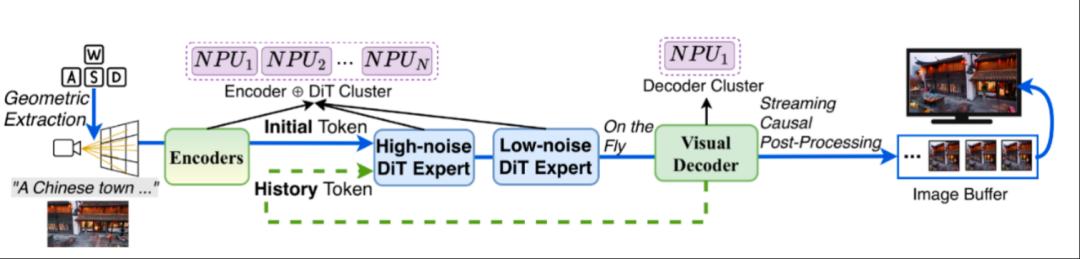
In the end, a 14B parameter MoE world model achieves a maximum real-time inference speed of over 50FPS on the Huawei Ascend 910C CloudMatrix384 NPU platform.
More importantly, under typical inference configurations, the inference cost is 70% lower than that of GPU solutions of the same scale.
For the entire industry, this represents not just a new engineering approach, but also a new industrialization mindset.
The most expensive threshold for world models has been breached
For a long time, a fundamental contradiction has persisted in the development of world models.
Models are becoming increasingly powerful.
But their costs are also rising sharply.
In the past, deploying a world model meant massive investments in GPUs, complex cluster maintenance, and prohibitively high deployment costs that were hard to replicate.
Now, the same level of world model performance can be run on domestic computing platforms with significant cost advantages.
This not only changes the way models are operated, but also transforms the path for world models to move toward industrialization.
For enterprises, this means lower deployment barriers, faster application validation, and easier large-scale replication.
For the entire industry, this means that world models are transitioning from being "technically feasible" to "practically usable", and then to "affordable for widespread use".
What truly drives a technology to transform industries is never the highest benchmark achieved in a laboratory.
It is the moment when that technology becomes accessible enough for more people to actually put it to use.
World models are stepping out of the laboratory
Which industries will witness transformative changes?
In the past few years, world models have been widely regarded as a futuristic technology.
But the future will eventually make its way into reality.
When real-time interaction becomes possible and deployment costs start to decline, the true value of world models is only beginning to be unlocked.
The first industries to undergo changes will be those that rely most heavily on real-world understanding and real-time feedback.
Gaming and Interactive Entertainment: Real-time interaction with free exploration
MoWorld supports full 6-degree-of-freedom camera control. Users can navigate through immersive, cinematic and game-level experiences using the W/A/S/D keys and a mouse.
The scenes are realistic and high-definition, supporting resolutions of 1080P and above. It fully covers all types of content, from natural landscapes and anime styles to game and animation scenarios.
Embodied Intelligence and Autonomous Driving: Virtual training with real-world validation
World models have become a critical bridge connecting generative AI with embodied intelligence.
MoWorld can provide a low-cost, high-fidelity "digital training ground" for robots and autonomous driving systems. It is one of the most promising world simulators in the industry that balances simulation value and economic value, capable of providing a large volume of high-precision environments for all autonomous driving teams, allowing AI to learn how to interact with the physical world in a virtual setting.
Film and Television Creation: Director-style camera control with real-time preview
Traditional film storyboarding requires long rendering cycles.
MoWorld allows creators to freely adjust perspectives in the generated virtual world, preview visual effects in real time, precisely edit camera frames, achieve smooth camera control, and support director-level cinematography that exceeds conventional imagination.
Digital Twins and 3D Reconstruction: Spatial reconstruction with precise restoration
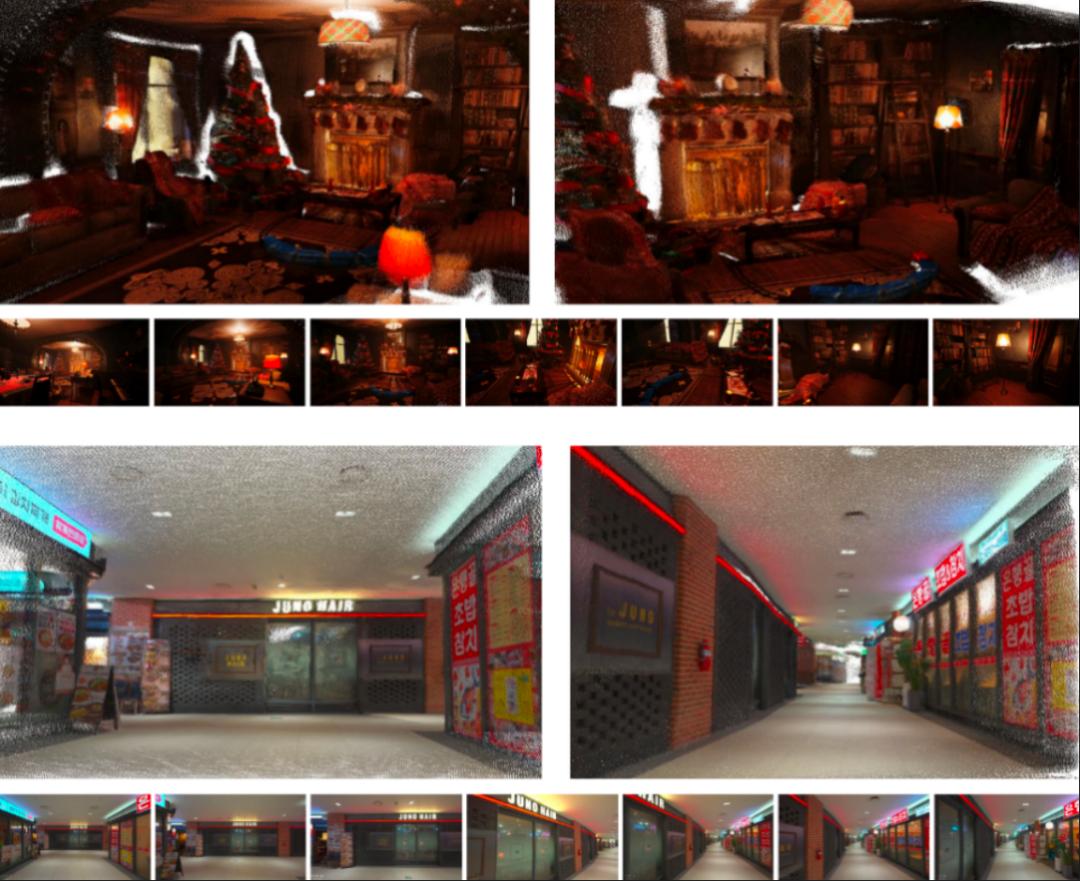
The videos generated by MoWorld demonstrate industry-leading geometric consistency, and can be directly applied to 3D reconstruction of indoor scenes — high precision, stable structures, and excellent spatial consistency are the distinctive advantages that set MoWorld apart from other solutions.
This provides a high-precision, cost-effective solution for scenarios such as digital twins, architectural visualization, virtual exhibition halls, and immersive games.
The world model represented by MoWorld
Is now at a "DeepSeek moment" for Physical AI
Over the past few years, AI has achieved successive breakthroughs from text generation and image generation to video generation. Each technological leap has given rise to a new cohort of industry leaders.
Now, as AI advances toward real-time interactive world models, a new window of opportunity is opening up.
Compared to large language models and video generation models, where the competitive landscape has gradually taken shape, world models are still in the early stages of industrial development. The entire global industry is exploring engineering implementation paths, and industry standards are far from being established.
This means that domestic world models have seized a rare "starting line parity" opportunity — they not only have the chance to compete, but also to participate in defining the technical standards for the next generation of spatial intelligence.
The significance of MoWorld lies not only in achieving real-time interaction at over 50FPS, nor in the fact that its inference cost is 70% lower than that of GPU solutions of the same scale.
More importantly, it has validated a question that the industry has long been exploring but never proven:
A full-stack domestic computing ecosystem is fully capable of supporting world models to achieve real-time interaction and industrial deployment.
This signifies that the competition in world models is shifting from "who can build a larger model" to "who can truly integrate into the real world".
With its unique model capabilities and outstanding progress in industrialization, Moxin Technology, the team behind MoWorld, has recently secured over $100 million in financing from national-level strategic reserve capital, well-known Middle Eastern dollar-denominated institutions, leading market-oriented funds, and more than a dozen industrial capital investors. Prior to this, Moxin Technology had already received investments from Hubble Investment, an affiliate of Huawei, and a fund under Legend Holdings.
The era that truly belongs to world models, starting from the Flash World Model, is poised to move forward rapidly.
This article is from the WeChat Official Account "Xin Zhiyuan", authored by ASI Revelation, and republished with authorization from 36Kr.