The price war has reignited, with photovoltaic module prices dropping below 0.7 yuan/W. The coldest moment for the photovoltaic industry has arrived.
Recently, leading module manufacturers including LONGi, Tongwei, Chint, and GCL have lowered their photovoltaic module quotations, with price cuts ranging from 0.01 yuan/W to 0.05 yuan/W. Among these companies, the quoted prices of some TOPCon modules have fallen below the 0.7 yuan/W threshold.

Coincidentally, data monitored by multiple institutions shows that prices across the entire photovoltaic industry chain, from silicon materials, silicon wafers, cells to modules, have ushered in another wave of declines. Data released by the Silicon Industry Branch shows that as of now, silicon material prices have fallen for five consecutive weeks, nearly halved compared to the high point at the beginning of the year. Data from Infolink also shows that the maximum decline in solar cell prices in the recent week reached 6.9%.
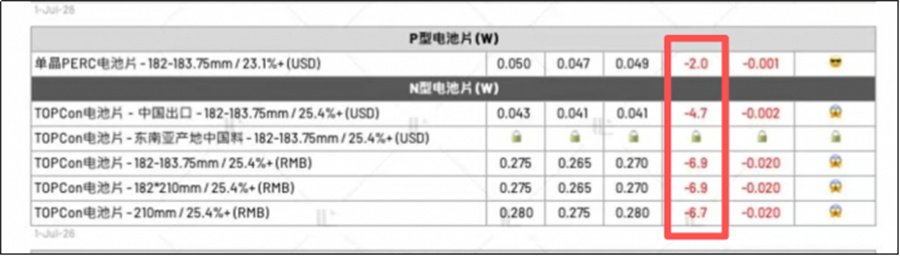
Photovoltaic cell prices as of July 1, Source: Infolink Consulting
After a round of price recovery at the beginning of this year, the prices of the photovoltaic industry chain have entered a new downward channel, showing a trend of comprehensive collapse and re-testing for lower levels. After experiencing a brief warm period, the photovoltaic industry has once again plunged into extreme cold. The spring of the photovoltaic industry is still far away.
Comprehensive Collapse of Photovoltaic Industry Chain Prices
Since the second half of 2023, the photovoltaic industry has entered a downward cycle, and the prices of photovoltaic products have been falling all the way. In 2024 alone, the price of polysilicon dropped by more than 35%, the price of silicon wafers by more than 45%, and the prices of solar cells and modules by more than 25%. In 2025, the downward trend of photovoltaic product prices continued, with polysilicon prices falling by more than 8%, silicon wafer prices by more than 36%, solar cell prices by more than 16%, and module prices by nearly 19%.
Faced with the continuously falling prices, the China Photovoltaic Industry Association once set a "module bidding cost red line" of 0.68 yuan/W, requiring industry enterprises not to engage in vicious competition at prices below the cost line. However, many enterprises went their own way and kept offering extremely low prices.
From the end of last year to the beginning of this year, the prices of photovoltaic products finally showed an upward trend. The guidance price of leading module enterprises even rose to around 1 yuan/W at one point, and the price of silicon materials also rose to nearly 60,000 yuan/ton. The price surge greatly boosted industry confidence. At that time, some experts predicted that the silicon material price range in 2026 would be 55,000-75,000 yuan/ton, and the integrated module price range would be 0.88-0.99 yuan/W.
But the price recovery did not last long before turning downward again.
Huaxia Energy Network noted that data released by the Silicon Industry Branch and Infolink shows that in early July, the average transaction price of N-type recycled feedstock (rod-shaped silicon) was 32,800 yuan/ton, and the average transaction price of N-type granular silicon was 32,300 yuan/ton, both falling by more than 40% compared to the high point at the beginning of the year; polysilicon dense material fell to 32.5 yuan/kg, and granular material fell to 32 yuan/kg. In the recent week, N-type G10L monocrystalline silicon wafers fell by 2.22%, N-type G12R monocrystalline silicon wafers by 2.02%, and N-type G12 monocrystalline silicon wafers decreased by 0.85% month-on-month.
The decline in solar cell prices is also very significant. In early February this year, the price of TOPCon solar cells could still be maintained at around 0.45 yuan/W, but by early July it had dropped to about 0.27 yuan/W, a decline of 40%.
In the module sector, according to statistics from DataBM.com, 11 module manufacturers have recently lowered their quotations. Among them, the quoted price range of TOPCon modules has dropped to 0.69-0.78 yuan/W; the quoted price range of BC modules remains at 0.75-0.90 yuan/W; the quoted price of HJT modules stays at 0.70-0.80 yuan/W.
It is worth noting that this is only the quotation range, and the actual transaction price will be even lower. Some industry insiders predict that this price war has only just begun, and in the future, the prices of all TOPCon modules will fall below the 0.7 yuan/W threshold.
Continuously Shrinking Demand, Capacity Reduction Fails to Meet Expectations
The recent comprehensive collapse of photovoltaic industry chain prices is the result of continuous accumulation over the past six months.
On the one hand, demand is continuing to shrink.
The "Global Solar Market Outlook 2026-2030" report released by SolarPower Europe predicts that under the neutral scenario, global photovoltaic installations in 2026 will drop by 8% to about 612GW, which will be the first decline in more than 20 years. The report attributes the main reason to China, predicting that China's installed capacity will drop by 24% after changes in market policies.
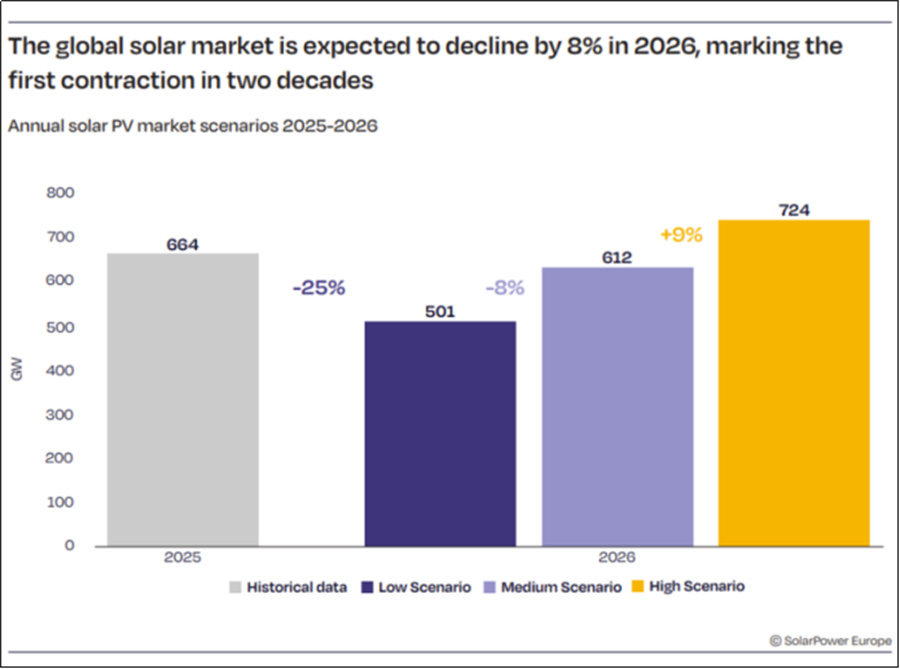
Global Photovoltaic Installation Forecasts Under Three Scenarios, Source: SolarPower Europe
Data from China confirms this point. Huaxia Energy Network noted that data released by the National Energy Administration shows that from January to May this year, the cumulative new installed capacity in China was 59.59GW, a year-on-year decrease of 69.9%; among which, the new installed capacity in May was 8.68GW, a year-on-year decrease of 91%.
The scale of module bidding and procurement also shows a downward trend. Data from the China Photovoltaic Industry Association shows that from January to April this year, a total of 17 bidding projects were monitored, with a total scale of 25.9GW, a year-on-year decrease of 68.9%; 17 winning projects were recorded, with a total scale of 46.5GW, a year-on-year decrease of 56.8%.
On the other hand, on the supply side, capacity clearance is still difficult. The "capacity reserve" initiated by leading silicon material enterprises, which was once highly expected, was stopped by regulators in January this year. The market can only rely on spontaneous mergers and reorganizations to "reduce overcapacity", but large-scale mergers and reorganizations have hardly taken place. In the past six months, although second- and third-tier photovoltaic enterprises have continuously encountered operational crises and exited the market, they have not substantially changed the overall overcapacity situation of the entire market.
According to SMM data, the global demand for modules and polysilicon in 2026 will be 536GW and 11.4 million tons respectively. In contrast, on the supply side, the module capacity is 1100GW, and the polysilicon capacity is about 30 million tons. The supply from leading enterprises alone can basically meet the vast majority of market demand, and the exit or closure of a small number of enterprises has little impact.
Under the condition of oversupply, the inventories of industry enterprises remain high. TrendForce points out that the current silicon material sector is facing the dual pressure of high inventory and supply release. The overall industry inventory remains at around 5.2 million tons, and the inventory digestion process is slow. In July, as mainstream enterprises resume and increase production, it is expected that the monthly output of silicon materials will be close to 1.1 million tons, and the release of incremental production will exacerbate the overcapacity trend relative to downstream demand.
Severe Lack of Confidence, The Industry Expects Anti-Involution "Big Move"
The most severe problem currently facing the photovoltaic industry is not the falling prices, but the severe lack of confidence in the future.
Institutions generally believe that the supply-demand relationship in the industry will still be difficult to improve in the second half of the year. Solarzoom stated that the third quarter has officially arrived, but there is still no obvious improvement in domestic demand. There are many recent bidding projects, but the actual number of projects that have started construction is still limited. Many end-users continue to wait and see, and the corresponding actual module procurement demand is also relatively weak.
On the supply side, there are reports that in July, the production schedules of solar cells and modules have both increased instead of decreasing, with month-on-month increases of 10.45% and 11.48% respectively. Many enterprises are producing under the pressure of high inventory. Although the market situation is not good, they still try their best to maintain their market share.
Without an improvement in the supply-demand relationship, prices will naturally be difficult to rise. The global photovoltaic market report released by OPIS on June 30 predicts that in the fourth quarter of 2026, the offshore forward price of TOPCon modules in China will fall by 0.88% week-on-month to $0.113/W, and the forward prices from the first to the third quarter of 2027 will also decline slightly, down 0.87% month-on-month to $0.114/W.
It is worth mentioning that recently, the Ministry of Industry and Information Technology, the National Development and Reform Commission, and the State Administration for Market Regulation jointly issued three mandatory national standards: "Minimum Allowable Values of Energy Efficiency and Energy Efficiency Grades for Crystalline Silicon Photovoltaic Modules and Inverters", "Energy Consumption Quota per Unit Product of Monocrystalline Silicon", and "Energy Consumption Quota per Unit Product of Polysilicon and Germanium". The three national mandatory standards will be officially implemented on January 1, 2027.
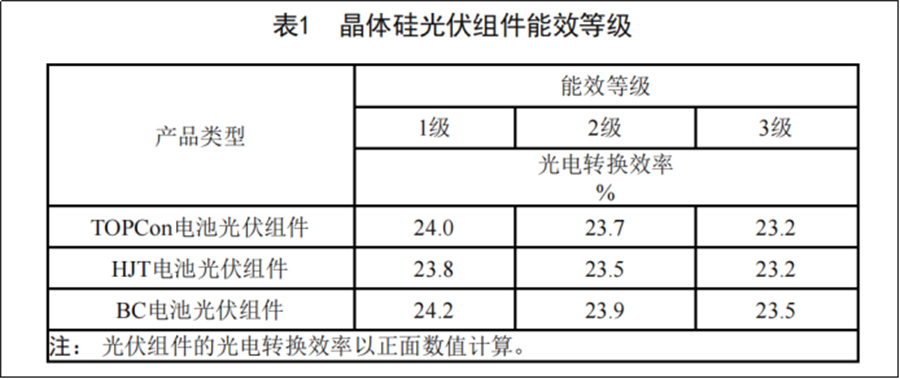
Optimistic people in the industry believe that the three new national standards will promote substantial progress in "reducing overcapacity", and more production lines of second- and third-tier enterprises will be shut down in the second half of this year. Some experts said that about 20% to 30% of the industry's capacity will exit the market as a result. However, according to SMM's data, even if 30% of the capacity is eliminated, the global module capacity will still be 770GW, which is still excessive relative to the demand of 536GW, and the motivation for enterprises to compete at low prices still exists.
At the current stage of the photovoltaic industry, focusing only on the supply side may not be enough to solve the severe structural contradictions. Only by taking multi-pronged measures in all aspects of supply and demand can the photovoltaic industry be completely pulled out of the quagmire. The anti-involution "big move" that has been brewing at the national level and expected by the industry for a long time should be introduced at the right time.
This article is from the WeChat public account "Huaxia Energy Network", Author: Han Chenggong, Editor: Jiang Bo, Published with authorization from 36Kr.