When Agent Becomes a Essential Partner in the Workplace and Laboratory
Key Takeaways
- This article shares two recent reports released by OpenAI and Google DeepMind respectively, demonstrating the underlying logic of how AI Agents are reshaping work paradigms and expanding the boundaries of human work and scientific research.
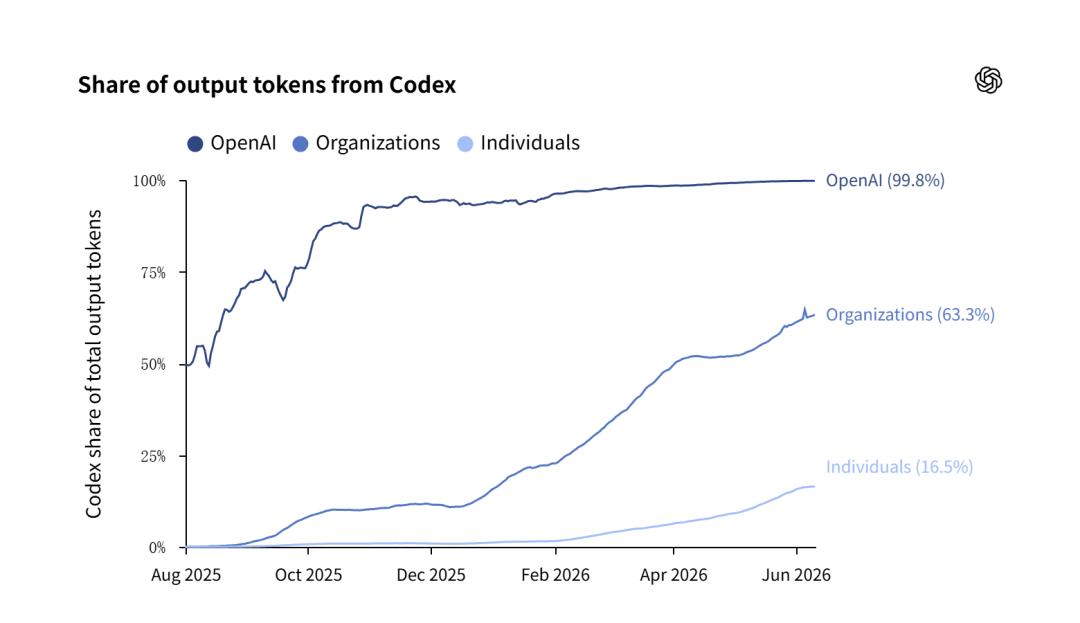
- OpenAI's report shows that the AI Agent tool Codex has become the primary work tool across all departments of the company, accounting for 99.8% of the total weekly token output within the organization. On one hand, task durations are continuously extending, with 80.6% of users having submitted tasks that would require more than 30 minutes of manual work to complete; on the other hand, since AI Agents can help non-professionals break through technical bottlenecks, the limitations of job roles are being dismantled.
- Google DeepMind published research on Co-Scientist in *Nature*, a multi-agent system that enables Agents to assist scientists in their work, and has already produced tangible scientific research outcomes across multiple fields. Scientists involved in the study stated that collaboration with Agents is expected to significantly shorten the cycle required to achieve scientific breakthroughs.
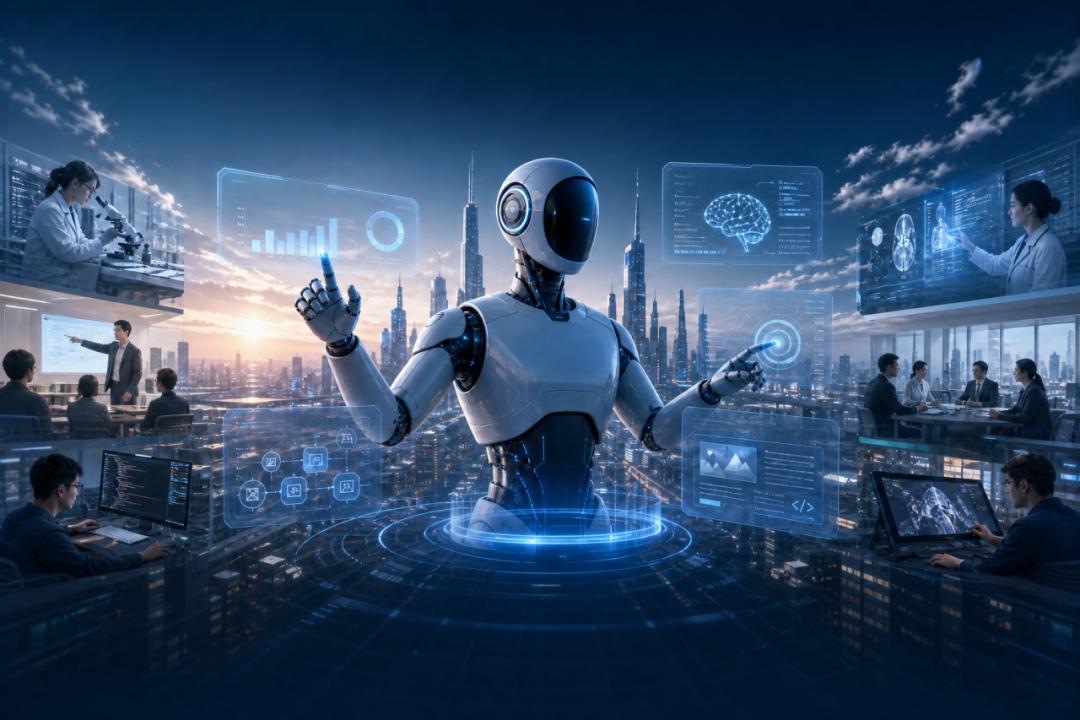
"AI Agents are redefining the fundamental unit of knowledge work — shifting from a single interaction to a task that can be delegated and executed autonomously for extended periods."
This is the opening line of a recent report released by OpenAI. The report states that Agents can run independently for hours, invoking tools, interacting with the external environment, and iterating continuously throughout the process until the task is completed. This leap in capability is driving Agents to become the most powerful AI tools in the workplace.
Similarly, Google DeepMind recently unveiled its latest Co-Scientist research published in *Nature* — a multi-agent system built on Gemini, where multiple specialized Agents collaborate to simulate the full cycle of scientific thinking. The study documents multiple real-world cases that demonstrate the tangible impact Co-Scientist has already had across various scientific domains.
AI Agents are not just making humans work faster; they are quietly expanding the boundaries of what human work can achieve while transforming how we work.
How Are Work Paradigms Being Transformed?
Using itself as a sample, this OpenAI report tracks the diffusion trajectory of the AI Agent tool Codex within the company.
In the first few months after Codex was released to the public, ChatGPT remained the default AI tool for employees even within OpenAI. As late as August 2025, the token usage of regular employees on Codex was less than 10%. But this situation reversed rapidly afterward.
By 2026, Codex has become the primary AI tool in every department of OpenAI — not just for engineers, but also for legal, finance, and recruitment teams. It currently accounts for 99.8% of the total weekly token output within the company. OpenAI believes this trend reflects the future direction of work, and as Agent tools become more capable and their barriers to entry lower, this will become a universal norm.
On one hand, task durations are continuously increasing. The report estimates the "human work time" corresponding to Codex requests. By May 2026, 80.6% of users had submitted tasks to Codex that would require more than 30 minutes of human work to complete, 70.2% had submitted tasks corresponding to more than 1 hour of human work, and tasks corresponding to over 8 hours of workload were growing the fastest.
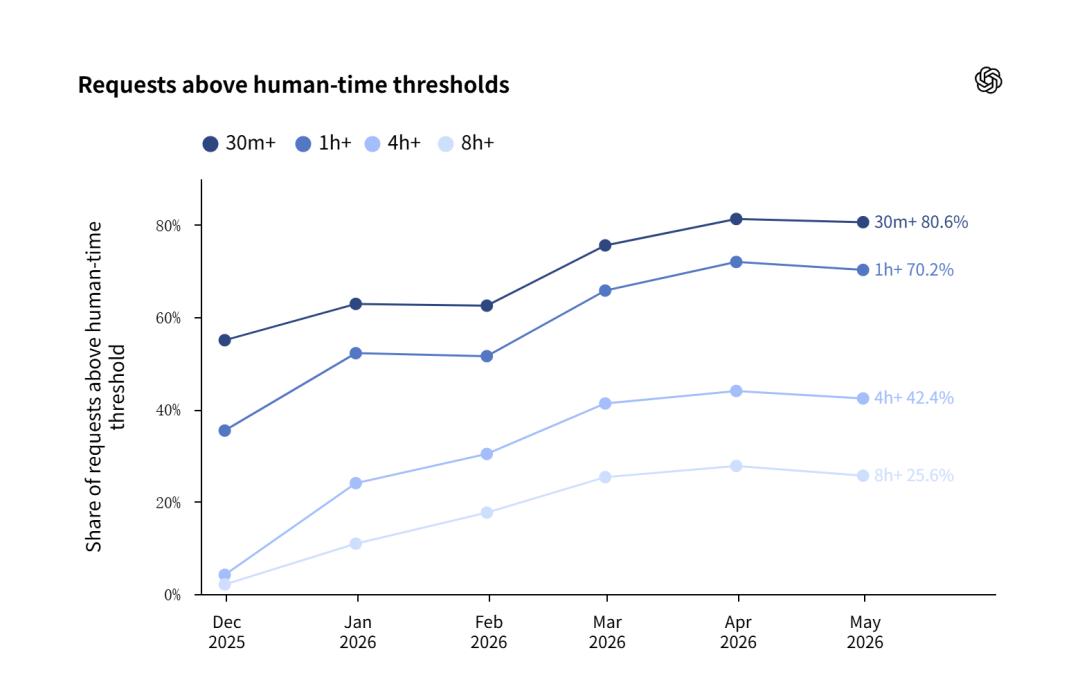
In the early days, Codex was mostly used to quickly answer questions and generate code snippets; now, users are beginning to "delegate" entire blocks of work to it — research, analysis, and process building. OpenAI notes that as Codex's ability to handle long contexts and operate independently continues to improve, user habits are also quietly shifting: from short, rapid interactions to more complex, longer-cycle task delegation.
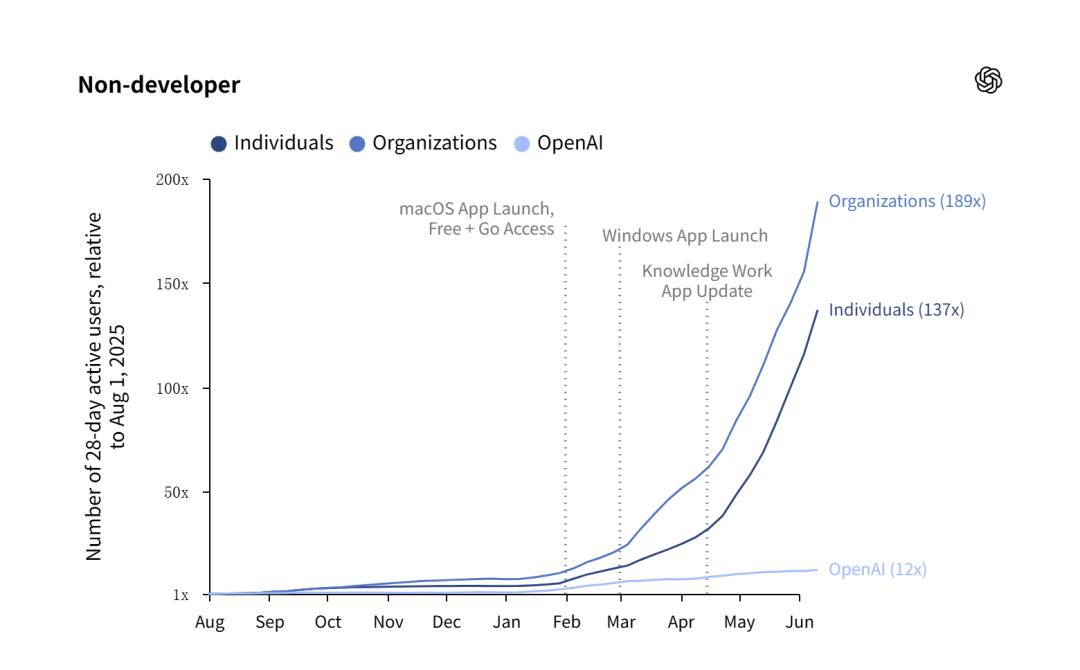
On the other hand, the potential boundaries of work are being expanded as a result. It is not surprising that programmers were the first to embrace Codex — it was originally a tool centered on programming. But the report shows that since August 2025, usage by non-developers among individual users has increased 137 times, and non-developer usage among enterprise users has increased 189 times. Furthermore, in other functional departments (non-programmer technical roles), over a quarter of the content employees produce using Codex falls into engineering or programming categories. This means that automation, data processing, tool building, and debugging tasks that previously required support from technical teams can now be delegated to Agents by non-programmer employees themselves.
These changes have direct reference value for enterprises redesigning their workflows, employees judging which skills are more valuable, and researchers understanding how AI is reshaping the labor market. OpenAI states that when people can fluently use powerful Agent tools, they will naturally use them for work that takes longer, is more difficult, and crosses more functional boundaries. Over time, this will likely be what the future of work looks like.
Agents Can Also Serve as Scientific Assistants
If OpenAI's report describes the ongoing transformation of how knowledge work is delivered in the workplace, then Google DeepMind's Co-Scientist study published in *Nature* demonstrates that AI Agents are playing a substantial role in all types of scientific research.
Google DeepMind notes that Co-Scientist aims to solve the "needle in a haystack" problem of finding the right scientific hypothesis among vast amounts of information in research, since "every major scientific breakthrough usually starts with a correct hypothesis". It is reported that Co-Scientist is a multi-agent system built on Gemini, composed of multiple specialized Agents collaborating to simulate the full cycle of scientific thinking — generating hypotheses, conducting critical reviews, and iterating for improvement. The system is divided into three phases: generation, debate, and evolution. First, Agents propose initial hypotheses and perform diversity clustering; then "virtual peer reviewers" conduct critical evaluations of the hypotheses; finally, the top-ranked directions are continuously optimized to output research proposals for researchers to review. The entire system is coordinated by a "supervisor Agent", which breaks down high-level research goals into executable steps and drives multiple Agents to explore in parallel.
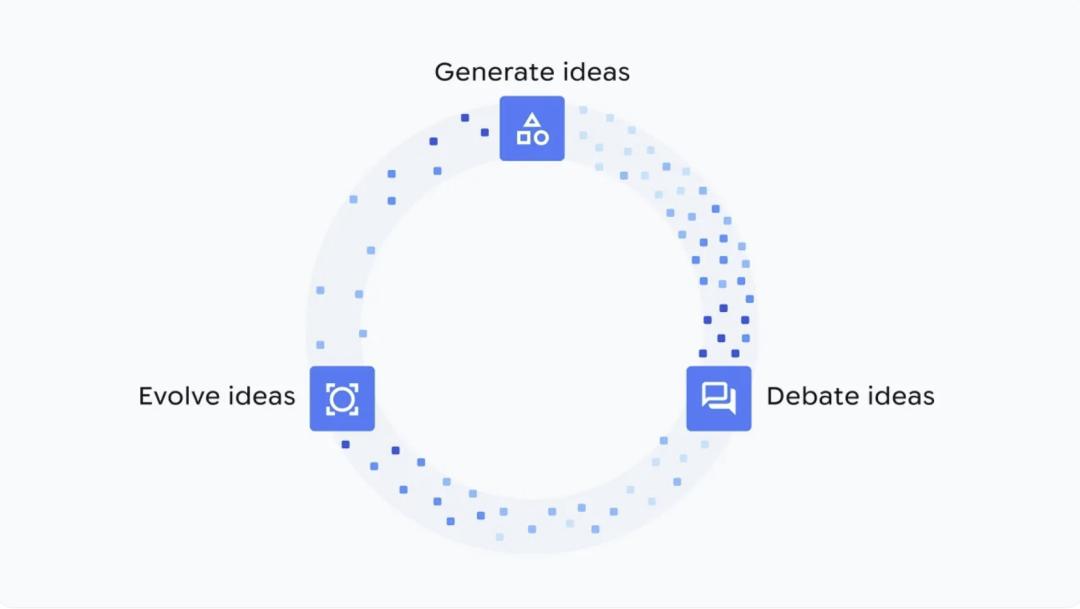
The most distinctive design of Co-Scientist is its method for verifying hypotheses. The system draws on the competitive mechanisms of AlphaGo and AlphaStar — but instead of having AI play chess or video games, it lets Agents engage in scientific debates. The system puts all candidate hypotheses into a "creativity tournament", continuously filtering, eliminating, and evolving through pairwise comparisons and simulated debates, while deeply cross-referencing scientific literature and professional databases to ensure that every remaining hypothesis is logically sound and factually supported. The majority of computational resources are also invested in this verification phase.
The report documents multiple real-world cases that demonstrate the tangible impact Co-Scientist has already had in scientific research. For example, some scientists and their teams used AI Agents to accelerate the exploration of liver fibrosis treatment solutions, discovering previously overlooked drugs; one team reduced the time required to analyze huge screening datasets in cellular senescence reversal research from several months to a few days; and a company in the field of aging biology generated new hypotheses through the system that were later verified in laboratory settings.
Scientists involved in the study stated that AI Agents bring various benefits to scientific research, but the most important one is improved efficiency, which can significantly shorten the cycle required to achieve scientific breakthroughs.
Google DeepMind noted on its official blog that their AI Agent is "designed to be a research partner, not a substitute for scientific or clinical expertise". On the other hand, OpenAI emphasized in its report that AI Agents do not just "speed up" people's work, but expand the scope of work each person can reach. Both organizations focus on how humans can collaborate with AI Agents to accomplish more complex work.
But the boundaries of collaboration will inevitably continue to be redrawn. When Agents can take over tasks that previously required specialized skills, how should workflows be redesigned? As functional boundaries begin to blur, what capabilities will become more valuable, and which ones will be re-evaluated? When the speed of generating scientific hypotheses increases by orders of magnitude, which fields will be the first to see breakthroughs?
The real question is where humans should focus their time and energy.
This article is from the WeChat Official Account "Sequoia Capital China" (ID: Sequoiacap), author: Hong Shan, published with authorization from 36Kr.